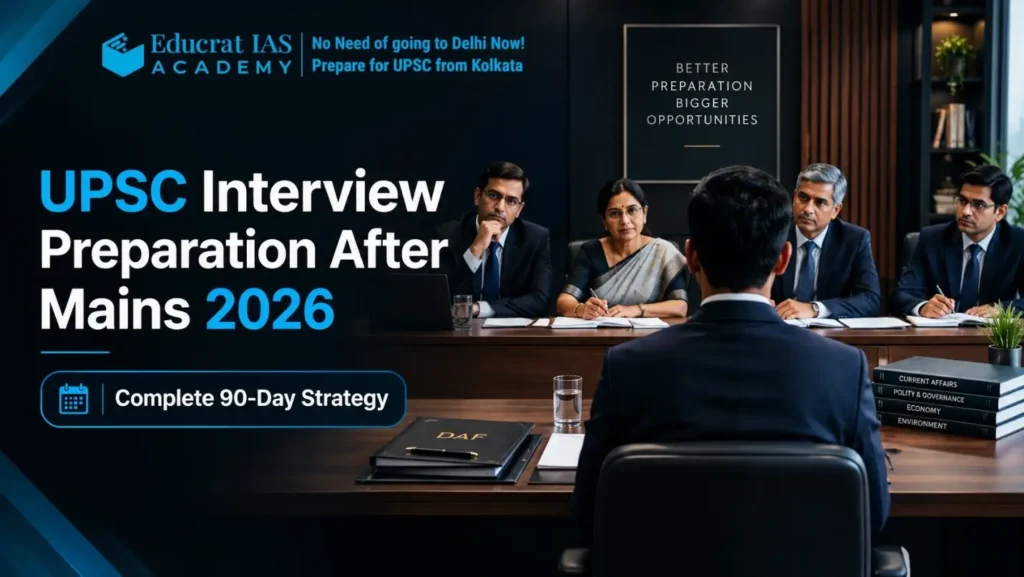
The UPSC Civil Services Mains Examination 2026 has concluded, and for aspirants who are now looking ahead to the next stage, an important question arises: What should you do after UPSC Mains? Should you wait for the Mains result, or should you begin preparing for the UPSC Interview?
For serious aspirants, this is the right time to start building the foundation for the UPSC Personality Test 2026. Waiting until the result is declared can leave very little time for DAF preparation, current affairs revision, communication practice and mock interviews. On the other hand, starting with a structured and realistic strategy can help you gradually prepare for the final stage of the Civil Services Examination.
According to the UPSC Civil Services Examination 2026 notification, the Personality Test carries 275 marks, while the written examination counted for merit carries 1,750 marks. UPSC states that the Personality Test is intended to assess the candidate’s suitability for a career in public service and focuses on qualities such as mental alertness, clear and logical expression, balance of judgement, leadership, social cohesion, and intellectual and moral integrity.
This means that UPSC Interview Preparation is not simply about memorising current affairs or preparing answers to common interview questions. It is about developing the ability to understand issues, express your thoughts clearly, respond naturally and demonstrate maturity in a formal interaction.
This complete 90-day UPSC Interview Preparation Strategy after Mains 2026 explains how aspirants can use the post-Mains period effectively.
Should You Start UPSC Interview Preparation Before the Mains Result?
The period between Mains and the result can be used for preparation without assuming that you will definitely receive an interview call. The objective at this stage should be to build the areas that require consistent preparation and cannot be developed overnight.
The first priority should be understanding your own profile. The Detailed Application Form, commonly known as the UPSC DAF, can become a major source of questions during the Personality Test. Your educational background, hometown, state, hobbies, work experience, achievements, attempts and other personal details can all lead to questions and follow-up discussions.
Current affairs should also remain part of your daily routine. However, your approach should now move beyond collecting facts. The interview demands an understanding of important issues and the ability to discuss them from different perspectives. UPSC itself states that candidates are expected to take an intelligent interest in events taking place around them as well as developments within the country and the world.
Therefore, the post-Mains period should be viewed as a preparation window. You may not know the exact interview schedule yet, but you already know the areas that require attention.
The 90-Day UPSC Interview Preparation Strategy
Days 1–15: Make the Transition from Mains to Interview Preparation
The first fifteen days should be used to make a healthy transition from written examination preparation to Personality Test preparation. After months of intense Mains study, taking a short break is reasonable, but the break should not turn into a complete loss of momentum.
Begin by reflecting on your Mains preparation and examination experience. Think about the areas where you performed well, the areas that created difficulty and the lessons you learnt during the process. This self-reflection can become useful later because UPSC Interview questions are not limited to academics and current affairs. Candidates may also be asked about their experiences, choices, failures, achievements and motivation for joining the civil services.
At the same time, restart a regular newspaper and current-affairs routine. You do not need to collect every piece of information published each day. Instead, identify major developments and try to understand why an issue matters, who is affected, what the different viewpoints are and what practical solutions may be possible.
This is also the ideal time to begin creating your DAF preparation file. Go through every section carefully and identify areas that can generate questions.
Days 16–30: Make Your DAF the Centre of Interview Preparation
Once the basic transition is complete, the next fifteen days should be dedicated largely to UPSC DAF Preparation. UPSC has a candidate’s career record before the Interview Board and asks questions on matters of general interest.
Your DAF should therefore be treated as a map of your interview preparation.
Start with your educational background. If you have mentioned a particular graduation subject, you should be comfortable discussing its fundamental concepts and its relevance to contemporary issues. Do not restrict yourself to what you studied only for university examinations. Think about how your subject connects with Indian society, the economy, governance or public administration.
Your hometown and state deserve similar attention. Learn about the history, geography, economy, culture and important development challenges of your district and state. Pay attention to recent developments as well. An interview question can begin with a simple fact about your hometown and develop into a broader discussion about administration, infrastructure, employment, agriculture or social issues.
Work experience, attempts and gap years also require honest preparation. Candidates should not try to create artificial explanations. Instead, they should understand their own journey clearly and be able to explain their decisions, experiences and lessons in a calm and concise manner.
Hobbies and interests are another important area. A hobby mentioned in the DAF should be genuine. The Board may ask not only why you enjoy it but also what you have learnt from it, how deeply you follow it and how it connects with wider social or contemporary issues.
Days 31–45: Prepare Current Affairs for the Personality Test
The current-affairs strategy for the UPSC Interview should be different from the strategy used for Prelims.
At the interview stage, memorising dozens of facts is less useful than developing a balanced understanding of important issues. For each major topic, try to understand the background, its significance, the stakeholders involved, the major arguments on different sides and the possible way forward.
For example, if you are studying a new government policy, do not stop at its objectives. Ask yourself why the policy was introduced, what problem it attempts to solve, how implementation may be challenging and whether there could be unintended consequences.
Similarly, while following international affairs, do not focus only on remembering agreements or dates. Think about India’s interests, strategic concerns, economic implications and diplomatic options.
A good interview current-affairs notebook should therefore focus on issue-based understanding rather than headline-based memorisation. This will also make it easier to respond when the Board asks follow-up questions.
Days 46–60: Improve Communication, Clarity and Confidence
A candidate may possess extensive knowledge and still struggle in an interview if that knowledge is not communicated clearly. This is why the middle stage of the 90-day strategy should focus strongly on communication.
Practise answering questions aloud every day. Start with simple questions about yourself, your education, hometown and hobbies, and gradually move towards current affairs and situational questions. While practising, pay attention to whether your answers are directly addressing the question or moving into unnecessary explanations.
Try to develop a natural pattern of listening carefully, taking a brief moment to think and then answering. You do not have to respond instantly to every question. A short pause can help you organise your thoughts.
Your communication should also remain balanced. UPSC’s description of the Personality Test places importance on qualities such as clear and logical exposition and balance of judgement. Therefore, interview preparation should not be about sounding aggressive or overly confident. It should be about expressing your thoughts with clarity, maturity and composure.
Body language is also part of interview readiness. Posture, eye contact, facial expressions, voice modulation and the ability to remain calm during unexpected questions should be practised alongside content preparation.
Days 61–75: Begin Structured Mock Interview Practice
After developing your DAF knowledge and communication skills, the next step is to test yourself through realistic mock interviews.
Mock interviews are valuable because self-practice cannot always reveal how you appear to another person. You may believe that your answers are concise, but feedback may show that you speak for too long. You may feel comfortable with current affairs but discover that follow-up questions expose gaps in your reasoning.
The purpose of a mock interview should therefore be more than simply answering questions. It should help identify your strengths, recurring mistakes and areas that require improvement.
A productive process is to complete a mock, analyse the feedback, make corrections and then return for another round of practice. Over time, this creates a cycle of continuous improvement.
Your mock interviews should cover your DAF, academic background, hometown, current affairs, hobbies, personal questions and situational issues. The more varied the questioning, the better prepared you become for an unpredictable conversation.
Days 76–90: Simulate the Real UPSC Personality Test
The final fifteen days of the 90-day strategy should focus on simulation and refinement. By this point, you should not be trying to read everything available on the internet. Your goal should be to strengthen the preparation you have already built.
Conduct full-length mock interviews and try to recreate the formal environment as closely as possible. Practise entering the room, greeting the Board, listening carefully, responding to questions and handling situations where you do not immediately know an answer.
At this stage, revise your DAF repeatedly. Your hometown, educational background, hobbies, work experience and other personal details should feel familiar enough that you can discuss them naturally.
Your current-affairs revision should also become selective. Focus on major national and international developments and revise your balanced views on issues you have already studied.
Most importantly, avoid replacing your personality with memorised responses. The purpose of the Personality Test is not to identify the candidate who can recite the largest number of prepared answers. It is a directed and purposeful conversation designed to understand the candidate’s qualities and suitability for public service.
What Should You Do If You Do Not Know an Answer in the UPSC Interview?
One of the biggest concerns among aspirants is the fear of not being able to answer every question. However, no candidate can reasonably know everything.
The important thing is how you handle uncertainty. If you genuinely do not know an answer, it is better to acknowledge that honestly than to invent information. A calm response shows self-awareness and composure.
Candidates should also avoid becoming defensive when the Board challenges an argument. The purpose of a follow-up question may be to understand how you think rather than simply whether you know a particular fact.
Therefore, practise not just answering questions but also handling uncertainty, disagreement and unexpected follow-ups.
Why Mock Interviews Matter in UPSC Personality Test Preparation
Self-study is essential, but external feedback can make preparation more focused. A structured mock interview helps an aspirant understand how an interviewer may perceive their answers, communication and overall presentation.
This is particularly important for DAF-based preparation. Every candidate has a different background, so the interview experience can vary significantly from one aspirant to another. A working professional may face questions about career transitions, while another candidate may face deeper questions about a particular academic discipline, hobby or hometown.
This is where Educrat IAS’s Vyaktitva Mock Interview Program can become a valuable part of the final stage of preparation.
Vyaktitva Mock Interview Program by Educrat IAS
Educrat IAS has designed the Vyaktitva Mock Interview Program specifically around the UPSC Personality Test stage. The program focuses on areas that are directly relevant to interview preparation, including DAF analysis, communication, self-awareness, career transitions, attempts, gap years, optional-subject changes, posture, body language, pragmatism and composure.
The value of a dedicated interview program lies in its personalised approach. Instead of relying entirely on generic lists of expected questions, aspirants can work on the specific areas emerging from their own background and preparation.
A mock interview should not teach candidates to memorise a fixed script. It should help them understand how to present their thoughts naturally, how to manage follow-up questions and where their communication or reasoning needs improvement.
That is the broader purpose of Vyaktitva—to help aspirants approach the Personality Test with greater awareness, preparation and composure.
Final 90-Day UPSC Interview Checklist
By the end of your preparation cycle, you should be comfortable discussing your DAF, academic background, hometown and state, hobbies, work experience and major current-affairs issues. You should also have practised responding to situational questions, handling follow-ups and communicating your views without unnecessary complexity.
Most importantly, your preparation should help you become more comfortable with your own profile. The objective is not to imitate another candidate or memorise the “perfect UPSC interview answer.” It is to develop the ability to communicate your genuine thoughts in a clear, balanced and composed manner.
Conclusion
The period after UPSC Mains 2026 should not be treated as a waiting period. It is an opportunity to prepare for the stage where your knowledge, experiences, judgement and personality come together.
A systematic 90-day UPSC Interview Preparation Strategy can help you move from DAF analysis to current-affairs preparation, from communication practice to mock interviews, and finally to complete interview simulations.
Start with the basics. Understand your own journey. Study your DAF deeply. Continue following important current affairs. Practise speaking clearly. Then use mock interviews and feedback to identify the areas that still need improvement.
The UPSC Personality Test is not about producing memorised responses. It is about demonstrating the qualities UPSC seeks in candidates for public service, including clarity, balance, awareness, judgement and integrity.
For aspirants who want structured guidance during this crucial stage, the Vyaktitva Mock Interview Program by Educrat IAS offers focused preparation around DAF analysis, mock interviews, communication and personality development.
Your Mains preparation has brought you to the final stage. Use the next 90 days to prepare not just what you will say, but how clearly, naturally and thoughtfully you will say it.
Begin Your UPSC Interview Preparation with Vyaktitva
Educrat IAS – Vyaktitva Mock Interview Program is designed to help UPSC aspirants prepare for the Personality Test through focused mock interviews, DAF-based preparation, personalised feedback and personality-focused guidance.