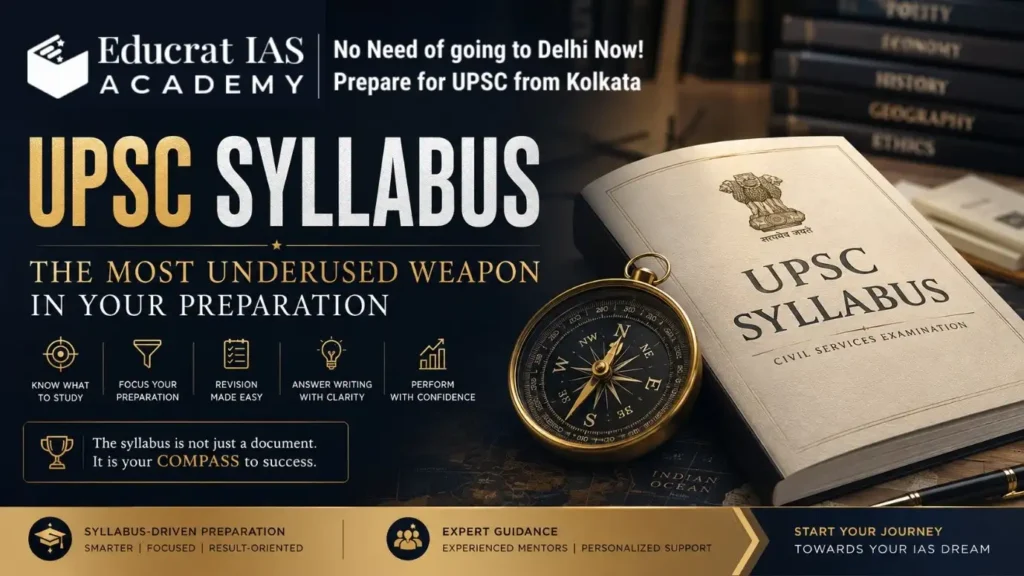
The UPSC Civil Services Examination is often described as a test of knowledge, analytical ability, awareness, consistency and perseverance. Every year, thousands of aspirants spend months reading standard books, following newspapers, making notes, watching lectures, solving mock tests and practising answer writing. Yet, there is one resource that is freely available, officially provided by UPSC and arguably more important than many of the resources aspirants spend hours collecting: the UPSC syllabus. Almost every aspirant downloads the syllabus, but very few actually study it. For many, it remains a PDF saved on a phone or a document glanced at once when preparation begins. This is a mistake. The UPSC syllabus should be treated as the foundation of your preparation: a master framework that tells you what to study, how to organise your knowledge, where to focus, what to revise and how to approach questions.
At Educrat IAS Academy, the Best IAS Institute in Kolkata, we believe that effective UPSC preparation begins with understanding the examination rather than simply accumulating information. The UPSC CSE syllabus is the most important tool for developing that understanding.
Why Is the UPSC Syllabus So Important?
The UPSC syllabus is much more than a list of subjects. It establishes the broad boundaries of the examination and provides a framework within which an aspirant must organise an enormous amount of information. UPSC covers subjects ranging from history, geography and polity to economy, environment, science and technology, society, governance, international relations, ethics and essay. Without a clear framework, this vast syllabus can easily become overwhelming. Aspirants often find themselves reading everything they come across: every government scheme, international development, newspaper article, report, editorial, committee recommendation or new book: without asking whether it contributes meaningfully to their preparation. The syllabus provides the first level of filtering. It helps you understand what UPSC expects and prevents preparation from becoming an endless search for information.
For example, the General Studies-II syllabus includes areas such as the Constitution, federalism, separation of powers, Parliament and State Legislatures, the Judiciary, constitutional and statutory bodies, governance, transparency, accountability, e-governance, welfare schemes, social-sector issues and international relations. Each of these broad areas can be broken down into smaller themes. Once you begin viewing the syllabus this way, current affairs also become easier to understand. A Supreme Court judgment is no longer simply “today’s news”; it can be connected to constitutional interpretation, fundamental rights, judicial review or separation of powers. A new government initiative can be studied under governance, welfare delivery or social-sector development. A diplomatic development can be connected to bilateral relations, regional groupings or India’s foreign-policy interests. The syllabus therefore transforms scattered information into structured knowledge.
Read the Syllabus as a Question Paper in Disguise
One of the most useful ways to understand the UPSC syllabus is to treat it as a question paper in disguise. Every phrase in the syllabus has significance. Words such as “discuss”, “examine”, “analyse”, “critically examine”, “evaluate”, “assess” and “comment” indicate the kind of intellectual engagement UPSC expects. Similarly, phrases such as “issues relating to”, “role of”, “effects of”, “challenges”, “opportunities”, “significance” and “measures” suggest the different dimensions from which a topic can be approached.
Consider a topic such as urbanisation. Simply knowing the definition of urbanisation is not enough. A syllabus-oriented approach would require you to understand its causes, demographic trends, economic significance, social consequences, environmental impact, infrastructure challenges, migration, informal settlements, urban governance and possible reforms. Similarly, when studying women empowerment, preparation should extend beyond government schemes. You should consider women’s education, health, workforce participation, political representation, financial inclusion, unpaid care work, violence, technology, legal safeguards and social attitudes. This is the essence of syllabus-based preparation: instead of asking only “What should I memorise?”, you begin asking, “What questions can UPSC construct from this topic, and what dimensions should my answer cover?”

Use the Syllabus with Previous Year Questions
The syllabus becomes significantly more powerful when combined with UPSC Previous Year Questions, or PYQs. These three words: Syllabus, PYQs and Current Affairs: should form the core of your preparation strategy. The syllabus tells you the territory, PYQs show you how UPSC has explored that territory, and current affairs help you connect static concepts with contemporary developments.
Suppose you are studying federalism. The syllabus identifies it as an important area. You then examine previous questions related to Centre-State relations, fiscal federalism, cooperative federalism, the role of Governors, inter-State disputes and constitutional mechanisms. Once you understand the patterns in PYQs, you can connect them with current developments such as debates around fiscal relations, centrally sponsored schemes, the functioning of the GST framework, Governor-related controversies or emerging issues in Centre-State relations. Your preparation then becomes much more focused. Instead of simply reading an entire chapter on federalism, you are building an examination-oriented understanding of a clearly defined syllabus theme.
This method should be followed across subjects. PYQs are not merely useful for testing yourself after completing a topic. They should be used at the beginning of preparation as well. Before reading a chapter or starting a new topic, look at the questions UPSC has previously asked. This gives you a better understanding of what deserves emphasis and what can receive comparatively less attention.
Let the Syllabus Guide Your Notes
A major advantage of syllabus-based preparation is that it can completely change the way you make notes. Rather than maintaining large notebooks organised only according to books or coaching lectures, structure your notes around syllabus keywords. For example, instead of having a generic section titled “Polity Current Affairs”, create separate sections for federalism, judiciary, Parliament, constitutional bodies, governance, transparency, accountability and e-governance. Under each heading, add relevant static concepts, important judgments, committee recommendations, current developments, examples and data.
This makes revision much easier. Imagine having to revise a broad subject such as governance before the Mains examination. If your notes are simply hundreds of pages of current affairs, revision becomes difficult. But if the information has already been classified under syllabus themes, you can revise systematically. You can immediately identify whether you have sufficient material on transparency, accountability, e-governance, civil-service reforms, citizen charters or welfare delivery. The syllabus thus becomes the architecture around which your notes are constructed.

Use the Syllabus to Control Current Affairs
Current affairs are essential for UPSC, but they are also one of the biggest sources of information overload. Newspapers, magazines, websites, monthly compilations, government releases, videos and social-media discussions can expose an aspirant to an almost unlimited amount of information. The problem is not finding information; it is deciding what deserves your attention.
The syllabus should be your primary filter. Whenever you encounter an important issue, ask yourself: Which syllabus topic does this belong to? If a development can be meaningfully connected to the syllabus, understand it and integrate it into your notes. If it has little or no relevance, do not feel compelled to study it simply because everyone else is discussing it.
For example, an issue involving artificial intelligence can be studied through several syllabus dimensions. From the perspective of governance, it may involve digital service delivery, accountability and privacy. From the perspective of the economy, it may involve productivity, employment and innovation. From the perspective of ethics, it may raise questions of algorithmic bias, transparency, accountability and human dignity. From the perspective of an essay, it can become part of broader discussions on technology, development and the future of work. The syllabus allows you to convert a single current-affairs issue into multidimensional knowledge.
The Syllabus Is Equally Important for Prelims
Many aspirants associate detailed syllabus analysis primarily with Mains. However, the syllabus is equally important for Prelims. The Prelims syllabus provides broad areas such as current events, history, geography, polity and governance, economic and social development, environment, ecology, biodiversity, climate change and general science. These broad categories must then be understood through PYQs and the evolving nature of UPSC questions.
For instance, environment is a broad term. UPSC can approach it through ecology, biodiversity, protected areas, species, environmental conventions, climate change, pollution, conservation strategies and environmental governance. The syllabus establishes the broad boundaries, while PYQs help you understand the kinds of concepts and factual areas UPSC has historically tested. Current affairs then provide the contemporary layer. This three-stage approach: syllabus, PYQs and current affairs: creates a much more efficient Prelims strategy than randomly studying every environmental issue appearing in the news.

Use the Syllabus for Mains Answer Writing
The syllabus can also become your answer-writing framework. UPSC Mains rewards candidates who can approach an issue from multiple dimensions rather than merely reproducing information. The syllabus itself can help develop this habit.
Suppose the question concerns urbanisation. A strong answer may discuss economic opportunities, migration, social inequality, housing, infrastructure, environmental sustainability, public transport, urban governance and institutional reforms. Similarly, a question on women’s empowerment can be approached through social, economic, political, legal, educational and technological dimensions.
Therefore, when preparing any major topic, do not stop at collecting facts. Ask yourself what dimensions the syllabus permits you to explore. Think in terms of social, economic, political, administrative, technological, environmental and ethical perspectives wherever relevant. This develops the multidimensional thinking that UPSC expects from a future civil servant.
Make the Syllabus Your Revision Checklist
One of the most common problems in UPSC preparation is the inability to accurately assess progress. Aspirants often say, “I have completed Polity” or “I have finished Geography.” But what does “completed” actually mean? Have you covered every relevant syllabus component? Have you analysed the PYQs? Have you integrated current affairs? Can you answer questions from the topic?
The syllabus provides a simple solution. Convert every broad syllabus heading into smaller topics and classify your preparation as Strong, Needs Revision or Not Covered. This creates an objective picture of your preparation.
During revision, move through the syllabus line by line. For every topic, ask yourself whether you can explain the concept, recall relevant examples, use current affairs, address multiple dimensions and construct a balanced answer. If you cannot, that topic needs another round of preparation. This method prevents the false confidence that often comes from simply completing books or watching lectures.
Let the Syllabus Shape Your Study Schedule
Your study timetable should ideally be syllabus-driven rather than book-driven. There is an important difference between saying, “I will finish this book this week” and saying, “I will complete the syllabus topics related to Parliament, Judiciary and Federalism this week using the relevant standard sources.”
Books are resources. The syllabus is the destination.
If your preparation is controlled by books, you may spend considerable time completing chapters that have limited examination relevance. If the syllabus controls your preparation, every book, lecture, article and current-affairs source has a defined purpose. This approach also makes it easier to avoid resource overload because you can evaluate every new source against your existing preparation.
Use the Syllabus to Avoid Preparation FOMO
UPSC preparation can create a constant fear of missing out. A fellow aspirant recommends a new book. A coaching institute releases a new compilation. A YouTube channel publishes a new strategy. A Telegram group shares hundreds of pages of notes. Before long, aspirants are collecting resources faster than they can revise them.
The syllabus can act as an antidote to this problem. Before adding another resource, ask whether it helps you cover a specific syllabus requirement better than your existing material. If it does, integrate it selectively. If it simply repeats information you already possess, move on.
The objective of UPSC preparation is not to collect the maximum amount of material. It is to develop the ability to understand, analyse, recall and communicate relevant knowledge under examination conditions.
A Five-Step Syllabus Strategy for UPSC Aspirants
A simple five-step process can make the syllabus a permanent part of your preparation. First, keep a printed or digital copy of the complete UPSC syllabus easily accessible. Second, break every broad heading into micro-topics. Third, map Previous Year Questions against each micro-topic. Fourth, add relevant current affairs, examples, data, reports, judgments and government initiatives. Finally, use the syllabus as your revision checklist.
You can create a simple framework such as: Syllabus Topic → PYQs → Static Sources → Current Affairs → Examples/Data → Revision Status. For instance, under “Federalism”, you can list relevant PYQs, constitutional provisions, important Supreme Court judgments, current Centre-State issues and examples of cooperative or competitive federalism. Under “Women Empowerment”, you can compile data on women’s workforce participation, government initiatives, institutional challenges, case studies and contemporary developments. Over time, this becomes a personalised UPSC knowledge bank.
The Most Important Shift in Your Preparation
Perhaps the most important change that syllabus-based preparation brings is a shift in the question you ask yourself. Instead of asking, “How much have I studied?”, begin asking, “How much of the syllabus can I handle?”
Completing ten books does not automatically mean you are prepared. Watching hundreds of lectures does not guarantee conceptual clarity. Reading the newspaper every day does not necessarily mean you can use current affairs effectively. Preparation must ultimately translate into performance.
Can you understand a question? Can you identify its syllabus connection? Can you recall relevant concepts? Can you bring in contemporary examples? Can you analyse the issue from multiple perspectives? Can you present a balanced and structured answer within the word limit?
These are much better indicators of preparation.

Conclusion: Make the Syllabus Your Preparation Compass
The UPSC syllabus may appear simple because it is only a few pages long. But its real value lies in how deeply you learn to interpret it. It can function simultaneously as your compass, filter, checklist, revision tool, answer-writing framework and preparation boundary.
The syllabus tells you where to go. PYQs tell you how UPSC has travelled through that territory. Current affairs show you what is changing within it. Standard books provide conceptual depth. Answer writing teaches you how to communicate your understanding. Revision ensures that the knowledge remains accessible when you need it.
At Educrat IAS Academy, the Best UPSC Coaching Centre in Kolkata, we encourage aspirants to move away from information-heavy and directionless preparation towards a more structured, examination-oriented approach. UPSC preparation should not be about studying everything. It should be about understanding what matters, studying it deeply, connecting it intelligently and revising it repeatedly.
The syllabus is not a document you finish reading on the first day of your preparation. It is a framework you should return to throughout your UPSC journey.
Know the syllabus. Decode the demand. Map the PYQs. Connect current affairs. Revise strategically.
Most importantly, remember that your preparation should be measured not by the number of resources you have consumed, but by your ability to handle the demands of the syllabus.
Ready to Prepare Smarter for UPSC?
The right guidance can make the difference between studying more and preparing better. At Educrat IAS Academy, Best UPSC Institute in Kolkata, our approach focuses on syllabus-oriented preparation, Previous Year Question analysis, current-affairs integration, conceptual clarity, answer writing and continuous evaluation.
Whether you are beginning your UPSC journey or looking to bring greater structure to your existing preparation, start with the most important resource you already have: the UPSC syllabus.
Build clarity. Prepare strategically. Write with confidence.
Educrat IAS Academy: Your Preparation, Structured. Your Goals, Guided.
Enquire now and take the first step towards a focused and structured UPSC preparation journey.