This article highlights that simultaneous elections can boost administrative efficiency and capital spending, provided federal consensus, constructive confidence votes, and legal limits on poll deferrals safeguard democracy.
One Nation, One Election (ONOE) proposes holding Lok Sabha and State Legislative Assembly elections within a common electoral cycle. Its supporters see an opportunity to reduce repeated election-related costs and administrative disruption. Critics raise questions about federal autonomy, regional representation and what happens when a government falls before the cycle ends.
The proposal is now before a Joint Parliamentary Committee. The committee’s report deadline has been extended to the first day of the last week of the Winter Session, 2026. The debate, therefore, is not only about whether elections can be synchronised, but how to protect democratic choice and constitutional accountability if they are. sansad.in
For Prelims: One Nation, One Election, Constitution (129th Amendment) Bill, 2024, Lok Sabha, Law Commission, NITI Aayog, Electoral Photo Identity Card, Election Commission, Article 327, Joint Parliamentary Committee, Model Code of Conduct, Right to Education Act, 2009, Federalism, Basic Structure, President, Governor, Parliament, Vote of No Confidence.
For Mains: Key facts regarding One Nation One Election, Arguments in favour and arguments against ONOE, Measures needed to implement ONOE in India.
Introduction
What Is One Nation, One Election?
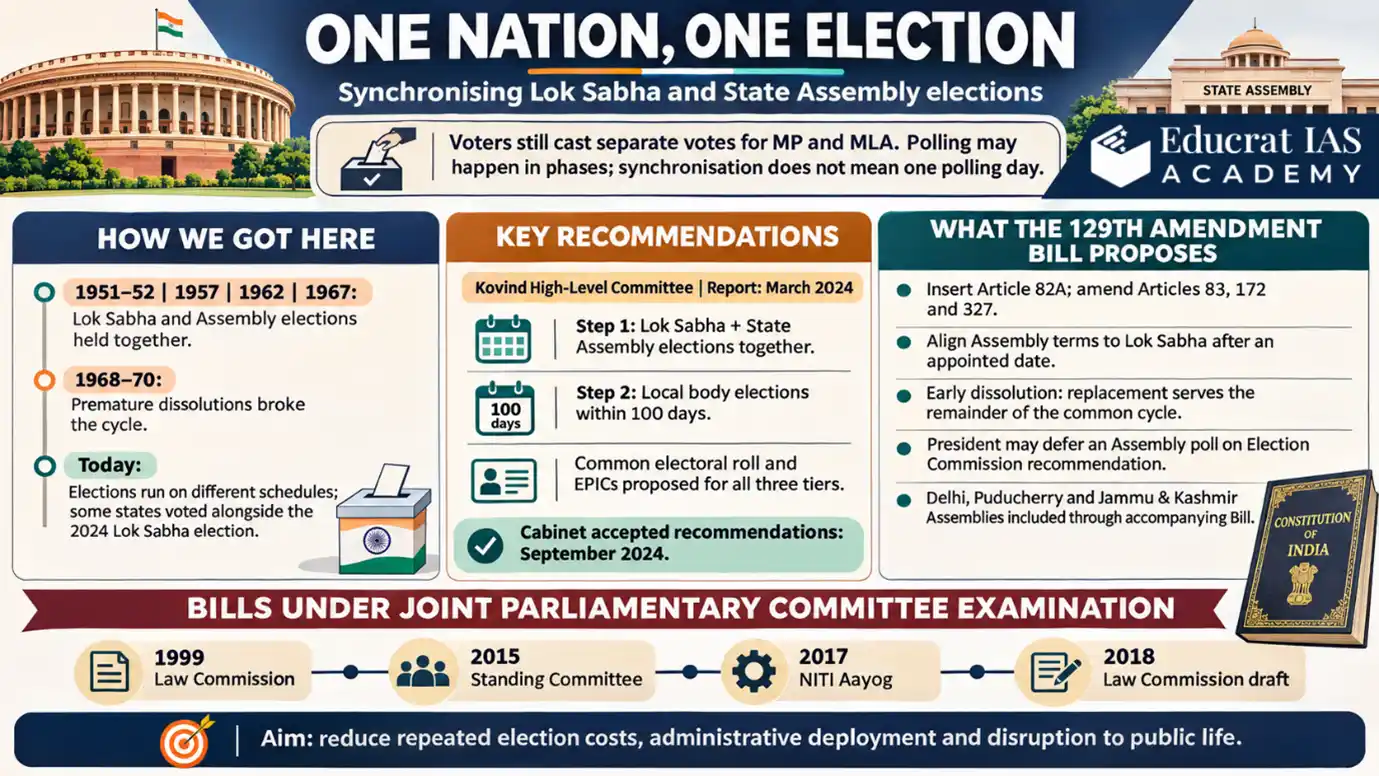
ONOE refers to aligning elections to the Lok Sabha and State Legislative Assemblies within a common electoral cycle. Voters would still cast separate votes for their MP and MLA. Polling could take place in phases across the country; synchronisation does not require a single polling day.
The proposal aims to reduce repeated election expenditure, administrative deployment and disruption to public life, while allowing governments longer periods to focus on policy and implementation.
A history of simultaneous elections: India held Lok Sabha and Assembly elections together in 1951–52, 1957, 1962 and 1967. The cycle began to break after some Assemblies were dissolved prematurely in 1968–69 and the Lok Sabha in 1970. Since then, elections have taken place on different schedules. Partial synchronisation continues: several states held Assembly elections alongside the 2024 Lok Sabha election.
Earlier proposals: The Law Commission’s 170th Report, 1999, favoured holding Lok Sabha and Assembly elections together once every five years. The Parliamentary Standing Committee’s 79th Report, 2015, considered feasibility and a phased approach. A NITI Aayog discussion paper in 2017 also examined phased synchronisation. The Law Commission’s 2018 draft report discussed constitutional issues, including how to handle a hung legislature.
High-Level Committee recommendations: The Ram Nath Kovind-led High-Level Committee submitted its report in March 2024. It recommended a two-step approach: first, simultaneous Lok Sabha and Assembly elections; then, local-body elections within 100 days. It also proposed a common electoral roll and Electoral Photo Identity Cards for all three tiers of government, prepared by the Election Commission in consultation with State Election Commissions. The Union Cabinet accepted the committee’s recommendations in September 2024. Press Information Bureau
The Constitution (129th Amendment) Bill, 2024: The Bill proposes inserting Article 82A and amending Articles 83, 172 and 327 to enable simultaneous Lok Sabha and Assembly elections. It provides for an “appointed date” after a general election, from which the terms of subsequently elected Assemblies would be aligned with the Lok Sabha’s term. If a legislature is dissolved early, the replacement legislature would serve only the remainder of the common cycle.
The Bill also allows the President, on the Election Commission’s recommendation, to defer an Assembly election. The accompanying Union Territories Laws (Amendment) Bill, 2024, seeks to include the Assemblies of Delhi, Puducherry and Jammu and Kashmir in the proposed cycle. The bills remain under Joint Parliamentary Committee examination. sansad.in
Arguments in Favour of One Nation One Election?
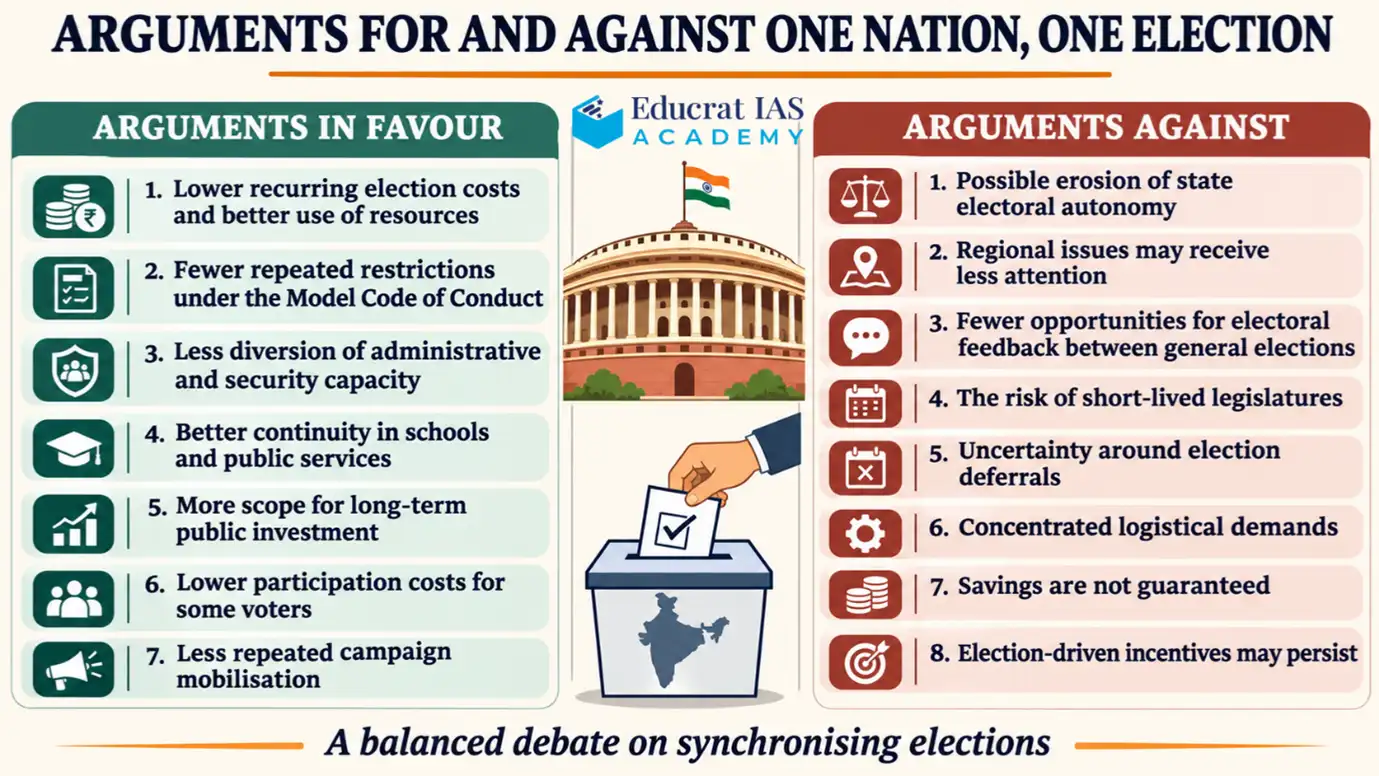
Lower recurring election costs and better use of resources: A combined election could allow polling premises, transport, training, communication and election-management arrangements to be used across more than one contest. The 2024 Lok Sabha election involved 10,52,664 polling stations, illustrating the scale of infrastructure required for a national election. Holding Assembly polls alongside parliamentary polls could reduce repeated mobilisation of those facilities. eci.gov.in
Fewer repeated restrictions under the Model Code of Conduct: Separate elections can bring repeated periods of campaign-related restrictions in the jurisdictions concerned. Synchronisation could create longer intervals for new project approvals and policy announcements. The Model Code of Conduct does not stop all ongoing work or essential services, but repeated elections can complicate fresh decisions and approvals.
Less diversion of administrative and security capacity: Elections require district officials, police personnel and security forces to manage polling, training and logistics. A common cycle could reduce repeated deployments and allow more time for routine administration, public safety and grievance redressal between elections.
Better continuity in schools and public services: Teachers may be assigned election duties, while schools can serve as polling premises. Coordinating elections could make it easier for schools to plan around those demands and protect instructional time, particularly where staffing is limited.
More scope for long-term public investment: Supporters argue that fewer overlapping election deadlines could give governments greater room to plan and complete infrastructure projects. Some research presented to the Joint Parliamentary Committee has associated simultaneous-election periods with a higher capital-to-current expenditure ratio. Such findings offer a case for further examination; they do not establish that synchronisation alone will cause higher or more effective investment. India News
Lower participation costs for some voters: A voter registered in their home constituency may have to make separate journeys or take leave to vote in parliamentary and Assembly elections held at different times. Holding the polls together could reduce travel, time away from work and related costs for some migrant and working voters.
Less repeated campaign mobilisation: Political parties may be able to share campaign offices, travel and organisational arrangements across parliamentary and Assembly contests. This could reduce some duplication in campaigning, though it would not remove the broader costs of political competition or fundraising.
Arguments Against One Nation One Election?
Possible erosion of state electoral autonomy: Aligning Assembly terms to a Lok Sabha cycle could make state electoral calendars dependent on a Union-level schedule. States have distinct constitutional responsibilities and political mandates. In S.R. Bommai v. Union of India (1994), the Supreme Court recognised federalism as part of the Constitution’s Basic Structure. The administrative case for synchronisation must therefore be weighed against the autonomy of state institutions.
Regional issues may receive less attention: Simultaneous campaigns could increase the influence of national parties, leaders and issues over state-level contests. A 2025 study in the Journal of Comparative Economics found that synchronised elections were associated with a 21% higher probability of the same party winning across parliamentary and Assembly tiers. The study also found increased party salience and straight-ticket voting, raising questions about how effectively voters can separate national and state choices. sciencedirect.com
Fewer opportunities for electoral feedback between general elections: Staggered elections give voters separate opportunities to assess governments and signal dissatisfaction between national elections. A common cycle could concentrate those opportunities at one point. Legislative scrutiny and other accountability mechanisms would remain, but separately timed elections can provide a distinct form of public feedback.
The risk of short-lived legislatures: Synchronisation cannot prevent a government from losing its majority or a legislature from being dissolved early. Under the Bill’s proposed approach, a replacement legislature would serve the remainder of the common term. If that period were short, the new government might have limited time for budgeting, legislation and policy implementation. PRS Legislative Research has noted that some legislatures could have terms of less than a year. prsindia.org
Uncertainty around election deferrals: The Bill allows an Assembly election to be deferred on the Election Commission’s recommendation but does not specify detailed grounds or an outer time limit. PRS has also raised questions about who would govern if an Assembly’s term expired before the postponed election, and under what authority. Clear legal limits would be needed to protect electoral certainty and continuity of representative government. prsindia.org
Concentrated logistical demands: Synchronisation could reduce repeated mobilisation over time while increasing the resources needed during a common election period. Polling personnel, security forces, voting equipment, transport and counting arrangements would need to support multiple contests together. Election phases would still be possible, but the common schedule could constrain flexibility around regional weather, festivals, security conditions and local disruptions.
Savings are not guaranteed: Any reduction in repeated deployment must be weighed against the costs of procuring, storing, maintaining and replacing equipment. Aligning election dates would also leave major drivers of campaign spending and political fundraising in place. The net savings would need to be demonstrated through a transparent, full-cycle cost assessment.
Election-driven incentives may persist: Synchronisation could concentrate electoral incentives into a single high-stakes period rather than remove them. Governments may still have reasons to time visible benefits or public-service decisions around elections. A common cycle by itself cannot guarantee fiscal discipline or steady service delivery.
Measures Needed to Implement One Nation One Election?
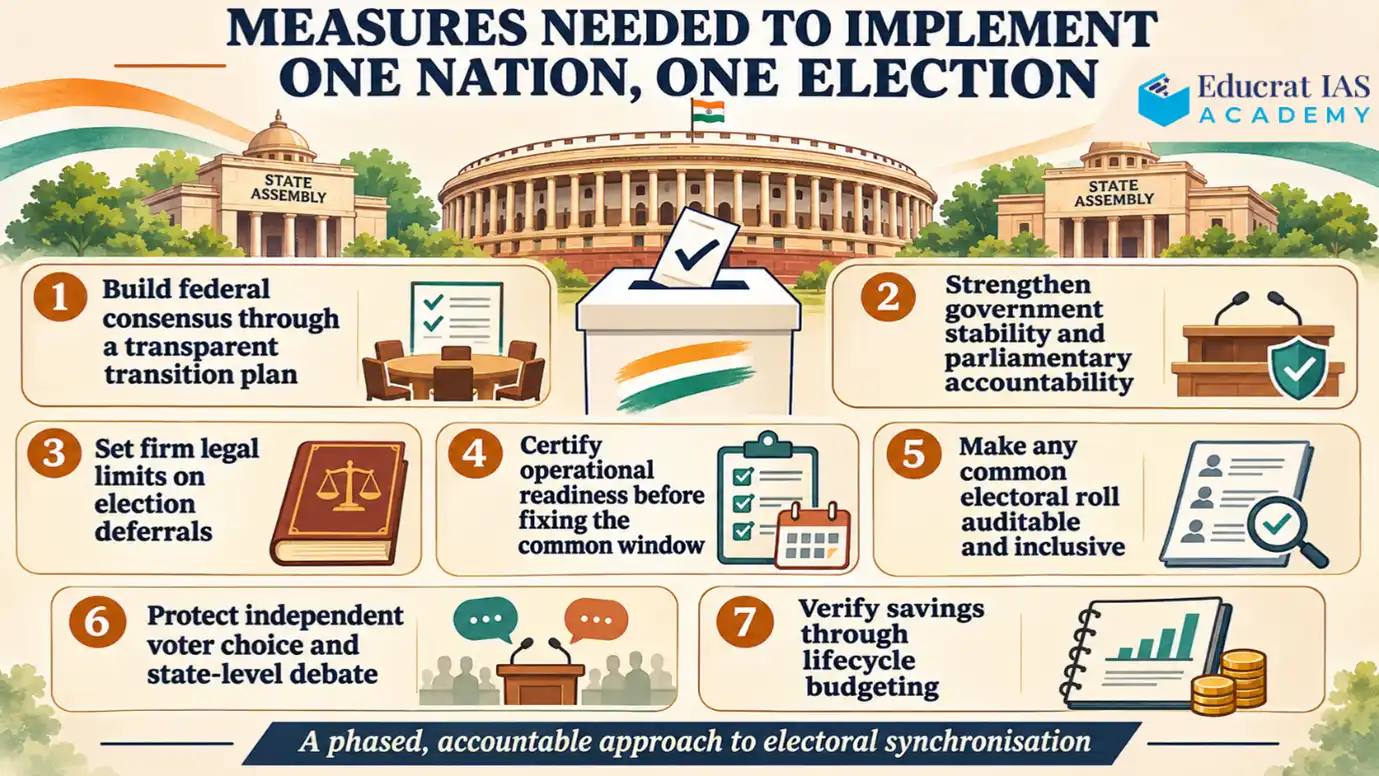
Build federal consensus through a transparent transition plan: Parliament should consult state governments, regional parties and constitutional experts before fixing a transition schedule. A public, state-wise statement should show how the proposal would affect each Assembly’s tenure, what alternatives were considered and why a particular transition was chosen. Constitutional and statutory amendments should follow the procedures that apply, including state ratification wherever required.
Strengthen government stability and parliamentary accountability: India could examine a constructive vote of no confidence, under which a legislature removes a government only while demonstrating majority support for a successor. Article 67 of Germany’s Basic Law offers one comparative example. Any adaptation would need to fit India’s constitutional framework and prevent prolonged minority governments. Clear deadlines for floor tests and government formation could help determine when an election is necessary.
Set firm legal limits on election deferrals: Legislation should specify the grounds for postponement, maximum delay periods and the requirement for a reasoned public order. Exceptional deferrals should involve documented assessments, periodic review and access to expedited judicial scrutiny. The law should also clarify interim governance, caretaker powers and the constitutional conditions for President’s Rule.
Certify operational readiness before fixing the common window: The Election Commission, State Election Commissions and security agencies should prepare a logistics plan covering staff, equipment, transport, counting centres and disaster contingencies. Readiness standards should address reserve availability, equipment replacement times and accessible polling capacity. Scenario-based exercises could test whether, for example, a failed machine can be replaced promptly in a remote constituency during simultaneous polling elsewhere.
Make any common electoral roll auditable and inclusive: If a common roll is adopted, responsibilities for verification should be clearly divided between the Election Commission and State Election Commissions. Corrections should leave an auditable record. Duplicate detection should trigger examination, not automatic deletion; voters should retain notice, verification and hearing safeguards. A time-bound grievance process should be accessible to migrants, newly eligible voters and persons with disabilities.
Protect independent voter choice and state-level debate: The Election Commission should test whether voters can readily distinguish parliamentary and Assembly contests under different ballot, polling-station and information formats. Civic education should explain the responsibilities of Union and state governments through accessible, multilingual and politically neutral material. Separate issue-based public discussions for each tier could also help keep state concerns visible during a combined campaign.
Verify savings through lifecycle budgeting: Governments should compare synchronised and staggered elections over the same period, counting procurement, maintenance, storage, reserve equipment, staffing and replacement costs. A transparent Union–state cost-sharing plan would show who bears the expense. Independent performance audits could assess whether the claimed savings produce measurable public value.
Data Compilation of One Nation One Election
- Historical practice — Lok Sabha and State Assembly elections were broadly held together in 1951–52, 1957, 1962 and 1967; the cycle fragmented after premature dissolutions in 1968–70.
- Constitutional proposal — The Constitution (129th Amendment) Bill, 2024, proposes Article 82A and amendments to Articles 83, 172 and 327. As of November 2026, the Bill and the accompanying Union Territories amendment Bill remain under Joint Parliamentary Committee examination.
- Scale of election management — The 2024 Lok Sabha election used 10,52,664 polling stations and mobilised approximately 1.5 crore polling and security personnel.
- Election-related restrictions — The Model Code of Conduct for the 2024 general election operated from the March announcement until 6 June 2024.
- Electoral equipment costs — An ECI estimate reported in January 2024 placed additional EVM procurement requirements for simultaneous elections at about ₹10,000 crore over 15 years.
- Economic evidence — An August 2025 working paper estimated a national-level growth differential of about 1.5 percentage points around simultaneous-election episodes in India’s 1952–2023 experience. This is an observed association and should not be treated as conclusive proof of causation.
- Electoral coattail evidence — A 2025 peer-reviewed study reported a 21% higher probability of the same party winning at parliamentary and Assembly levels under synchronised elections.
- Campaign expenditure — An ADR analysis of 2024–25 accounts found that 15 regional parties spent over 55% of their total expenditure on elections.
UPSC Perspective of One Nation One Election
Syllabus Linkages of One Nation One Election:
- GS Paper II — Indian Constitution, federalism, Centre–State relations, Parliament and State Legislatures, constitutional amendments, electoral reforms and the Election Commission.
- GS Paper III — Public expenditure, administrative efficiency and the allocation of personnel and resources.
- Prelims — Track the proposed Article 82A, the provisions proposed for amendment (Articles 83, 172 and 327), the Ram Nath Kovind-led High-Level Committee, and the present status of the Bills.
Mains Analytical Framework
- Potential gains — Assess whether synchronisation can reduce repeated election deployment, improve continuity in administration, protect teaching time and create room for planned capital expenditure.
- Constitutional concerns — Examine federal autonomy, distinct State mandates, electoral accountability, regional issue salience, short legislative terms and the proposed scope for deferring an Assembly election.
- Evidence-based assessment — Distinguish projected savings and research associations from guaranteed outcomes; consider lifecycle costs, logistics and the limits of cross-country or historical comparisons.
- Way forward — Emphasise federal consultation, clear legal limits and review of deferrals, transparent transition arrangements, operational readiness and safeguards for independent voter choice.
Mains Practise Question:
Conclusion
One Nation, One Election could reduce repeated administrative mobilisation and create more predictable election cycles. But synchronisation also affects the tenure of representative institutions, the visibility of state issues and the continuity of government when a legislature falls early.
As the Joint Parliamentary Committee examines the bills, the central test should be whether the reform can deliver practical gains while protecting federalism, voter choice and electoral certainty. A transparent transition, enforceable limits on deferrals and clear arrangements for government formation are essential to achieving that balance.
Educrat IAS Academy
Preparing for UPSC requires a clear understanding of constitutional provisions, balanced analysis and regular answer writing. Educrat IAS Academy supports aspirants through structured guidance and exam-focused preparation.
For counselling and course information:
Call: 9163228921