This editorial is based on “Indian Diaspora’s Politics Is A Double-edged Sword,” published in the Deccan Chronicle on 9 November 2026. It examines how overseas Indians can strengthen India’s global influence through remittances, investment, expertise and cultural outreach, while also creating diplomatic challenges when migration pressures, social exclusion or political polarisation affect their lives abroad.
For Prelims: NRIs, PIOs, UN DESA, World Bank, UNESCO, semiconductors, quantum technologies, biotechnology, BHARTI initiative, VAIBHAV, Operation Sindhu.
For Mains: Global standing of the Indian diaspora; its contribution to India’s development; challenges faced by overseas Indians; and measures to strengthen diaspora engagement.
Introduction
The Indian diaspora—estimated by the Ministry of External Affairs (MEA) at approximately 35.4 million people—is among India’s most significant links with the world. Its members contribute to host societies as workers, professionals, entrepreneurs, students and public leaders. They also connect India to international capital, research networks, markets and cultural communities.
This presence can advance India’s interests, but it does not automatically translate into influence. Immigration uncertainty, labour exploitation, racial hostility and political polarisation can place overseas Indians at risk and complicate India’s relations with host countries. India’s challenge is to build a diaspora partnership that supports development while respecting the diaspora’s diversity, autonomy and need for protection.
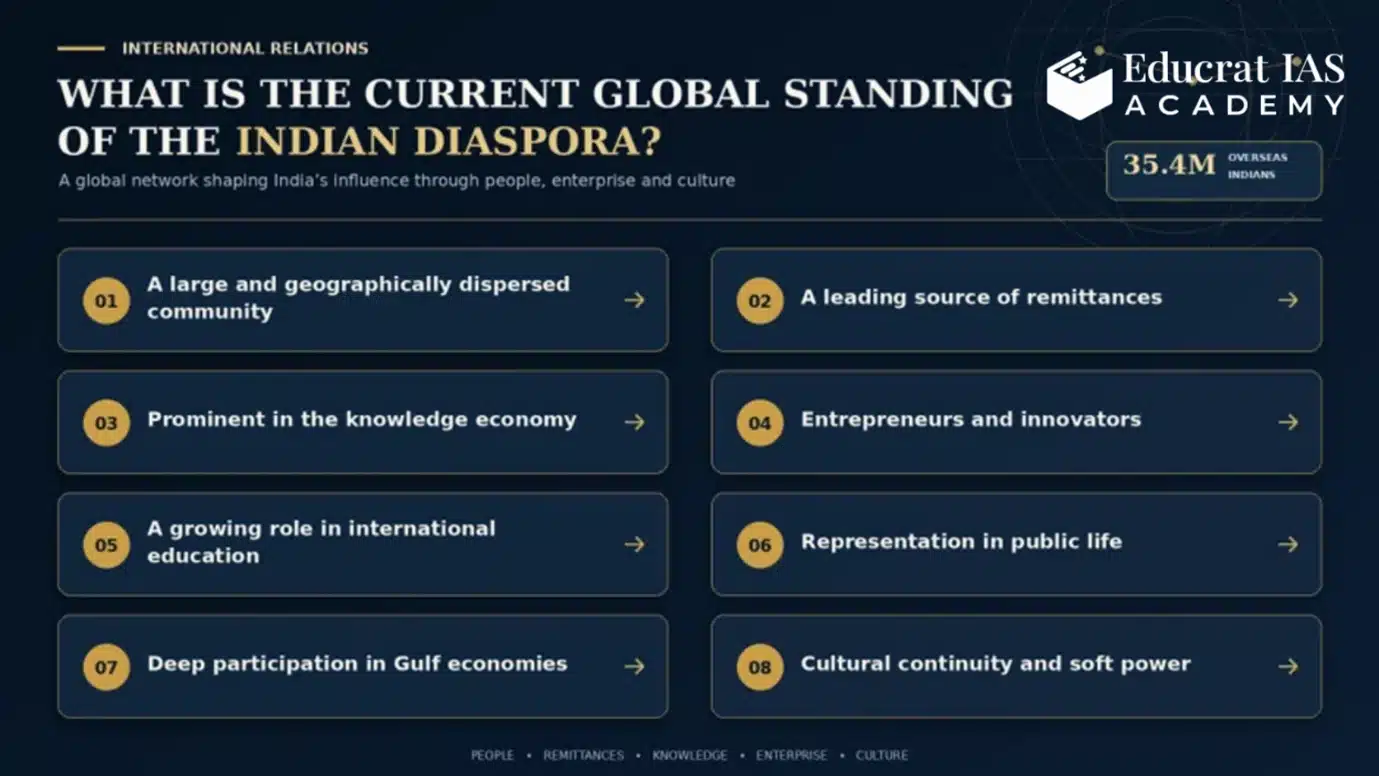
What Is the Current Global Standing of the Indian Diaspora?
- A large and geographically dispersed community: MEA estimates place the overseas Indian population at approximately 4 million, comprising about 15.9 million NRIs and 19.6 million PIOs. Separately, UN DESA’s International Migrant Stock 2024 identifies India as the world’s largest migrant-origin country, with 18.5 million migrants living overseas. These figures use different definitions: the MEA estimate includes NRIs and PIOs, while the UN figure counts international migrants. The diaspora’s distribution is wide. Long-established communities in countries such as Mauritius, Fiji, the United Kingdom and South Africa coexist with newer professional and student communities across North America, Europe, East Asia and the Gulf.
- A leading source of remittances: Overseas Indians maintain strong household and financial links with India. The World Bank’s series records approximately USD 150.7 billion in personal remittances received by India in 2025. RBI’s 2023–24 survey found that the United States, United Kingdom, Singapore, Canada and Australia together accounted for more than half of inward remittances.These transfers support households and contribute to India’s external financial inflows. Their impact, however, is not limited to the national total: remittances can help families pay for education, healthcare, housing and daily needs.
- Prominent in the knowledge economy: Indian-origin professionals have a significant presence in technology, healthcare, finance, academia and entrepreneurship. Pew Research Center’s 2025 profile, drawing on American Community Survey data, found that 77% of Indian Americans aged 25 and above held at least a bachelor’s degree, compared with 56% of Asian Americans overall. Indian-headed households recorded a median annual income of USD 151,200 in 2023, compared with USD 105,600 for Asian-headed households overall.
- Entrepreneurs and innovators: A June 2026 National Foundation for American Policy study identified 96 privately held US companies valued at over USD 1 billion with Indian-born founders or co-founders, based on companies counted as of April 2026. The study placed India first among immigrant-origin countries, ahead of Israel. Entrepreneurs such as Arvind Jain and Jyoti Bansal have founded companies in fields including cybersecurity and enterprise software.Their contribution extends beyond employment and technical skills. Through company-building, intellectual property and investment networks, diaspora entrepreneurs can shape markets and create links between Indian and global businesses.
- A growing role in international education: Student mobility connects Indian institutions and families with universities, research centres and employers abroad. The Open Doors 2025 report recorded 363,019 Indian students in the United States during 2024–25, including students on Optional Practical Training, making India the largest source country. DAAD recorded 59,419 Indian students in Germany in winter 2024–25, the country’s largest international student group.
- Representation in public life: People of Indian origin hold senior political positions in several countries. Tharman Shanmugaratnam serves as Singapore’s President, while Navinchandra Ramgoolam returned to office as Mauritius’s Prime Minister in November 2024. Such representation reflects the political participation and integration of parts of the diaspora, though individual leaders should not be treated as representatives of every overseas Indian community.
- Deep participation in Gulf economies: Millions of Indian nationals work across the Gulf in sectors including construction, healthcare, hospitality and services. An MEA parliamentary annexure published in 2026 estimated approximately 33 million Indian nationals in the UAE and 2.75 million in Saudi Arabia. Their work supports families in India and contributes to the economies of host countries, while also making worker protection and consular support essential.
- Cultural continuity and soft power: Festivals, languages, food, cinema, religious institutions and community associations help maintain cultural ties across generations. UNESCO’s inscription of Deepavali on its Representative List of the Intangible Cultural Heritage of Humanity in December 2025 recognised the festival’s living traditions and the role of communities, including the diaspora, in transmitting them.
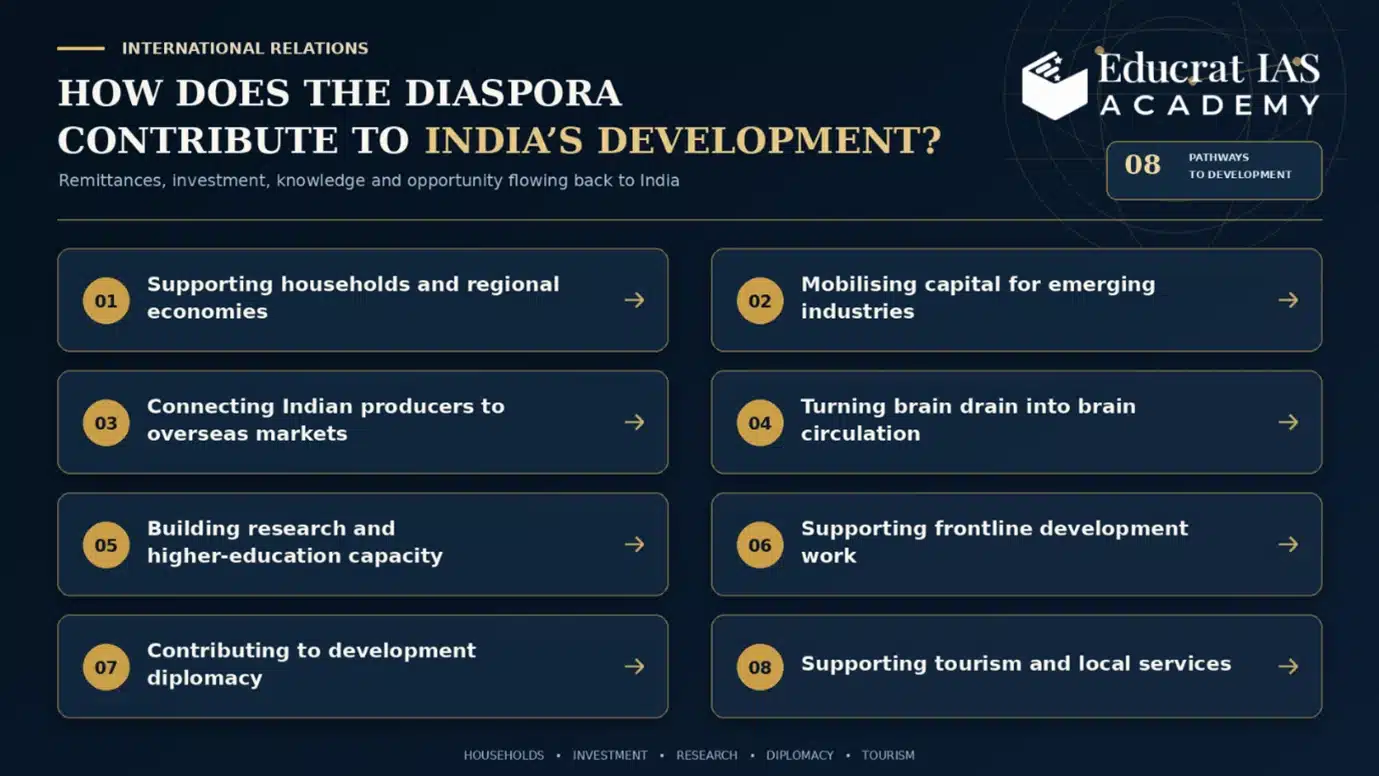
How Does the Diaspora Contribute to India’s Development?
- Supporting households and regional economies: Remittances help families manage income shocks and invest in education, healthcare and housing. Their regional effect can be particularly visible in areas with high migration. The Kerala Development Report 2026, citing the Kerala Migration Survey, records remittances of ₹2,16,893 crore in 2023, up from ₹85,092 crore in 2018.When remittance income is spent locally, it can also support demand for construction, transport, retail and other services. The development effect depends on how these funds are used and whether households have access to reliable financial and public services.
- Mobilising capital for emerging industries: Diaspora investors can connect Indian businesses with funding, international expertise and commercial networks. The India Deep Tech Investment Alliance, established in September 2025 with support from investors including Celesta Capital co-founder Sriram Viswanathan, announced USD 1 billion in collective capital commitments. Its focus includes semiconductors, quantum technologies, robotics, biotechnology and clean energy.Such commitments can help address a financing gap in sectors where research and commercialisation require patient capital. The long-term impact depends on how much capital is ultimately deployed and whether promising firms can access it.
- Connecting Indian producers to overseas markets: Diaspora-led business networks can help Indian producers understand foreign markets, find buyers and reach distribution channels. In September 2025, APEDA entered into an agreement with LuLu Hypermarket under the BHARTI initiative. The agreement provides for Indian agri-food startups to access shelf space across 252 LuLu outlets in GCC countries, alongside product sampling and access to its export division.These partnerships can support export diversification and agricultural value addition by connecting domestic producers with international retailers.
- Turning brain drain into brain circulation: Overseas scientists and professionals can share expertise without permanently relocating to India. Under the VAIBHAV programme, overseas Indian-origin academics and scientists collaborate with Indian institutions through short-term visits. The Indian National Academy of Engineering’s March 2026 newsletter reported that 17 fellows were selected under the VAIBHAV 2024 call, with first-year funding disbursed to 16 eligible fellows and institutional visits progressing.This model can strengthen research relationships, mentor doctoral students and transfer specialised methods. Its success depends on sustained institutional partnerships and the ability of Indian teams to continue the work after a visiting expert’s assignment ends.
- Building research and higher-education capacity: Diaspora philanthropy can create lasting educational infrastructure. In 2024, US-based entrepreneur and IIT Madras alumnus Sunil Wadhwani endowed ₹110 crore to establish the Wadhwani School of Data Science and AI at IIT Madras. The school’s mandate includes foundational and applied research, Responsible AI and policy advice.Such contributions can build capacity across successive generations of students, researchers and entrepreneurs when they are supported by strong institutional planning.
- Supporting frontline development work: Diaspora philanthropy can complement public programmes in health, education and livelihoods. The American India Foundation’s New York gala raised over USD 4.5 million in June 2025 for its work in these areas. Its Maternal and Newborn Survival Initiative supports ASHAs and other frontline workers through locally adapted training, home-based care and referral of high-risk pregnancies. AIF reported in January 2025 that the initiative had cumulatively trained more than 10,800 frontline workers.
- Contributing to development diplomacy: Diaspora organisations can build public and legislative support for partnerships that affect India’s development. The MEA has acknowledged Indian-American lobbying in support of India–US civil nuclear cooperation. In April 2026, the Department of Atomic Energy reported that 16 safeguarded reactors with a capacity of 6,380 MW were being fuelled by imported fuel.
Diaspora advocacy can contribute to wider diplomatic processes, but it should operate transparently and should not be treated as a substitute for formal diplomacy.
- Supporting tourism and local services: Visits by overseas Indians generate demand for aviation, hospitality, transport, heritage experiences and local retail. The Ministry of Tourism dashboard recorded 07 million NRI arrivals in 2025, an increase of 4.26% over 2024 and more than half of India’s recorded international tourist arrivals.
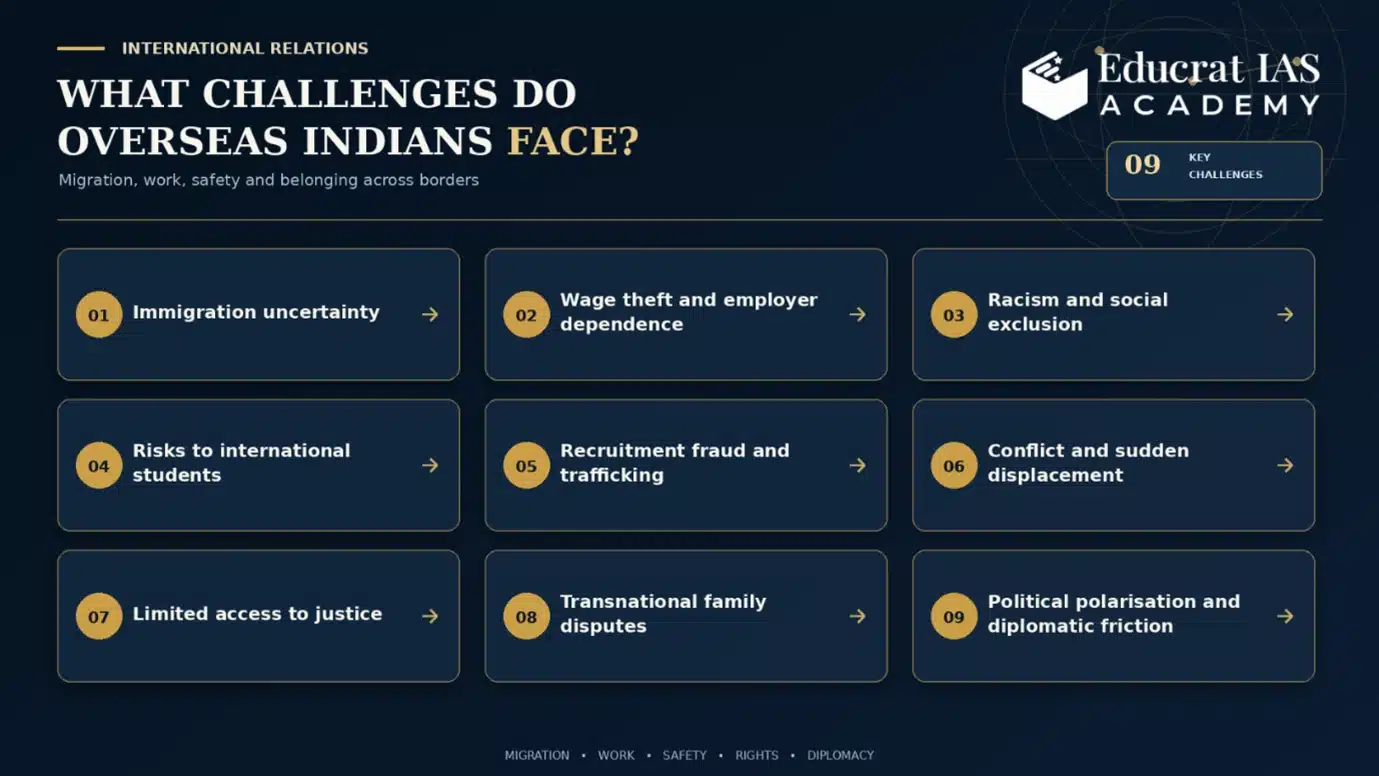
What Challenges Do Overseas Indians Face?
- Immigration uncertainty: Skilled migrants may spend years in temporary or uncertain residency, affecting career choices, family planning and long-term settlement. The US Department of State’s November 2026 Visa Bulletin placed the final-action cut-off for India’s employment-based second-preference category, EB-2, at 1 November 2013. Long queues can leave professionals economically integrated but without secure immigration status.
- Wage theft and employer dependence: Migrant workers may face unpaid salaries, contract substitution, passport confiscation and poor working conditions. An MEA parliamentary reply in March 2026 recorded 4,081 labour-related complaints received by the Indian Embassy in Kuwait during 2025. Where workers depend on employers for housing or immigration status, reporting violations or changing jobs can be difficult.
- Racism and social exclusion: Professional success does not protect people from hate-motivated violence or discrimination. In August 2025, Ireland’s Justice Minister met Indian community organisations to discuss racist attacks against members of the Indian community. Earlier that month, the Indian Embassy in Dublin issued a security advisory after increased reports of physical attacks. Such incidents can undermine people’s safety and sense of belonging.
- Risks to international students: Students may face high education costs, loan burdens and uncertainty about whether a course satisfies immigration or residence requirements. A November 2026 Indian Council of World Affairs analysis highlighted Indian students in Berlin who faced deportation-related difficulties after their university’s hybrid programmes did not meet requirements for on-campus study. Students and families need clear, verifiable information before committing to costly overseas programmes.
- Recruitment fraud and trafficking: Fake job offers can expose Indians to debt bondage, confinement and forced criminality. In March 2025, India repatriated 283 nationals from Myanmar through Thailand after securing their release. According to the official statement, they had been lured by fraudulent employment offers and made to participate in cybercrime and other fraudulent activities near the Myanmar–Thailand border.
- Conflict and sudden displacement: Conflict can turn ordinary residence into an emergency. Under Operation Sindhu in June 2025, India evacuated 4,415 Indian nationals—3,597 from Iran and 818 from Israel. Evacuation protects lives, but returning migrants may still face disrupted education, lost income and uncertainty about when they can resume work abroad.
- Limited access to justice: Indians who face detention or legal disputes abroad must navigate unfamiliar legal systems, language barriers and legal costs. An MEA reply dated March 2026 listed 9,047 Indians in foreign prisons, including undertrial and convicted prisoners. Indian missions may provide eligible, means-tested initial legal assistance, but do not conduct court cases on behalf of Indian nationals. Access to effective legal representation can therefore remain difficult.
- Transnational family disputes: Women in overseas marriages may face abandonment, domestic violence, passport withholding, maintenance disputes and contested child custody. In March 2025, the government informed Parliament that Indian missions had received 1,617 complaints over the preceding five years from NRI women alleging abandonment by spouses abroad. When spouses, children, assets and legal proceedings are spread across countries, enforcing family-related decisions becomes especially complex.
- Political polarisation and diplomatic friction: Diaspora communities are politically diverse. When political actors treat overseas Indians as a single bloc or use community organisations for partisan outreach, disagreements within the diaspora can spill into bilateral relations. India must maintain engagement with communities while respecting their independence and the laws and democratic processes of host countries.
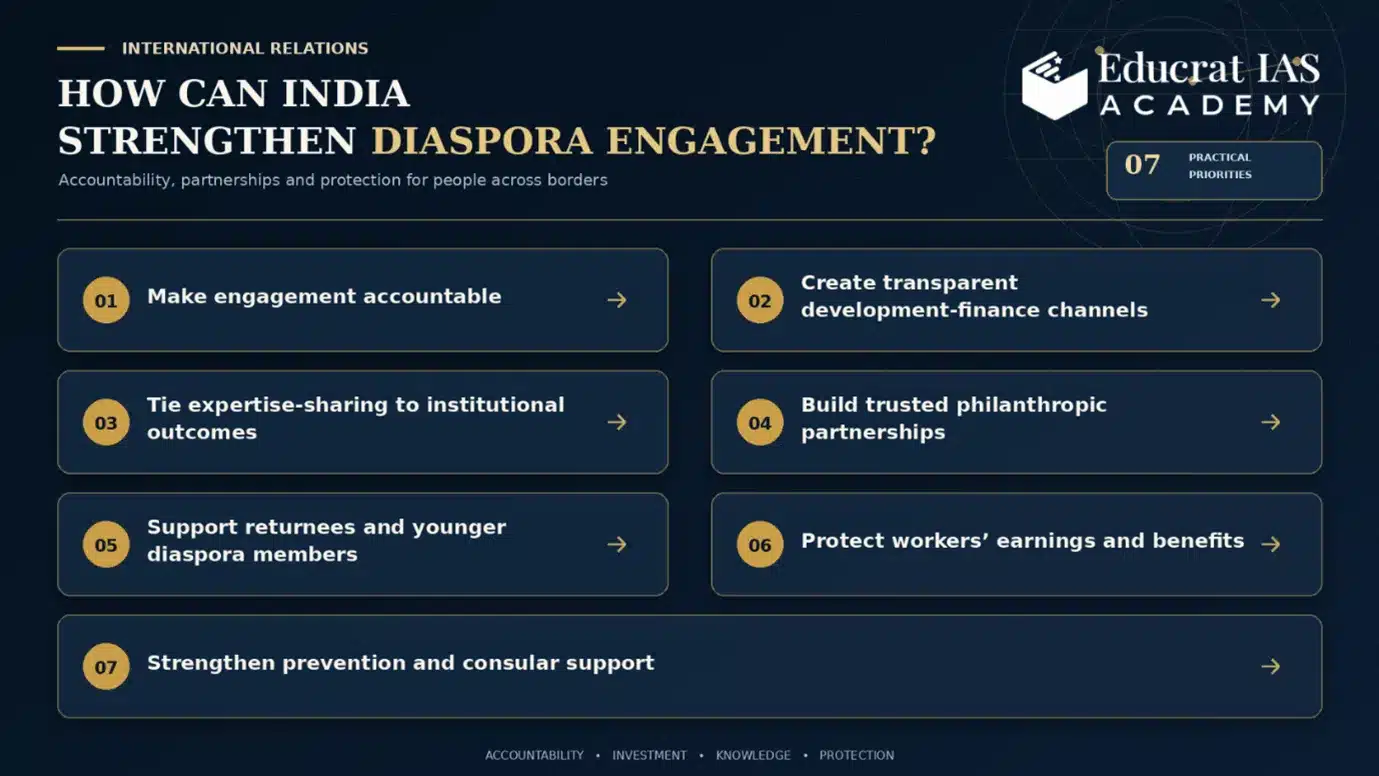
How Can India Strengthen Diaspora Engagement?
- Make engagement accountable: The MEA, DPIIT and state governments can designate a case officer for substantial diaspora investment, research and philanthropic proposals. Published service timelines, written explanations for delays and clear escalation channels would make engagement easier to navigate. Progress should be measured through completed projects, capital deployed and beneficiaries reached.
- Create transparent development-finance channels: Regulators, development-finance institutions and states can pilot professionally managed investment windows for viable projects such as cold chains, wastewater recycling and distributed renewable energy. Ring-fenced accounts, milestone-based disbursement and public reporting would help investors understand how funds are used.
- Tie expertise-sharing to institutional outcomes: Universities and research agencies should offer fractional appointments and challenge-based partnerships. Each assignment should have an Indian institutional counterpart, agreed intellectual-property terms, training responsibilities and a measurable deliverable. A visiting materials scientist, for example, could help validate a battery-recycling process while training local researchers to operate it independently.
- Build trusted philanthropic partnerships: States and credible intermediaries can connect diaspora donors with district priorities and verified local organisations. Shared due diligence, audited accounts and independent outcome assessments can build trust. Multi-year commitments and matching support can help projects serve underserved areas.
- Support returnees and younger diaspora members: State skill missions can assess returnees’ experience and connect them with employers, technical institutes and enterprises. Experienced returnees could take paid master-trainer roles with ITIs and MSMEs. Universities, cultural institutions, startups and nonprofits can also offer paid project placements for second- and third-generation overseas Indians, building lasting professional relationships.
- Protect workers’ earnings and benefits: India can negotiate practical arrangements with priority destination countries to help workers pursue unpaid-wage claims, obtain employment records and access eligible social-security benefits after returning home. Missions can maintain consent-based digital case files and work with authorised local partners to support continuing claims.
- Strengthen prevention and consular support: Migrant workers and students need accessible information before departure on recruitment channels, contracts, course requirements, local laws and emergency contacts. Missions should coordinate with host-country authorities, community organisations and legal-aid partners, while improving support for trafficking survivors, prisoners and people displaced by conflict.
Data Compilation: Indian Diaspora and India’s Global Influence
| Indicator | Data | What it shows |
| Overseas Indian population | 35.4 million: 15.9 million NRIs and 19.6 million PIOs | The scale and reach of India’s diaspora network. |
| Indian migrants overseas | 18.5 million | UN DESA identifies India as the world’s largest migrant-origin country. |
| Remittances received by India | USD 150.7 billion in 2025 | The diaspora’s contribution to household incomes and India’s external financial flows. |
| Major remittance corridors | The US, UK, Singapore, Canada and Australia supplied more than half of inward remittances | Remittances are closely linked to high-income professional and migration corridors. |
| Indian students abroad | 363,019 in the US in 2024–25; 59,419 in Germany in winter 2024–25 | Student mobility strengthens education, research and professional networks. |
| Indian-origin founders of US unicorns | 96 companies, as of April 2026 | Diaspora entrepreneurs contribute to innovation, enterprise creation and global markets. |
| Remittances to Kerala | ₹2,16,893 crore in 2023, up from ₹85,092 crore in 2018 | Migration can support regional development and household resilience. |
| Deep-tech investment commitments | USD 1 billion announced by the India Deep Tech Investment Alliance | Diaspora-linked capital can support sectors such as semiconductors, quantum technologies and biotechnology. |
| Indian nationals in the Gulf | About 4.33 million in the UAE and 2.75 million in Saudi Arabia | Indian workers are deeply integrated into Gulf labour markets and economies. |
| VAIBHAV fellows | 17 selected under the 2024 call; funding disbursed to 16 eligible fellows | Overseas expertise can support Indian research through collaboration and short-term visits. |
| NRI arrivals in India | 11.07 million in 2025, up 4.26% from 2024 | Diaspora visits support tourism and local service economies. |
| Indians evacuated under Operation Sindhu | 4,415 from Iran and Israel in June 2025 | Crisis response and consular protection are important dimensions of diaspora policy. |
Sources cited in the editorial include the MEA, UN DESA, World Bank, RBI, Open Doors, DAAD, the National Foundation for American Policy, the Kerala Development Report, and the Ministry of Tourism.
Why Is the Indian Diaspora Important for UPSC?
The diaspora connects several recurring UPSC themes: migration, globalisation, India’s foreign relations, inclusive development, human rights and soft power. It is relevant across GS Paper I, GS Paper II, GS Paper III and the Essay paper.
- GS Paper I — Effects of globalisation on Indian society: Diaspora communities illustrate how migration reshapes identities, family structures, cultural exchange and social ties across borders.
- GS Paper II — International relations: The diaspora can deepen India’s relationships with host countries through business, public advocacy, cultural links and professional networks. At the same time, political polarisation or community tensions may create diplomatic friction.
- GS Paper II — Government policies and interventions: Issues such as consular protection, labour rights, recruitment fraud, student welfare and support during conflict highlight the role of institutions and overseas missions.
- GS Paper III — Indian economy: Remittances, diaspora investment, entrepreneurship, exports and tourism connect migration with household welfare, external financial flows, employment and technological development.
- GS Paper III — Science and technology: Programmes such as VAIBHAV show how overseas scientists can contribute to Indian research through collaboration, mentoring and knowledge transfer.
- GS Paper IV — Ethics and governance: The topic raises questions of accountability, fairness, protection of vulnerable migrants, responsible philanthropy and the ethical conduct of recruitment agencies and employers.
- Essay and answer writing: The diaspora provides examples for themes such as brain drain and brain circulation, globalisation and identity, soft power, migration and development, and India’s rise in a multipolar world.
For Mains answers, present the diaspora as both an opportunity and a governance responsibility. Link its contributions to specific evidence, acknowledge the risks faced by overseas Indians, and conclude with practical measures such as transparent investment channels, institutional research partnerships and stronger consular support.
Mains Practise Question
The Indian diaspora can transform brain drain into brain gain through knowledge transfer, investment and institutional partnerships. Discuss.
Conclusion
The Indian diaspora can advance India’s development and global standing through remittances, entrepreneurship, research, philanthropy, tourism and cultural exchange. Its contribution is strongest when engagement is built on trust, clear institutions and respect for the diaspora’s diversity.
India’s task is to turn diaspora goodwill into lasting partnerships while protecting the people who sustain those links. With transparent channels for investment, structured knowledge-sharing and stronger consular support, brain drain can increasingly become brain circulation—and India’s global connections can deliver broader public value.
Prepare for the Final Stage with EDUCRAT IAS ACADEMY
Qualified for the UPSC CSE Interview? Take the next step with the Vyaktitva UPSC Interview Guidance Program at EDUCRAT IAS ACADEMY.
Get DAF-focused guidance, mock interview practice and constructive feedback as you prepare for the board.
For registration and details, contact: 1800 4120 0587
EDUCRAT IAS ACADEMY — Your Dream. Our Guidance.