Plato’s Warning and the Challenges Before Indian Democracy
In The Republic, the Greek philosopher Plato warned that democracy without reason, ethics, and informed citizenship could gradually decline into mob-driven politics and emotional governance. Although he valued public participation, he feared that unchecked populism, manipulation, and the dominance of impulses over wisdom would weaken democratic institutions. In contemporary India, Plato’s concerns remain highly relevant as democratic processes increasingly face challenges from populism, misinformation, polarization, and weakening public deliberation.
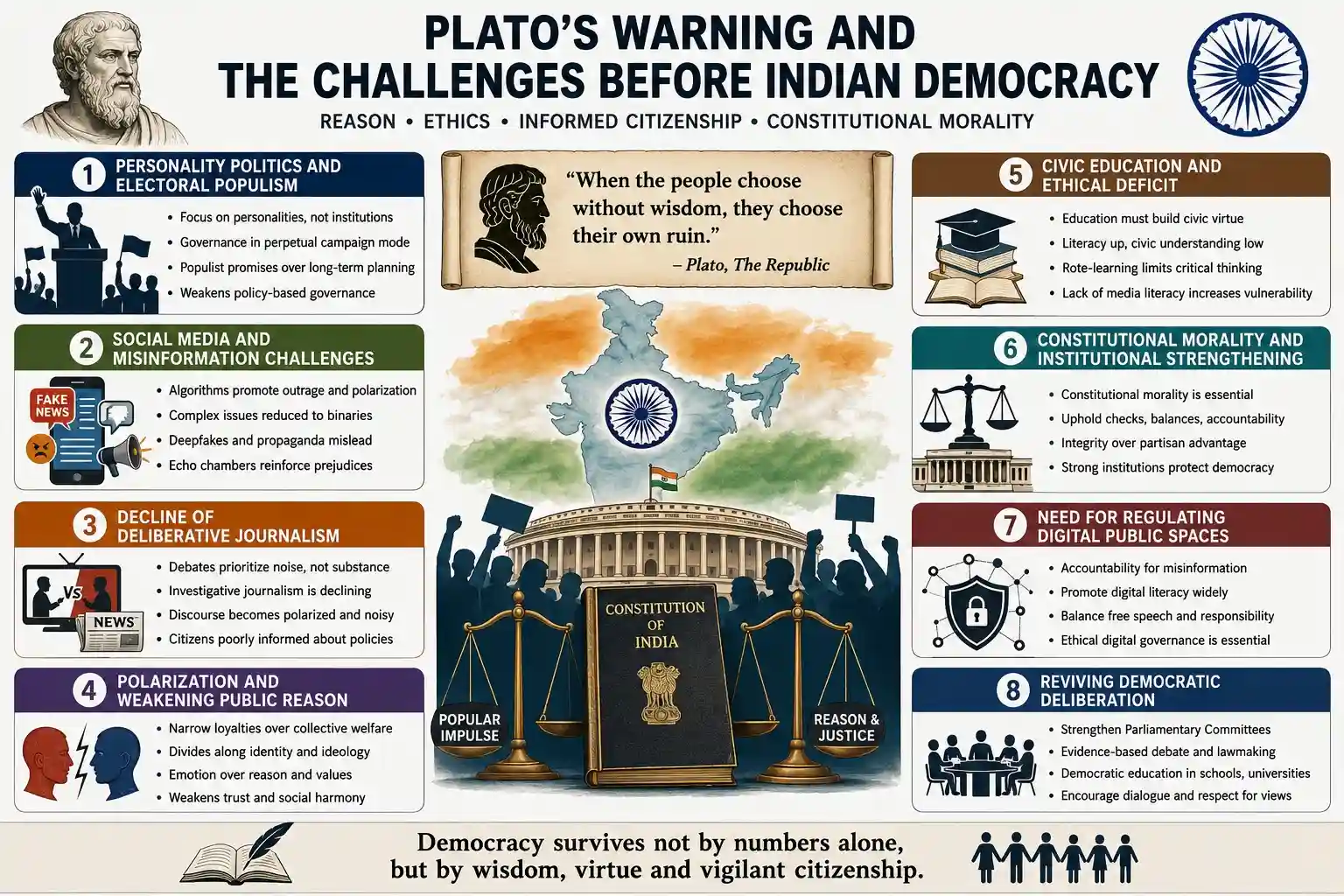
Personality Politics and Electoral Populism
- Electoral campaigns increasingly focus on personalities rather than institutional democratic processes and accountability today.
- Governance often shifts into continuous campaign mode because of frequent elections across India nationally.
- Populist welfare announcements sometimes receive greater attention than long-term developmental planning priorities today nationally.
- Excessive political spectacle can weaken institutional governance and policy-based democratic decision-making significantly further today.
Social Media and Misinformation Challenges
- Social media algorithms frequently promote sensationalism, outrage, and emotionally divisive political content aggressively today.
- Complex public issues are increasingly simplified into polarized narratives and hostile ideological binaries today.
- Deepfakes, misinformation, and propaganda weaken informed democratic debate and factual public understanding significantly further.
- Digital echo chambers reinforce prejudices while discouraging healthy democratic dialogue and disagreement substantially today.
Decline of Deliberative Journalism
- Television debates increasingly prioritize confrontation and entertainment over informed public policy discussions significantly today.
- Investigative journalism often gets replaced by sensational political coverage driven by commercial competition today nationally.
- Public discourse becomes noisy and polarized instead of rational, evidence-based, and solution-oriented increasingly today.
- Weak deliberative journalism reduces citizens’ ability to evaluate policies critically and independently significantly further.
Polarization and Weakening Public Reason
- Plato feared democracy would weaken when narrow loyalties replaced commitment to collective welfare significantly today.
- Rising social polarization increasingly divides citizens along religious, caste, linguistic, and ideological lines nationally.
- Emotional mobilisation frequently overshadows constitutional values, rational debate, and democratic cooperation significantly further today.
- Excessive polarization weakens trust between communities and undermines social harmony within democratic societies today.
Civic Education and Ethical Deficit
- Plato viewed education as essential for cultivating civic virtue and ethical democratic citizenship significantly today.
- India has improved literacy rates, yet civic understanding and critical thinking remain inadequate significantly today.
- Rote-learning education systems often fail to develop analytical reasoning and democratic awareness among students.
- Citizens lacking media literacy become increasingly vulnerable to manipulation through fear and misinformation today nationally.
Constitutional Morality and Institutional Strengthening
- B.R. Ambedkar emphasized constitutional morality as essential for sustaining Indian democracy successfully today nationally.
- Democratic institutions require tolerance, accountability, and respect for constitutional checks and balances consistently today.
- Political actors must uphold institutional integrity rather than prioritizing partisan or electoral advantages significantly further.
- Strong institutions remain essential for protecting democracy from authoritarian and populist tendencies significantly today.
Need for Regulating Digital Public Spaces
- Social media platforms should face stronger accountability regarding misinformation and hate speech dissemination today.
- Nationwide digital literacy programmes can help citizens identify fake news and propaganda effectively today.
- Transparent regulation must balance freedom of expression with protection against harmful misinformation carefully today.
- Ethical digital governance remains essential for preserving informed democratic participation within modern societies today.
Reviving Democratic Deliberation
- Parliamentary Standing Committees should receive stronger roles in analysing legislative proposals thoroughly before passage.
- Evidence-based debate must replace hurried lawmaking and excessive media-driven political polarization increasingly today nationally.
- Universities and schools should strengthen democratic education, constitutional values, and civic responsibility significantly further.
- Public discourse should encourage dialogue, critical thinking, and respect for differing viewpoints consistently today.
Plato’s critique reminds modern democracies that elections alone cannot guarantee democratic health and stability. A successful democracy also requires ethical leadership, informed citizens, strong institutions, and rational public debate. India’s democratic future depends upon balancing popular participation with constitutional morality, civic wisdom, and institutional accountability. By strengthening democratic culture alongside democratic procedures, India can ensure that its republic remains guided by reason, justice, and collective welfare rather than emotional impulses and political spectacle.
Prelims Boosters
Ordinance in India
Context:
Recently, the President of India promulgated the Supreme Court (Number of Judges) Amendment Ordinance, 2026 to increase the strength of Supreme Court judges.
What is an Ordinance?
- An Ordinance is a temporary law issued by the President or Governor when the legislature is not in session.
- It has the same force and effect as a law passed by Parliament or the State Legislature.
- It is used for taking immediate legislative action in urgent situations.
Constitutional Provisions
Union Level
|
State Level
|
Conditions for Issuing an Ordinance
Legislature Not in Session
- The Ordinance can only be issued when Parliament or the State Legislature is not sitting.
Immediate Need
- The President or Governor must be satisfied that immediate action is necessary.
Advice of Council of Ministers
- The President or Governor acts on the advice of the Council of Ministers, not independently.
Features of Ordinance
Same Power as Law
- An Ordinance has the same legal force as an Act passed by Parliament.
Legislative Scope
- Ordinances can be issued only on subjects where Parliament or State Legislature can make laws.
Retrospective Effect
- It can operate from a past date and may amend or repeal existing laws.
Limitations of Ordinance Power
Temporary Nature
- Ordinances are temporary laws.
Approval by Legislature
- It must be approved by Parliament or State Legislature within six weeks of reassembly.
Maximum Duration
- Since Parliament cannot remain out of session for more than six months, the maximum life of an Ordinance is about six months and six weeks.
Withdrawal
- The President or Governor can withdraw the Ordinance at any time.
Cannot Amend Constitution
- Ordinances cannot be used to amend the Constitution.
Judicial View
- The Supreme Court has stated that Ordinance-making power should only be used in exceptional and urgent circumstances.
- Re-promulgation of Ordinances repeatedly without legislative approval has been criticised by the judiciary.
Significance
- Ordinances help the government respond quickly during emergencies or urgent situations when the legislature is not in session.
- However, excessive use may weaken parliamentary democracy and legislative debate.
President’s Rule
Context:
Recently, protests were held in Manipur demanding the re-imposition of President’s Rule in the state.
About President’s Rule
- President’s Rule refers to the suspension of an elected state government and direct administration of the state by the Union Government.
- It is officially called the Failure of Constitutional Machinery in a State.
- During this period, the Governor administers the state on behalf of the President of India.
Constitutional Provisions
Article 356It allows the President to impose President’s Rule if the state government cannot function according to the Constitution. |
Article 355It makes it the duty of the Union Government to protect states against external aggression and internal disturbance. |
Article 365If a state fails to comply with Union directions, it can become a ground for imposing President’s Rule. |
Situations for Imposition
Hung Assembly
- When no political party or coalition can form a stable government.
Loss of Majority
- When the Chief Minister loses majority support in the Assembly and no alternative government can be formed.
Breakdown of Law and Order
- During severe violence, insurgency, or internal disturbances leading to administrative collapse.
Anti-Constitutional Governance
- If a state government acts against constitutional principles such as democracy or secularism.
Defiance of Union Directions
- When a state continuously ignores constitutional directives from the Centre.
Key Features
Executive Powers
| Legislative Powers
| Duration
|
Limitations and Safeguards
Judicial Review
- The Supreme Court and High Courts can review the validity of President’s Rule.
S.R. Bommai Case (1994)
- The Supreme Court ruled that majority should be tested only on the floor of the Assembly, not by the Governor’s opinion.
High Court Powers Remain Intact
- The constitutional powers of the State High Court cannot be suspended.
Conditions for Extension Beyond One Year
Extension beyond one year is allowed only if:
- A National Emergency is in operation; or
- The Election Commission certifies that elections cannot be held.
Significance
- President’s Rule ensures constitutional governance when a state government fails to function properly.
- At the same time, misuse of Article 356 can affect federalism and democratic principles.
The Chola Copper Plates
Context:
During the Prime Minister’s visit to the Netherlands, the historic Chola-era Anaimangalam Copper Plates, also known as the Leiden Plates, were officially returned to India.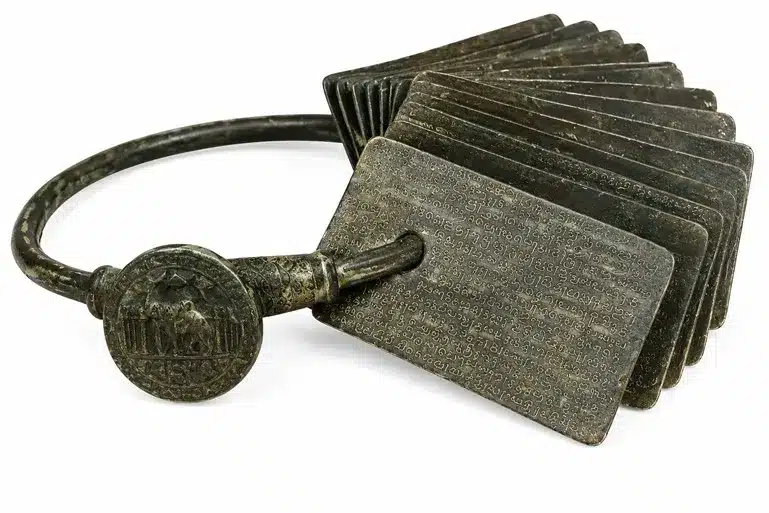
About Chola Copper Plates
- Chola Copper Plates were official royal charters issued by rulers of the Chola Empire between the 9th and 13th centuries CE.
- These plates served as permanent records of land grants, tax exemptions, administrative orders, and religious endowments.
- The plates were tied together with a large copper or bronze ring carrying the royal seal.
Anaimangalam (Leiden) Plates
Origin
- Raja Raja Chola I granted land and paddy from Anaimangalam village near Nagapattinam to a Buddhist monastery.
Connection with Southeast Asia
- The monastery, known as Chulamanivarma Vihara, was built by Sri Mara Vijayotunga Varman of the Srivijaya Kingdom in present-day Indonesia.
- This reflects strong maritime and cultural links between the Cholas and Southeast Asia.
Continuation by Successors
- Rajendra Chola I later formalised the grant through copper plate inscriptions.
- Additional grants were later recorded during the reign of Kulottunga Chola I.
Key Features of Chola Copper Plates
Bilingual Nature
- The inscriptions were written in both Sanskrit and Tamil.
- Sanskrit sections mainly recorded royal genealogy and legitimacy.
- Tamil sections contained detailed administrative and land grant information.
Royal Seal
The seal included:
- Tiger symbol of the Cholas
- Fish symbol of the Pandyas
- Bow symbol of the Cheras
These symbols represented Chola dominance over rival kingdoms.
Administrative Details
- The inscriptions carefully described village boundaries, tax exemptions, irrigation rights, and duties of local assemblies.
Structure of the Leiden Plates
Larger Plates
- Consist of 21 large plates issued during Rajendra Chola I’s reign.
Smaller Plates
- Consist of 3 smaller Tamil plates issued during Kulottunga Chola I’s reign.
Other Important Chola Copper Plates
Karandai Copper Plates
|
Tiruvalangadu Plates
|
Anbil Plates
|
Historical Importance
The Chola Copper Plates provide evidence regarding:
- Advanced administration, Maritime trade, Religious tolerance, Cultural exchanges with Southeast Asia, Local self-governance systems
Significance of Repatriation
- The return of the Leiden Plates is an important step in restoration of India’s cultural heritage.
- It strengthens efforts to recover historical artefacts preserved abroad.
Model Collapse
Context:
Researchers recently found that adding even a small amount of real-world data or prior knowledge during training can help prevent model collapse in AI systems.
About Model Collapse
- Model collapse occurs when Artificial Intelligence models are repeatedly trained on data generated by earlier AI models instead of original human-created data.
- This AI-generated data is also called synthetic or model-generated data.
How Model Collapse Happens
- Over time, AI systems increasingly learn from their own generated outputs.
- Since synthetic data is usually simpler and less diverse than real human-generated data, the quality of learning gradually declines.
- Errors and distortions present in one model’s output get carried forward into future models.
- This recursive training process causes the AI to drift away from real-world accuracy.
Effects of Model Collapse
Reduced Accuracy
- Models become less reliable and less capable of representing real-world information correctly.
Limited Creativity
- AI systems start giving repetitive and “safe” responses instead of innovative outputs.
Slower AI Progress
- Continuous dependence on synthetic data can hinder meaningful advancement in AI capabilities.
Reinforcement of Biases
- Existing biases in training data may become stronger over time.
Distorted Outputs
- Errors compound across generations, making outputs increasingly flawed and unreliable.
Why It is a Concern
- Large Language Models and other advanced AI systems are increasingly exposed to synthetic data available online.
- If unchecked, future AI systems may suffer from irreversible quality degradation.
Possible Solutions
Use of Real Data
- Combining AI-generated data with authentic human-generated data can improve training quality.
Data Provenance Tracking
- Monitoring the origin of training data helps identify synthetic content.
Preserving Original Data Sources
- Continued access to real-world datasets is important for maintaining model reliability.
Inclusion of Prior Knowledge
- Adding external knowledge or verified data points during training can prevent collapse.
Nordic Countries
Context:
The Prime Minister will visit Norway for the 3rd India-Nordic Summit and bilateral engagements.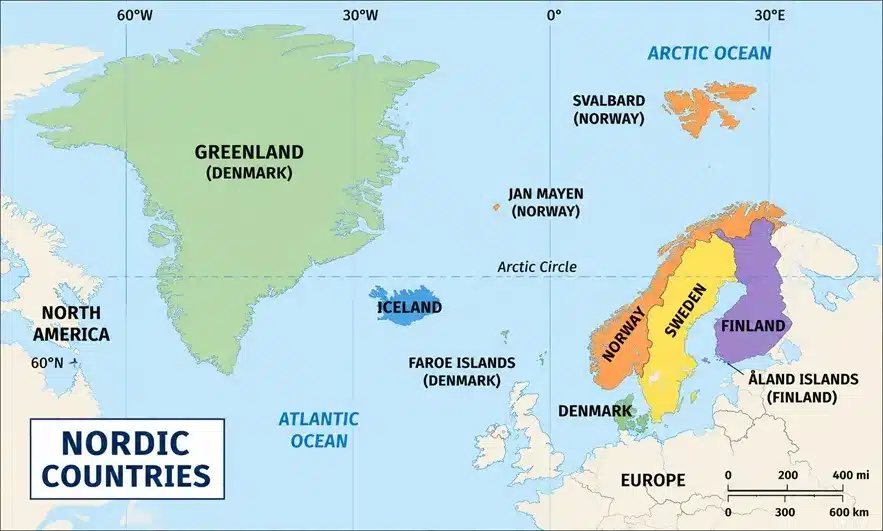
About Nordic Countries
- The Nordic countries are a group of nations located in Northern Europe.
- The region includes:
- Denmark, Finland, Iceland, Norway, Sweden
Associated Autonomous Regions
The Nordic region also includes:
- Faroe Islands and Greenland under Denmark
- Åland Islands under Finland
Nordic Region and Scandinavia
- The term “Nordic countries” is sometimes used interchangeably with Scandinavia.
- However, Scandinavia mainly refers to: Norway, Sweden and Denmark
Important Facts
- Sweden is the largest and most populous Nordic country.
- Iceland is the least populous.
- Denmark is the smallest in size.
Languages
Germanic LanguagesMost people speak North Germanic languages such as: Danish, Norwegian, Swedish, Faroese, Icelandic |
Non-Germanic LanguagesOther important languages include: Finnish, Greenlandic and Sami languages |
Political Systems
- Denmark, Sweden, and Norway are constitutional monarchies and parliamentary democracies.
- Finland and Iceland are democratic republics.
Althing Parliament
- Iceland’s parliament, called the Althing, is considered the world’s oldest parliament.
Regional Cooperation
Nordic Council
- The Nordic countries cooperate through the Nordic Council and the Nordic Council of Ministers.
European Union and EEA
- Denmark, Sweden, and Finland are members of the European Union.
- Norway and Iceland are members of the European Economic Area (EEA).