
Left Wing Extremism: Maoists are “more or less wiped out”
Understanding Left Wing Extremism (LWE)
- Definition: LWE refers to extremist movements inspired by Maoist ideology aiming to overthrow the state through armed struggle.
- Core Areas: Concentrated in tribal and forest regions (earlier called the “Red Corridor”)
- Root Causes: Underdevelopment, lack of governance, land alienation, and tribal exploitation
Recent Achievements in LWE Control
- Focus on security operations & development measures
- Improved state presence in remote areas
- Significant weakening of Maoist organisational structure
Importance of Controlling LWE
- Internal Security: LWE has been one of India’s biggest internal security threats
- Development of Tribal Areas: Ensures access to roads, schools, healthcare
- National Integration: Brings remote regions into mainstream governance
- Investment Climate: Stability encourages economic activity in mineral-rich regions
Government Strategy (Integrated Approach)
- Security Measures: Increased deployment of Central Armed Police Forces (CAPFs)
- Development Initiatives: Roads, ration shops, schools in remote areas
- Administrative Reach: Expansion of governance in previously inaccessible areas
- Surrender Policy: Incentives for Maoists to join mainstream
Opposition Concerns and Ground Reality
Despite achievements, concerns remain:
- Premature Declaration: Claim of being “Naxal-free” may be overstated
- Residual Presence: Maoist ideology and networks may still exist underground
- Need for Vigilance: Security gains can reverse if attention declines
- Political Debate: Differences over credit and approach
Key Challenges
- Ideological Persistence: LWE is not just a law-and-order issue but also ideological
- Underdevelopment: Tribal regions still face poverty and lack of basic services
- Trust Deficit: Historical alienation between state and local communities
- Geographical Difficulty: Dense forests and remote terrain aid insurgents
Way Forward: Sustaining the Gains
- Development-Led Approach: Focus on education, health, and livelihoods in tribal areas
- Inclusive Governance: Strengthen participation of local communities
- Continued Security Vigilance: Prevent regrouping of Maoist elements
- Address Root Causes: Land rights, forest rights, and social justice
Clean Cooking Crisis: Limits of Welfare Design
India’s recent LPG crisis, triggered by global supply disruptions, has exposed structural weaknesses in its clean cooking policy. While schemes such as the Pradhan Mantri Ujjwala Yojana have significantly expanded access to LPG, they have not ensured continuity and reliability of supply. This raises important concerns regarding the effectiveness of welfare guarantees.
Understanding the LPG Welfare Model
The Pradhan Mantri Ujjwala Yojana was launched to provide LPG connections to poor households, especially women, with the objective of promoting clean cooking fuel and reducing dependence on traditional biomass.
- The scheme has provided more than ten crore connections and substantially increased LPG coverage in India.
- It has reduced indoor air pollution and improved health outcomes.
- It has also saved time for women, particularly in rural areas, by reducing the need to collect firewood.
However, the success of the scheme has been measured largely in terms of connections rather than sustained usage.
Structural Weakness in Policy Design
| Aspect | Earlier System (PDS Kerosene) | LPG System (PMUY) |
| Supply Nature | State-controlled | Market-dependent |
| Distribution | Physical stock through ration shops | Dependent on global supply chains |
| Reliability | Relatively stable | Vulnerable to disruptions |
Key Causes of the LPG Crisis
The present crisis can be attributed to multiple structural factors:
- India imports approximately sixty percent of its LPG consumption.
- Nearly ninety percent of these imports pass through the Strait of Hormuz, making supply vulnerable to geopolitical disruptions.
- While India maintains strategic petroleum reserves, there is no equivalent buffer for LPG.
- Disruptions in West Asia directly affect domestic supply and availability.
Gaps in Sovereign Responsibility
The welfare design focused on visible indicators such as connection distribution and subsidy transfer, but did not adequately address continuity of supply.
- The state gradually withdrew from direct supply responsibility.
- Physical stock management and supply assurance mechanisms were not strengthened.
- The system relies heavily on uninterrupted global supply chains.
As a result, when disruptions occur, the burden is transferred to households, undermining the idea of a welfare guarantee.
Socio-Economic Impact
The crisis has had significant socio-economic consequences:
- Rising LPG prices have made refilling cylinders unaffordable for many poor households.
- There are delays in delivery, especially in rural areas.
- Marginalised groups, including Scheduled Castes and Scheduled Tribes, have lower access and usage rates.
- Many households revert to biomass fuels such as firewood when LPG becomes inaccessible.
Gender Dimension
The impact of the crisis is particularly significant for women, who are the primary users of cooking fuel.
- Although women are formal beneficiaries of LPG connections, they often do not control supply or affordability.
- Studies indicate that a majority of women decide cooking practices, but are forced to shift back to traditional fuels when LPG becomes expensive or unavailable.
- This leads to increased physical burden and loss of welfare gains achieved through clean cooking initiatives.
Policy Issue: Access versus Continuity
The core issue lies in the distinction between access and sustained usage.
- Policy success has been measured in terms of the number of connections provided.
- However, access does not automatically ensure regular and affordable usage.
- A welfare scheme must guarantee continuity, especially during crises.
Key Challenges
- Excessive dependence on global markets for essential welfare goods.
- Absence of strategic reserves for LPG.
- Weak last-mile delivery systems in rural areas.
- Rising costs affecting affordability.
- Persistent social and regional inequalities in access.
Way Forward: Strengthening Welfare Design
- Establish a strategic LPG reserve to ensure supply during disruptions.
- Diversify import sources to reduce dependence on specific routes such as the Strait of Hormuz.
- Strengthen distribution networks, especially in rural and remote areas.
- Promote alternative energy sources such as community biogas systems under initiatives like GOBAR-Dhan.
- Redesign welfare policies to focus on reliability and continuity rather than mere access.
India’s transition to clean cooking has been an important welfare achievement, but it remains incomplete. A system that depends heavily on global markets without adequate safeguards cannot ensure continuity for vulnerable households. The focus must now shift from expanding access to ensuring reliable, affordable, and resilient delivery of clean cooking energy.
Prelims Boosters
Biotechnology Research and Innovation Council (BRIC)
Context:
- First meeting of BRIC–Research Advisory Board held at Regional Centre for Biotechnology
About BRIC
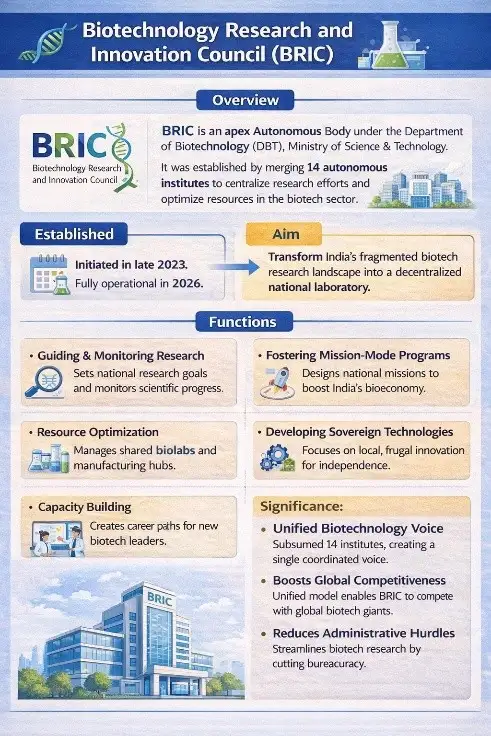
- BRIC is an apex autonomous body under the Department of Biotechnology (Ministry of Science & Technology).
- It is a registered society.
- Formed by merging 14 autonomous biotech institutes.
Objective
- To bring all biotech research under one coordinated system
- Create a decentralised national laboratory network (many institutes working together)
Key Functions
- Research Oversight: Guides and monitors research through RAB
- Mission Projects: Runs national-level biotech programmes (health, agriculture, etc.)
- Resource Sharing: Promotes shared labs and infrastructure
- Indigenous Tech: Focus on self-reliance and local innovation
- Capacity Building: Develops skilled scientists
Significance
- Reduces fragmentation in biotech research
- Improves efficiency and coordination
- Boosts India’s bioeconomy and global competitiveness
Baltic Sea
Context:
- A research expedition is mapping World War II munitions and shipwrecks on the Baltic Sea floor
About
- The Baltic Sea is a semi enclosed, brackish inland sea in Northern Europe
- It is one of the largest brackish water bodies in the world
- It is important for trade, energy transport, and communication networks
Location
- Lies between the Scandinavian Peninsula, mainland Europe, and Danish islands
- Connected to the North Sea through the Kattegat and Skagerrak straits
Bordering countries:
Key Features
- It is a shallow sea with an average depth of about 55 metres
- It has very slow water renewal, taking nearly 30 years
- Water is brackish due to mixing of river water and limited seawater
- It has low biodiversity, making it highly sensitive to disturbances
- It faces heavy human pressure from shipping, pipelines, cables, and wind farms
Environmental Concerns
- World War II ammunition releases toxic chemicals such as TNT and mercury
- These chemicals enter the food chain and affect marine life and humans
- Sunken ships carrying oil may cause long term pollution
- Slow water circulation leads to long lasting environmental damage
Denotified, Nomadic and Semi-Nomadic Tribes (DNTs)
About DNTs
- Denotified Tribes (DNTs):
- Communities earlier notified as “criminal tribes” under the Criminal Tribes Acts (1871 to 1947) during British rule
- Following the repeal of the Act in 1952, these communities were denotified
- Nomadic Tribes:
- Communities that migrate from place to place for livelihood and generally lack permanent settlement
- Semi-Nomadic Tribes:
- Communities that combine periodic mobility with partial settlement
- These groups constitute some of the most marginalised and socio-economically disadvantaged sections of society
- Historically, they lacked access to private land and housing, relying on forests and common grazing lands
Status in India
- Approximately 10 percent of India’s population is estimated to belong to these communities
- Around 1235 communities have been identified
Commissions and Committees
- Renke Commission (2008): First comprehensive attempt to identify DNTs
- National Commission for DNTs (2014):
- Chaired by Bhiku Ramji Idate
- Submitted its report in 2018
- Recommended state-wise identification and welfare measures
Institutional Framework
- Development and Welfare Board for Denotified, Nomadic and Semi-Nomadic Communities (2019):
- Established under the Ministry of Social Justice and Empowerment
- Mandated to formulate and implement welfare and development programmes
Scheme for Economic Empowerment of DNTs (SEED)
- Launched by the Ministry of Social Justice and Empowerment
- Implemented through the Development and Welfare Board
Key Features
- Target beneficiaries: Families with annual income up to 2.5 lakh rupees
- Provides:
- Free coaching for competitive examinations
- Health insurance coverage
- Financial assistance for housing
- Livelihood support initiatives
- Financial allocation: 200 crore rupees for five years from 2021 to 2026
Competition Commission of India (CCI)
About
- The Competition Commission of India (CCI) is a statutory body established under the Competition Act, 2002
- It functions under the Ministry of Corporate Affairs
- Established in 2003 and became operational in 2009
- It replaced the Monopolies and Restrictive Trade Practices (MRTP) Act, 1969
Objective
- To ensure fair competition in the market
- To prevent unfair trade practices
- To protect consumer interests and ensure freedom of trade
Key Functions
- Prevents anti-competitive agreements such as price fixing and collusion
- Checks abuse of dominant position by large companies
- Regulates mergers and acquisitions to avoid monopoly formation
- Conducts investigations and imposes penalties on violators
- Provides advisory support to the government on competition-related matters
Composition
- Consists of a Chairperson and up to 6 members
- Appointed by the Central Government
- Members must have at least 15 years of experience in relevant fields such as law, economics, or finance
Important Provisions of the Competition Act, 2002
- Section 3: Prohibits anti-competitive agreements
- Section 4: Deals with abuse of dominant position
- Sections 5 and 6: Regulate mergers and acquisitions
- Section 19: Empowers the Commission to conduct inquiries
Recent Update
- Competition (Amendment) Act, 2023:
- Strengthens regulation of digital markets
- Introduces faster approval process for mergers
- Increases penalties for violations
OPU–IVF–ET Technology
Context:
- Scientists at Indian Veterinary Research Institute produced five Sahiwal calves from a single donor cow
What is OPU–IVF–ET?
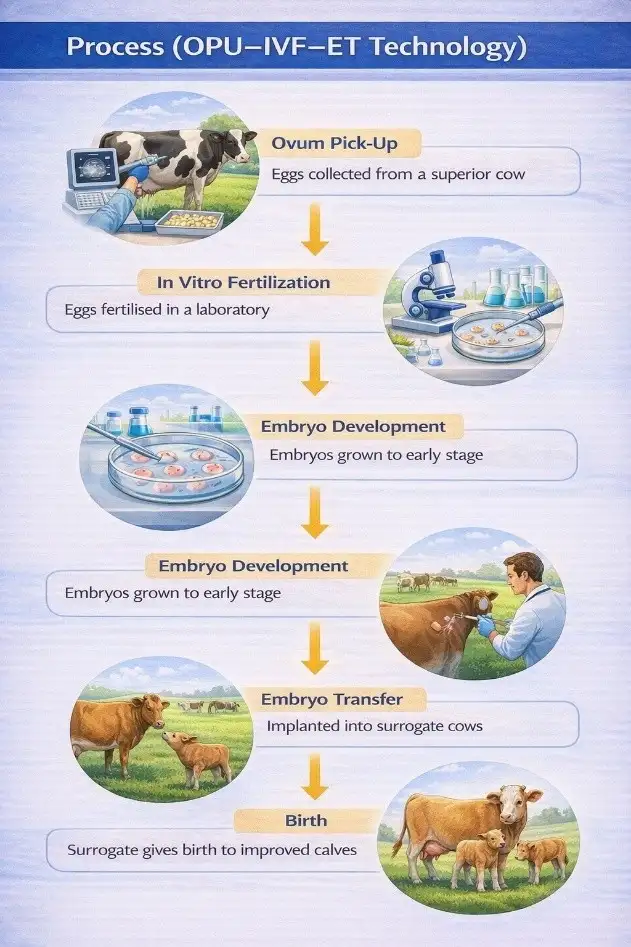
- It is an advanced reproductive technology in livestock
- Full form: Ovum Pick-Up, In Vitro Fertilization, Embryo Transfer
- It involves: Collecting eggs from a superior cow. Then, fertilising them in a laboratory and then transferring embryos into surrogate cows
Objective
- To rapidly improve the genetic quality of livestock
- To increase milk production and productivity
Key Features
- Enables multiple offspring from one superior cow
- Does not require heavy hormone use
- Embryos can be stored and transported
- Helps in fast genetic improvement
Sahiwal Cow
- One of the best indigenous dairy breeds of India
- Origin: Punjab region (India and Pakistan)
- Found mainly in Punjab, Haryana, Rajasthan
Characteristics
- High milk yield among indigenous breeds
- Heat tolerant and disease resistant
- Reddish-brown colour with loose skin and hump
- Milk is rich in A2 protein (considered easier to digest)
Prelims MCQ
Q1. With reference to Biotechnology Research and Innovation Council (BRIC), consider the following statements:
- BRIC is a statutory body under the Ministry of Science & Technology.
- It has been formed by merging multiple autonomous biotechnology institutes.
- It aims to create a centralized laboratory system under one single institute.
Which of the statements given above is/are correct?
(a) 1 and 2 only
(b) 2 only
(c) 2 and 3 only
(d) 1, 2 and 3
Q2. With reference to the Baltic Sea, consider the following statements:
- It is a fully enclosed freshwater sea in Northern Europe.
- It is one of the largest brackish water bodies in the world.
- It is connected to the North Sea through the Kattegat and Skagerrak straits.
Which of the statements given above is/are correct?
(a) 2 and 3 only
(b) 1 and 2 only
(c) 3 only
(d) 1, 2 and 3
Q3. With reference to Denotified Tribes (DNTs), consider the following statements:
- They were earlier classified as “criminal tribes” under British rule.
- They were denotified after the repeal of the Criminal Tribes Act in 1952.
- They are currently classified uniformly under Scheduled Tribes across India.
Which of the statements given above is/are correct?
(a) 1 and 2 only
(b) 2 only
(c) 1 and 3 only
(d) 1, 2 and 3
Q4. With reference to the Competition Commission of India (CCI), consider the following statements:
- It is a statutory body established under the Competition Act, 2002.
- It functions under the Ministry of Finance.
- It became operational in 2009.
Which of the statements given above is/are correct?
(a) 1 and 3 only
(b) 1 and 2 only
(c) 2 and 3 only
(d) 1, 2 and 3
Q5. With reference to the Sahiwal breed of cattle, consider the following statements:
- It is an exotic breed introduced from Europe.
- It is known for high milk yield among indigenous breeds.
- It is highly heat tolerant and disease resistant.
Which of the statements given above is/are correct?
(a) 2 and 3 only
(b) 1 and 2 only
(c) 1 only
(d) 1, 2 and 3


2 Responses
1. b
2. a
3. a
4. a
5. a
1. B
2. A
3. A
4. A
5. A