Thermal Cost of India’s Textile Surge: A Structural Challenge
India’s textile industry is a key pillar of economy, employment, and exports. However, it is increasingly facing a structural challenge from climate-induced heat stress. This affects productivity, worker health, and long-term sustainability of the sector. The issue highlights the need to integrate climate considerations into industrial policy.
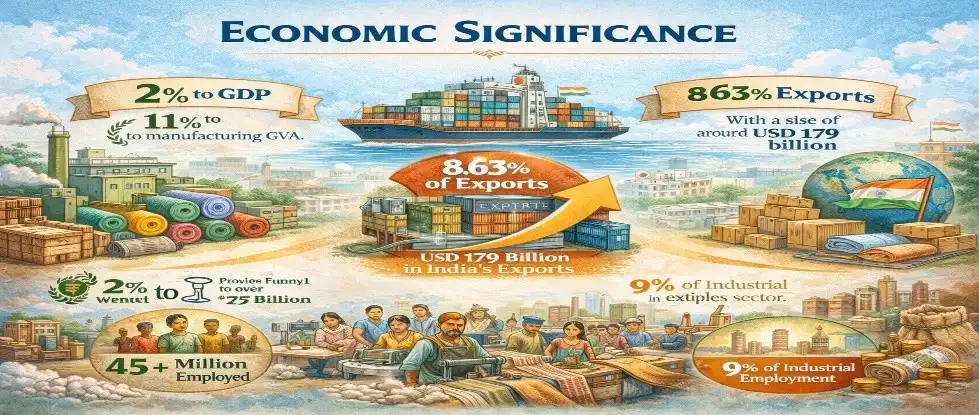
Overview of India’s Textile Industry
- The industry is diverse and vertically integrated, from cotton cultivation to garment exports.
- It connects agriculture with manufacturing, especially in rural and semi-urban areas.
- It has a strong presence of both organised (mills) and unorganised (handlooms, MSMEs) sectors.
- The dual structure creates efficiency gaps and policy challenges.
India in Global Textile Value Chain
- India benefits from China+1 strategy and global supply chain diversification.
- Strong export markets include USA, European Union, and Middle East.
- However, global markets impose strict deadlines and price pressures.
- Indian MSMEs often face low bargaining power in global supply chains.
Core Issue: Heat Stress as a Structural Constraint
Worker-Level Impact
- At around 40°C temperature, productivity can fall by nearly 50 percent.
- Workers face heatstroke, dehydration, and wage losses due to reduced working hours.
Macro-Level Impact
- India lost about 259 billion labour hours annually (2001–2020) due to heat stress.
- In 2024 alone, around 247 billion labour hours were lost.
- Output declines by nearly 2 percent for every 1°C rise in temperature.
Factory-Level Impact
- Production capacity may fall by up to 50 percent during extreme heat conditions.
- Increased risks of health emergencies and operational disruptions.
Future Projection
- By 2030, India may lose 5.8 percent of daily working hours.
- This is equivalent to loss of around 34 million full-time jobs.
Additional Structural Challenges
|
Supply Chain Trap
|
Government Initiatives
- Policy support through Ministry of Textiles schemes and export promotion measures.
- Development of textile parks, clusters, and MSME support systems.
- Skill development programmes for labour-intensive sectors.
- Energy efficiency initiatives through Bureau of Energy Efficiency (BEE).
Way Forward: Climate-Smart Industrialisation
Policy Measures
- Recognise heat stress as a major industrial and supply chain risk.
- Integrate climate projections into trade and industrial policy frameworks.
Workplace Reforms
- Introduce mandatory heat-action plans and cooling infrastructure.
- Ensure access to water, rest breaks, and health monitoring systems.
Financial Measures
- Promote climate-linked credit and subsidies for cooling technologies.
- Encourage investment in energy-efficient production systems.
Labour Protection
- Strengthen legal safeguards for worker safety under extreme heat conditions.
- Extend social security coverage to informal workers.
Innovation
- Invest in heat-resilient cotton, wearable cooling technologies, and efficient machinery.
Global Responsibility
- International brands should ensure fair pricing and flexible delivery timelines.
Heat stress is not just a climate issue but a structural economic challenge for textiles. The sector must shift from a low-cost labour model to a climate-resilient system. Sustainable growth requires balancing productivity, worker welfare, and environmental realities. India’s ability to adapt will determine its position as a global textile manufacturing hub.
Womaniya Initiative: Building Inclusive Market Access for Women Entrepreneurs
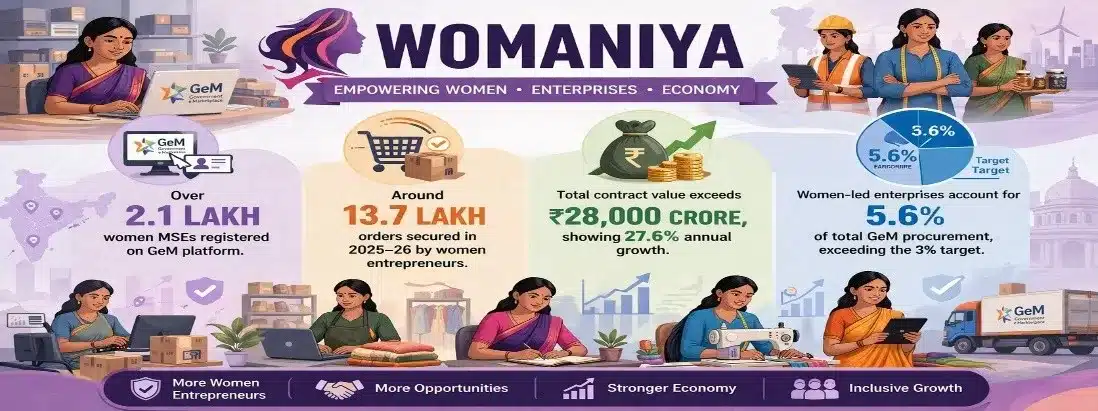
The Womaniya initiative on Government e-Marketplace (GeM) aims to enhance market access for women entrepreneurs. It reflects a shift from welfare to economic empowerment and formal market participation. Recently, it enabled over 2.1 lakh women entrepreneurs to secure orders worth ₹28,000 crore. The initiative is important for inclusive growth and gender-responsive economic development.
What is Womaniya?
- Launched in 2019 under Ministry of Commerce and Industry as part of GeM platform.
- It provides a dedicated digital interface for women-led MSEs and Self Help Groups (SHGs).
- Enables listing of products such as handicrafts, handloom, and office supplies.
- Facilitates direct procurement by Central Ministries, State Governments, and PSUs.
Key Features of the Initiative
- Digital Onboarding: Udyam verification and training workshops ensure smooth entry of women entrepreneurs.
- Standardised Cataloguing: Uniform product templates improve discoverability and comparison.
- Paperless System: End-to-end digital process reduces dependency on intermediaries.
- Time-Bound Payments: Ensures faster payments, crucial for micro-enterprises with limited capital.
- Outreach Support: Vernacular training and buyer-seller meets improve participation across regions.
Impact on Women Empowerment
- Promotes grassroots economic empowerment, especially in rural areas.
- As of February 2026, about 05 crore women are part of 90.09 lakh SHGs.
- Provides direct market access, reducing exploitation by middlemen.
- Enhances supplier diversity in government procurement systems.
- Creates financial visibility through digital transactions, improving credit access.
Structural Benefits
- Transforms informal activities into formal enterprise participation.
- Encourages entrepreneurship, self-reliance, and income generation.
- Strengthens linkage between local production and national markets.
- Supports inclusive development aligned with women-led growth model.
Challenges Faced by Women Entrepreneurs
- Digital Literacy Gap: Limited technical skills restrict effective platform usage.
- Time Constraints: Household responsibilities reduce business engagement time.
- Information Barriers: Lack of awareness about schemes and procurement processes.
- Limited Autonomy: Decision-making power may be restricted in some socio-cultural settings.
- Credit Constraints: Lack of collateral limits access to finance and scaling opportunities.
Way Forward
- Promote flow-based lending models using digital data from GeM and UPI.
- Develop vernacular and voice-enabled platforms for ease of access.
- Strengthen SHG-based trust networks for training and digital adoption.
- Focus on graduation from micro-credit to larger business financing.
- Provide mentorship, market linkages, and capacity-building support.
Womaniya has evolved into a major platform for integrating women into formal markets. It bridges the gap between production capacity and market access. By enabling participation in public procurement, it promotes economic independence and inclusion. The initiative represents a key step towards women-led development in India.
Prelims Boosters
Khanij Bidesh India Limited (KABIL)
Context:
- KABIL received approval to explore lithium reserves in Argentina
About
- KABIL is a joint venture company (JVC) of three PSUs: NALCO, Hindustan Copper Limited (HCL) and Mineral Exploration & Consultancy Limited (MECL)
- It functions under the Ministry of Mines.
- It was established in 2019
- Authorized capital: ₹500 crore
Objective
- To ensure mineral security for India
- To secure supply of critical and strategic minerals
- To support Make in India and self-reliance
Key Functions
- Overseas acquisition: Acquires mineral assets in countries like Argentina, Australia, Brazil
- Exploration: Conducts surveys and drilling for minerals like lithium and cobalt
- Strategic sourcing: Builds agreements for steady supply of minerals
- R&D and efficiency: Works on substitutes and recycling of minerals
- Value chain development: Focus on processing and battery ecosystem
Significance
- Ensures supply of critical minerals (lithium, cobalt, etc.)
- Supports electric vehicles and energy storage sector
- Reduces dependence on imports
- Strengthens energy security and clean energy transition
Kalai-II Hydro Electric Project
Context:
- Approved by Cabinet with ₹14,105 crore investment in Arunachal Pradesh
About
- Kalai-II is a large hydropower project for clean energy generation
- Developed through a joint venture of THDC India Ltd. and Arunachal Pradesh Government
Location
- Located in Anjaw district, Arunachal Pradesh
- Situated on the Lohit River
- First major project in the Lohit Basin
Key Features
- Installed capacity: 1200 MW
- Units: 6 units of 190 MW + 1 unit of 60 MW
- Annual generation: Around 4852 MU (Million Units)
- Timeline: Expected completion in 78 months
- Includes development of: Roads and bridges (around 29 km)
Financial Support
- Central support for infrastructure: ₹599.88 crore
- Equity assistance to state: ₹750 crore
Significance
- Helps in peak power demand management
- Strengthens national power grid stability
- Promotes renewable energy generation
- Benefits to state:
- 12% free power to Arunachal Pradesh
- 1% power for Local Area Development Fund (LADF)
Mauritius
Context:
- India is finalising an oil and gas supply pact with Mauritius
About
- Mauritius is a sovereign island nation in the Indian Ocean
- It is known for its strategic location and volcanic origin
- A key partner in India’s Indian Ocean strategy
- Capital: Port Louis
Location
- Located east of Madagascar (Africa)
- Part of the Mascarene Islands
- Lies in the southwestern Indian Ocean
Territories
- Includes:
- Rodrigues Island
- Agalega Islands
- Cargados Carajos Shoals
- Chagos Archipelago (including Diego Garcia)
Geographical Features
- Volcanic origin with a central plateau
- Surrounded by coral reefs
- Relief: Central plateau with surrounding mountain ranges
- Highest Peak: Piton de la Petite Rivière Noire
- Rivers: Grand River South East and Black River
- Lake: Lake Vacoas (main water source)
Economic Features
- Large portion of land is arable
- Major crop: Sugarcane
Significance
- Important for maritime security in Indian Ocean Region (IOR)
- Strategic partner for India’s energy and trade interests
- Key location for sea lanes and regional connectivity
Windfall Tax
Context:
- Government increased windfall tax on diesel and aviation fuel (ATF)
About
- A windfall tax is a higher tax imposed on unexpected and extra profits
- Levied when companies earn abnormally high profits due to external factors
- “Windfall” means sudden and unearned gain
- Not due to company effort or investment, but due to external conditions
When is it Imposed?
- During situations like: War or geopolitical tensions; Supply shortages; Pandemics and Sudden price rise in commodities
- Commonly applied to sectors like: Oil and gas & Mining and energy industries
Objective
- To tax excess profits earned unexpectedly
- To ensure fair distribution of gains for public welfare
- To generate additional government revenue
Key Features
- Temporary and situation-based tax
- Targets extraordinary profits beyond normal levels
- Based on principle of equity and redistribution
Significance
- Helps government control inflationary impact of high profits
- Provides funds for welfare and development programmes
- Ensures fairness in economic gains
Hib Disease (Haemophilus influenzae type b)
Context:
- Hib cases rising in the US due to declining vaccination rates
About
- Hib disease is a bacterial infection caused by Haemophilus influenzae type b
- Mainly affects children below 5 years
- Can also affect adults with weak immunity
- Important: It does NOT cause influenza (flu)
Transmission
- Spreads through respiratory droplets
- Via coughing, sneezing, or close contact with infected person
Types of Infection
- Mild infections: Ear infection and Bronchitis
- Severe infections: Blood infection (septicemia), Brain infection (meningitis) and Joint infections
Symptoms
- Depend on affected body part
- May include: Fever, Breathing issues and Neurological problems (in severe cases)
- Severe cases may lead to long-term complications or death
Prevention and Treatment
- Vaccination: Highly effective Hib vaccine available
- Treatment: Antibiotics (though resistance may occur) and Hospital care in severe cases
Significance
- Previously controlled through universal immunisation
- Re-emergence highlights importance of vaccination coverage