Real Equity Gap in Higher Education
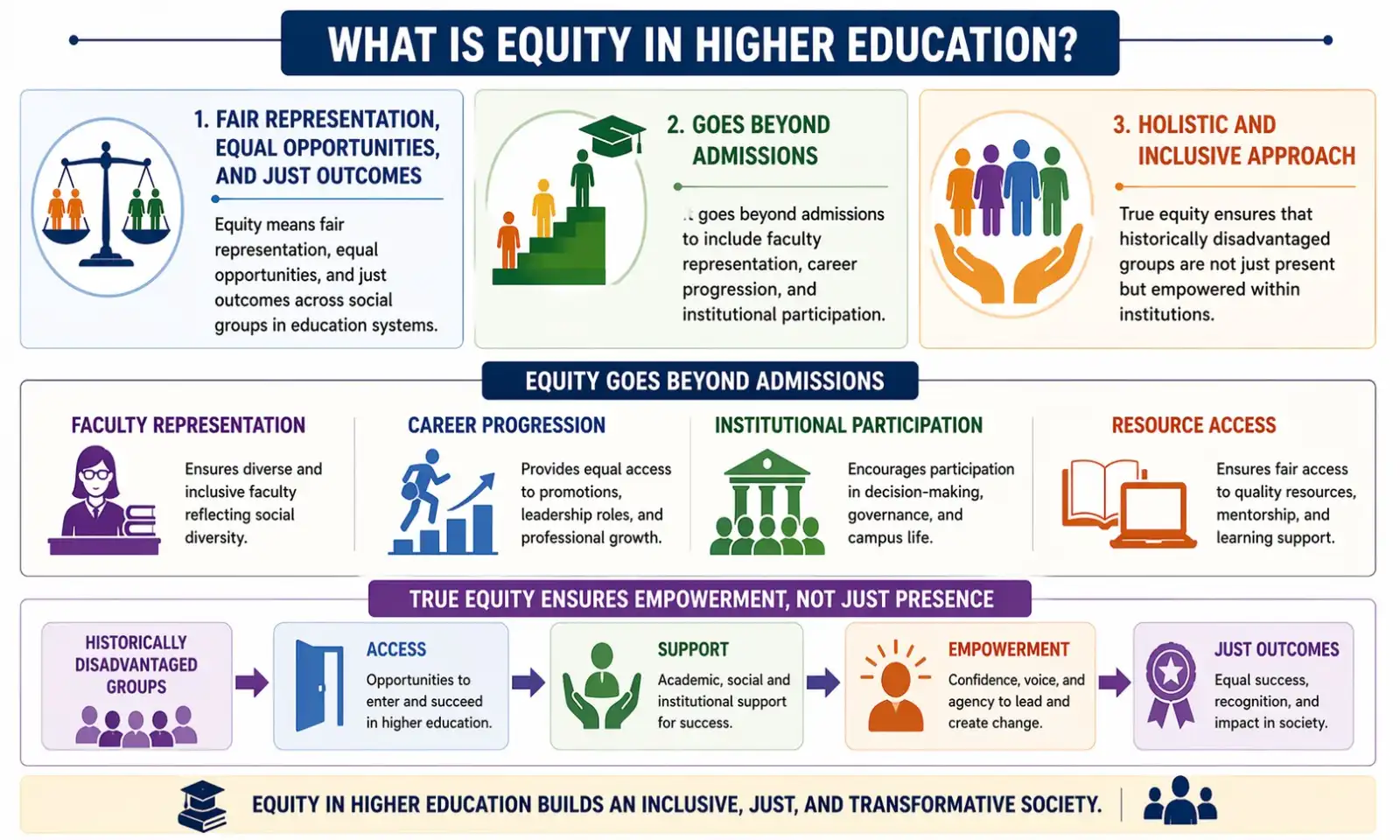
Equity in higher education is often measured through access and admissions, but the deeper challenge lies in unequal outcomes beyond entry. Despite policy focus on reservations and anti-discrimination frameworks, structural inequalities continue to shape representation, employment, and academic progression. This creates a gap between formal inclusion and actual equity within institutions.
Key Issue: Equity Gap Beyond Admissions
- Policies largely focus on reservation in student admissions, but neglect representation in faculty and leadership roles.
- Data shows that SC/ST/OBC representation declines sharply at higher academic and employment levels.
- This creates an “uneven ladder” where inclusion at entry does not translate into equal outcomes.
Evidence of Representation Gaps
- In central universities, SC representation drops significantly from student level to professor positions.
- ST representation is even lower, especially in senior academic and administrative roles.
- OBC representation is relatively better but still lags in higher positions compared to general category groups.
- This indicates systemic barriers in career advancement within higher education institutions (HEIs).
Employment-Based Inequality
- Equity is more constrained by employment gaps than by admission gaps in higher education.
- Hiring processes, promotions, and institutional biases affect long-term representation outcomes.
- Faculty diversity remains limited, impacting inclusive knowledge production and academic culture.
Crime and Discrimination Dimension
- Data indicates incidents of discrimination and violence against SC/ST students within campuses.
- Many cases remain underreported due to fear, stigma, or institutional barriers.
- Discrimination affects academic performance, mental health, and retention of marginalised students.
Limitations of Current Policies
- UGC regulations focus on anti-discrimination mechanisms and complaint redressal systems.
- However, they do not sufficiently address structural inequalities in hiring, promotion, and institutional culture.
- Existing policies are reactive (address complaints) rather than proactive (ensure representation and inclusion).
Data and Measurement Issues
- Equity is often measured through enrolment data, ignoring employment and career outcomes.
- Lack of comprehensive datasets leads to incomplete understanding of inequality within HEIs.
- There is a need to track long-term indicators like faculty diversity, promotions, and leadership representation.
Structural Barriers
- Social inequalities outside institutions influence access to networks, mentorship, and opportunities within academia.
- Informal practices in hiring and promotion can reinforce existing social hierarchies.
- Marginalised groups face challenges in academic mobility, research opportunities, and institutional recognition.
Impact on Education System
- Lack of diversity affects quality of education, research perspectives, and institutional inclusivity.
- It limits representation of diverse experiences in knowledge creation and curriculum design.
- Persistent inequities weaken the democratic and inclusive character of higher education.
Way Forward
- Shift focus from access-based equity to outcome-based equity in higher education policies.
- Ensure representation in faculty recruitment, promotions, and leadership positions.
- Strengthen data collection on employment outcomes and institutional diversity.
- Promote inclusive campus environments through sensitisation, mentorship, and support systems.
- Move from compliance-based approach to structural reforms addressing root causes of inequality.
The real challenge of equity in higher education lies not in opening doors, but in ensuring equal opportunities after entry. Without addressing structural barriers in employment, representation, and institutional culture, inclusion remains incomplete. A shift towards outcome-based equity is essential to make higher education truly fair, inclusive, and transformative.
India’s Goldilocks Moment is Over, Macro Situation Will Worsen
India’s economy recently enjoyed a “Goldilocks phase” marked by strong growth, low inflation, and external stability. However, external shocks—especially the West Asia crisis and rising energy prices—are now reversing these favourable conditions. The economy is entering a phase of higher uncertainty, where multiple macroeconomic indicators may deteriorate simultaneously.
What was the Goldilocks Phase
- India experienced high GDP growth (~7.6% in 2025–26) with low inflation (~2%).
- The current account deficit (CAD) remained manageable (~1% of GDP).
- Government followed fiscal consolidation, maintaining macroeconomic stability.
- This combination of growth + stability + low inflation = “Goldilocks situation”.
Why the Goldilocks Phase is Ending
- West Asia crisis has disrupted global energy supply chains significantly.
- Crude oil prices expected to remain high (~$85–90/barrel in 2026–27).
- India’s high import dependence on oil (~88%, with ~51% from West Asia) increases vulnerability.
- Global uncertainties (geopolitics, El Niño risks) are worsening outlook.
Impact on Growth and Inflation
- GDP growth likely to slow to ~6.7% (below earlier projection of 7.2%).
- Higher oil prices increase input costs → inflationary pressures.
- CPI inflation expected at ~4.6% vs earlier ~4.3% projection.
- Risk of food inflation due to weak monsoon (El Niño effect).
- Overall impact = slower growth + higher inflation (stagflation-type pressure).
External Sector Stress (Balance of Payments)
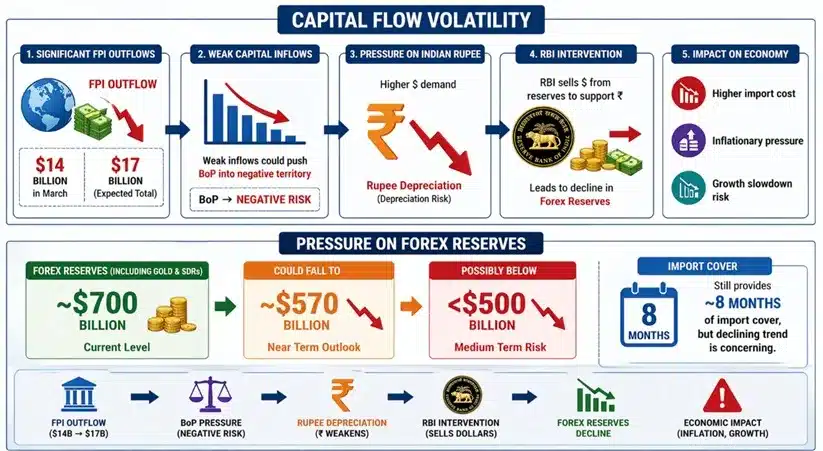
- Current Account Deficit (CAD) may widen to ~2.1% of GDP.
- India’s exposure:
- Goods exports to West Asia: ~15% and Remittances share: ~38% from region
- Capital flows weakening:
- Net FDI flows declining sharply
- Gross FDI strong, but outflows (profit repatriation) rising
- External borrowing also slowing → capital account stress.
Fiscal Impact (Government Finances)
- Fiscal burden of West Asia crisis estimated at ~0.5% of GDP.
- Factors increasing fiscal stress:
- Excise duty cuts on petrol/diesel → revenue loss
- Higher fertiliser subsidies (linked to LNG prices)
- Reduced revenues due to economic slowdown
- Could affect Centre’s fiscal consolidation path and disinvestment targets.
- State finances also impacted due to higher welfare spending and lower tax devolution.
Broader Economic Risks
- Energy security risk due to supply disruptions.
- Inflation persistence affecting households and consumption.
- Investment slowdown due to uncertainty.
- Macroeconomic stability under stress from multiple fronts simultaneously.
Policy Response and Challenges
- Government has taken short-term measures (tax cuts, subsidies, supply management).
- However, these are temporary and insufficient for long-term stability.
- Need to balance between:
- Growth vs inflation control
- Fiscal stability vs welfare spending
Way Forward
- Strengthen energy security through diversification of sources.
- Build resilience in supply chains to reduce external shocks impact.
- Ensure stable capital flows by improving investment climate.
- Maintain fiscal discipline while targeting efficient subsidies.
- Focus on long-term macroeconomic stability rather than short-term fixes.
India’s transition from a stable Goldilocks phase to a more uncertain macroeconomic environment highlights the vulnerability of growth to global shocks. Rising energy prices, weakening external balances, and fiscal pressures demand careful policy calibration. Sustaining growth now requires stronger structural resilience, prudent fiscal management, and strategic economic planning.
Prelims Booster
Atal Pension Yojana (APY)
Context:
- The scheme has crossed 9 crore enrollments
About
- Atal Pension Yojana (APY) is a social security pension scheme of the Government of India
- It was launched on 9 May 2015
- It targets: Poor and unorganized sector workers
Nature of Scheme
- It is a voluntary and contributory pension scheme
- It aims to ensure income security after retirement
Key Features
- Guaranteed Pension- It provides ₹1,000 to ₹5,000 monthly pension after age 60
- Family Security- Pension continues to spouse after subscriber’s death. After both die, corpus is given to nominee
- Eligibility- Age group: 18–40 years. It is mainly for non-income taxpayers (unorganized sector)
- Contribution System- Subscriber contributes regularly till 60 years. Pension amount depends on contribution level
- Exit Rules- Voluntary exit allowed. Only own contribution + interest is returned. Government contribution (if any) is forfeited
Administration
- It is regulated by: Pension Fund Regulatory and Development Authority (PFRDA)
Significance
- It promotes financial security in old age
- It supports social protection for unorganized workers
- It reduces dependency after retirement
Sustainable Aviation Fuel (SAF)
Context:
- The Government has brought SAF-blended ATF under ATF Control Order, 2001
About
- Sustainable Aviation Fuel (SAF) is a biofuel used in aircraft
- It is chemically similar to Aviation Turbine Fuel (ATF)
- It can be used: Directly in existing aircraft engines (as blends) and Without affecting performance or safety
Nature of SAF
- It consists of aviation-grade hydrocarbons
- It is compatible with conventional jet fuel systems
Sources (Feedstock)
- It is produced from renewable and sustainable sources such as: Waste oils and fats; Municipal and green waste; Non-food crops
- It can also be produced through: Synthetic processes (capturing carbon from air)
Production
|
Key Features
|
Significance
- It helps in reducing aviation sector emissions
- It supports climate goals and sustainable development
- It reduces dependence on fossil fuels
NAMASTE Scheme
Context:
- The government highlighted the impact of NAMASTE Scheme in eliminating hazardous manual cleaning practices
About
- The NAMASTE Scheme (National Action for Mechanised Sanitation Ecosystem) is a Central initiative for sanitation workers
- It focuses on Sewer and Septic Tank Workers (SSWs)
- It aims to ensure: Safety, Dignity, Better working conditions
Implementation
- It is jointly implemented by:
- Ministry of Social Justice and Empowerment (MoSJE)
- Ministry of Housing and Urban Affairs (MoHUA)
- Implementing Agency: National Safai Karmacharis Finance Development Corporation (NSKFDC)
- Duration: FY 2023–24 to FY 2025–26
Aim
- It aims to:
- Achieve zero fatalities in sanitation work
- Eliminate manual handling of human waste
- Promote mechanised cleaning systems
Key Features
- Mechanisation of Sanitation- It ensures cleaning is done using machines and safety equipment
- Worker Safety & Health– It provides protective gear and training. It improves occupational safety standards
- Skill Development & Livelihood– It promotes skill training and entrepreneurship. It supports formation of Self-Help Groups (SHGs)
- Emergency Response Units
- It strengthens Emergency Response Sanitation Units (ERSUs) (teams for urgent sanitation-related emergencies)
- Elimination of Manual Scavenging– It ensures no direct contact with human faecal matter
Significance
- It improves dignity and social justice for sanitation workers
- It reduces health risks and deaths
- It promotes technology-driven sanitation systems
Curiosity Rover (Mars Science Laboratory Mission)
Context:
- The Curiosity Rover has detected organic molecules on Mars
About
- Curiosity Rover is a robotic rover sent by NASA to explore Mars
- It is part of the Mars Science Laboratory (MSL) mission
Launch & Landing
- Launched: 26 November 2011 (Atlas V rocket, Florida)
- Landed: 5 August 2012
- Landing method: Sky crane system (parachute + rocket-assisted landing)
Location on Mars
- It is exploring: Gale Crater and Mount Sharp (Aeolis Mons)
Key Features
1. Size & Weight
| 2. Power Source
| 3. Mobility & Instruments
|
Objectives (Science Goals)
- Determine if life ever existed on Mars
- Study Martian climate
- Analyze geology (rocks, soil)
- Support future human missions
Recent Finding
- It has detected organic molecules (carbon-based compounds, important for life studies)
Significance
- It provides evidence about possibility of past life on Mars
- It helps understand Mars’ habitability
- It supports future human exploration missions
INS Nireekshak
Context:
- INS Nireekshak participated in India–Sri Lanka Diving Exercise (DIVEX 2026) in Colombo
About
- INS Nireekshak is a Dive Support and Submarine Rescue Vessel of the Indian Navy
- It is used for deep-sea diving and rescue operations
Development & Commissioning
- It was built by Mazagon Dock Shipbuilders Limited (India)
- It entered service in 1989 and was commissioned in 1995
Key Features
1. Deep-Sea Diving Capability
| 2. Submarine Rescue Role
|
3. Medical Support
| 4. Stability & Precision
|
Functions
- It is used for:
- Search and rescue operations
- Underwater inspection and repair
- Diver training
- Submarine rescue missions
DIVEX 2026 (Exercise)
|
Significance
- It strengthens India’s maritime safety and rescue capability
- It enhances naval cooperation with Sri Lanka
- It supports Humanitarian Assistance and Disaster Relief (HADR)