India’s Labour Reforms and the Reality of Workers’ Protection
India’s labour framework is undergoing a major transformation with the consolidation of laws into labour codes, aimed at improving ease of doing business and simplifying regulation. However, recent events and structural trends reveal a widening gap between legal intent and ground reality, where workers continue to face insecurity, weak bargaining power, and inadequate protection despite formal recognition.
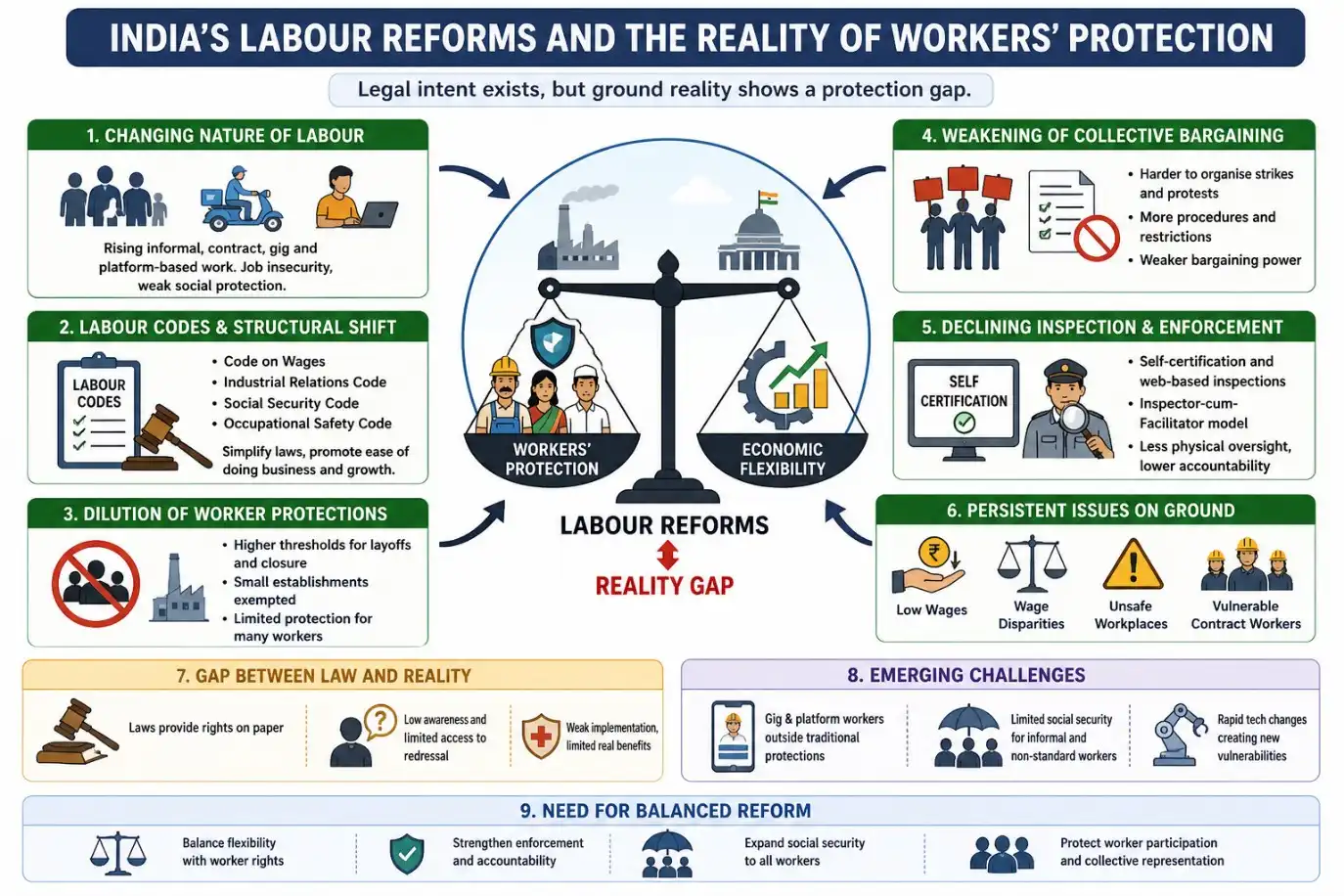
Changing Nature of Labour in India
- India’s workforce is increasingly informal, with a large share in contract, gig, and platform-based employment.
- Traditional employer-employee relationships are weakening due to outsourcing and subcontracting practices.
- Many workers lack job security, social protection, and legal safeguards in this evolving system.
Labour Codes and Structural Shift
- The four labour codes have replaced multiple earlier laws to simplify compliance and regulation.
- These include the Code on Wages, Industrial Relations Code, Social Security Code, and Occupational Safety Code.
- The reforms aim to balance worker welfare with industrial flexibility and economic growth.
Dilution of Worker Protections
- Thresholds for layoffs, retrenchment, and closure have been increased, reducing regulatory oversight.
- Smaller establishments are now exempt from several compliance requirements.
- This limits protections for a large number of workers employed in small units.
Weakening of Collective Bargaining
- Legal provisions make it more difficult for workers to organise strikes and protests.
- Procedural requirements such as prior notice and restrictions reduce the effectiveness of unions.
- This weakens workers’ ability to negotiate better wages and working conditions.
Declining Inspection and Enforcement
- The shift to self-certification and web-based inspections reduces physical oversight.
- The “Inspector-cum-Facilitator” model focuses more on facilitation than enforcement.
- This may lead to underreporting of violations and reduced accountability.
Persistent Wage and Livelihood Issues
- Workers continue to struggle with low wages that do not meet basic living costs.
- Wage disparities exist across regions and sectors, even for similar work.
- Inflation and rising living expenses further reduce real income.
Workplace Safety Concerns
- Industrial accidents and unsafe working conditions remain a serious issue.
- Many workplaces lack basic safety infrastructure and monitoring systems.
- Contract workers are often the most vulnerable, with limited accountability for employers.
Gap Between Law and Reality
- Although labour laws provide legal recognition and rights, implementation remains weak.
- Workers often lack awareness and access to grievance redressal mechanisms.
- Legal protections exist on paper but fail to translate into real benefits.
Historical Context and Continuity
- Labour laws in India date back to colonial times and were designed for industrial-era economies.
- Despite reforms, many structural issues such as informality and weak enforcement persist.
- The nature of labour has changed faster than the legal framework’s ability to adapt effectively.
Emerging Challenges in Modern Economy
- Gig workers and platform-based workers fall outside traditional labour protections.
- Social security coverage remains limited for informal and non-standard workers.
- Rapid technological and economic changes are creating new forms of labour vulnerability.
Need for Balanced Reform
- Labour reforms must ensure flexibility for industries without compromising worker rights.
- Strengthening enforcement mechanisms is essential for effective implementation.
- Social security systems must be expanded to include informal and gig workers.
- Worker participation and collective representation should be protected and encouraged.
India’s labour reforms reflect an attempt to modernise the regulatory framework, but their success depends on balancing economic efficiency with social justice. Without strong enforcement, fair wages, and inclusive protections, the promise of labour rights will remain incomplete, leaving workers without the security and dignity that the law seeks to guarantee.
Prelims Boosters
Tathagata Buddha
Context:
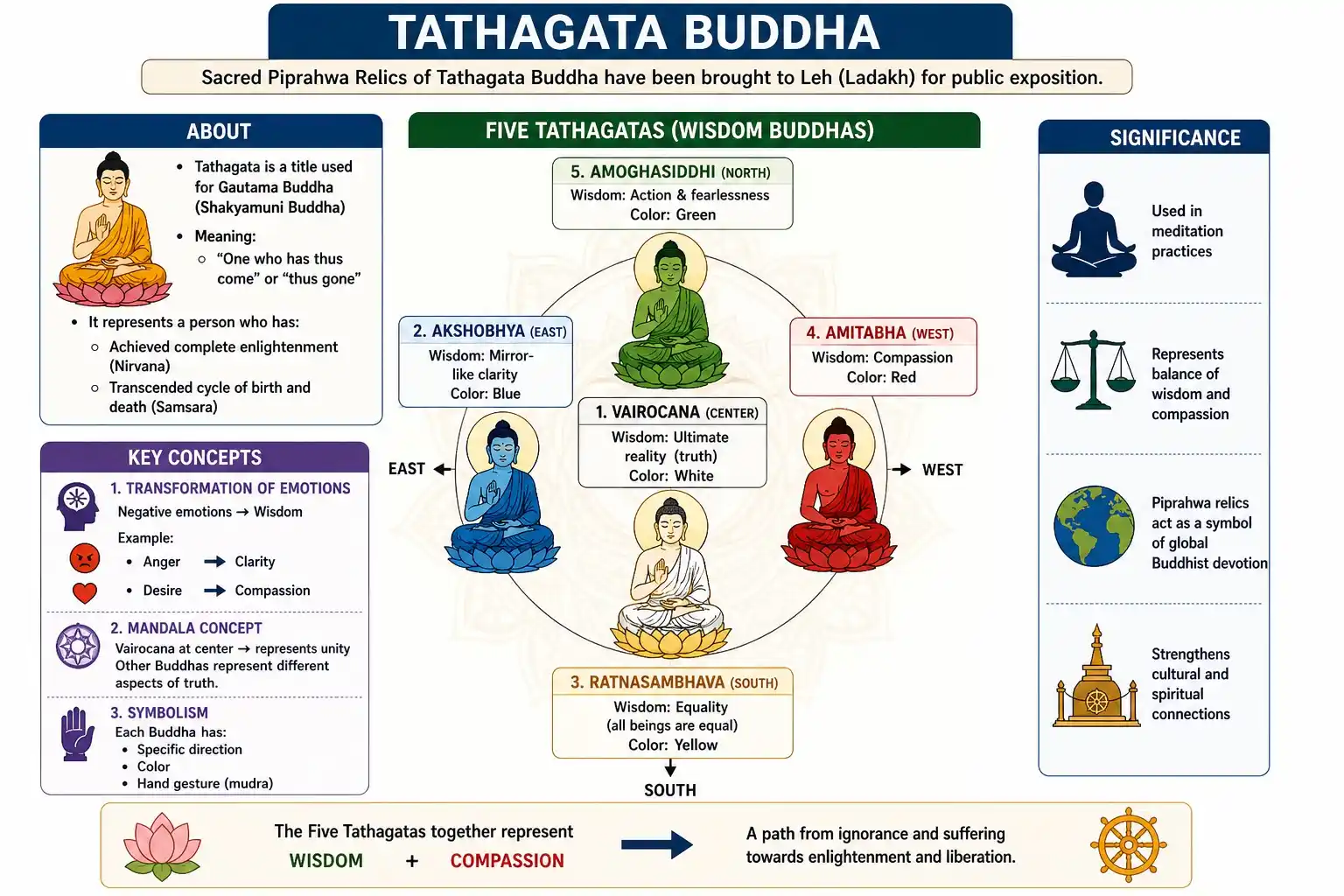
- Sacred Piprahwa Relics of Tathagata Buddha have been brought to Leh (Ladakh) for public exposition
About
- Tathagata is a title used for Gautama Buddha (Shakyamuni Buddha)
- Meaning:
- “One who has thus come” or “thus gone”
- It represents a person who has:
- Achieved complete enlightenment (Nirvana)
- Transcended cycle of birth and death (Samsara)
Five Tathagatas (Wisdom Buddhas)1. Vairocana (Center)
2. Akshobhya (East)
3. Ratnasambhava (South)
4. Amitabha (West)
5. Amoghasiddhi (North)
|
Key Concepts1. Transformation of Emotions
2. Mandala Concept
3. Symbolism
|
Significance
- Used in meditation practices
- Represents balance of wisdom and compassion
- Piprahwa relics act as a symbol of global Buddhist devotion
Op Netra 1.0
Context:
- The Indian Army conducted a high-altitude mega eye camp in Leh (Ladakh)
About
- Op Netra 1.0 is an Advanced Surgical Eye Camp
- Conducted by: Indian Army
- Location: 153 General Hospital, Leh
- Aim:
- Provide advanced eye treatment (ophthalmic care)
- Ensure healthcare access in remote areas
Key Features
1. Wide Outreach
2. Surgeries Conducted
|
3. Advanced Technology
4. Digital Innovation
5. Inter-Service Cooperation
|
Significance
- Restored vision to 15 completely blind patients
- Improved quality of life in remote areas
- Shows Army’s humanitarian role (civil assistance)
- Example of civil-military coordination
Past Risk and Return Verification Agency (PaRRVA)
Context:
- SEBI has operationalised PaRRVA to improve transparency in financial markets
About
- PaRRVA is a regulatory system to verify past performance (risk & return) claims
- It ensures that financial data shown to investors is accurate and trustworthy
- It is introduced by:
- Securities and Exchange Board of India (SEBI)
Structure
- Recognised Agency: CARE Ratings Limited
- Data Centre (PDC): National Stock Exchange (NSE)
Who Can Use PaRRVA?
- Investment Advisers (IA)
- Research Analysts (RA)
- Trading Members (TM)
- Investors (to check verified data)
Key Features
1. Performance Verification
2. Standardised Data
3. Transparency
|
4. Investor Protection
5. Advertisement Use
|
Significance
- Reduces fraud and false claims in financial markets
- Strengthens investor confidence
- Improves market transparency and accountability
International Labour Day (May Day)
Context:
- Celebrated every year on May 1 worldwide
About
- International Labour Day (ILD) is observed to honour workers and their contributions
- It also remembers the struggles and achievements of the labour movement
History
- Origin: USA (Chicago, 1886)
- Around 400,000 workers protested
- Demand: 8-hour workday
- Event turned violent → known as Haymarket Affair
- Became a symbol of workers’ struggle
- In 1889, May 1 was declared International Workers’ Day
International Observance
|
In India
|
Theme (2026)
- “Ensuring a Healthy Psychosocial Working Environment”
(means mental and emotional well-being at workplace)
Significance
- Promotes:
- Workers’ rights
- Fair wages and working conditions
- Work-life balance
- Reminds governments and society about:
- Labour dignity and protection
National Company Law Tribunal (NCLT)
Context:
- The Supreme Court has taken suo motu cognisance (on its own) of delays by NCLT in approving resolution plans under IBC
About
- NCLT is a quasi-judicial body
(means it works like a court but is not a full court) - It deals with:
- Corporate disputes (company-related cases)
- Established under:
- Companies Act, 2013
- Constituted on: 1 June 2016
- Based on recommendation of:
- Balakrishna Eradi Committee
Composition
- It consists of:
- President
- Judicial Members (legal experts)
- Technical Members (finance/industry experts)
Jurisdiction (What it handles)
- Company disputes
- Insolvency cases (bankruptcy process) under IBC, 2016
- Matters related to:
- Mergers
- Winding up of companies
- Corporate restructuring
Powers
1. Based on Natural Justice
2. Court-like Powers
|
3. Procedural Power
4. Insolvency Authority
|
Appeal Structure
- NCLT → appeal goes to:
- National Company Law Appellate Tribunal (NCLAT)
- NCLAT → further appeal to:
- Supreme Court (only on point of law)
Significance
- Ensures faster resolution of corporate disputes
- Plays key role in bankruptcy resolution (IBC)
- Helps improve ease of doing business