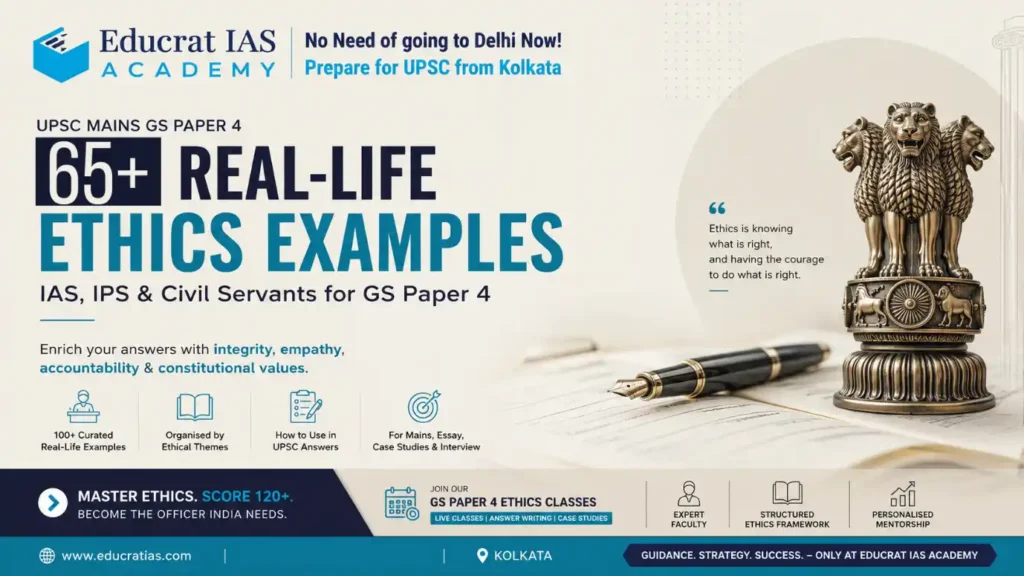
Master 65+ UPSC Ethics Examples to Score 120+ in GS Paper 4
The UPSC Ethics, Integrity & Aptitude (GS Paper 4) is one of the highest-scoring papers in the Civil Services Mains Examination. However, aspirants often lose marks because their answers remain theoretical. UPSC consistently rewards answers that connect ethical concepts with real-life administrative examples, constitutional values, and practical governance.
This comprehensive UPSC Mains Ethics Example Bank by Educrat IAS Academy, UPSC Coaching Centre in Kolkata brings together 65+ carefully curated examples of IAS, IPS, IFoS, IFS, IRS, and other distinguished public servants, classified according to the ethical values most frequently tested in UPSC GS Paper 4.
Whether you’re writing answers on Integrity, Probity, Empathy, Emotional Intelligence, Accountability, Transparency, Leadership, Compassion, Constitutional Morality, Environmental Ethics, Innovation, or Public Service, this collection will help you enrich your answers with authentic and memorable examples.
Every example includes:
- Ethics angle
- Officer’s contribution
- Administrative significance
- How to use it directly in UPSC Mains answers
This makes the collection useful for UPSC MAINS:
- UPSC GS Paper 4 (Ethics)
- UPSC Essay Paper
- Ethics Case Studies
- UPSC Interview (Personality Test)
- State PSC Ethics Papers
- Daily Answer Writing Practice
Real-Life Examples Matter in UPSC Ethics
Unlike other General Studies papers, UPSC Mains Ethics (GS Paper 4) is not about reproducing definitions. It evaluates whether an aspirant can apply ethical principles in real governance situations.
A well-chosen example of an honest IAS officer, an empathetic District Collector, a courageous IPS officer, or an innovative civil servant instantly strengthens your answer. It demonstrates administrative maturity, practical understanding, and constitutional thinking: all qualities UPSC expects in future civil servants.
For example, rather than simply defining Integrity, you could write:
“Integrity means consistently upholding public interest despite pressure. Former Chief Election Commissioner T. N. Seshan demonstrated this by fearlessly enforcing the Model Code of Conduct against powerful political interests.”
One relevant example often makes an answer more persuasive than several paragraphs of theory.
How to Use These UPSC Ethics Examples
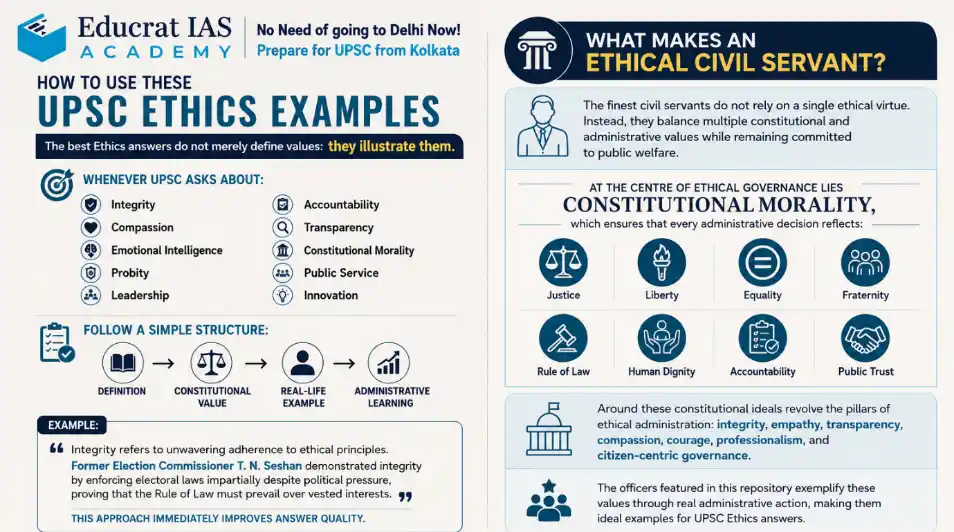
The best Ethics answers do not merely define values: they illustrate them.
Whenever UPSC asks about:
- Integrity
- Compassion
- Emotional Intelligence
- Probity
- Leadership
- Accountability
- Transparency
- Constitutional Morality
- Public Service
- Innovation
follow a simple structure:
Definition → Constitutional Value → Real-Life Example → Administrative Learning
Example:
Integrity refers to unwavering adherence to ethical principles.
Former Election Commissioner T. N. Seshan demonstrated integrity by enforcing electoral laws impartially despite political pressure, proving that the Rule of Law must prevail over vested interests.
This approach immediately improves answer quality.
What Makes an Ethical Civil Servant?
The finest civil servants do not rely on a single ethical virtue. Instead, they balance multiple constitutional and administrative values while remaining committed to public welfare.
At the centre of ethical governance lies Constitutional Morality, which ensures that every administrative decision reflects:
- Justice
- Liberty
- Equality
- Fraternity
- Rule of Law
- Human Dignity
- Accountability
- Public Trust
Around these constitutional ideals revolve the pillars of ethical administration: integrity, empathy, transparency, compassion, courage, professionalism, and citizen-centric governance.
The officers featured in this repository exemplify these values through real administrative action, making them ideal examples for UPSC Ethics answers.
What You'll Find in This Ethics Example Bank
This repository contains examples under all major GS Paper 4 themes, including:
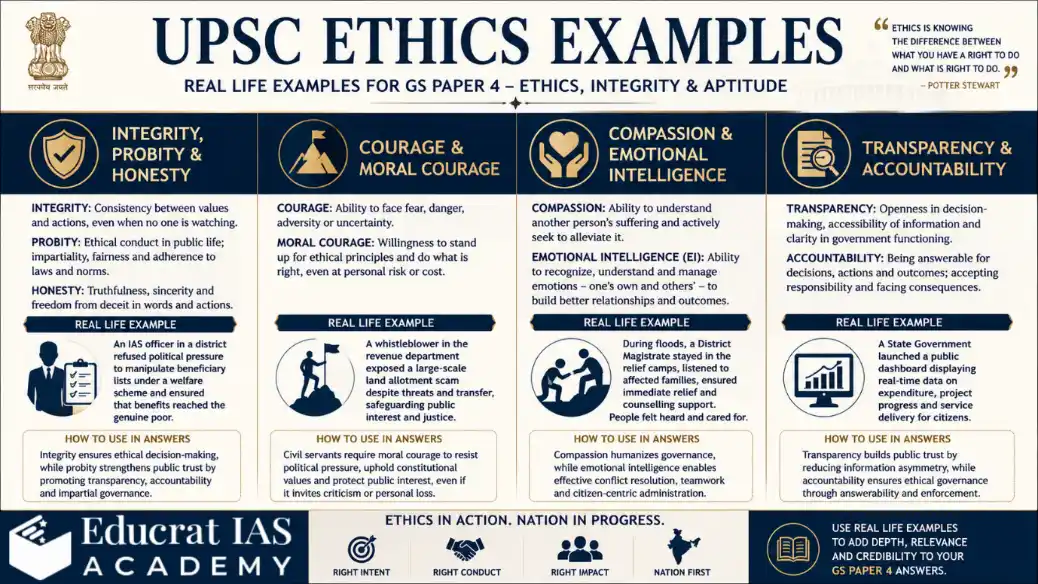
- Integrity, Probity & Honesty
- Courage & Moral Courage
- Compassion & Emotional Intelligence
- Transparency & Accountability
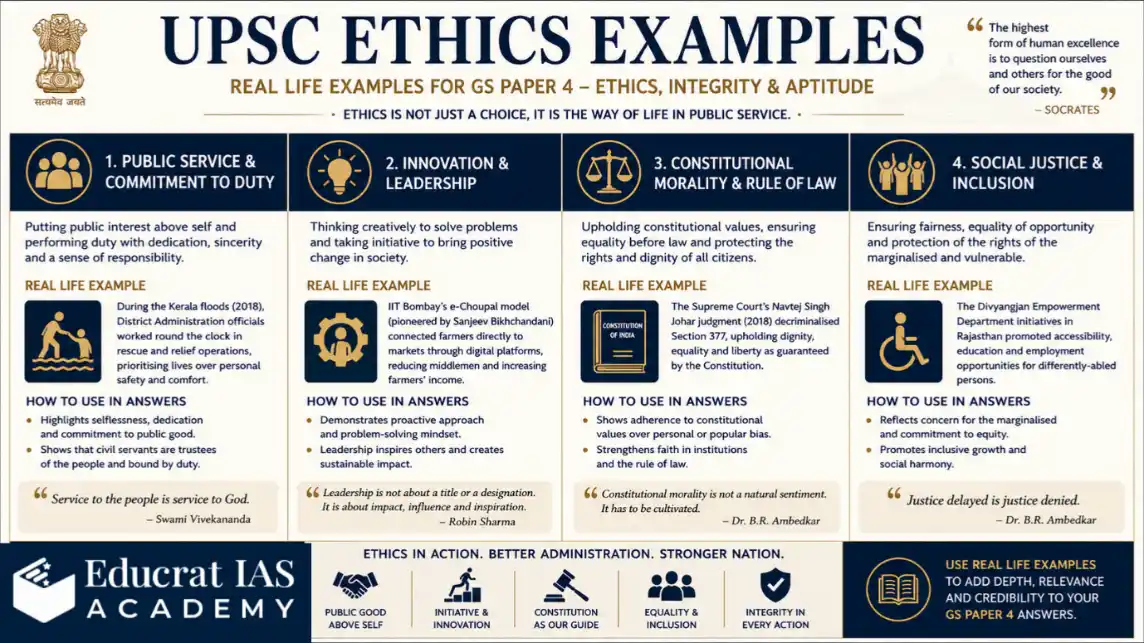
- Public Service & Commitment to Duty
- Innovation & Leadership
- Constitutional Morality & Rule of Law
- Social Justice & Inclusion
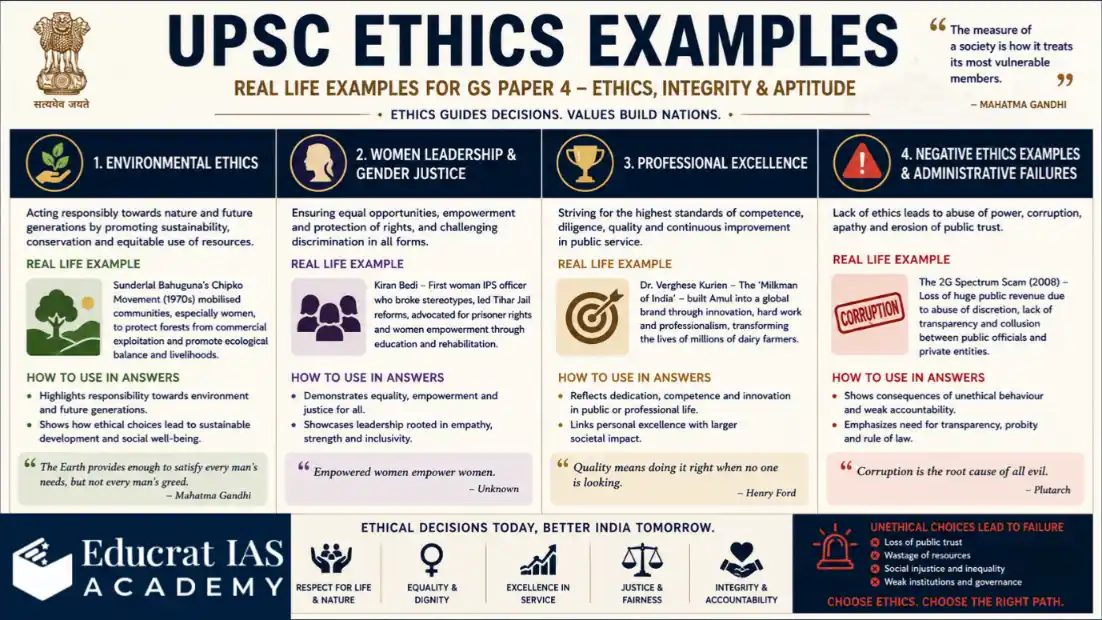
- Environmental Ethics
- Women Leadership & Gender Justice
- Professional Excellence
- Negative Ethics Examples & Administrative Failures
Each section explains how to use the example in UPSC answers, making revision quick and exam-oriented.
1. Integrity, Probity & Honesty
Ashok Khemka – IAS (Haryana)
- Post: IAS – Haryana Cadre
- Ethics Angle: Integrity, Probity, Moral Courage, Resistance to Pressure
- Key Achievement: Cancelled the controversial land deal involving Robert Vadra. Transferred 53+ times in 25 years of service: a record: yet refused to compromise on integrity.
- How to Use in UPSC Answer: Symbol of an upright officer who puts duty above career. Shows that integrity has a price but is non-negotiable for a civil servant of character.
Aamir Subhani – IAS
- Post: IAS; Former Chief Secretary, Bihar
- Ethics Angle: Integrity, Administrative Leadership, Public Service
- Key Achievement: Led governance reforms across departments in Bihar and is known for efficient, professional and politically neutral administration over a long civil service career.
- How to Use in UPSC Answer: Demonstrates professionalism, institutional leadership and administrative continuity.
Raju Narayana Swamy – IAS
- Post: IAS, Kerala Cadre
- Ethics Angle: Integrity, Anti-Corruption, Courage
- Key Achievement: Cancelled several illegal land deals and repeatedly resisted political interference despite frequent transfers.
- How to Use in UPSC Answer: Highlights that ethical administration often demands resilience against institutional pressure.
Rajni Sekhri Sibal – IAS (Haryana)
- Post: IAS – Haryana Cadre
- Ethics Angle: Transparency, Integrity, Meritocracy
- Key Achievement: She sealed the original JBT (Junior Basic Training) teacher selection list inside a steel almirah using four meters of cotton bandages and cloth seals before she was transferred: exposed mass irregularities in teacher recruitment. Faced severe backlash but stood firm, protecting meritocracy.
- How to Use in UPSC Answer: Example of transparency and courage in governance. Protected merit and fairness against vested interests in public recruitment.
Vinod Rai – Comptroller and Auditor General (CAG)
- Post: Comptroller and Auditor General of India (2008–13)
- Ethics Angle: Independence, Accountability, Probity, Fearlessness
- Key Achievement: His CAG reports exposed the 2G spectrum scam (₹1.76 lakh crore presumptive loss) and Coal Block Allocation scam, leading to a major accountability discourse in Indian polity.
- How to Use in UPSC Answer: Shows institutional integrity and independence of constitutional offices. Used audit power to hold government accountable without fear.
2. Courage, Moral Courage & Courage of Conviction
T.N. Seshan – Chief Election Commissioner
- Post: IAS – Chief Election Commissioner of India (1990–96)
- Ethics Angle: Courage of Conviction, Impartiality, Rule of Law, Integrity
- Key Achievement: Revolutionised Indian elections: introduced Voter ID cards, enforced the Model Code of Conduct (MCC) fearlessly, and significantly reduced booth-capturing and electoral malpractice.
- How to Use in UPSC Answer: Defied political pressure to conduct free and fair elections. “No party, no candidate is above the law.” Classic example of an upright civil servant changing the system from within.
Ajit Doval – National Security Advisor
- Post: IPS (Retd.), National Security Advisor
- Ethics Angle: Courage, Commitment to Duty, Strategic Leadership, National Interest
- Key Achievement: Led several high-risk intelligence operations and played a key role in the planning of the 2016 Surgical Strikes and the 2019 Balakot response.
- How to Use in UPSC Answer: Demonstrates calm decision-making under pressure, courage of conviction, and unwavering commitment to national security.
Hemant Karkare – IPS
- Post: ATS Chief, Maharashtra
- Ethics Angle: Courage, Integrity, Duty
- Key Achievement: Led anti-terror investigations and was martyred during the 26/11 Mumbai attacks while protecting citizens.
- How to Use in UPSC Answer: Exemplifies devotion to duty and courage in the face of extreme adversity.
Satyendra Dubey – IES Officer
- Post: Indian Engineering Service – NHAI Project Director
- Ethics Angle: Whistleblowing, Moral Courage, Integrity even at Cost of Life
- Key Achievement: Exposed large-scale corruption in the Golden Quadrilateral highway project. Wrote to the Prime Minister requesting anonymity; his identity was leaked and he was murdered in 2003.
- How to Use in UPSC Answer: Ultimate example of moral courage and integrity. Led to the Whistleblowers Protection Act. Quote: “I will continue to write to you as long as I am alive.” ““Don’t remember me or my work, just one request, remember my message.”
Narendra Kumar – IPS (Madhya Pradesh)
- Post: IPS Officer, Morena District, Madhya Pradesh
- Ethics Angle: Courage, Integrity, Devotion to Duty, Rule of Law
- Key Achievement: On 8 March 2012, Narendra Kumar was run over and killed by a tractor allegedly involved in illegal stone mining while attempting to stop it during an anti-illegal mining operation in Morena district. His sacrifice exposed the influence of the illegal mining mafia and became a symbol of fearless policing and unwavering commitment to the rule of law.
- How to Use in UPSC Answer: An outstanding example of courage, integrity, and commitment to public service. Narendra Kumar laid down his life while enforcing the law against the illegal sand mining mafia, demonstrating that ethical public servants must uphold justice despite grave personal risks and pressure from powerful vested interests.
Vijay Kumar – IPS
- Post: IPS, Tamil Nadu Cadre
- Ethics Angle: Leadership, Courage, Professional Excellence
- Key Achievement: Led Operation Cocoon, resulting in the successful neutralisation of forest brigand Veerappan.
- How to Use in UPSC Answer: Excellent example of ethical leadership, patience, and coordinated policing.
3. Compassion, Empathy & Emotional Intelligence
Kiran Bedi – IPS
- Post: IPS – India’s first woman IPS officer
- Ethics Angle: Moral Courage, Service, Emotional Intelligence, Leadership
- Key Achievement: Transformed Tihar Jail into a model rehabilitation centre. Introduced yoga, education and vocational training for prisoners: humanising the penal system.
- How to Use in UPSC Answer: Shows Emotional Intelligence in action by empathising with prisoners’ dignity. Classic example of compassionate governance.
S.R. Sankaran – IAS (Andhra Pradesh)
- Post: IAS – Andhra Pradesh Cadre
- Ethics Angle: Compassion, Social Justice, Service to Marginalised
- Key Achievement: Champion of Dalit and tribal rights. Implemented land reforms and bonded labour abolition fearlessly. Lived a simple life close to the poor. Called a “Naxal sympathiser” by opponents but respected for his integrity.
- How to Use in UPSC Answer: Shows that ethics means standing for the weakest and most vulnerable. Sacrificed career advancement for principles of social justice.
Armstrong Pame – IAS (“Miracle Man of Manipur”)
- Post: IAS – Manipur Cadre
- Ethics Angle: Compassion, Innovation, People-Centric Governance, Dedication
- Key Achievement: Built a 100 km road in Manipur’s remote Tamenglong district through crowdfunding (₹80 lakh from Facebook): without government budget. Popularly known as the “People’s Road.”
- How to Use in UPSC Answer: Shows that a civil servant need not wait for resources to serve people. Demonstrates citizen participation and empathetic administration.
Prashant Nair – IAS (Kerala)
- Post: IAS – District Collector, Kozhikode
- Ethics Angle: Emotional Intelligence, Compassion, Transparency
- Key Achievement: During the Kerala floods, (Operation Sulaimani) managed relief operations with extraordinary calmness and empathy. Personally connected with affected communities and restored normalcy quickly. While he served in various capacities in Kerala, his legendary, famous initiative “Compassionate Kozhikode” (which earned him the moniker “Collector Bro”) was executed during his tenure as the District Collector of Kozhikode.
- How to Use in UPSC Answer: Excellent example of Emotional Intelligence during crisis. Model of servant leadership.
O.P. Choudhary – IAS (Chhattisgarh)
- Post: IAS – District Collector, Raipur
- Ethics Angle: Empathy, Emotional Intelligence, Service Delivery, Innovation
- Key Achievement: Transformed Raipur into a model district by promoting Sarangi folk art, building night shelters for the homeless and conducting “Jan Samvad” for transparent governance.
- How to Use in UPSC Answer: Demonstrates that governance is about empathy, not merely policy execution.
Om Prakash Kasera – IAS
- Post: IAS – District Collector, Kota (Rajasthan)
- Ethics Angle: Empathy, Compassion, Mental Health, Student Welfare
- Key Achievement: Through #ThankYouDMKota, helped over 50,000 students stranded during the COVID lockdown return home by personally coordinating transport and welfare.
- How to Use in UPSC Answer: Shows empathy in crisis and concern for citizens’ physical and mental well-being.
Poonam Malakondaiah – IAS
- Post: IAS, Andhra Pradesh Cadre
- Ethics Angle: Compassion, Health Governance, Service Orientation
- Key Achievement: Strengthened maternal and child healthcare through innovative public health interventions.
- How to Use in UPSC Answer: Demonstrates empathy-driven governance focused on human development.
Dr. Rajendra Bharud – IAS
- Post: IAS, Maharashtra Cadre
- Ethics Angle: Compassion, Public Service, Inspirational Leadership
- Key Achievement: Rose from an impoverished tribal background to become an IAS officer and worked extensively on public health awareness and youth outreach. He exceptionally handled the COVID-19 crisis as the District Collector of Nandurbar (making the district self-reliant in oxygen).
- How to Use in UPSC Answer: Illustrates empathy, servant leadership and social commitment.
Sonal Goel – IAS
- Post: IAS, Tripura Cadre
- Ethics Angle: Women Empowerment, Compassion, Inclusive Governance
- Key Achievement: Worked extensively on women’s empowerment, education and social inclusion through administrative initiatives.
- How to Use in UPSC Answer: Suitable example for gender-sensitive governance and inclusive administration.
Divya Devarajan – IAS
- Post: IAS, Telangana Cadre (Former District Collector, Adilabad)
- Ethics Angle: Empathy, Respect for Diversity, Grassroots Community Connect
- Key Achievement: In the conflict-prone, tribal-dominated district of Adilabad, she learned the native Gondi language to directly understand and resolve tribal grievances regarding land, health, and livelihood.
- How to Use in UPSC Answer: Illustrates a positive administrative attitude by breaking linguistic barriers to bring the state closer to marginalized citizens.
4. Transparency, Accountability & Citizen-Centric Governance
Rajeev Chawla – IAS (Karnataka)
- Post: IAS – Karnataka Cadre
- Ethics Angle: Technology, Transparency, Anti-Corruption
- Key Achievement: Developed Bhoomi (digital land records) and the e-Procurement system, drastically reducing corruption.
- How to Use in UPSC Answer: Classic example of technology improving transparency and accountability.
Deepak Rawat – IAS
- Post: IAS, Uttarakhand Cadre
- Ethics Angle: Accountability, Transparency, Public Engagement
- Key Achievement: Conducted surprise inspections against illegal mining, encroachments and administrative irregularities while maintaining direct public interaction.
- How to Use in UPSC Answer: Illustrates responsive and citizen-centric governance.
Nitin Sangwan – IAS
- Post: IAS
- Ethics Angle: Transparency, Accountability, Citizen-Centric Governance
- Key Achievement: Popularised simplified governance through public outreach, grievance redressal and administrative transparency.
- How to Use in UPSC Answer: Demonstrates that accessibility and communication strengthen public trust.
Smita Sabharwal – IAS (Telangana)
- Post: IAS – Telangana Cadre
- Ethics Angle: Innovation, Compassion, Accountability, Service Delivery
- Key Achievement: As Municipal Commissioner of Warangal, she introduced the “Fund Your City” scheme to crowdsource civic public utilities via Public-Private Partnerships. Later, as a senior administrator, she effectively oversaw welfare delivery at the state level.
- How to Use in UPSC Answer: Example of innovative governance combined with emotional connect with citizens.
K. Vijayakarthikeyan – IAS
- Post: IAS, Tamil Nadu Cadre
- Ethics Angle: Innovation, Public Service, Digital Governance
- Key Achievement: Introduced several technology-driven civic initiatives and modernised municipal administration in Coimbatore.
- How to Use in UPSC Answer: Shows how digital governance improves accountability and service delivery.
5. Public Service & Commitment to Duty
E. Sreedharan – “The Metro Man”
- Post: IRES – Delhi Metro Rail Corporation (DMRC)
- Ethics Angle: Integrity, Accountability, Commitment to Excellence, Probity
- Key Achievement: Fast-tracked mega-infrastructure projects (Konkan Railway and DMRC) with absolute transparency. Decades earlier, he achieved an engineering miracle by restoring the cyclone-ravaged Pamban Bridge in Tamil Nadu in just 46 days (1964) against a 6-month target.
- How to Use in UPSC Answer: The ultimate textbook definition of Administrative Accountability. Following a fatal under-construction Metro bridge collapse at Zamrudpur in July 2009, he immediately took collective moral responsibility and resigned (though the government refused to accept it).
Hemant Karkare – IPS
- Post: ATS Chief, Maharashtra
- Ethics Angle: Courage, Integrity, Duty
- Key Achievement: Martyred while protecting citizens during the 26/11 Mumbai attacks.
- How to Use in UPSC Answer: Exemplifies supreme devotion to public duty.
Govind Jaiswal – IAS
- Post: IAS, 2006 Batch
- Ethics Angle: Commitment to Public Service, Perseverance, Integrity
- Key Achievement: Overcame acute structural poverty as the son of a rickshaw puller in Varanasi to secure a top rank in the Civil Services. Throughout his career, he has focused on grass-roots citizen delivery and transparent governance.
- How to Use in UPSC Answer: Exemplifies extreme determination and an unwavering desire to use state machinery as an instrument of social upliftment.
6. Innovation & Transformational Leadership
Rajeev Chawla – IAS (Karnataka)
- Post: IAS – Karnataka Cadre
- Ethics Angle: Technology, Transparency, Anti-Corruption
- Key Achievement: Developed Bhoomi (digital land records) and the e-Procurement system, drastically reducing corruption.
- How to Use in UPSC Answer: Classic example of technology improving transparency and accountability.
Damodar Gautam Sawang – DGP
- Post: DGP – Andhra Pradesh Police
- Ethics Angle: Technology in Governance, Women Safety, Innovation
- Key Achievement: Launched the Disha Mobile App, enabling rapid police response for women’s safety.
- How to Use in UPSC Answer: Excellent example of technology-driven governance promoting human dignity.
Shalini Agarwal – IAS
- Post: IAS – Chief Minister’s Good Governance Associates Programme
- Ethics Angle: Environmental Stewardship, Innovation, Water Conservation
- Key Achievement: Led the Varsha Kal Nidhi initiative that enabled harvesting of 10 crore litres of rainwater in one monsoon.
- How to Use in UPSC Answer: Demonstrates innovation for sustainable governance.
Anupam Sharma – IAS
- Post: IFoS, MP
- Ethics Angle: Sustainability, Eco-Stewardship, Circular Economy, Community Connect
- Key Achievement: As a forest officer, launched a plastic-free plantation drive, collecting and selling metric tons of discarded nursery polybags. The proceeds were used to install a community biogas plant converting wet waste into energy for local tribal village communities.
- How to Use in UPSC Answer: Excellent example of environmental administration and converting ecological waste into community assets.
Smita Sabharwal – IAS
- Post: IAS – Telangana Cadre
- Ethics Angle: Innovation, Compassion, Accountability, Service Delivery
- Key Achievement: Introduced the “Fund Your City” initiative enabling citizens to contribute directly to civic infrastructure. Efficiently implemented schemes like Rythu Bandhu and Aasara Pension.
- How to Use in UPSC Answer: Example of innovative governance combined with emotional connect with citizens.
K. Vijayakarthikeyan – IAS
- Post: IAS, Tamil Nadu Cadre
- Ethics Angle: Innovation, Public Service, Digital Governance
- Key Achievement: Introduced several technology-driven civic initiatives and modernised municipal administration in Coimbatore.
- How to Use in UPSC Answer: Shows how digital governance improves accountability and service delivery.
7. Rule of Law, Constitutional Morality & Political Neutrality
K. Kailashnathan – IAS
- Post: IAS (Retd.), Gujarat Cadre
- Ethics Angle: Administrative Stability, Executive Professionalism, Institutional Memory
- Key Achievement: Served continuously as the trusted Chief Principal Secretary in the Gujarat Chief Minister’s Office (CMO) for over a decade (2013–2024), bridging leadership transitions across four successive chief ministers.
- How to Use in UPSC Answer: Illustrates how high-level bureaucratic stability and strong administrative professionalism ensure the unhindered execution of long-term state infrastructure projects.
D. Subbarao – RBI Governor
- Post: RBI Governor (2008–13)
- Ethics Angle: Integrity, Institutional Independence, Professionalism
- Key Achievement: Articulated the “New Trilemma”: balancing central bank independence, democratic accountability and financial stability: while maintaining RBI’s autonomy despite political pressure.
- How to Use in UPSC Answer: Symbol of institutional integrity and professional ethics. An excellent example for answers on institutional independence and constitutional governance.
8. Social Justice, Inclusion & Human Dignity
Dr. Bindeshwar Pathak
- Post: Founder, Sulabh International
- Ethics Angle: Human Dignity, Social Justice, Compassion
- Key Achievement: Revolutionised sanitation, eliminated manual scavenging through affordable toilet technology and social reform.
- How to Use in UPSC Answer: Ideal example for dignity of labour, inclusive development and ethical leadership.
S.R. Sankaran – IAS (Andhra Pradesh)
- Post: IAS – Andhra Pradesh Cadre
- Ethics Angle: Compassion, Social Justice, Service to Marginalised
- Key Achievement: Champion of Dalit and tribal rights. Implemented land reforms and bonded labour abolition fearlessly. Lived a simple life close to the poor. Called a “Naxal sympathiser” by opponents but respected for his integrity.
- How to Use in UPSC Answer: Shows that ethics means standing for the weakest and most vulnerable. Sacrificed career advancement for principles of social justice.
Aruna Roy – IAS (Rajasthan)
- Post: IAS turned Social Activist – Mazdoor Kisan Shakti Sangathan (MKSS)
- Ethics Angle: Integrity, Transparency, People’s Rights, RTI
- Key Achievement: Resigned from IAS to work with rural poor. Led the Right to Information movement in India. RTI Act, 2005 is largely attributed to her grassroots campaign.
- How to Use in UPSC Answer: Proves that ethical commitment can sometimes require leaving institutional power to serve a larger cause. Symbol of transparency, accountability and citizen empowerment.
Ira Singhal – IAS
- Post: IAS
- Ethics Angle: Perseverance, Equality, Inclusiveness
- Key Achievement: First differently-abled woman to secure Rank 1 in the Civil Services Examination after successfully challenging discriminatory recruitment practices.
- How to Use in UPSC Answer: Illustrates constitutional values of equality, resilience and inclusion in public service.
Sonal Goel – IAS
- Post: IAS, Tripura Cadre
- Ethics Angle: Women Empowerment, Compassion, Inclusive Governance
- Key Achievement: Worked extensively on women’s empowerment, education and social inclusion through administrative initiatives.
- How to Use in UPSC Answer: Suitable for answers on gender-sensitive governance and inclusive administration.
Poonam Malakondaiah – IAS
- Post: IAS, Andhra Pradesh Cadre
- Ethics Angle: Compassion, Health Governance, Service Orientation
- Key Achievement: Strengthened maternal and child healthcare through innovative public health interventions.
- How to Use in UPSC Answer: Shows empathy-driven governance focused on improving human development.
9. Environmental Ethics & Sustainability
Dharam Singh Meena – IFoS
- Post: IAS – Rajasthan Cadre
- Ethics Angle: Environmental Stewardship, Persistence, Community Mobilisation
- Key Achievement: Revived 86 natural springs in Rajasthan using traditional water harvesting methods. Mobilised communities and combined modern science with indigenous knowledge.
- How to Use in UPSC Answer: Demonstrates the environment-ethics nexus. Excellent example of community-led ecological governance.
Dr. Adarsh Singh – IAS
- Post: IAS – District Collector, UP Cadre
- Ethics Angle: Environmental Conservation, Community Leadership
- Key Achievement: Revived the dying Kalyani River in Barabanki by mobilizing over 50,000 local villagers and leveraging MGNREGA funds, creating a sustainable water source without dedicated state budgetary irrigation allocations.
- How to Use in UPSC Answer: Excellent example of ecological restoration through participatory governance.
Shalini Agarwal – IAS
- Post: IAS – Chief Minister’s Good Governance Associates Programme.
- Ethics Angle: Environmental Stewardship, Innovation, Water Conservation
- Key Achievement: Led the Varsha Kal Nidhi initiative, enabling collection of 10 crore litres of rainwater in a single monsoon season for water-stressed communities.
- How to Use in UPSC Answer: Demonstrates environmental consciousness and innovative governance.
Dr. T. Arun – IAS
- Post: Former District Collector, Puducherry.
- Ethics Angle: Innovation, E-Governance, Environmental Stewardship.
- Key Achievement: Collaborated with CSIR-NEERI to develop the “Neer Padhivu” app, digitizing and geo-tagging over 400 local water bodies to prevent encroachment and successfully revive the groundwater table.
- How to Use in UPSC Answer: Illustrates technology-enabled governance and institutional collaboration for environmental sustainability.
Anupam Sharma – IFoS
- Post: IAS – District Collector
- Ethics Angle: Sustainability, Innovation, Rural Development
- Key Achievement: Set up a biogas plant converting waste into energy for rural communities, improving sanitation and providing clean cooking fuel.
- How to Use in UPSC Answer: Demonstrates circular economy principles in public administration.
Sanjiv Chaturvedi – IFS
- Post: Indian Forest Service
- Ethics Angle: Integrity, Whistleblowing, Probity
- Key Achievement: Exposed corruption in AIIMS and the Haryana Forest Department; recipient of the Ramon Magsaysay Award.
- How to Use in UPSC Answer: Shows that transparency and accountability often demand personal sacrifice while protecting public resources.
Avishyant Panda – IAS
- Post: IAS – Maharashtra Cadre
- Ethics Angle: Environmental Stewardship, Foresight, Climate Resilience, Public Service Commitment
- Key Achievement: Future-proofed Gadchiroli district against El Niño-induced water scarcity by proactively implementing thousands of water conservation and irrigation projects. Accelerated the completion of check dams, farm ponds, groundwater recharge structures, revived local water bodies, and completed over 1,000 irrigation projects, strengthening water security for more than one million people.
- How to Use in UPSC Answer: Demonstrates anticipatory governance and ethical public administration. An excellent example of climate-resilient development, sustainable water resource management, and disaster risk reduction through proactive administrative leadership.
10. Women Leadership & Gender Justice
Kiran Bedi – IPS
- Post: IPS – India’s first woman IPS officer
- Ethics Angle: Moral Courage, Service, Emotional Intelligence, Leadership
- Key Achievement: Transformed Tihar Jail into a model rehabilitation centre. Introduced yoga, education and vocational training for prisoners.
- How to Use in UPSC Answer: Demonstrates courageous leadership, gender-breaking achievement and compassionate policing.
Damayanti Sen – IPS
- Post: IPS – West Bengal Cadre (First female Joint Commissioner of Police (Crime) in Kolkata), (Current Posting: ADG & IGP, Armed Police (AP) in West Bengal)
- Ethics Angle: Courage, Integrity, Gender Justice, Professional Excellence
- Key Achievement: Known as “Bengal Tigress”, IPS Damayanti Sen led several high-profile criminal investigations and played a significant role in combating human trafficking and crimes against women in West Bengal. She is known for promoting community policing and victim-centric policing.
- How to Use in UPSC Answer: Demonstrates that ethical policing requires courage, professionalism and sensitivity towards vulnerable sections. A strong example for answers on gender-sensitive policing, integrity and public service.
Sonal Goel – IAS
- Post: IAS, Tripura Cadre
- Ethics Angle: Women Empowerment, Compassion, Inclusive Governance
- Key Achievement: Worked extensively on women’s empowerment, education and social inclusion through administrative initiatives.
- How to Use in UPSC Answer: Suitable example for gender-sensitive governance.
Smita Sabharwal – IAS (Telangana)
- Post: IAS – Telangana Cadre
- Ethics Angle: Innovation, Compassion, Accountability, Service Delivery
- Key Achievement: Introduced the “Fund Your City” initiative and efficiently implemented flagship welfare schemes. Known as the “People’s Officer.”
- How to Use in UPSC Answer: Demonstrates responsive leadership and people-centric governance.
Harshika Singh – IAS
- Post: IAS – District Collector, Tikamgarh (Madhya Pradesh)
- Ethics Angle: Gender Justice, Education, Social Upliftment
- Key Achievement: Conceptualized and launched the “Mahila Gyanalaya Vidyalaya” (All-Women’s schools) initiative in Tikamgarh. She set up classrooms in Gram Panchayat buildings where educated local daughters-in-law volunteered to teach unlettered women and dropout girls. She later scaled this model as the “Niraksharta Se Azadi” (Freedom from Illiteracy) campaign in Mandla district, achieving 100% functional literacy to safeguard tribal communities from financial fraud.
- How to Use in UPSC Answer: Excellent example of gender-sensitive governance and commitment to constitutional equality.
Poonam Malakondaiah – IAS
- Post: IAS, Andhra Pradesh Cadre
- Ethics Angle: Compassion, Health Governance, Service Orientation
- Key Achievement: Strengthened maternal and child healthcare through innovative public health interventions.
- How to Use in UPSC Answer: Demonstrates women-led compassionate public health administration.
11. Professional Excellence & Institutional Leadership
Syed Akbaruddin – IFS
- Post: Indian Foreign Service; Former Permanent Representative of India to the United Nations
- Ethics Angle: Diplomacy, Professionalism, Integrity, Leadership
- Key Achievement: Represented India at the United Nations with distinction, particularly during India’s tenure in the UN Security Council and on issues relating to terrorism and peacekeeping.
- How to Use in UPSC Answer: Demonstrates professionalism, constitutional values and ethical diplomacy in public service.
K.J. Alphons – IAS
- Post: IAS, Kerala Cadre
- Ethics Angle: Innovation, Accountability, Public Service
- Key Achievement: Earned the title “Demolition Man” as DDA Commissioner by reclaiming public land worth ₹10,000 crore from illegal encroachments. Earlier, as District Collector of Kottayam, he spearheaded a volunteer-led mass campaign that made Kottayam India’s first 100% literate town in 1989.
- How to Use in UPSC Answer: Demonstrates that ethical governance combines firmness with developmental vision.
Asra Garg – IPS
- Post: IPS – Telangana Cadre
- Ethics Angle: Integrity, Community Policing, Public Service
- Key Achievement: Known for responsive policing, effective law enforcement and public outreach initiatives during his tenure in Telangana.
- How to Use in UPSC Answer: Illustrates citizen-centric policing, professionalism and accessibility in administration.
Vinayak Mahamuni – IAS
- Post: IAS
- Ethics Angle: Innovation, Public Service, AI in Governance
- Key Achievement: Dnyan Rath: a fully equipped bus travels to rural zilla parishad schools, turning each school campus into a temporary high-tech learning environment for a week. The bus is set up with computers, virtual reality headsets, AI, 3D printers, robotics kits and science experiments. A trained facilitator guides students through hands-on practical sessions.
- How to Use in UPSC Answer: Illustrates citizen-centric policing, AI in governance, out-reach program.
12. Cautionary Officers : Negative Examples
Use as contrast/counter-examples.
‘Committed Bureaucracy’ : Emergency 1975–77
- Post: IAS officers under PM Indira Gandhi
- Key Fact: Obeyed unconstitutional orders (mass sterilisation drives) without dissent. Shah Commission: systemic ethical failure.
- How to Use in UPSC Answer: Following orders ≠ moral defence (Nuremberg). Constitutional morality over political loyalty.
Bhanwari Devi + Administrative Failure
- Post: Sathin (village woman worker), Rajasthan
- Key Fact: Gang-raped after stopping child marriage; police/admin failed to act; community ostracised her. Led to Vishakha Guidelines.
- How to Use in UPSC Answer: Admin must protect those who do their duty. Gender ethics, institutional accountability.
Ghost Beneficiaries : PDS Corruption
- Post: Systemic administrative failure
- Key Fact: 2.35 crore ghost beneficiaries removed by DBT reform : meaning crores were systematically looted for decades.
- How to Use in UPSC Answer: Systemic corruption requires systemic accountability. RTI + DBT + social audit.
ICS : Bengal Famine (1943)
- Post: British Indian Civil Service
- Key Fact: Churchill’s policy + administrative complicity → ~3 million deaths while food was exported from Bengal.
- How to Use in UPSC Answer: Civil servants carry moral responsibility for outcomes, not just orders. Role of conscience.
NSE Co-location Scam : Chitra Ramkrishna
- Post: MD & CEO, National Stock Exchange (Note: Clearly state she is a Corporate Leader, not a civil servant).
- Key Fact: Allowed preferential access to one broker; leaked strategy to anonymous ‘yogi’; SEBI penalised Rs 3 crore.
- How to Use in UPSC Answer: Use this to address Corporate Governance, Boardroom Ethics, and Regulatory Failures. It demonstrates how a lack of integrity, conflict of interest, and compromised institutional gatekeeping by a top executive can collapse market trust and ruin public institutions.
Tips to Score 120+ in UPSC GS Paper 4
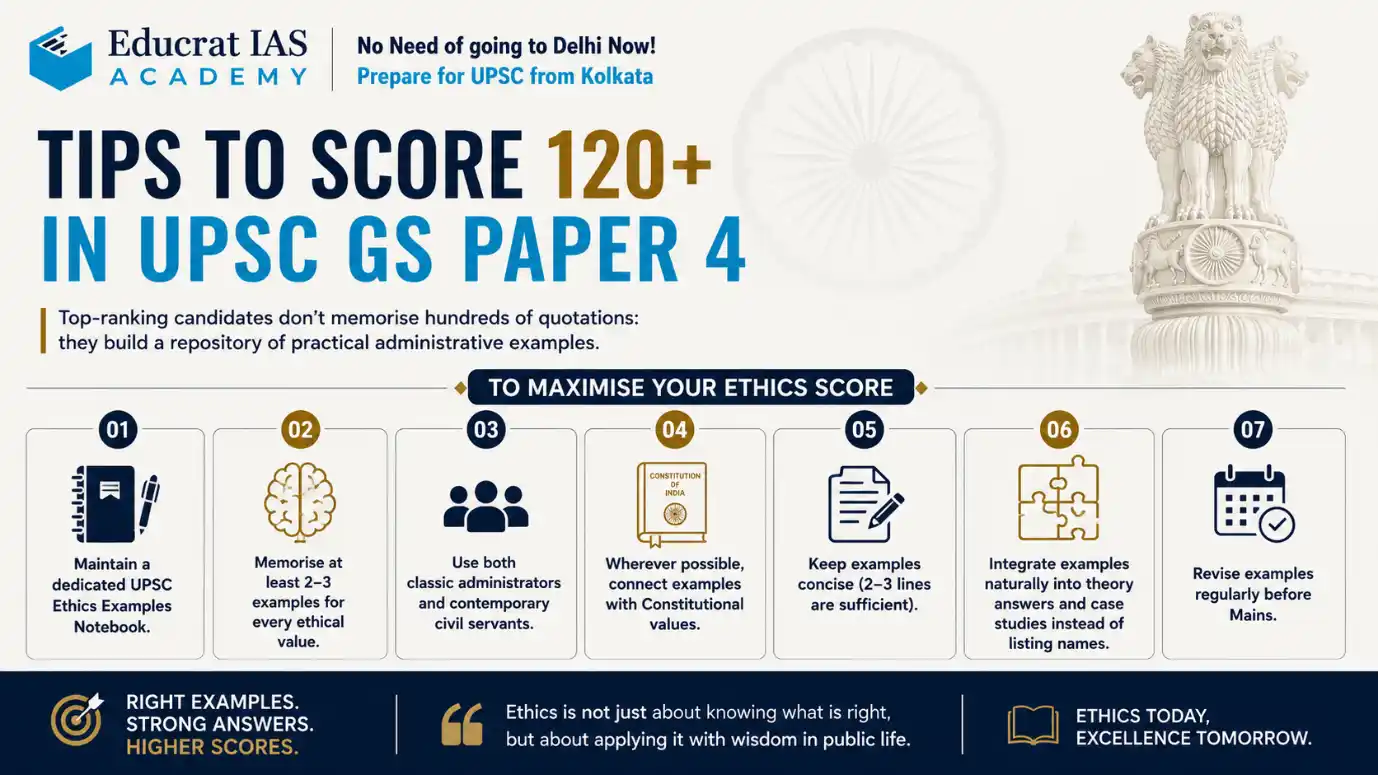
Top-ranking candidates don’t memorise hundreds of quotations: they build a repository of practical administrative examples.
To maximise your Ethics score:
- Maintain a dedicated UPSC Ethics Examples Notebook.
- Memorise at least 2–3 examples for every ethical value.
- Use both classic administrators and contemporary civil servants.
- Wherever possible, connect examples with Constitutional values.
- Keep examples concise (2–3 lines are sufficient).
- Integrate examples naturally into theory answers and case studies instead of listing names.
- Revise examples regularly before Mains.
Why Learn Ethics with Educrat IAS Academy?
At Educrat IAS Academy, UPSC Coaching in Kolkata, we believe Ethics is not a subject to memorise: it is a paper to master through structured thinking, answer writing, and administrative examples.
Our Ethics preparation focuses on:
✅ GS Paper 4 value-based framework
✅ 65+ real-life IAS & IPS examples
✅ Ethics Case Study practice
✅ Model answers based on UPSC trends
✅ Constitutional morality approach
✅ Answer writing with personalised feedback
Whether you’re preparing for UPSC CSE 2026, 2027, 2028, or State PSC examinations, our mentorship helps you write ethical, analytical, and high-scoring answers.
Final Thoughts
Scoring high in UPSC Ethics (GS Paper 4) is not about memorising definitions: it is about demonstrating how ethical values guide public administration.
The 65+ real-life IAS, IPS, IFoS, IFS, IRS, and civil servant examples in this repository bridge the gap between theory and practice. They help you write richer answers, strengthen case-study analysis, and present yourself as a future civil servant with constitutional values at the core.
Keep updating your repository with exemplary administrators, governance innovations, and landmark public service initiatives. Over time, this collection will become one of your most valuable resources for UPSC Mains.
At Educrat IAS Academy, IAS Coaching in Kolkata, we are committed to helping aspirants transform knowledge into marks through structured guidance, expert mentorship, and exam-oriented resources.
Ready to master UPSC Ethics?
Join Educrat IAS Academy, IAS Coaching Institute in Kolkata, for comprehensive answer writing practice, case study discussions, and personalised mentorship designed to help you maximise your Mains score. Explore our UPSC Foundation Programme, Mains Test Series, and Ethics Mentorship to prepare with confidence.