Five Principles That Should Guide India’s Diplomacy in a Changing World Order
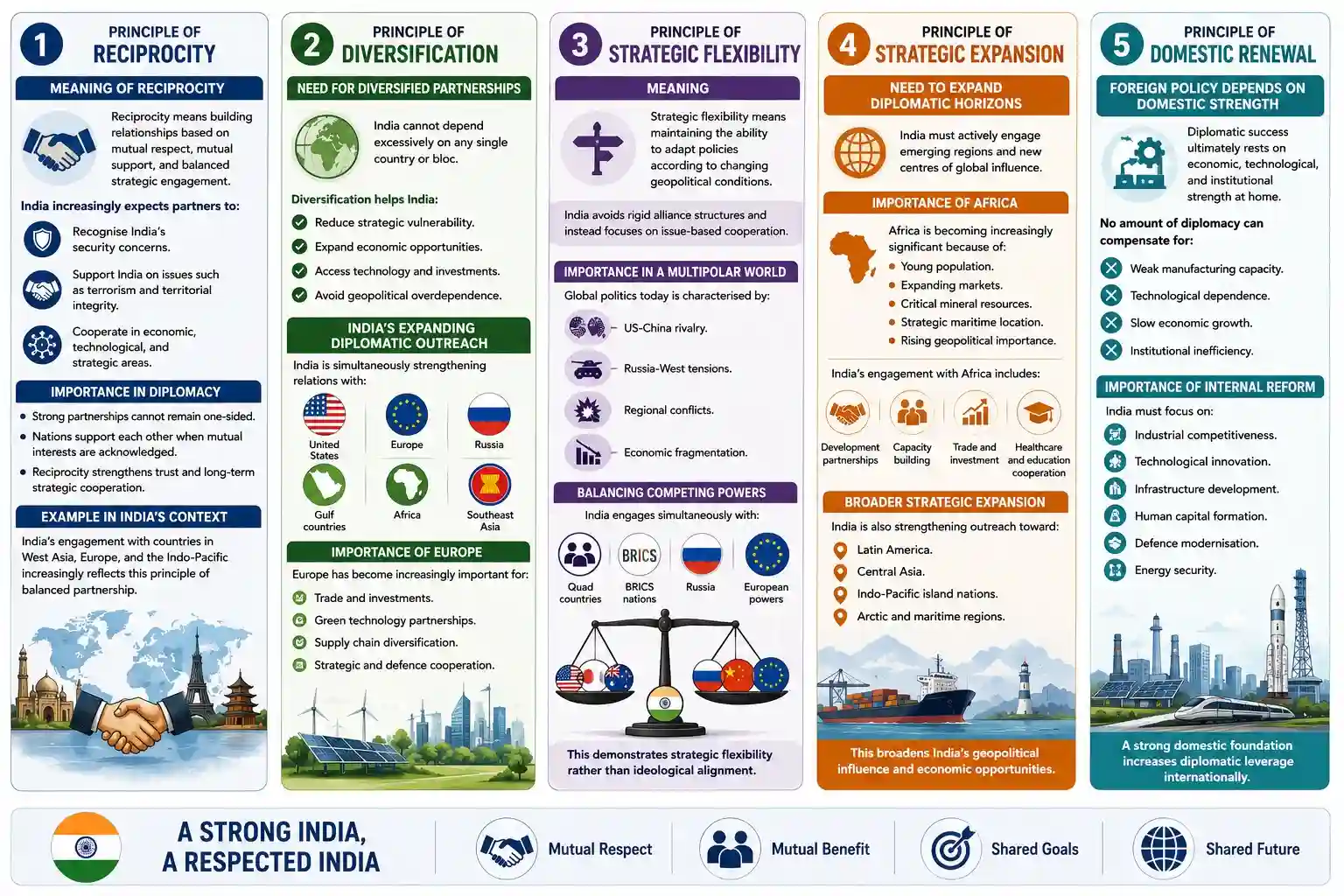
Strategic Autonomy in the Modern EraMeaning of Strategic AutonomyStrategic autonomy means maintaining independent decision-making without external domination. India’s foreign policy traditionally emphasises:
Why It Matters TodayIn an era of great-power rivalry, strategic autonomy helps India:
|
Challenges Facing India’s Diplomacya) Global Geopolitical InstabilityWars and regional conflicts create uncertainty in trade, energy markets, and supply chains.b) Economic FragmentationProtectionism and strategic decoupling are reshaping global economic relations.c) Technological CompetitionArtificial Intelligence, semiconductors, cyber security, and digital infrastructure have become strategic domains.d) Energy and Resource SecurityCompetition over critical minerals, energy supplies, and maritime routes is increasing.e) Pressure of Competing BlocsIndia faces pressure to align more closely with particular geopolitical camps. |
India’s Emerging Diplomatic Approach
India’s diplomacy increasingly reflects:
- Multi-alignment rather than non-alignment.
- Pragmatism over ideology.
- Economic diplomacy.
- Strategic balancing.
- Issue-based coalitions.
India seeks to maximise opportunities while minimising vulnerabilities.
Importance of Trusted Partnerships
Although diversification is important, stable and trusted partnerships remain essential.
Long-term strategic partnerships help in:
- Defence cooperation, Technology transfers, Trade stability, Crisis management, Regional security coordination.
The key challenge is balancing trust with strategic flexibility.
Broader Significance for India
India’s foreign policy choices will shape:
- Economic growth, National security, Technological advancement, Energy security, Global influence.
As India rises globally, diplomacy will increasingly become central to national development and strategic positioning.
The Impact of Structural Adjustment Programmes on the Global South
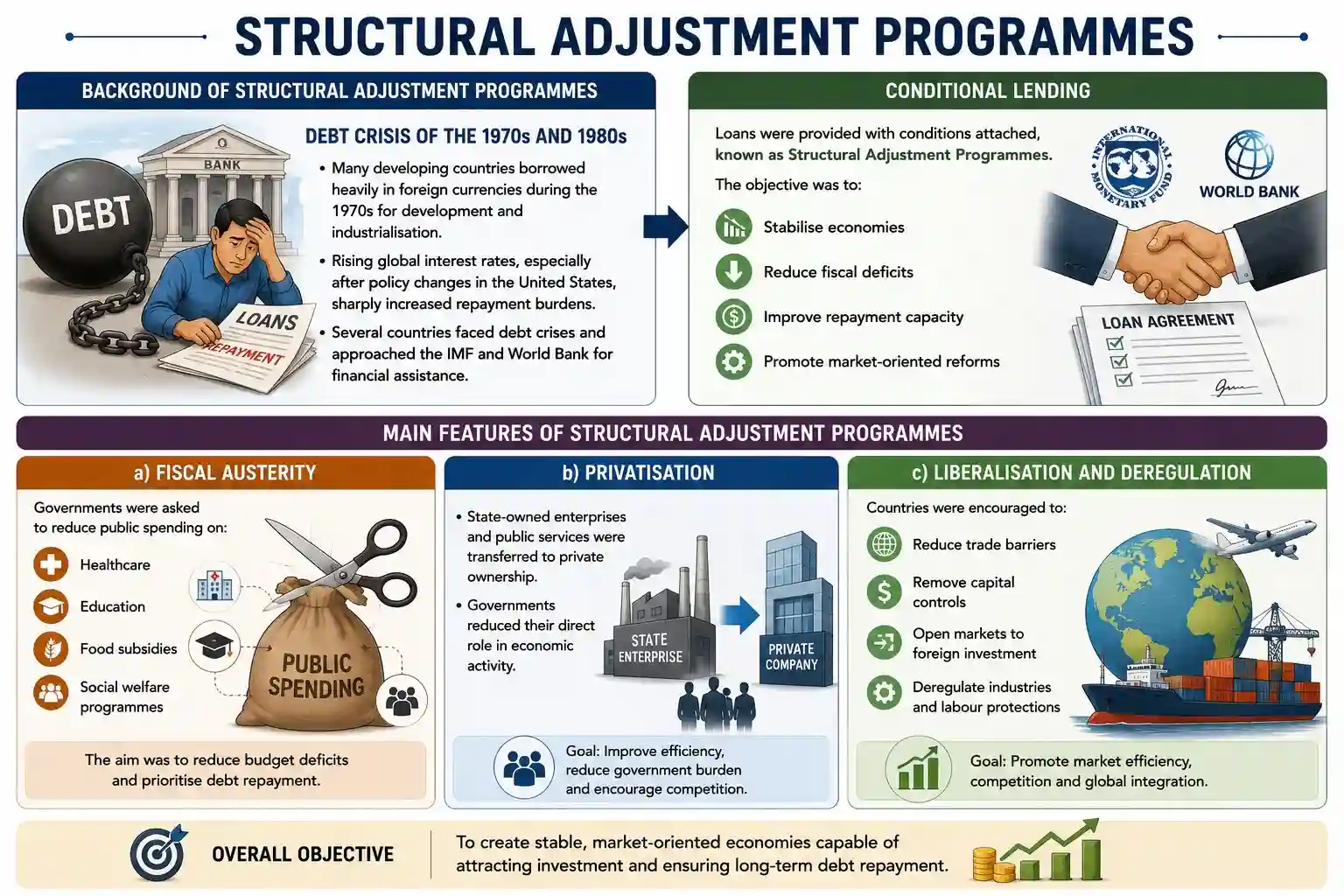
Economic Consequences for the Global SouthSlower Economic Growth
Income Decline
Debt Dependence Continued
|
Social ConsequencesImpact on HealthcareCuts in public spending reduced access to healthcare services. Consequences included:
Impact on Education
Rise in Inequality
|
Impact on Food and Agriculture
Removal of Subsidies
- Reduction of agricultural subsidies increased input costs for farmers.
- Food prices rose sharply in many countries.
Export-Oriented Agriculture
- Economies were encouraged to focus on export crops rather than domestic food security.
- This increased dependence on volatile global markets.
Privatisation and Public Services
Commercialisation of Essential Services
Privatisation often affected:Water supply, Electricity, Healthcare, Transport systems.
In many cases, access became more expensive for poorer populations.
Reduced State Capacity
Governments gradually lost control over key sectors of development and welfare provision.
Capital Outflows and Economic Dependence
Financial Liberalisation
Removal of capital controls allowed easier movement of money across borders.
This led to:
- Profit repatriation by multinational corporations.
- Large capital outflows from developing economies.
- Increased vulnerability to global financial shocks.
Dependence on Global Finance
Developing countries became increasingly dependent on:
- International creditors.
- Foreign investment flows.
- Global market conditions.
Criticism of Structural Adjustment Programmes
a) One-Size-Fits-All Policies
- SAPs often ignored local social, political, and developmental realities.
- Uniform market reforms were applied across diverse economies.
b) Weak Democratic Participation
- Policies were frequently designed externally rather than through domestic democratic processes.
- Borrowing countries had limited bargaining power.
c) Prioritising Creditors Over Citizens
Critics argue that debt repayment was prioritised over:- Human development, Social welfare, Poverty reduction.
Accountability DebateDemand for ReparationsSome scholars and activists argue that institutions responsible for SAPs should acknowledge and address the long-term damage caused. Proposals include:
|
Challenges to Accountability
|
Calls for Institutional Reform
Democratisation of Global Financial Institutions
Reforms demanded include:
- Greater representation for developing countries.
- More transparent decision-making.
- Reduced dominance of powerful economies.
End to Harsh Conditionalities
Many argue that future financial assistance should avoid rigid austerity conditions that weaken social development.
Emergence of Alternative Institutions
Dissatisfaction with traditional institutions has encouraged interest in alternatives such as:
- BRICS New Development Bank (NDB).
- Asian Infrastructure Investment Bank (AIIB).
These institutions are often viewed as more flexible and less conditional in lending practices.
Lessons for Developing Countries
The experience of SAPs highlights the importance of:
- Balanced economic reforms.
- Strong public institutions.
- Social sector protection.
- Domestic policy autonomy.
- Inclusive development models.
Economic reform without social safeguards can produce long-term instability and inequality.
Prelims Boosters
SEHAT Mission
Context:
Recently, the Union Ministers for Health and Agriculture launched the SEHAT Mission in Delhi.
About SEHAT Mission
- SEHAT stands for Science Excellence for Health through Agricultural Transformation.
- It is a national mission-mode programme aimed at linking agricultural progress with better health outcomes.
- The mission has been jointly launched by the Indian Council of Agricultural Research (ICAR) and the Indian Council of Medical Research (ICMR).
Objective
- The mission aims to build a framework for “Healthy Food, Healthy Farms and a Healthy India.”
- It seeks to align agriculture, nutrition, and healthcare for improving public health and farmer well-being.
Focus Areas of the Mission
Biofortified and Nutrient-Rich Crops
Integrated Farming Systems
Occupational Health of Farmers
|
Prevention of Non-Communicable Diseases
One Health Approach
|
Significance
- SEHAT Mission promotes convergence between agriculture and healthcare sectors.
- It supports nutrition security, preventive healthcare, and sustainable farming.
- The mission also strengthens the One Health framework in India.
Limestone
Context:
The Ministry of Mines is preparing to launch the second tranche of limestone block auctions in Jammu and Kashmir.
About Limestone
- Limestone is a sedimentary rock mainly composed of calcium carbonate (CaCO₃).
- It generally occurs in the form of calcite or aragonite.
- Limestone is found in almost all geological formations from the Pre-Cambrian period to recent formations, except Gondwana formations.
Composition
- Limestone may also contain magnesium carbonate in the form of dolomite or magnesite.
- Minor impurities include clay, quartz, feldspar, pyrite, and iron carbonate.
Distribution in India
- Karnataka possesses the largest share of limestone resources in India.
- Other major limestone-producing states include:
- Andhra Pradesh, Rajasthan, Gujarat, Meghalaya, Chhattisgarh
Uses of Limestone
Cement Industry
Metallurgical Industry
Chemical Industry
|
Agriculture
Consumer Products
|
National Jute Board (NJB)
Context:
The National Jute Board has expanded the implementation of the Jute Crop Information System developed with ISRO to modernize jute crop monitoring.
About National Jute Board
- The National Jute Board is the apex body responsible for the development of the jute sector in India.
- It functions under the Ministry of Textiles, Government of India.
- The board operates under the National Jute Board Act, 2008.
- It was formally established in 2009.
Objective
- The board aims to increase the global share of Indian jute products.
- It promotes innovation, technology adoption, and modernization in the jute sector.
- It also supports skill development and welfare activities for jute workers.
Key Functions
Research and Development
Market Promotion
|
Modernisation Support
Welfare Measures
|
About Jute Crop Information System (JCIS)
- JCIS is a digital platform developed jointly by ISRO and the Jute Corporation of India (JCI).
- It is designed to improve monitoring and assessment of jute cultivation.
Key Features of JCIS
Satellite-Based Monitoring
- The system uses satellite imagery and vegetation indices to monitor crop conditions and cultivation areas.
Digital Applications
- BHUVAN JUMP is used for geo-tagged field data collection.
- PATSAN is a web-based analytics platform for crop surveillance and production assessment.
Smart Sampling
- Geospatial smart sampling is used for accurate crop yield estimation.
Weather and Disaster Alerts
- The system provides early warnings for floods, droughts, and temperature fluctuations.
National Mission for Sustainable Agriculture (NMSA)
Context:
The Government has set a target of bringing 100 lakh hectares under micro-irrigation between 2025–26 and 2029 under the National Mission for Sustainable Agriculture.
About NMSA
- The National Mission for Sustainable Agriculture was launched in 2014–15.
- It was launched under the National Action Plan on Climate Change (NAPCC).
- The mission aims to reduce the adverse impact of climate change on agriculture while ensuring food and livelihood security.
Objective
- NMSA promotes climate-resilient and sustainable farming practices.
- It focuses on improving water-use efficiency, soil health, and agricultural productivity.
Nodal Ministry
- The Ministry of Agriculture and Farmers Welfare is the nodal ministry for the mission.
Integration with PMRKVY
- Since 2022–23, NMSA has been included under the Pradhan Mantri Rashtriya Krishi Vikas Yojana (PMRKVY).
Key Components of NMSA
Rainfed Area Development (RAD)
| Per Drop More Crop (PDMC)
| Soil Health Management (SHM)
|
Climate Change and Sustainable Agriculture: Monitoring, Modelling and Networking
- Climate Change and Sustainable Agriculture: Monitoring, Modelling and Networking provides climate-related information and knowledge sharing between farmers and scientific institutions.
Significance
- NMSA strengthens climate-resilient agriculture in India.
- It promotes efficient use of water and natural resources.
- The mission supports sustainable agricultural growth and improves farmers’ resilience against climate variability.
Lavan Island
Context:
Reports claimed that the UAE carried out military strikes on Iran during the recent Middle East conflict, including an alleged attack on a refinery at Lavan Island.
About Lavan Island
- Lavan Island is a strategically important Iranian island located in the Persian Gulf.
- It lies near the Strait of Hormuz, one of the world’s most important maritime chokepoints.
- The island is situated in Hormozgan Province of Iran.
- It is located around 40 kilometres west of Qeshm Island.
Geographical Features
- Lavan Island is approximately 25 kilometres long and about 5 kilometres wide.
- The island is also known as the “Hidden Pearl Island” because of its historical association with pearl fishing.
Economic Importance
- The island is one of Iran’s major oil export terminals.
- The local economy is mainly dependent on oil-related activities and fishing.
- Oil produced from offshore fields is transferred to Lavan Island for processing and export.
Offshore Oil Fields
Lavan Island serves as the operating base for three important offshore oil fields:
- Salman Field, Resalat Field, Reshadat Field
Salman Field
- Salman Field is located about 144 kilometres south of Lavan Island.
- It is one of the largest offshore oil complexes in the Persian Gulf.
Infrastructure
- The island has processing plants, storage facilities, export systems, maintenance units, and loading jetties.
- These facilities make it an important centre for Iran’s energy exports.
Strategic Importance
- Its location near the Strait of Hormuz gives it major geopolitical and economic significance.
- Any disruption in this region can affect global oil supply and maritime trade.