India’s Global Right Linkages: Costs and Consequences
The emergence of a coordinated global right-wing ideological ecosystem is reshaping international politics, and India’s growing engagement with these networks marks a significant shift in its external orientation. While such alignments may offer short-term political and strategic advantages, they also raise concerns about India’s diplomatic credibility, strategic autonomy, and long-standing commitment to a balanced and inclusive global order.
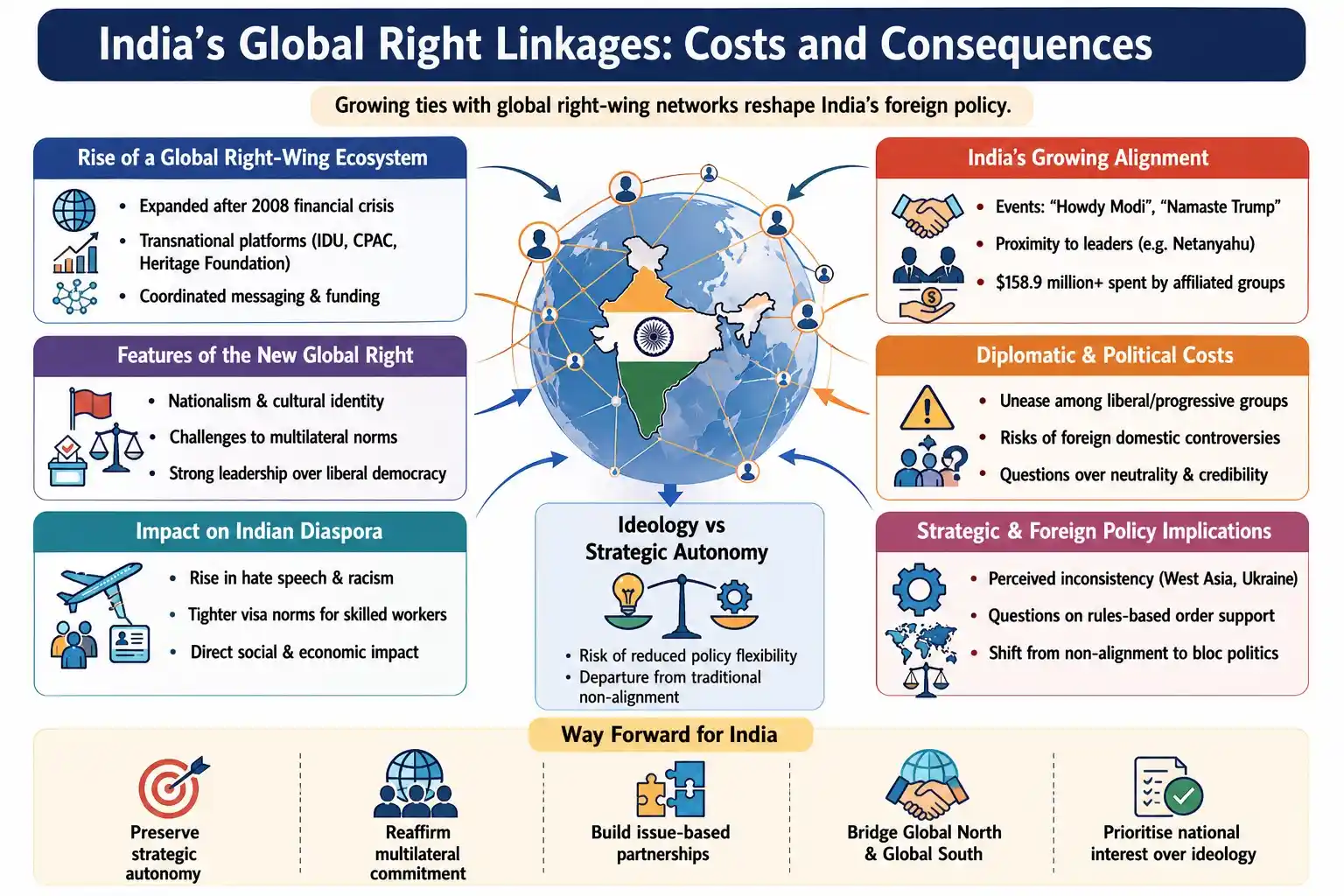
Rise of a Global Right-Wing Ecosystem
- The global right has expanded significantly after disruptions like the 2008 financial crisis, which fuelled economic anxieties and populist politics.
- It operates through organised transnational platforms such as the International Democracy Union, Conservative Political Action Conference (CPAC), and the Heritage Foundation.
- These networks coordinate political messaging, funding, and strategies across countries, creating a shared ideological space beyond national boundaries.
Features of the New Global Right
- The global right promotes a worldview centred on nationalism, cultural identity, and scepticism of liberal international norms.
- It often challenges multilateral institutions and emphasises strong leadership over liberal democratic processes.
- There is increasing evidence of democratic regression in several countries influenced by these trends.
India’s Growing Alignment
- India’s foreign policy shows signs of ideological signalling through events like “Howdy Modi” and “Namaste Trump”.
- Political proximity to leaders such as Benjamin Netanyahu reflects emerging alignment within this global network.
- Reports indicate large-scale funding support for right-wing causes globally, including over $158.9 million spent by a few affiliated organisations in the United States.
- India’s engagement appears to extend beyond diplomacy into ideological convergence, marking a departure from purely interest-based policy.
Diplomatic and Political Costs
- India’s perceived alignment with the global right has created unease among liberal and progressive groups internationally.
- Incidents such as political controversies in Leicester (UK) highlight risks of involvement in domestic issues of other countries.
- This can undermine India’s image as a neutral and responsible global actor.
Impact on Indian Diaspora
- The rise of global ideological polarisation has coincided with increased hate speech, racism, and restrictions on Indian migrants in some countries.
- Skilled Indian workers face tighter visa norms, affecting mobility and economic opportunities.
- These developments show that foreign policy choices can have direct social and economic consequences for Indians abroad.
Strategic and Foreign Policy Implications
- India’s traditional support for a rules-based international order and multilateralism is being questioned.
- Its selective responses to global conflicts (West Asia, Ukraine, etc.) create perceptions of inconsistency and strategic ambiguity.
- India’s cautious or limited responses are increasingly viewed as a retreat from its role as a leader of the Global South.
Ideology vs Strategic Autonomy
- A key concern is that ideological alignment may override national interest considerations.
- Close association with specific global blocs can reduce India’s strategic flexibility and independent decision-making.
- This marks a shift from India’s traditional approach of non-alignment and multi-alignment.
Global Context: Crisis of Liberal Order
- The rise of the global right is partly a reaction to perceived failures of the liberal international order, including:
- Economic inequality
- Colonial legacy
- Unequal global governance structures
- However, replacing it with a rigid ideological order risks fragmentation, nationalism, and weakened cooperation.
Way Forward for India
- India must balance engagement with global powers while preserving strategic autonomy.
- It should reaffirm commitment to multilateralism and inclusive global governance.
- There is a need to build issue-based partnerships rather than ideological alliances.
- India should strengthen its role as a bridge between Global North and Global South.
- Diplomatic efforts must prioritise long-term national interest over short-term ideological gains.
India’s association with global right-wing networks reflects an evolving geopolitical reality, but it also carries significant risks to its diplomatic identity and global standing. To navigate this complex environment, India must adopt a balanced approach that safeguards its strategic autonomy, reinforces multilateral engagement, and ensures that its foreign policy remains guided by national interest rather than ideological alignment.
Prelims Boosters
Atomic Energy Regulatory Board (AERB)
Context:
- AERB has approved installation of key equipment for Kudankulam Nuclear Power Project (Units 5 & 6)
About
- AERB is India’s nuclear regulatory authority
- It ensures safe use of nuclear energy and radiation
- Established on: 15 November 1983
- Under: Atomic Energy Act, 1962
Objective
- To ensure:
- Public safety
- Environmental protection
- From risks of:
- Radiation and nuclear activities
Evolution (Background)
- 1969 → Safety committees for nuclear plants
- 1972 → DAE Safety Review Committee (DAE-SRC)
- 1979–81 → Committees recommended independent regulator
- 1983 → AERB established
- 1987 → Expanded functions (SARCOP formed)
Key Functions
Safety Standards
- Sets rules and guidelines for nuclear safety
Licensing & Permissions
- Approves stages like:
- Construction
- Equipment installation
- Operation
Safety Review
- Conducts multi-level safety checks
- Reviews plant design and construction
Radiation Protection
- Ensures safety in:
- Medical radiation (X-rays etc.)
- Industrial use
Monitoring & Oversight
- Supervises working of nuclear plants through:
- SARCOP (Safety Review Committee)
Policy Support
- Helps government frame rules under:
- Atomic Energy Act
- Environment Protection Act
Significance
- Ensures safe nuclear power expansion
- Builds public confidence in nuclear energy
- Prevents nuclear accidents and radiation risks
INS Mahendragiri
Context:
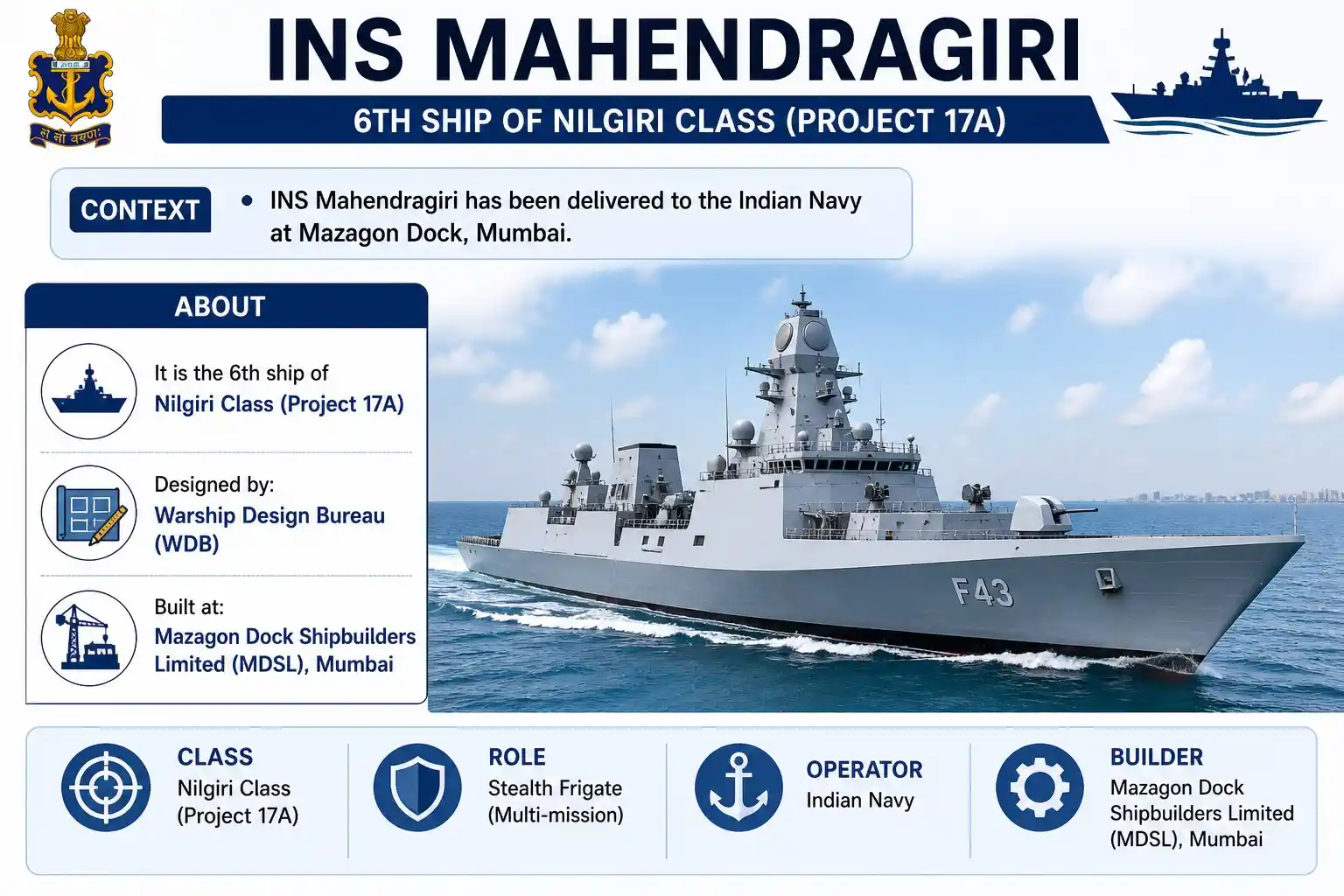
- INS Mahendragiri has been delivered to the Indian Navy at Mazagon Dock, Mumbai
About
- It is the 6th ship of Nilgiri Class (Project 17A)
- Designed by: Warship Design Bureau (WDB)
- Built at: Mazagon Dock Shipbuilders Limited (MDSL), Mumbai
Project 17A Frigates
- These are advanced stealth multi-mission frigates
- Designed for:
- Modern maritime warfare challenges
- Other ships in this class:
- INS Nilgiri
- INS Himgiri
- INS Udaygiri
- INS Taragiri
- INS Vindhyagiri
Key Features
Propulsion
- Uses CODOG system (Combined Diesel or Gas)
(diesel for efficiency + gas turbine for speed) - Equipped with:
- Controllable Pitch Propeller (CPP)
- Integrated Platform Management System (IPMS)
Weapon Systems
- Capable of:
- Anti-air warfare
- Anti-surface warfare
- Anti-submarine warfare
- Advanced systems include:
- BrahMos missiles
- Barak-8 air defence system
- MF-STAR radar
Significance
- Enhances India’s naval power and maritime security
- Strengthens indigenous defence manufacturing
- Improves capability in multi-dimensional warfare
Leprosy (Hansen’s Disease)
Context:
- Delhi plans to make Leprosy a notifiable disease (mandatory reporting of cases)
About
- Leprosy is an infectious disease
- Caused by bacteria: Mycobacterium leprae
- It affects:
- Skin
- Peripheral nerves (nerves in hands/feet)
- Respiratory tract lining
- Eyes
- It is a Neglected Tropical Disease (NTD)
Transmission
- Spreads through:Droplets from nose and mouth of untreated patient
- Requires:Prolonged close contact
- Does NOT spread by:Handshake, Hugging and Sharing food
- Patient becomes non-infectious after treatment starts
Symptoms
|
Treatment
|
Issues
- Leads to:Social stigma and discrimination
- Still present in:120+ countries (~2 lakh cases/year)
Significance of Notifiable Status
- Ensures:
- Early detection
- Better monitoring
- Disease control
Whitley Awards (“Green Oscars”)
Context:
- Indian conservationists Barkha Subba and Parveen Shaikh won awards for protecting Himalayan salamander and Indian skimmer
About
- Whitley Awards are called the “Green Oscars”
- Given by: Whitley Fund for Nature (UK)
- Purpose:Recognise grassroots conservation leaders (especially in Global South)
- Funding:Winners receive £50,000 for conservation projects
Significance
- Supports local biodiversity conservation
- Encourages community-based solutions
- Helps protect endangered species
Himalayan SalamanderAbout
Distribution
Features
Status
|
Indian SkimmerAbout
Unique Feature
Habitat
Distribution
Status
|
DAMPE Satellite (Wukong)
Context:
- China’s DAMPE satellite observed changes in cosmic ray intensity at high energy levels
About
- DAMPE (Dark Matter Particle Explorer) is a space telescope
- Nickname: “Wukong”
- It is China’s first astronomical satellite
Launch Details
- Launched on: 17 December 2015
- Orbit:Sun-synchronous polar orbit
- Altitude: ~500 km
Purpose (Objectives)
- To study:
- Dark matter (unknown invisible matter in universe)
- Cosmic rays (high-energy particles from space)
- Gamma rays (high-energy radiation)
Key Functions
Dark Matter Detection
- Searches for signs/signatures of dark matter
Cosmic Ray Study
- Studies particles like:Hydrogen nuclei and Helium nuclei
- Helps understand:Origin of cosmic rays and How they travel in space
High-Energy Astronomy
- Observes gamma rays and energetic particles
Recent Finding
- Found that:Cosmic radiation intensity drops sharply after a certain high-energy level
- This helps scientists understand:Particle acceleration in space
Performance
- Recorded:~18.5 billion particle events since launch
Significance
- Helps in solving the mystery of dark matter
- Improves knowledge of space physics and cosmic radiation
- Supports advanced space research