Can Middle School Students Engage with AI?
The integration of Artificial Intelligence (AI) into school education reflects the changing demands of a digital society, where early exposure to technology is becoming essential. The proposal to introduce Computational Thinking (CT) and AI at the middle school level raises an important question about whether students at this stage possess the cognitive ability and pedagogical readiness to meaningfully engage with such advanced concepts.
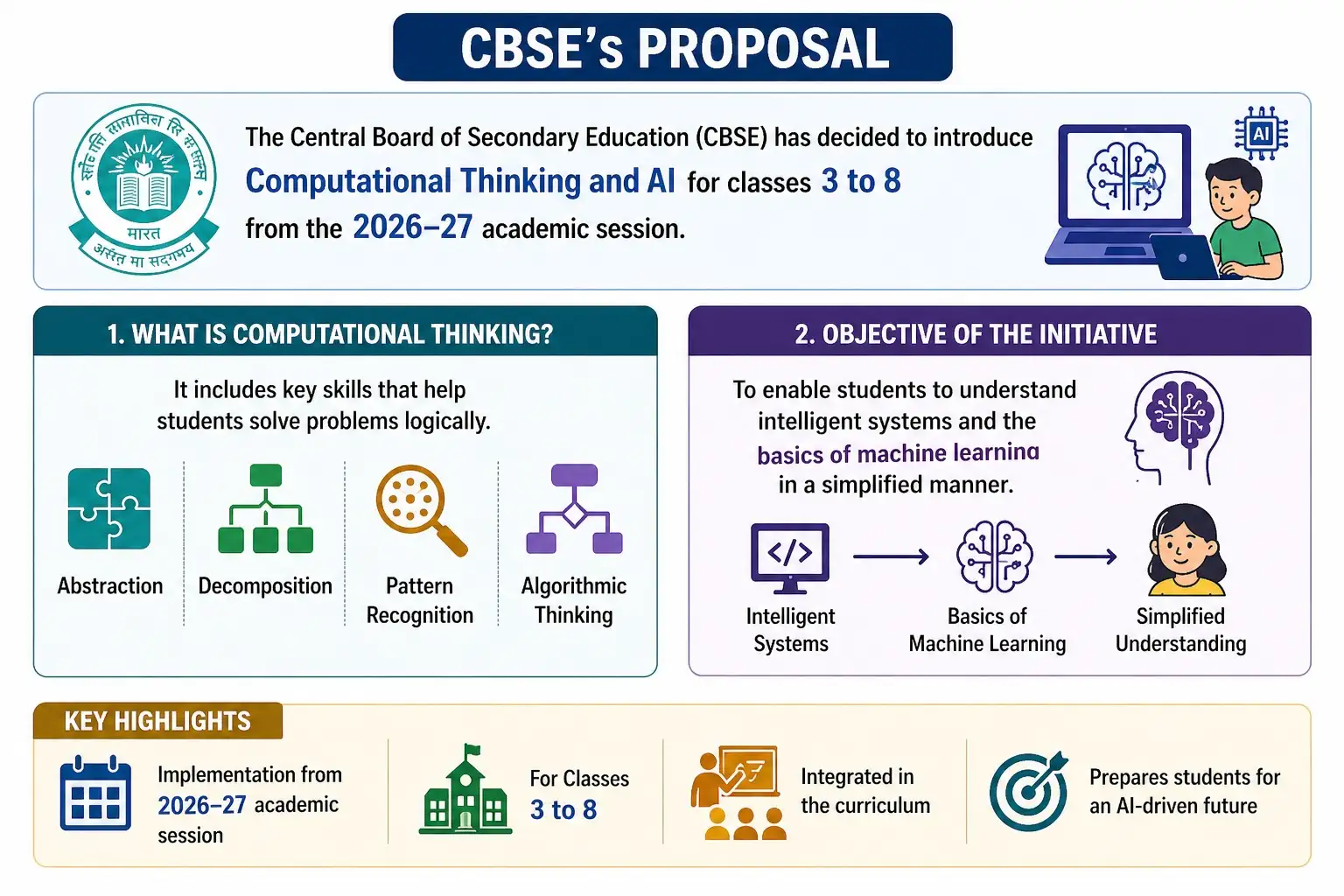
Importance of Early AI Exposure
- Early exposure to AI helps students develop logical thinking and structured problem-solving abilities from a young age.
- It enables students to understand the functioning of digital technologies that are increasingly shaping everyday life.
- AI literacy is gradually becoming as important as basic literacy, making early education in this field necessary.
Global Best Practices
- International frameworks developed by organisations such as OECD and UNESCO recognise Computational Thinking as the foundation for AI learning.
- The AI4K12 initiative in the United States introduces AI concepts progressively across different school levels.
- These frameworks recommend introducing concepts such as data literacy and basic AI understanding at an early stage.
- The CBSE curriculum broadly aligns with these global practices and standards.
Learning Capacity of Middle School Students
- Research studies indicate that children between the ages of 10 and 14 can understand foundational AI concepts when taught appropriately.
- Students can engage effectively with AI concepts when teaching methods are interactive and structured.
- They are capable of understanding basic ideas such as pattern recognition, prediction, and simple models.
- Therefore, introducing AI at the middle school level is pedagogically feasible.
Role of No-Code Tools
- The use of no-code tools allows students to engage with AI without requiring programming knowledge.
- These tools enable students to design, build, and test simple AI-based projects.
- This approach makes AI learning more accessible, practical, and engaging for young learners.
Risks and Concerns
- There is a possibility that students may begin to attribute human-like intelligence and emotions to AI systems.
- Young learners may develop overdependence on AI tools without fully understanding their limitations.
- There is also a risk of exposure to biased or incorrect outputs generated by AI systems.
Addressing Risks through Ethical Education
- The CBSE curriculum includes components related to AI fairness, responsible usage, and digital safety.
- Students are taught to identify biases in data and to critically evaluate AI outputs.
- Ethical awareness helps students distinguish between human intelligence and machine capabilities.
Shift from Rote Learning
- The introduction of CT and AI represents a shift away from traditional rote-based learning methods.
- It promotes inquiry-based learning, critical thinking, and problem-solving skills.
- This approach encourages students to actively engage with concepts rather than passively
Interdisciplinary Learning
- The curriculum integrates AI with subjects such as Mathematics and Environmental Studies.
- This interdisciplinary approach helps students understand real-world applications of AI concepts.
- It also enhances holistic learning and improves analytical abilities.
Middle school students are capable of engaging with Artificial Intelligence when it is taught through simplified, structured, and ethical frameworks. The focus should be on building foundational understanding, critical thinking, and responsible usage rather than technical complexity. If implemented effectively, this initiative can transform the education system by preparing students for a technology-driven future while promoting meaningful and experiential learning.
Where Fossil Fuel Shocks Hurt India’s Farms
India’s agricultural system has undergone a major transformation from traditional, animal-based farming to mechanised and chemical-intensive agriculture. This shift has significantly increased productivity but has also made farming heavily dependent on fossil fuels, thereby exposing the sector to global energy price shocks and supply disruptions.
Structural Shift in Indian Agriculture
- India has transitioned from bullock-based farming to tractor-driven and machine-based agriculture over time.
- Mechanisation has replaced animal labour in ploughing, irrigation, and harvesting activities.
- Electrical and diesel-powered systems now dominate farm operations, especially irrigation pumps.
- As a result, agriculture has become increasingly dependent on energy-intensive inputs.
Rise of Chemical Fertilisation
- Traditional farming relied on organic manure such as cow dung and crop residues for nutrients.
- The Green Revolution introduced chemical fertilisers such as urea, DAP, and MOP for higher productivity.
- These fertilisers provide nutrients in concentrated forms, enabling higher crop yields.
- However, their production is highly dependent on fossil fuels, especially natural gas.
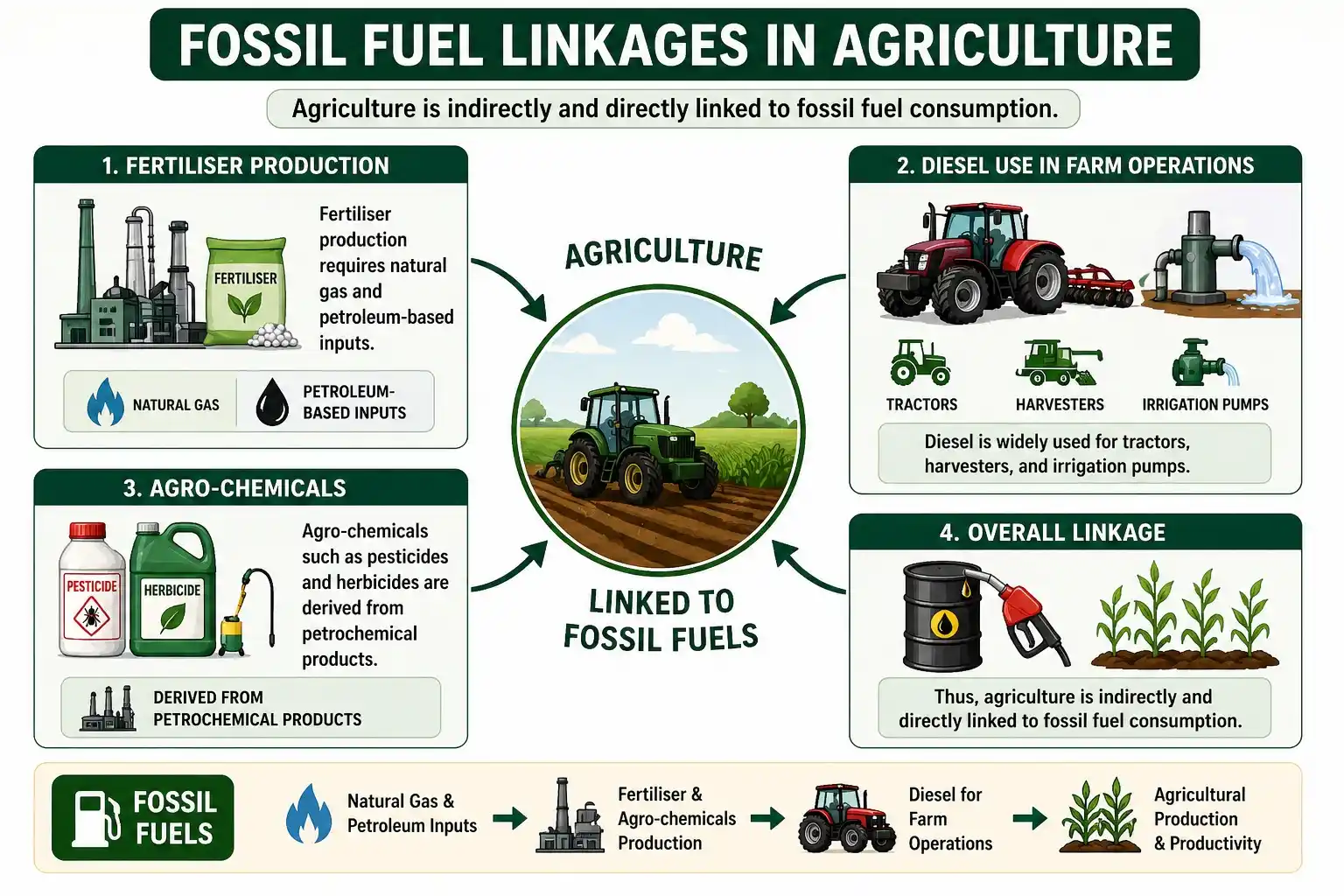
Impact of Global Energy Shocks
- Disruptions such as geopolitical conflicts increase global oil and gas prices.
- Higher input costs raise the cost of fertilisers, diesel, and agro-chemicals.
- This leads to increased cost of cultivation for farmers.
- Farmers’ profit margins decline, especially for small and marginal farmers.
Supply Chain Vulnerabilities
- India imports a significant share of its fertiliser inputs and raw materials.
- Dependence on global markets exposes the sector to external shocks and shortages.
- Events like disruptions in the Strait of Hormuz can affect fertiliser supply chains.
- Export restrictions by major producers can further worsen availability.
Green Revolution and Energy Dependence
- The Green Revolution increased agricultural output through high-yielding varieties and chemical inputs.
- It was heavily dependent on fossil fuel-based inputs such as fertilisers and irrigation energy.
- While it ensured food security, it also created long-term structural dependence on energy inputs.
Broader Economic Effects
- Rising input costs contribute to food inflation in the economy.
- Increased subsidy burden on the government for fertilisers and fuel support.
- Pressure on rural incomes and consumption patterns.
- Macroeconomic instability due to imported inflation and fiscal stress.
Need for Transition
- There is a need to reduce dependence on fossil fuel-based inputs in agriculture.
- Promotion of organic farming and bio-fertilisers can reduce chemical dependence.
- Renewable energy solutions such as solar-powered irrigation pumps should be expanded.
- Efficient water and nutrient management practices can lower input requirements.
India’s agricultural success has been closely tied to fossil fuel-driven inputs, but this dependence has also created structural vulnerabilities to global energy shocks. Moving towards sustainable, energy-efficient, and locally resilient farming systems is essential to protect farmers’ incomes and ensure long-term food security.
Prelims Boosters
INS Kalpeni
Context:
- INS Kalpeni has arrived at Gan (Addu Atoll, Maldives) to strengthen India–Maldives maritime cooperation
About
- INS Kalpeni is a Fast Attack Craft (FAC) of the Indian Navy
- It belongs to the Car Nicobar-class Waterjet Fast Attack Crafts
- Built by: Garden Reach Shipbuilders and Engineers (GRSE), Kolkata
- Commissioned on: 14 October 2010
- It is named after Kalpeni Island (Lakshadweep)
Base & Command
Primary Roles
|
Key Features1. High Speed Craft
2. Size
3. Armaments
|
Significance
- It strengthens maritime security in Indian Ocean Region (IOR)
- It enhances India–Maldives defence cooperation
- It supports anti-smuggling and coastal protection
New Zealand
Context:
- India and New Zealand are set to sign a Free Trade Agreement (FTA)
About
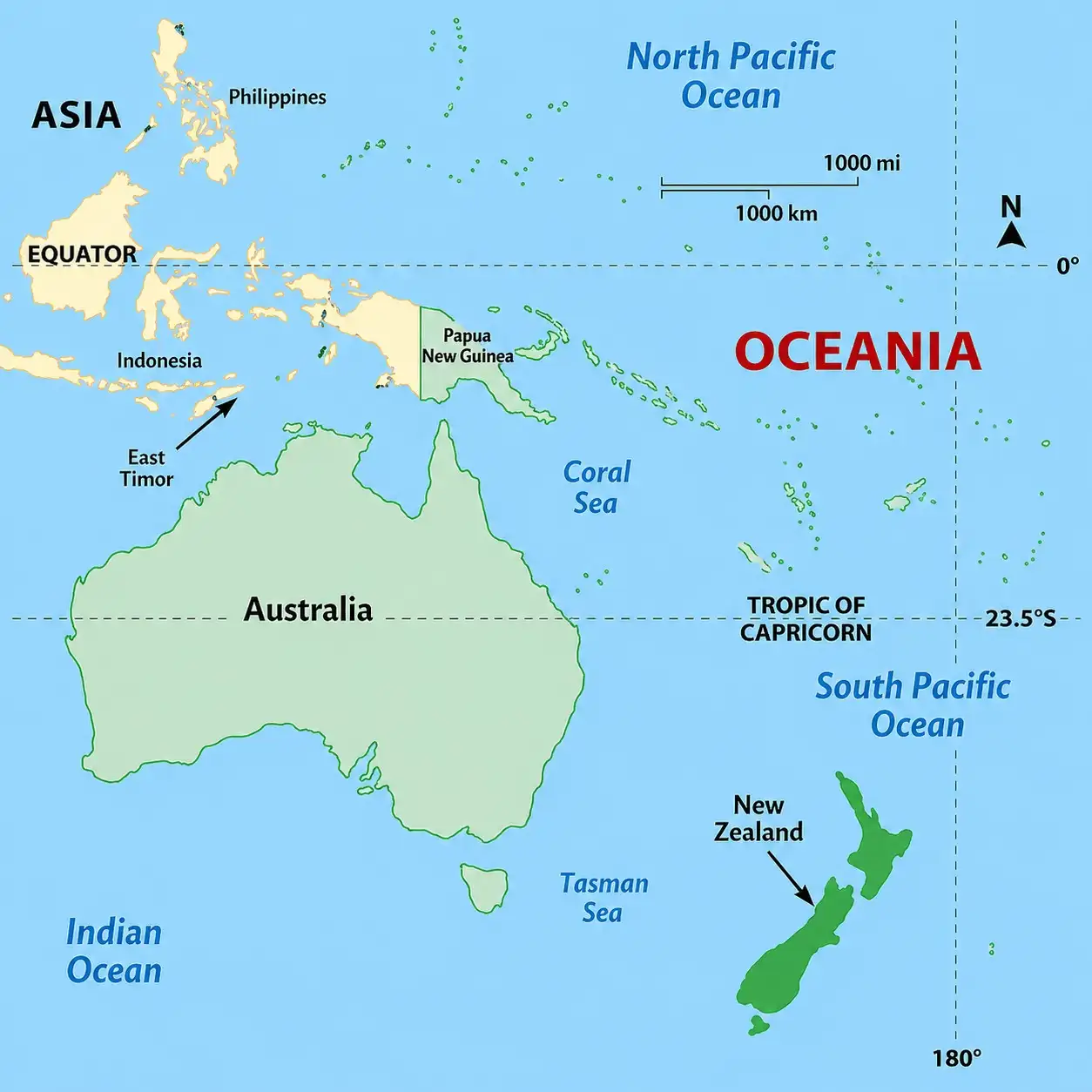
- New Zealand is an island country in Oceania
- It lies in the South Pacific Ocean
- It is located: Southeast of Australia. Near Fiji, Tonga, New Caledonia
- Capital: Wellington
Geographical Features
1. Island Structure
2. Tectonic Activity
|
3. Climate
4. Mountains & Peaks
5. Volcanoes
6. Glaciers & Lakes
|
Natural Resources
- It has: Gold, silver, Iron sands, Phosphate, limestone
Significance
- It is strategically located in the Pacific region
- It is important for trade and Indo-Pacific cooperation
- The FTA will boost India’s exports and economic ties
Doppler Weather Radar (DWR)
Context:
- A new X-band Doppler Weather Radar has been installed at Mahabaleshwar under Mission Mausam
About
- A Doppler Weather Radar (DWR) is a special radar used for weather monitoring
- It works using the Doppler Effect (change in frequency due to movement of objects)
- It provides information about: Position of objects (rain, clouds) & Movement and speed of weather systems
Types of Radar Bands
- S-band → Long-range weather monitoring
- C-band → Cyclone tracking
- X-band → Thunderstorms, lightning detection
Working
|
Applications1. Weather Forecasting
2. Cyclone Monitoring
3. Thunderstorm Detection
4. Disaster Management
|
Significance
- It improves accuracy of weather forecasting
- It helps in disaster preparedness
- It supports agriculture and aviation safety
Nilgiri Tahr
Context:
- A synchronized Nilgiri Tahr survey is being conducted by Tamil Nadu and Kerala
About
- The Nilgiri Tahr is a mountain-dwelling hoofed animal (ungulate)
- Scientific Name: Nilgiritragus hylocrius
- It is the only mountain ungulate in southern India
Habitat & Distribution
- It lives in high-altitude grasslands (montane grasslands)
- Altitude range: 1200–2600 meters
- It is found in: Western Ghats (India) and From Nilgiris (north) to Kanyakumari hills (south)
- Major population: Eravikulam National Park (Kerala)
- It is now found in fragmented habitats due to habitat loss
Key Characteristics
1. Adaptation
2. Social Behaviour
|
3. Reproduction
4. Monitoring Tools
|
Conservation Status
- IUCN Status: Endangered
Significance
- It is the State Animal of Tamil Nadu
- It is endemic to the Western Ghats (found nowhere else)
- It acts as an indicator of ecosystem health
Leaf Spot Diseases
Context:
- Leaf spot disease is affecting arecanut plantations in Karnataka, and field demonstrations are being conducted for management
About
- Leaf spot disease refers to a group of plant diseases
- It is caused by: Fungi (major cause ~85%), Bacteria and Other microorganisms
- It affects the leaves of plants
Symptoms
- It causes:
- Spots or lesions on leaves
- Yellowing and browning of leaves
- Shrivelling and premature leaf fall
- It reduces photosynthesis (food-making process in plants)
Causes
- Biological Causes: Fungi (most common) and Bacteria
- Environmental Causes (Non-pathogenic): Water stress (too much/too little water); Sun damage (sun scald); Chemical burns (pesticides/herbicides); Nutrient deficiency
Favourable Conditions
- Humid and wet climate
- It spreads faster in warm, moist conditions
Affected Crops
- It affects: Arecanut, Vegetables, Fruit trees, Ornamental plants
Impact
- It leads to: Reduced crop yield, Poor plant health and Economic loss to farmers
Control Measures
- It requires a combination of:
- Cultural methods (proper spacing, sanitation)
- Biological control (natural agents)
- Chemical treatment (fungicides/bactericides)