India Needs to Win Back Foreign Investors: Three Critical Steps Ahead
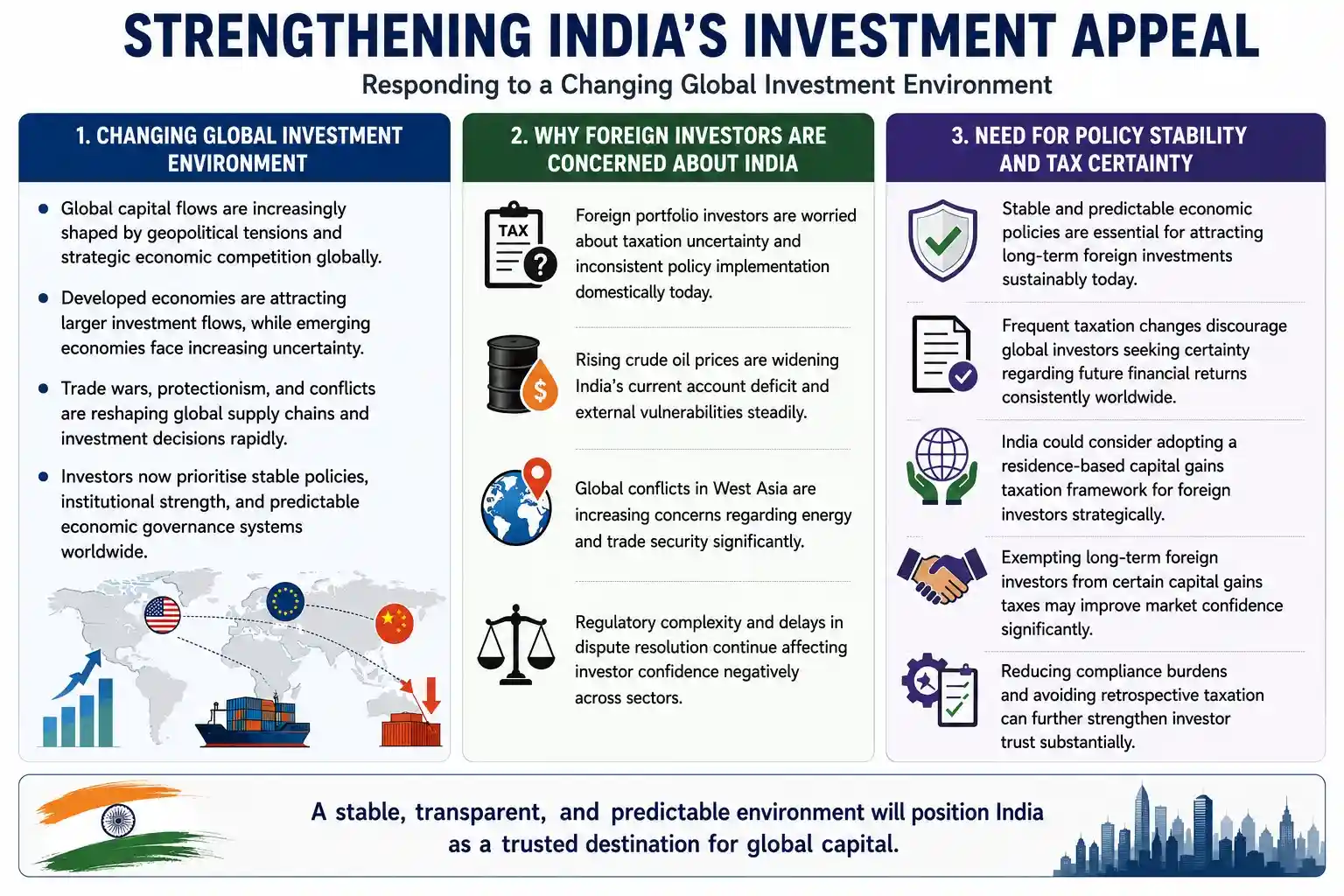
Importance of Macroeconomic Stability
- Strong macroeconomic fundamentals remain crucial for maintaining long-term foreign investor confidence across financial markets.
- India must carefully manage inflation, fiscal deficits, and currency volatility through balanced economic policies.
- Stable exchange rates and manageable debt levels reassure investors regarding future financial stability domestically today.
- Healthy foreign exchange reserves provide protection against sudden global economic and financial disruptions internationally.
Boosting India’s Competitiveness
- India must improve competitiveness through infrastructure expansion and efficient logistics networks nationwide rapidly today.
- Closing infrastructure gaps can reduce business costs and improve manufacturing productivity substantially over time.
- Reliable transport, electricity, and digital connectivity are essential for attracting global manufacturing investments consistently worldwide.
- Labour reforms should balance industrial flexibility with employment security and worker welfare carefully together.
Strengthening Manufacturing and Global Value Chains
- India should deepen integration with global manufacturing and supply-chain ecosystems strategically and efficiently further.
- Export-oriented manufacturing can generate employment while increasing India’s global economic competitiveness substantially further.
- Production Linked Incentive schemes should complement broader structural and institutional reforms effectively nationwide today.
- India must focus on sectors like electronics, semiconductors, and renewable energy technologies strategically further.
Liberalising Foreign Direct Investment Policies
- India should gradually liberalise FDI rules in strategically important economic sectors carefully and transparently.
- Higher FDI inflows can support technology transfer, innovation, and industrial modernisation across sectors nationally.
- Simplified approval systems and transparent regulations can improve India’s attractiveness to global investors significantly.
- National security concerns must remain balanced alongside economic openness and foreign participation carefully together.
Role of Judicial and Institutional Reforms
- Judicial delays remain a major concern for foreign businesses operating within India currently today.
- Fast-track commercial courts can improve contract enforcement and strengthen ease of doing business significantly.
- Time-bound dispute resolution mechanisms can reduce uncertainty and improve overall investor confidence considerably further.
- Transparent governance and administrative accountability are equally important for sustaining investment inflows over time.
Importance of Financial Sector Reforms
- India requires deeper corporate bond markets to strengthen long-term domestic financing capacity significantly further.
- A stronger banking sector can improve credit availability for industries and infrastructure projects nationwide effectively.
- Financial deepening can reduce dependence on volatile short-term foreign portfolio investment flows externally today.
- Strong domestic financial institutions enhance resilience against sudden global economic and capital market shocks.
Balancing Protectionism and Global Integration
- Excessive protectionism may discourage foreign investors and weaken India’s export competitiveness over time gradually.
- India must pursue strategic trade openness while safeguarding important domestic economic interests carefully together.
- Trade agreements with major economies can improve exports, investments, and technology collaborations substantially further.
- Global integration remains essential for sustaining long-term growth and industrial transformation in India effectively.
Challenges Before India
- Global economic uncertainty continues affecting investment decisions across emerging economies significantly today worldwide.
- Oil price volatility remains a major risk because India heavily depends on crude imports.
- Infrastructure gaps, bureaucratic delays, and policy unpredictability continue affecting investor perceptions negatively domestically today.
- Competition from other emerging economies is intensifying in attracting global investment capital rapidly today.
Way Forward
- India needs comprehensive structural reforms instead of relying only on short-term policy measures today.
- Stable taxation policies and simplified regulations can significantly improve investor confidence and participation nationally.
- Infrastructure modernisation and judicial reforms should become top national economic priorities urgently today nationwide.
- India must strengthen manufacturing competitiveness while integrating deeply into global value chains strategically further.
- A predictable, transparent, and growth-oriented economic framework can restore foreign investment momentum sustainably again.
Building a Preventive Health Culture in India
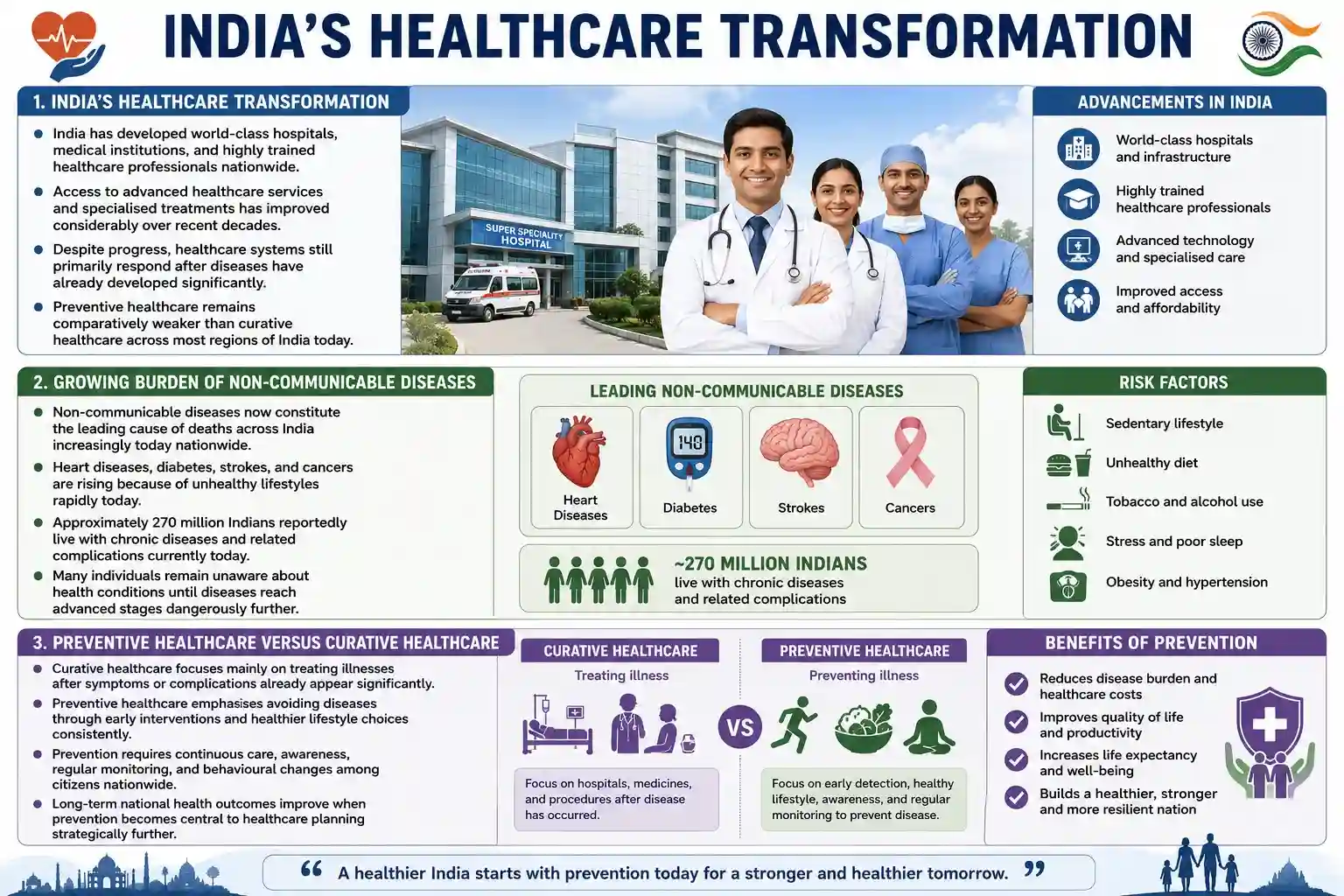
Economic Impact of Poor Preventive Healthcare
- Preventable illnesses reduce workforce productivity and negatively affect national economic growth substantially over time.
- Chronic diseases increase healthcare expenditure for families, governments, and insurance systems significantly further today.
- Young populations suffering lifestyle diseases weaken India’s demographic dividend and developmental potential considerably further.
- Productivity losses caused by illness affect both household incomes and broader economic performance negatively today.
Importance of Early Detection and Timely Intervention
- Early diagnosis significantly improves treatment outcomes and reduces healthcare costs for patients substantially further.
- Timely interventions can prevent diseases from progressing into severe or irreversible medical conditions significantly.
- Regular health screenings help identify hidden risks before visible symptoms emerge among individuals nationwide.
- Preventive check-ups can delay or reverse many lifestyle-related health disorders effectively over time further.
Critical Age Group for Preventive Action
- The age group between thirty and forty years requires focused preventive healthcare interventions urgently nationwide.
- During these years, lifestyle patterns strongly influence future cardiovascular and metabolic health outcomes significantly.
- Career pressures, urban lifestyles, stress, and unhealthy diets increase disease risks during adulthood rapidly.
- Early preventive measures during this phase can improve long-term health and productivity substantially further.
Need for Lifestyle and Behavioural Changes
- Healthy lifestyles remain the foundation of effective preventive healthcare systems across societies globally today.
- Balanced diets, regular exercise, sufficient sleep, and stress management reduce disease risks significantly further.
- Tobacco use, alcohol abuse, and sedentary lifestyles contribute heavily to chronic illnesses nationwide increasingly.
- Public awareness campaigns must encourage citizens toward healthier behavioural choices and habits consistently further.
Building a Culture of Health Awareness
- Healthcare awareness should become part of everyday life rather than emergency medical situations only.
- Citizens must understand health as continuous self-care instead of temporary treatment after illness significantly further.
- Schools, workplaces, and communities should actively promote preventive healthcare education and awareness nationwide today.
- Social attitudes toward routine health check-ups and wellness monitoring need significant transformation nationally further.
Role of Technology and Health Assessments
- Digital health technologies can improve preventive healthcare outreach and early disease detection significantly further.
- Large-scale health assessments provide valuable insights regarding emerging disease trends across populations nationally today.
- Wearable devices and telemedicine services can support continuous health monitoring and preventive interventions effectively.
- Technology-driven healthcare systems improve accessibility and efficiency, especially in remote regions nationwide further.
Government’s Role in Strengthening Preventive Healthcare
- Public health policies should prioritise prevention alongside treatment and healthcare infrastructure expansion strategically further.
- Government programmes must promote nutrition, fitness, mental health, and regular health screenings nationwide consistently.
- Primary healthcare centres should become hubs for preventive healthcare awareness and community outreach activities.
- Investments in preventive healthcare reduce long-term pressure on hospitals and emergency medical systems significantly.
Challenges in Developing Preventive Health Culture
- Lack of awareness remains one of the biggest barriers to preventive healthcare adoption nationwide today.
- Many people avoid health check-ups because symptoms are absent during early disease stages initially.
- Urban lifestyles, work pressures, and poor dietary habits continue worsening health conditions across populations nationally.
- Preventive healthcare services remain inaccessible or underutilised in several rural and economically weaker regions.
Way Forward
- India must integrate preventive healthcare into mainstream public health and development policies strategically further.
- Routine health screenings should become affordable, accessible, and socially encouraged across communities nationwide consistently.
- Educational institutions should incorporate health literacy and lifestyle awareness into academic curriculums comprehensively nationwide.
- Workplaces can promote employee wellness programmes focusing on fitness, nutrition, and mental health regularly.
- Preventive healthcare should evolve into a national movement involving governments, communities, and families together.
PRELIMS BOOSTERS
Intellectual Property Catalyst Initiative
Context:
Recently, the Ministry of Electronics and Information Technology launched the Intellectual Property Catalyst Initiative along with its digital platform.
About Intellectual Property Catalyst Initiative
- The Intellectual Property Catalyst Initiative is a digital ecosystem created to support innovation, patent development, and commercialization.
- It is being implemented by the Centre for Development of Advanced Computing (C-DAC), Pune.
- The initiative is supported by the Ministry of Electronics and Information Technology (MeitY).
Objective
- The initiative aims to bridge the gap between publicly funded research and industry adoption.
- It seeks to strengthen collaboration among government institutions, startups, MSMEs, academia, and industry.
Key Features
Support for Intellectual Property Filing
International Patent Support
Digital Platform
|
Commercialisation Support
Industry-Academia Collaboration
Indigenous Technology Promotion
Prototype-to-Product Support
|
Significance
- The initiative strengthens India’s innovation and intellectual property ecosystem.
- It promotes commercialization of indigenous technologies and supports startup growth.
- It can help improve technology transfer and enhance India’s global competitiveness in innovation.
Coal Gasification
Context:
Recently, the Union Cabinet approved a ₹37,500 crore package to promote coal gasification in India.
About Coal Gasification
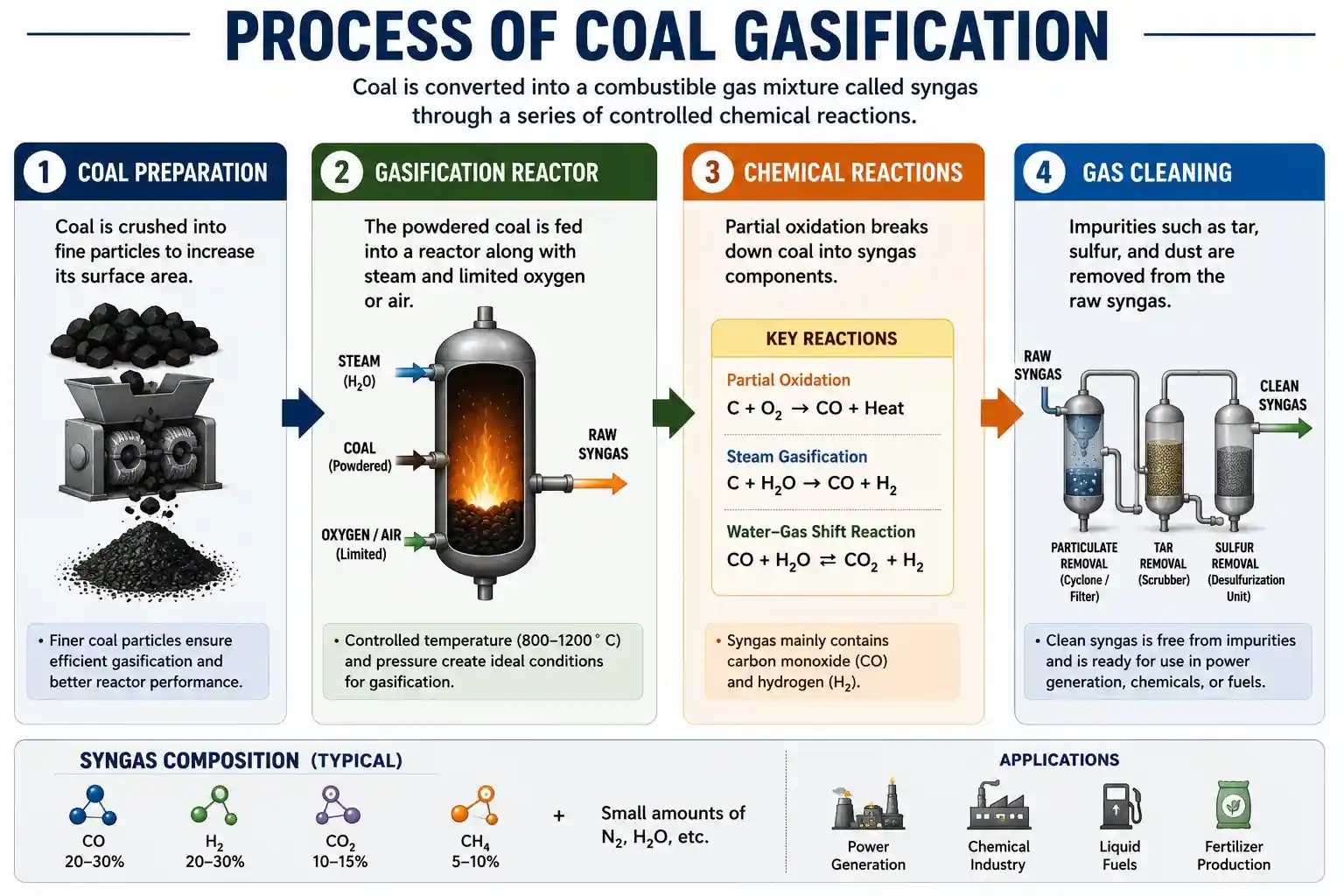
- Coal gasification is a thermo-chemical process that converts coal into syngas.
- Syngas is a synthetic gas mainly composed of:
- Carbon monoxide (CO), Hydrogen (H₂), Carbon dioxide (CO₂), Methane (CH₄), Water vapour (H₂O)
- In this process, coal reacts with a controlled amount of oxygen and steam at very high temperatures ranging from 1000°C to 1400°C.
Benefits of Coal Gasification
Cleaner Alternative
Reduced Pollution
|
Import Reduction
Industrial Use
|
Directorate General of Foreign Trade (DGFT)
Context:
Recently, the Directorate General of Foreign Trade prohibited the export of raw, white, and refined sugar till September 30 amid the ongoing West Asia conflict.
About DGFT
- The Directorate General of Foreign Trade is an attached office of the Ministry of Commerce and Industry.
- It is responsible for implementing and regulating India’s foreign trade framework.
Objective
- DGFT formulates and implements India’s Foreign Trade Policy (FTP).
- It aims to promote exports, regulate imports, and facilitate international trade.
Background
- Before 1991, DGFT was known as the Chief Controller of Imports and Exports (CCI&E).
- After economic liberalisation, it was restructured as DGFT with a greater focus on trade facilitation.
Headquarters
- DGFT headquarters is located in New Delhi.
It functions through a network of 24 regional offices across India.
Key Functions of DGFT
Foreign Trade Policy Implementation
Importer Exporter Code (IEC)
Regulation of Trade
|
Export Permissions
Input-Output Norms
Trade Promotion
|
Indian Ocean Dialogue (IOD)
Context:
India recently hosted the 10th edition of the Indian Ocean Dialogue in New Delhi under the theme “Indian Ocean Region in a Transforming World.”
About Indian Ocean Dialogue
- The Indian Ocean Dialogue is a premier Track 1.5 forum focused on strategic and regional issues in the Indian Ocean Region.
- It brings together government representatives, scholars, think tanks, and civil society experts for discussions on regional cooperation.
Establishment
- The dialogue was conceived during the 13th Council of Ministers meeting of IORA held in Perth, Australia, in 2013.
- The first edition of the dialogue was hosted by India in Kerala in 2014.
Objective
- The main aim of the dialogue is to encourage free and open discussions on issues affecting the Indian Ocean Region.
- It seeks to strengthen maritime cooperation, regional security, and sustainable development.
Theme of the 10th Edition
- The theme of the 10th edition was “Indian Ocean Region in a Transforming World.”
- It focused on geopolitical changes and emerging maritime challenges.
Key Features
Track 1.5 Forum
- It combines participation of both government officials and non-government experts.
Organising Bodies
- The dialogue is organised by the Ministry of External Affairs in partnership with the Indian Council of World Affairs and the IORA Secretariat.
Participation
- Representatives from 23 IORA member states and 12 dialogue partners participate in the event.
Focus Areas
The discussions focus on:
- Maritime safety and security, Blue economy, Fisheries management, Trade and investment, Disaster risk management
Significance
- The dialogue strengthens regional cooperation in the Indian Ocean Region.
- It highlights India’s growing leadership role in maritime affairs, especially during its IORA Chairship for 2025–27.
- It also supports India’s MAHASAGAR vision for regional security and growth.
National Sports Development Fund (NSDF)
Context:
Recently, information obtained through the RTI Act revealed that contributions to the National Sports Development Fund have declined sharply between 2023–24 and 2025–26.
About National Sports Development Fund
- The National Sports Development Fund was established in 1998.
- It was created under the Charitable Endowments Act, 1890.
Objective
- The main objective of NSDF is to support and promote sports development in India.
- It aims to help sportspersons achieve excellence at national and international levels.
Funding Sources
- The fund receives contributions from:
- Public sector organisations, Private sector companies, Non-Resident Indians (NRIs), Charitable institutions and non-profit organisations and Government contributions
Major Objectives of NSDF
Promotion of Sports
Training and Coaching
Sports Infrastructure
| Sports Equipment
Research and Development
International Cooperation
|
Management and Administration
Council of NSDF
|
Members
|
Executive Committee
|