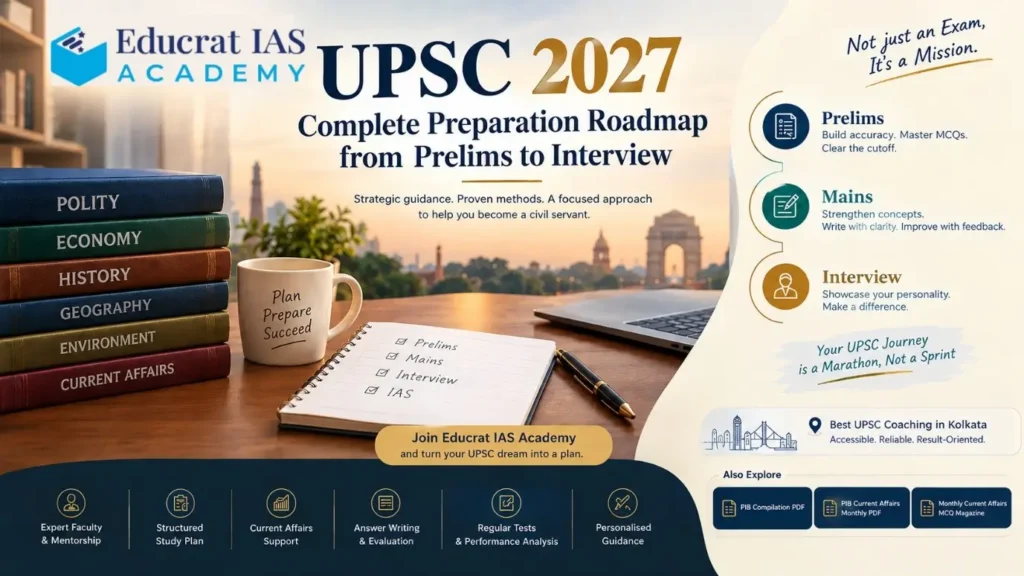
Preparing for UPSC 2027 requires more than collecting books, watching lectures, or studying for long hours. What matters is building a structured preparation system that connects Prelims, Mains and the Personality Test from the beginning.
At Educrat IAS Academy, the Best IAS Academy in Kolkata, we believe that for a serious aspirant, preparation should be a process of understanding the syllabus, building conceptual foundations, integrating current affairs, practising answer writing, revising repeatedly and evaluating performance through tests.
This roadmap explains how to approach UPSC 2027 step by step, from understanding the examination and choosing sources to preparing for Prelims, transitioning to Mains and eventually facing the Personality Test.
Understand the UPSC Examination Before You Start Preparing
Before beginning preparation, understand what the examination actually demands. The Civil Services Examination has three broad stages: Preliminary Examination, Main Examination and Personality Test.
Stage 1: Preliminary Examination
The Preliminary Examination consists of two objective-type papers:
| Paper | Key Feature |
| General Studies Paper I | Used for determining qualification for the Mains stage |
| General Studies Paper II / CSAT | Qualifying in nature |
Prelims is a screening examination. The marks obtained in Prelims are not counted towards the final merit list. The objective at this stage is to clear the prescribed cutoff while managing accuracy, elimination and time effectively.
Stage 2: Main Examination
The Main Examination is descriptive and tests your ability to analyse issues, organise arguments and present them in a clear, relevant and balanced manner.
The written examination consists of nine papers, including two qualifying papers. The merit papers include Essay, General Studies I to IV and two papers of the chosen optional subject. The language papers are qualifying in nature.
Mains therefore demands more than factual knowledge. It tests whether an aspirant can interpret a question, organise relevant knowledge and communicate a balanced argument within a limited time.
Stage 3: Personality Test
Candidates who qualify in the written Mains appear for the Personality Test. It assesses qualities relevant to public service, including awareness, judgement, balance, communication, intellectual curiosity and integrity.
Start With the UPSC Syllabus
The syllabus should become the foundation of your preparation.
Before purchasing multiple books, joining several courses or collecting large amounts of material, study the official UPSC syllabus carefully. Keep it beside your study material and ask a simple question about every topic:
Where does this fit into the syllabus?
A useful working division is between static and dynamic areas.
Static areas include Polity, History, Geography, basic Economy, Environment, Ethics and foundational social issues. Dynamic areas are continuously enriched by current developments, such as government schemes, international relations, economic policy, science and technology, environment, internal security and governance.
The objective is not to study the two separately forever. The real advantage comes from connecting them.
Top UPSC coaching centres like Educrat IAS Academy follow a syllabus-oriented approach so that preparation remains focused rather than becoming an exercise in content accumulation.
Build a Strong Foundation First
For a UPSC 2027 aspirant, the initial months should focus on conceptual clarity rather than rushing towards test after test.
NCERTs can help establish basic understanding, particularly when a subject is unfamiliar. Once the fundamentals are clear, move towards a limited set of standard sources. One good primary source, revised several times, is generally more useful than several partially studied sources.
A sound foundation usually includes NCERTs where required, one standard source per major subject, newspaper reading, PYQ analysis, current affairs integration, regular revision and gradual answer-writing practice.
The aim is to understand the syllabus, recognise recurring themes and explain basic concepts clearly.
Connect Current Affairs With Static Subjects
Current affairs are essential, but they should not become the entire preparation.
A common beginner mistake is spending several hours every day reading newspapers and monthly magazines while static subjects remain incomplete. Current affairs should supplement static knowledge rather than replace it.
A useful process is:
Static concept → Current development → Example → Data → PYQ connection → Revision
For example, while studying federalism in Polity, a contemporary Centre-State issue can become an application of the static concept. While studying climate change, an international agreement, government initiative or recent report can provide the contemporary dimension.
For government developments, a PIB compilation pdf can support selective revision. A PIB Current Affairs Monthly PDF can also help consolidate important official announcements without repeatedly searching for individual releases. A Monthly Current Affairs MCQ Magazine can be useful for checking recall and identifying factual gaps.
However, no current-affairs resource should become a substitute for understanding the underlying subject.
The better question is: how effectively can I connect current affairs to the UPSC syllabus?
Current affairs should not become an endless collection of newspaper facts. Their purpose is to add relevance, examples, data and contemporary dimensions to the syllabus.
At Educrat IAS Academy we provide UPSC Aspirants with:
Daily Current Affairs Analysis
Monthly Current Affairs Analysis Magazine
Monthly Current Affairs MCQ Magazine
Each Analysis is based on UPSC Syllabus with syllabus mapping to enhance UPSC Preparation.
Choose Your Optional Subject Early
The optional subject deserves serious attention because it forms a significant part of Mains preparation.
Do not choose an optional simply because someone calls it “scoring”. Evaluate it through practical criteria: interest, academic background, syllabus size, previous-year questions, availability of reliable resources and access to appropriate guidance.
Read the syllabus, examine PYQs and assess whether you can study and write the subject consistently.
Do not postpone optional preparation until after Prelims. Ideally, a substantial portion of optional preparation should be completed before the Prelims-focused phase begins.
If you are uncertain, personalised academic counselling can help. Educrat IAS Academy can help aspirants examine their optional choice through a structured discussion of background, syllabus, PYQs and preparation requirements.
Make Previous-Year Questions Your Decoding Tool
Previous-Year Questions are among the most valuable resources in UPSC preparation because they reveal what the examination actually asks.
PYQs help answer three questions:
What is important?
To what depth should I study it?
How does UPSC frame questions from the syllabus?
Study PYQs alongside your subjects rather than leaving them for the end. At the same time, do not build your entire strategy around one or two unusual questions. Every paper contains exceptional questions; they should be understood, but they should not dictate the whole preparation strategy.
Start with questions that directly connect to the syllabus and recurring themes. A beginner who learns to decode PYQs early can study with direction instead of simply studying more.
At Educrat, PYQs can be used to move from “What should I study?” to “Why is this being asked?” and finally to “How would I answer it?”
The Most Important Skill: Revision
UPSC preparation is not an information-collection competition. Information becomes useful only when it can be recalled and applied under examination conditions.
A sustainable cycle looks like this:
Understand → Consolidate → Revise → Recall → Test → Analyse → Revise Again
Three techniques are particularly useful.
Spaced repetition: Revisit important topics at planned intervals instead of reopening them only before the examination.
Active recall: Test yourself without looking at the source and reconstruct concepts, examples and arguments from memory.
Concise revision material: Progressively reduce large books and notes into short sheets, mind maps, tables and flowcharts.
Your final revision material should be much smaller than your original study material.
CTA: Study, revise, test and improve through a preparation cycle rather than scattered resources.
Start Answer Writing Before You Feel Ready
Aspirants often make one of two mistakes: starting answer writing before developing enough content, or waiting until after Prelims.
A better approach is gradual.
Once the basic conceptual foundation is established, begin with one or two answers a day. Progress to three answers, five answers, sectional tests and eventually full-length tests.
Focus on understanding the demand of the question, writing a relevant introduction, structuring the body logically, using examples and data where appropriate, maintaining balance and concluding effectively.
Answer writing is not simply handwriting practice. It is the ability to convert knowledge into a structured argument within a time limit. This is why feedback matters. Without evaluation, an aspirant may repeat the same structural or analytical errors for months.
Use Tests as Feedback, Not Just Evaluation
A test becomes useful only when it is analysed.
After each test, classify mistakes as knowledge gaps, conceptual gaps, application gaps, revision gaps or time-management issues. Then connect the result to your next revision cycle.
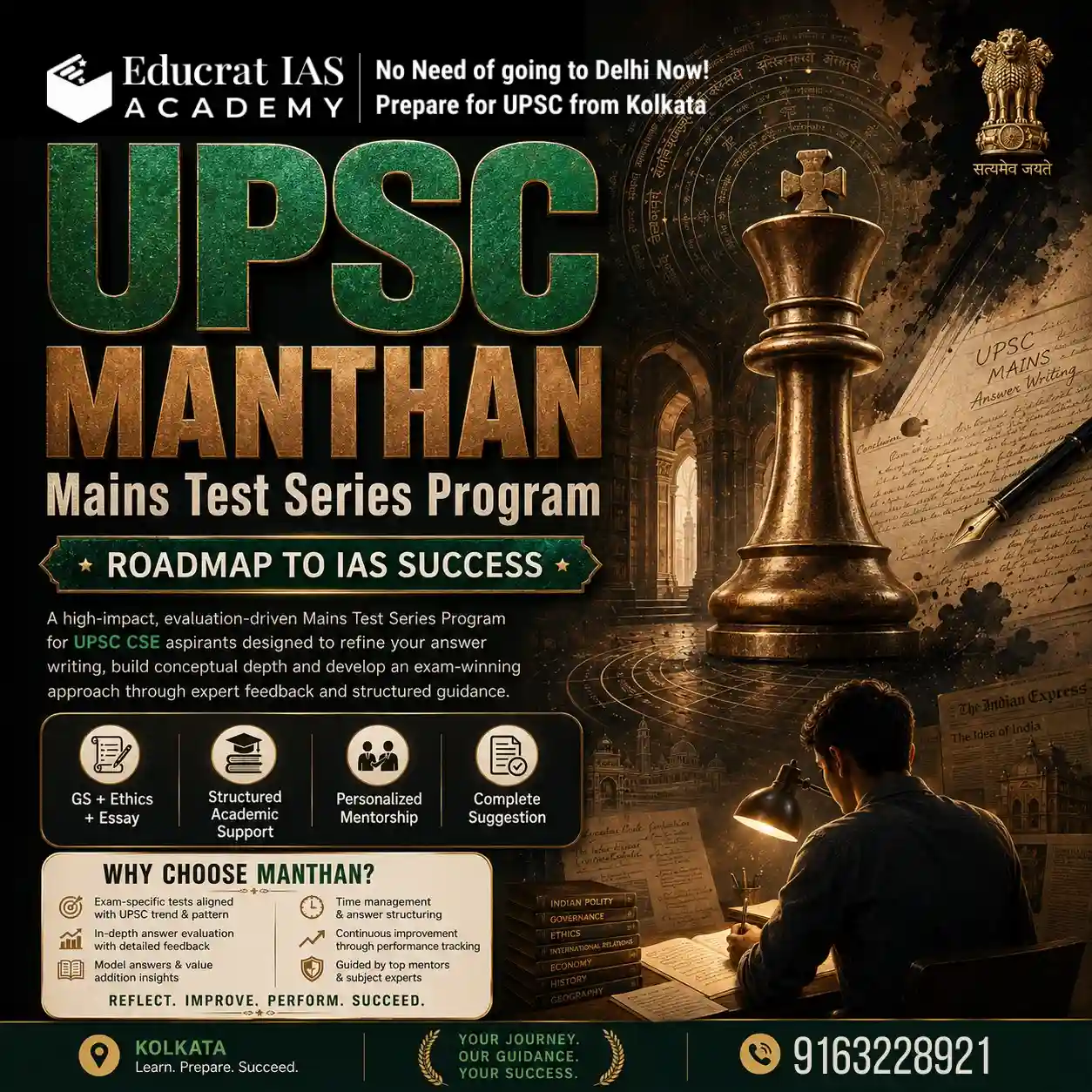
At Educrat IAS Academy, the Best UPSC Institute in Kolkata, we begin answer from the very beginning supplemented with our UPSC Mains Test Series: Manthan. Each Answer writing session and Test is followed by personalized feedback from the respective faculties.
A test should show:
Where are you losing marks?
Why are you losing them?
What should you revise next?
UPSC 2027 Preparation Timeline
The following timeline is indicative and should be adjusted according to the official UPSC calendar.
Foundation Phase: September–December 2026
Focus on understanding the syllabus, beginning core subjects, analysing PYQs, starting optional preparation, developing current-affairs habits, making notes and beginning limited answer writing.
Do not try to finish everything simultaneously. Build the academic base first.
Starting your preparation now is the stage where the right guidance can save months of trial and error.
January–May 2027: Prelims-Focused Phase
As Prelims approaches, shift gradually towards revision, MCQs, CSAT practice, PYQs, current-affairs consolidation and full-length tests.
Avoid repeatedly starting new sources. The emphasis should increasingly be on recall, accuracy and elimination.
Take simulated tests under examination conditions, but remember that a test is useful only when it is analysed. Record mistakes, revise weak areas and track recurring patterns.
CSAT should not be ignored simply because it is qualifying.
Educrat’s Prelims-oriented preparation can support this phase through structured revision, practice, testing and performance analysis.
May–August 2027: Transition to Mains
Do not wait for the Prelims result before resuming Mains preparation. Once Prelims is over, move immediately towards GS answer writing, optional revision, essay, ethics, current affairs and Mains tests.
The transition must be quick because the available preparation window is limited.
The 90-Day Mains Strategy
A structured post-Prelims plan can be divided into three cycles.
Consolidation: Complete pending portions and revise notes.
Answer-writing intensive: Increase sectional and full-length practice while improving structure, relevance and time management.
Examination simulation: Reproduce actual paper conditions and gradually reduce dependence on notes.
The goal is to enter Mains with a revision-oriented strategy rather than trying to learn an entirely new body of material.
Educrat’s integrated preparation model is designed around this transition, helping aspirants connect Prelims learning with Mains execution through testing, answer writing and mentorship.
Do not enter the Mains phase without a plan. Let the experts at Educrat IAS help you build a structured Mains preparation strategy.
After Mains: Prepare for the Personality Test
Interview preparation does not begin only after the interview call letter.
Once the DAF is available, analyse every word carefully: educational background, optional subject, hobbies, work experience, achievements, home state, current affairs and major national and international developments.
The objective is not to memorise model answers. The Personality Test requires the ability to listen, reason, respond clearly and maintain balance.
Personalised interview guidance can help aspirants identify areas for deeper preparation and practise responding to unfamiliar questions.
At Educrat IAS Academy, interview preparation can be approached through DAF-based preparation, issue discussions, mock interactions and feedback.
Reaching the Personality Test stage? Prepare your DAF and interview approach with personalised guidance from Educrat.
Make Current Affairs Revision More Efficient
By the later stages, current affairs should become increasingly compact.
A PIB Current Affairs Monthly PDF can support consolidation of important government initiatives and official developments. A Monthly Current Affairs MCQ Magazine can then be used to test recall.
Important issues can also be converted into one-page notes covering background, key facts, constitutional or legal provisions, government initiatives, challenges, examples and the way forward.
This is what makes current affairs usable in both Prelims and Mains.
Build the Right Study Ecosystem
UPSC preparation is not only about books and hours. The study environment also affects consistency.
A strong preparation ecosystem should provide structured academic guidance, reliable sources, test-based evaluation, mentor feedback, current-affairs support, answer-writing practice and a disciplined study environment.
For aspirants evaluating the Best UPSC Coaching in Kolkata, the important question is not simply whether classes are available. Examine the academic structure, faculty, testing system, mentorship, study environment and the extent to which the programme connects Prelims and Mains. Look beyond promotional claims and examine what the aspirant actually receives in terms of guidance, evaluation and preparation support. Aspirants comparing the Best IAS Coaching in Kolkata should also examine how the institute supports revision, testing and mentorship beyond classroom teaching.
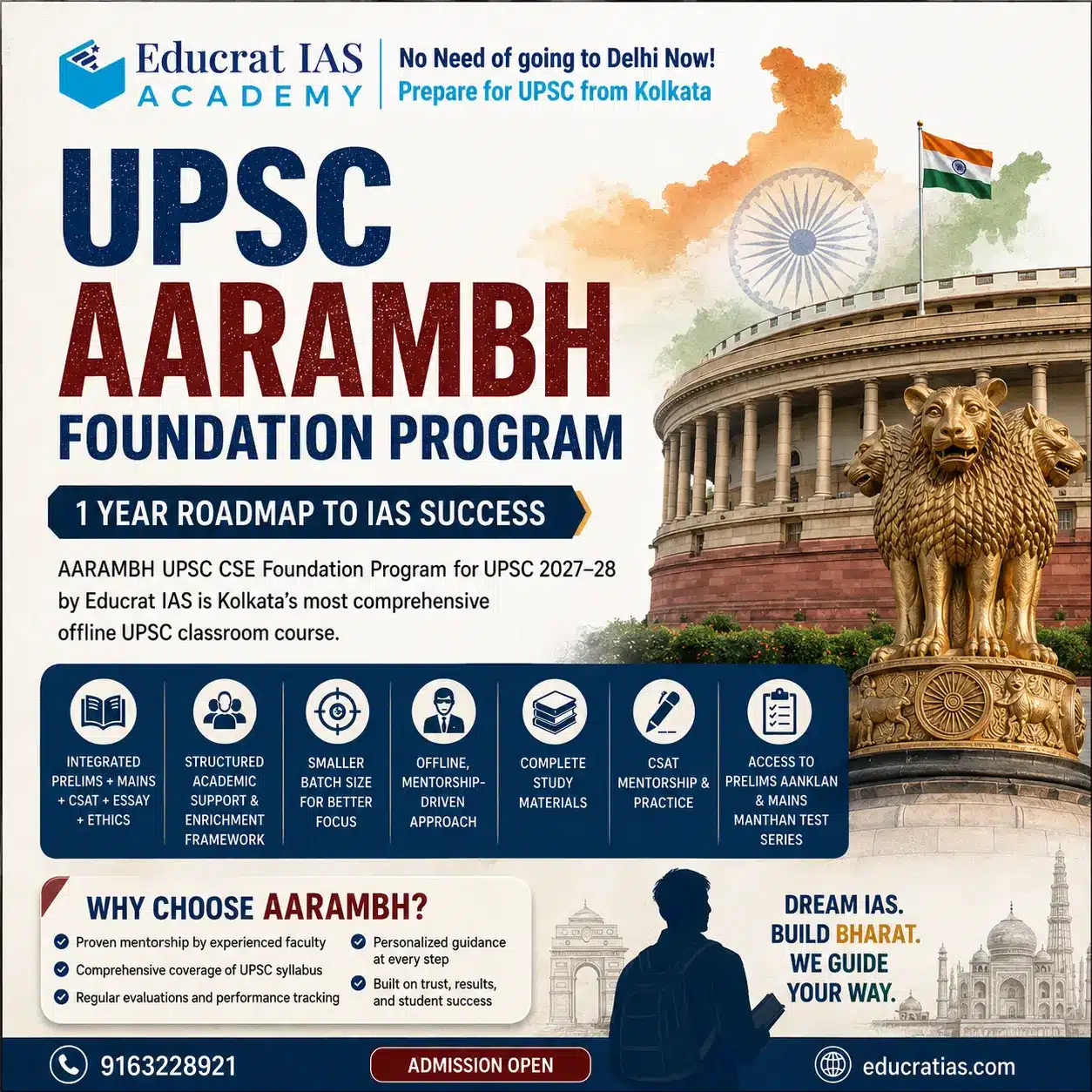
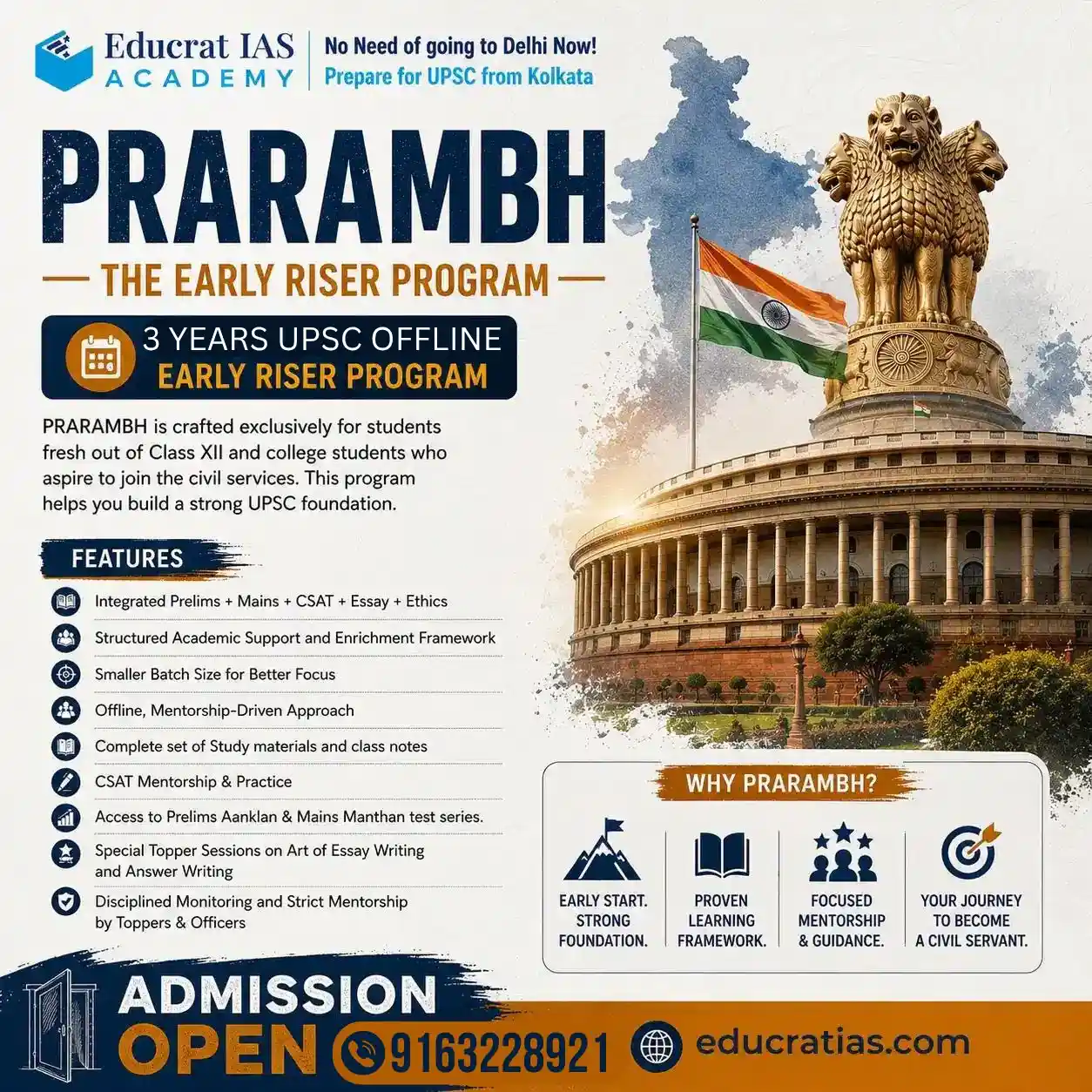
Educrat IAS Academy is built for aspirants who want to pursue a serious UPSC preparation journey from Kolkata, with a structured ecosystem covering foundation, current affairs, answer writing, testing, mentorship and Mains-oriented preparation.
Stay Mentally and Physically Sustainable
UPSC preparation is a long process. Studying at maximum intensity for a few weeks and then becoming exhausted is not a sustainable strategy.
Consistency matters more than occasional extremes.
Adequate sleep, regular physical activity and planned breaks can support concentration and help maintain a sustainable routine. The objective is sustainable consistency.
Avoid These Common UPSC 2027 Mistakes
Studying Without the Syllabus
Without the syllabus, preparation can become endless.
Collecting Too Many Sources
More books do not automatically mean more knowledge.
Ignoring PYQs
Without PYQ analysis, it becomes difficult to understand question patterns.
Delaying the Optional
Leaving optional preparation until after Prelims can create unnecessary pressure.
Ignoring CSAT
A qualifying paper can still become a barrier if it is neglected.
Writing Answers Without Feedback
Without evaluation, the same structural mistakes can continue.
Continuously Chasing New Current Affairs
Current affairs should strengthen static preparation, not replace it.
Neglecting Revision
The final outcome depends heavily on what you can recall and apply in the examination.
Final Takeaway: Prepare With a Roadmap, Not Just a Routine
UPSC 2027 should not be treated as a race to finish the largest number of books or study the longest hours.
It should be approached as a structured process:
Understand the syllabus → Build the foundation → Integrate current affairs → Analyse PYQs → Prepare the optional → Practise answer writing → Revise repeatedly → Test yourself → Transition strategically from Prelims to Mains → Prepare for the Personality Test.
The objective is not to know everything. It is to know what matters, why it matters and how to reproduce it effectively in the examination.
For current-affairs consolidation, a PIB Current Affairs Monthly PDF and a Monthly Current Affairs MCQ Magazine can support revision when used alongside core subject preparation.
Whether you are studying independently or researching the Best UPSC Coaching in Kolkata, the central question should remain the same: does your preparation system help you study selectively, revise repeatedly, practise consistently and improve through feedback?
For aspirants who want to prepare from Kolkata, Educrat IAS Academy offers a structured academic ecosystem built around that principle.
Your Dream. Our Guidance.
Educrat IAS Academy
Shaping India’s Future Administrators.