Introduction: Trust is the real test of an election
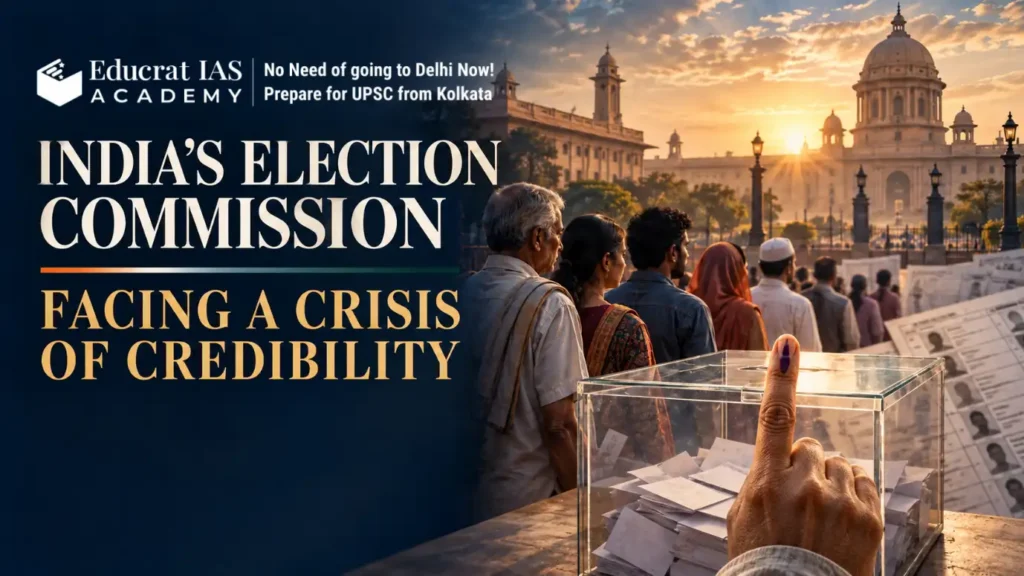
An election is credible not merely when voting takes place on schedule, but when citizens and political parties trust that the rules are fair, the referee is impartial and every eligible voter can participate. India’s Election Commission (ECI) is again under scrutiny over the Special Intensive Revision (SIR) of electoral rolls, reported disagreements within the Commission and the appointment of Election Commissioners. These developments do not prove that elections have been manipulated, but they raise a central question: can the ECI command confidence across the political spectrum?
Credibility has a legal and public dimension: a lawful decision can still invite questions if its process is opaque, while criticism alone does not prove wrongdoing. The debate must distinguish verified facts, allegations and judicial findings.
- Core issue: Credibility depends on impartial conduct and public confidence.
- Democratic stakes: Electoral rolls determine who can vote.
What this article contains:
- The ECI’s constitutional mandate
- SIR: Accuracy of rolls versus the risk of exclusion
- Internal disagreement and the Form 6 controversy
- Appointment of Election Commissioners: independence must be visible
- What the Supreme Court has and has not: decided
- Why credibility matters beyond the polling booth
- Rebuilding confidence: a reform agenda
- The referee must be trusted
- Data compilation: Key figures and developments
- UPSC perspective on India’s Election Commission
The ECI’s constitutional mandate
Article 324 of the Constitution vests the “superintendence, direction and control” of electoral rolls and elections to Parliament, State Legislatures, and the offices of President and Vice-President in the ECI. Article 325 provides for one general electoral roll for each territorial constituency and prohibits a person’s exclusion from that roll solely on grounds of religion, race, caste or sex. Article 326 provides for elections to the Lok Sabha and State Legislative Assemblies on the basis of adult suffrage for citizens aged 18 and above, subject to lawful disqualifications. Together, these provisions place the ECI at the centre of India’s electoral democracy and protect both common electoral membership and broad participation.
Article 325 is directly relevant to access and exclusion: verification of voter eligibility must not make any of its listed grounds a basis for ineligibility. The Representation of the People Acts and Registration of Electors Rules provide the statutory framework within which the ECI must act.
- Article 324 vests electoral administration in the ECI; Article 325 bars exclusion from a general roll solely on grounds of religion, race, caste or sex; Article 326 establishes adult suffrage.
- Statutory framework: The Representation of the People Acts and Registration of Electors Rules govern elections and voter registration.
SIR: Accuracy of rolls versus the risk of exclusion
The ECI says SIR aims to improve accuracy by removing deceased, duplicate, shifted and otherwise ineligible entries. Rolls need regular updating, but the exercise must not create avoidable barriers for eligible voters.
Reuters reported in October 2026 that approximately 130 million names had been removed under the revision. This aggregate covers different categories and states and does not show that every removal was wrongful; its scale makes verification and remedies essential.
In Karnataka, the draft roll fell from 5.54 crore to 4.46 crore electors after enumeration. By October 22, 2,28,917 Form 7 applications had been received. These applications seek to object to an inclusion or request deletion; they are not confirmed deletions. The final roll was scheduled for October 27, 2026, so this October 25 update precedes publication. Bangalore News – The Indian Express
Wrongful exclusion may be discovered only when a person tries to vote, leaving little time to correct the record. Migrants, people in informal housing and those with limited documentation may face added barriers. SIR should be assessed by how carefully it verifies proposed removals and corrects mistakes, as well as by the number of entries removed.
- Objective: Keep rolls current and remove duplicate or ineligible entries.
- Risk: A mistaken deletion can deny an eligible citizen the vote.
- Safeguard: Give notice, state verifiable grounds and allow a meaningful response.
Internal disagreement and the Form 6 controversy
The Indian Express reported that Election Commissioners Vivek Joshi and Sukhbir Singh Sandhu objected to a change in Form 6, used by new voters to register. The online form had included an additional declaration asking about the applicant’s or their parents’ or grandparents’ presence on an earlier electoral roll. The commissioners reportedly questioned whether this change could be introduced through an SIR process without amending the relevant rules. The ECI later removed the additional declaration from Form 6 online in states where the SIR had concluded.
The Supreme Court’s position is precise: it said it had neither approved nor disapproved the modified Form 6. The Court had not adjudicated the form’s legality when it decided the Bihar SIR case, because the modified form was not before it at that time. It tagged the matter with related petitions listed for October 27. This procedural clarification avoids treating the Bihar judgment as a ruling on the form itself. The commissioners’ reported objections likewise remain distinct from a judicial finding that the ECI acted unlawfully. Legal News – The Indian Express
Disagreement in a multi-member body can expose legal or practical problems early. The concern is whether objections were considered and explained. The ECI has disputed reports that key decisions were taken without the Commission’s approval; that response is part of the record.
- Rule of law: Administrative convenience cannot replace prescribed legal procedure.
- Institutional health: Dissent can strengthen decision-making when it is documented and addressed.
- Public record: The Court has not yet decided the legality of the modified Form 6.
Appointment of Election Commissioners: independence must be visible
The Constitution provides for presidential appointment of the CEC and other Election Commissioners, subject to any law made by Parliament. In practice, appointments were made on Union executive advice. The 1991 legislation addressed service conditions and Commission business, not the current selection committee.
In Anoop Baranwal v. Union of India (2023), the Supreme Court set an interim committee of the Prime Minister, Leader of the Opposition (or largest opposition party) and Chief Justice of India, pending legislation. The 2023 Act replaced the CJI with a Union Cabinet Minister nominated by the Prime Minister, alongside the Prime Minister and Leader of the Opposition.
Critics say the composition gives the government a majority and may weaken confidence; supporters argue Parliament can legislate and a statutory process is preferable to an interim arrangement. The issue is whether the process assures the public of the appointees’ independence.
In September 2026, a two-judge Bench split on referring challenges to the Act. The matter was then placed before the CJI to consider constituting a Constitution Bench to decide its validity. As of October 25, the Act had not been finally adjudicated; a plea to recall or modify the referral was also raised in October. Order summary – Supreme Court Observer
The Tarkunde and Dinesh Goswami Committees supported selection processes involving the Prime Minister, Leader of the Opposition and Chief Justice. Such proposals remain relevant where a more plural process could strengthen confidence.
- Institutional principle: Independence must exist in practice and be visible to the public.
- Appointment concern: A selection panel dominated by the executive can create a perception of executive influence.
- Procedural status: The CJI is to consider constituting a Constitution Bench; the Act’s validity remains undecided.
What the Supreme Court has and has not: decided
The Supreme Court’s May 2026 Bihar SIR judgment upheld the ECI’s authority to conduct the revision under the constitutional and statutory framework, while addressing safeguards such as notice, response and appeals. It did not endorse every state-level implementation decision or rule out individual errors.
Authority to revise rolls does not establish that every removal was correct; individual mistakes do not prove the entire exercise unlawful. The Form 6 issue is separate: the Court neither approved nor disapproved the modified form, had not adjudicated it in the Bihar case and tagged it with related petitions listed for October 27.
- Bihar judgment: Confirms the ECI’s authority to revise rolls within the law.
- Pending: The Form 6 legality question and the appointments Act challenge.
- Principle: Administrative authority must be matched by procedural safeguards.
Why credibility matters beyond the polling booth
The ECI is a democratic referee. Doubts about its impartiality can turn routine decisions on roll corrections, the Model Code of Conduct or poll scheduling into political conflict, weakening acceptance of results and deepening polarisation.
Elections depend on citizens, parties and officials accepting common procedures. Confidence is strengthened by evidence, consistency and openness.
Political parties should substantiate allegations, and the ECI should answer material questions with verifiable information.
- Legitimacy rests on fair access, consistent procedures and trusted results.
Rebuilding confidence: a reform agenda
Electoral-roll revision is necessary, but it must allow citizens to stay enrolled and correct errors. The ECI should publish clear, constituency-level data on additions, deletions, reasons and appeals so that changes can be scrutinised.
Before deletion, the ECI should give individual notice, explain its grounds in accessible language and provide simple, multilingual claim channels. Appeals must be resolved before polling. Parliament can also strengthen appointments through a plural, transparent process and publish clear records of Commission decisions.
- Publish constituency-level roll data and reasons for changes.
- Provide notice, accessible correction channels and timely appeals.
- Make appointments transparent and plural; use oversight to correct procedural failures.
The referee must be trusted
The ECI’s credibility challenge is to combine accurate rolls with fair procedures, independence with accountability, and legal authority with public trust. The Supreme Court affirmed its power to revise rolls in the Bihar case; the task is to ensure that every eligible voter can exercise the franchise without avoidable barriers.
The institution safeguarding the ballot earns confidence through clear rules, credible appointments, transparent decisions and timely correction of mistakes.
- Democratic test: Accurate rolls must include every eligible voter, with errors corrected promptly.

Data compilation: Key figures and developments
- About 130 million names were reported removed under the revision in October 2026; this is not a count of wrongful deletions.
- Karnataka draft roll: 5.54 crore to 4.46 crore after enumeration.
- Karnataka Form 7: 2,28,917 applications by October 22; applications are not confirmed deletions. Final roll scheduled for October 27.
- Legal milestones: Anoop Baranwal (2023), appointments Act (2023), Bihar SIR judgment (May 2026), and September 2026 referral order on the Act’s validity.
UPSC perspective on India’s Election Commission
GS Paper II links: constitutional bodies, governance, electoral reforms and democratic rights. Frame the issue as a balance between roll accuracy and inclusive participation. Use Articles 324–326, then assess SIR safeguards, Form 6 and the appointments framework. Distinguish the ECI’s authority to revise rolls from the handling of individual deletions. Conclude with notice, reasons, accessible appeals, timely remedies and a plural appointment process.
Conclusion
The ECI’s credibility is not a topic to prepare through facts alone. It requires you to connect constitutional provisions, current developments, data and the status of court proceedings—while distinguishing allegations from established findings. Strong answers explain both the ECI’s authority to revise electoral rolls and its responsibility to protect eligible voters from wrongful exclusion.
At EDUCRAT IAS, our Mains programme is built around the skills that turn knowledge into clear, balanced answers: content, structure and feedback. If you are looking for the Best IAS coaching institute that treats Mains as a skill to practise, come talk to us.
Start answer-writing today. Get it evaluated. Rewrite it. That is how marks are built.