Shaping India’s Climate Trajectory
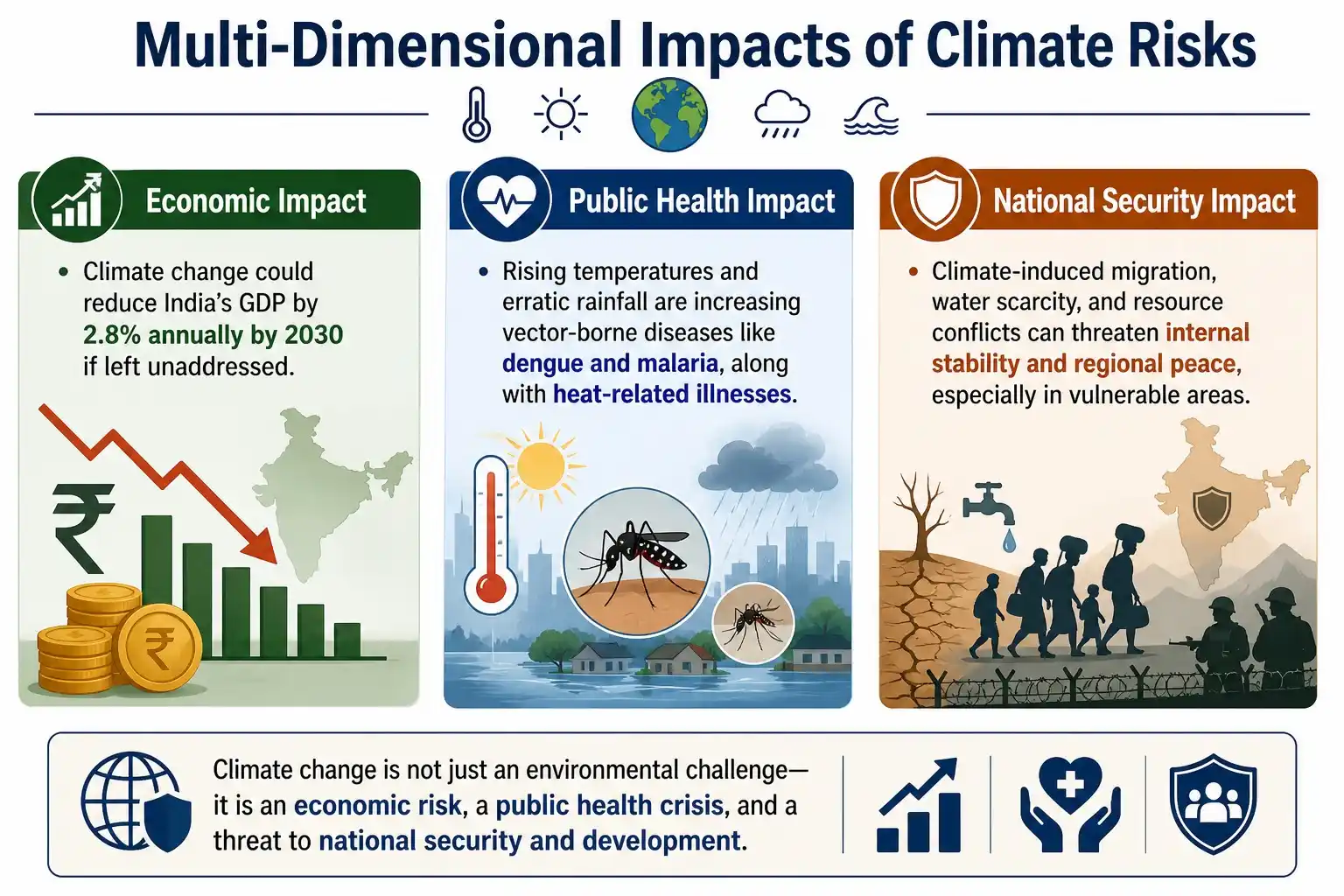
Climate change is no longer a distant threat but a lived reality across India, where more than 80% of the population lives in climate-vulnerable districts. From floods in the Northeast to heatwaves in central India, these events are becoming systemic risks, while India’s response remains largely reactive and fragmented.
Understanding Climate Physical Risks (CPRs)
- Climate Physical Risks refer to the long-term physical impacts of climate change, including extreme events like floods, cyclones, droughts, and heatwaves, as well as slow-onset changes such as sea-level rise and desertification.
- These risks have a dual nature, where acute risks include sudden disasters like flash floods, while chronic risks involve gradual changes like shifting rainfall patterns.
- In India, CPRs manifest differently across regions, such as coastal erosion in Kerala, glacier retreat in the Himalayas, and desertification in Rajasthan, reflecting geographical diversity.
Why CPRs Require a Long-Term Approach
- Short-term weather forecasts are useful for immediate response but fail to capture long-term climate shifts, making long-term predictive modelling essential.
- Scientific tools such as IPCC projections and Earth System Models are necessary to anticipate future risks rather than just reacting to present events.
- A proactive approach helps build economic and infrastructure resilience, reducing dependence on post-disaster relief.
IPCC Risk Framework: Understanding Risk
- Climate risk depends on three key factors:
- Hazard: Climate events like floods or droughts
- Exposure: People and assets in affected areas
- Vulnerability: Capacity to cope and recover
- Even similar hazards can cause different outcomes depending on preparedness and infrastructure, highlighting the importance of reducing vulnerability.
India’s Gaps in Climate Risk Assessment
- India’s climate risk assessment is fragmented, as agencies like IMD, NIDM, and IITs use different methodologies, leading to data silos and duplication.
- There is no unified national CPR model, unlike developed countries, limiting integration of climate risks into policy and investment decisions.
- Global models such as RCPs and SSPs fail to capture India’s micro-level climate variations, restricting localised planning.
Steps Taken by India
- India submitted its Adaptation Communication (2023) under the Paris Agreement and is preparing a comprehensive National Adaptation Plan (NAP) covering multiple sectors.
- The Reserve Bank of India is incorporating climate risks into financial regulation.
- Institutions like IIT Gandhinagar, IMD, and NIDM are contributing through hazard mapping and vulnerability assessments.
Global Trends and India’s Position
- Global climate finance is skewed towards mitigation (renewable energy) rather than adaptation (resilience measures).
- However, adaptation investments yield high returns, with estimates suggesting $1 investment can generate $4 in avoided losses.
- India must advocate for greater adaptation funding through international climate platforms.
Way Forward
Build a National CPR Assessment Tool
- Develop integrated models combining scientific data with local knowledge for real-time and localised projections.
Create a Central Climate Data Hub
- Consolidate climate data from multiple agencies and ensure open access for policymakers and researchers.
Strengthen Institutional Capacity
- Establish a National Centre for Climate Risk Assessment and train district officials in climate planning.
Integrate CPR into Policy
- Embed climate risks into urban planning, agriculture, infrastructure, and EIA processes.
Engage Private Sector
- Mandate climate risk disclosures and promote use of CPR data in investment and insurance decisions.
Promote Community-Based Adaptation
- Empower local bodies and communities through participatory planning and climate finance support.
India’s aspiration of becoming a developed nation by 2047 depends on its ability to shift from reactive disaster management to proactive climate resilience. By building a robust Climate Physical Risk framework, integrating science with governance, and prioritising adaptation, India can secure not just survival but sustainable and inclusive growth for the future.
Keeping India’s Carbon Money at Home
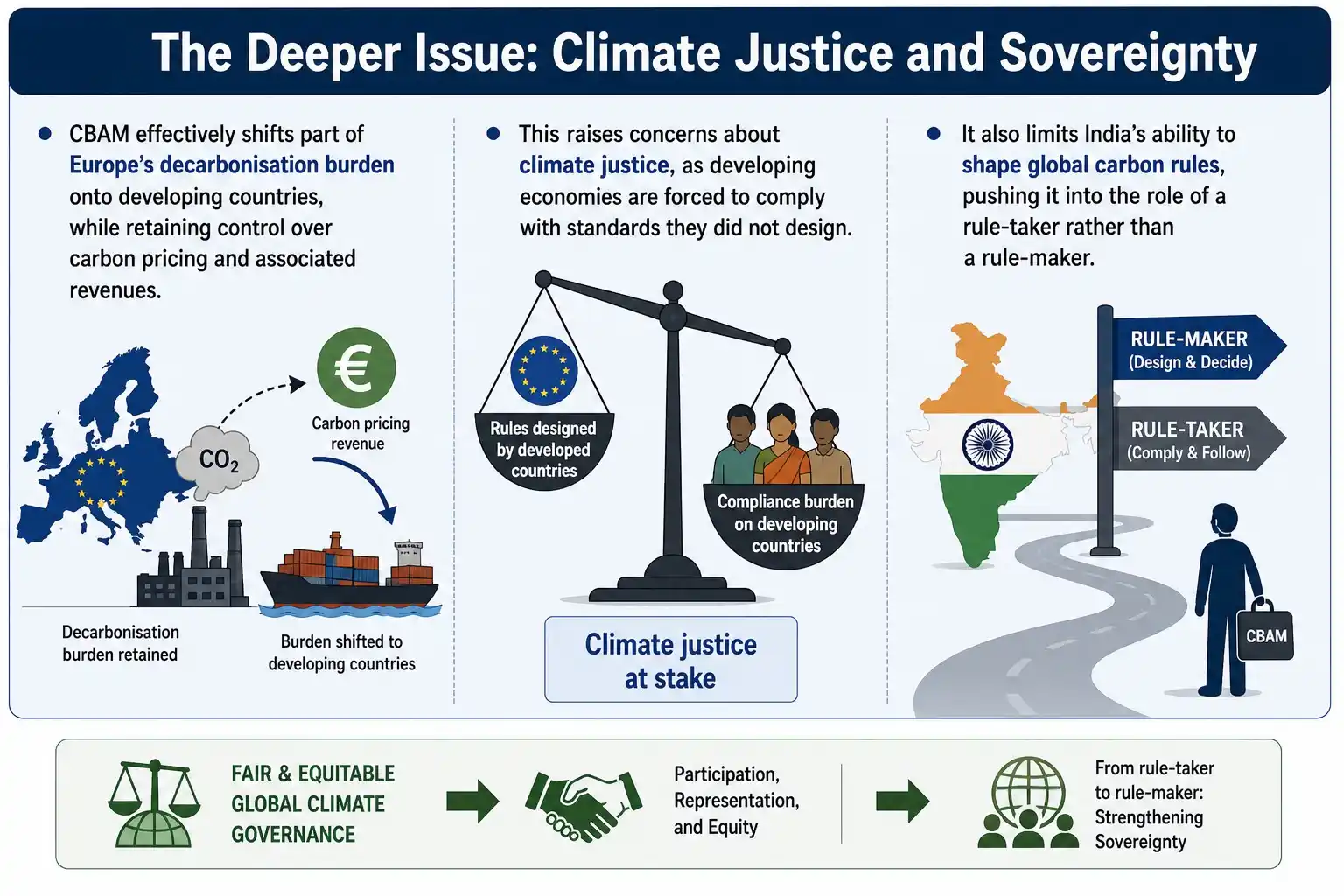
The European Union’s Carbon Border Adjustment Mechanism (CBAM), implemented in 2026, represents a major shift in global climate governance by linking trade with carbon pricing. While it is presented as a fair mechanism to prevent carbon leakage, it creates significant challenges for countries like India by shifting the burden of decarbonisation onto exporters, raising concerns about climate justice, economic competitiveness, and policy sovereignty.
What CBAM Means in Practice
- CBAM requires imports into the EU to bear a carbon cost equivalent to what European producers pay, aiming to create a level playing field.
- However, European industries already benefit from subsidies, public finance, and free emission allowances, which are gradually being phased out, giving them an advantage.
- Indian exporters, especially in sectors like steel, aluminium, and cement, face the full burden of carbon costs without similar state support.
- This creates an uneven playing field despite CBAM’s claim of fairness.
Limits of India–EU Engagement
- The India–EU Free Trade Agreement (FTA) does not provide direct exemptions from CBAM, limiting India’s negotiating leverage.
- While technical provisions allow recognition of carbon pricing in the country of origin, the scope for flexibility remains narrow.
- This makes it essential for India to develop domestic policy tools rather than relying on external negotiations.
India’s Domestic Response: Carbon Credit Trading Scheme (CCTS)
- India has introduced the Carbon Credit Trading Scheme (2023) to create a domestic carbon market.
- The system establishes a carbon price through tradable certificates, especially targeting key industrial sectors.
- If properly implemented, it can allow Indian exporters to claim credit for carbon costs already paid domestically, reducing CBAM impact.
- A transparent and credible system can prevent double pricing of carbon while maintaining environmental integrity.
Need for a Counter Strategy: India’s Border Adjustment Mechanism (IBAM)
- India should consider introducing its own India Border Adjustment Mechanism (IBAM).
- Instead of passively accepting CBAM, India can impose a carbon-linked charge on exports, ensuring that carbon pricing happens within its jurisdiction.
- This would help India retain carbon-related revenues domestically rather than transferring them to Europe.
- However, IBAM should be carefully designed and aligned with international trade rules.
Strategic Importance of Retaining Carbon Revenues
- The key issue is not just compliance but where the money goes.
- Under CBAM, a portion of revenues effectively flows to Europe, whereas IBAM would allow India to retain and utilise these funds domestically.
- These funds can be channelled into:
- Cleaner industrial technologies
- Low-carbon infrastructure
- Support for workers affected by transition
Supporting Green Transition in India
- Carbon revenues should be ring-fenced for verified green investments, such as:
- Modernising industrial processes
- Expanding renewable energy
- Promoting hydrogen and low-carbon technologies
- This ensures that climate policy supports both sustainability and economic growth.
Balancing Trade and Climate Policy
- India must ensure that climate measures do not become hidden trade barriers that disadvantage developing economies.
- At the same time, it must demonstrate credible climate action to remain competitive in global markets.
- This requires a careful balance between environmental responsibility and economic interests.
Way Forward
- Strengthen domestic carbon pricing mechanisms to align with global standards.
- Use policy tools like IBAM to retain economic value within the country.
- Engage proactively in global climate negotiations to ensure fair and inclusive rules.
- Integrate climate policy with industrial strategy to support long-term competitiveness.
CBAM marks a new phase where climate policy and trade are deeply intertwined. For India, the challenge is not just to comply but to respond strategically by building domestic capacity, retaining carbon revenues, and shaping global rules. By doing so, India can turn a potential constraint into an opportunity for a self-directed and equitable green transition.
Prelims Boosters
Komagata Maru Incident (1914)
Context:
- Recently highlighted in global media, bringing attention to colonial discrimination and migration history
About
- The Komagata Maru Incident (1914) was a maritime standoff
- Ship: Komagata Maru (Japanese steamship)
- Led by: Gurdit Singh
- Passengers: 376 Indians: 340 Sikhs, 24 Muslims and 12 Hindus
- Aim:To migrate to Canada (they were British subjects)
Background
Punjab Conditions
- Poverty, debt, and epidemics pushed people to migrate abroad
Discriminatory Law (Canada)
- Continuous Journey Regulation (1908)
- Required direct travel from India → impossible at that time
- Used to block Indian immigrants
Ghadar Movement Link
- Indian revolutionaries abroad wanted to overthrow British rule
Key Events
Arrival at Vancouver (May 1914)
- Denied entry into Canada
- Forced to stay offshore for 2 months
- Faced food and water shortages
Conflict
- Court supported discriminatory law
- Passengers resisted police attempts to board
Forced Return
- Only 22 passengers allowed
- Ship sent back to India
Return to India (Budge Budge Incident)
- Location: Near Calcutta (September 1914)
- British suspected links with revolutionaries
- Result:
- Police firing
- 20 people killed
- Many arrested
Significance
- Exposed racial discrimination in British Empire
- Boosted Ghadar Movement (freedom struggle)
- Showed limits of “equal citizenship” under colonial rule
- Canada apology:
- 2016 (PM Justin Trudeau)
Hepatitis
Context:
- As per WHO Global Hepatitis Report 2026, India has a high burden of hepatitis-related deaths
About
- Hepatitis means inflammation (swelling) of the liver
- Causes:
- Viral infection (most common)
- Alcohol, drugs, toxins
- Autoimmune disease(body attacks its own liver)
Symptoms
|
|
Types of Hepatitis
- Hepatitis A (HAV): Short-term (acute) and spread through contaminated food/water
- Hepatitis B (HBV): Chronic (long-term) and spread through blood & body fluids
- Hepatitis C (HCV): Blood-borne infection and often becomes chronic
- Hepatitis D (HDV): Occurs only with Hepatitis B and cannot exist independently
- Hepatitis E (HEV): Water-borne disease and linked to poor sanitation
Treatment & Prevention
Vaccines available for:
|
No vaccine for:
|
Management includes:
|
Significance
- Major cause of:Liver damage & liver failure
- Public health concern due to:High mortality and infection rates
Kanha Tiger Reserve (KTR)
Context:
- Death of a tigress and cubs due to suspected Canine Distemper Virus (CDV)
- Rising concern over tiger mortality in Madhya Pradesh
About
- Kanha Tiger Reserve is a major protected area in India
- Known for rich biodiversity (plants + animals)
- Location:
- Madhya Pradesh
- In Maikal ranges of Satpura hills
- Districts: Mandla &Balaghat
- Area: ~2,074 sq. km
History
- 1879 → Declared Reserve Forest
- 1955 → Became National Park
- Included in Project Tiger (1973)(one of the first tiger reserves)
Key Features
1. Zonation
2. Satellite Area
| 3. Flora
4. Fauna
|
Significance
- Tiger Conservation: One of the best tiger habitats in India
- Barasingha Conservation: Saved Hard-ground Barasingha from extinction
- Biodiversity Hotspot: Represents Central Indian ecosystem
Tatya Tope
Context:
- A rare handwritten letter (1857) of Tatya Tope (Ramachandra Pandurang Tope)has been discovered
About
- Born: 1814, Nashik (Maharashtra)
- Original name: Ramachandra Pandurang Tope
- Father:Served in court of Baji Rao II (last Peshwa)
- Close associate of:Nana Sahib (leader of 1857 revolt)
Role in Revolt of 1857
|
Military Tactics
|
End of Life
- Captured by British
- Executed in: Shivpuri (1859)
- After a formal trial
Significance
- Symbol of bravery and resistance
- Key figure in First War of Independence (1857 revolt)
- Known for military strategy and leadership
Citizenship (Amendment) Rules, 2026
Context:
- Government has notified new rules related to OCI and citizenship processes
About
- Amendments made to:Citizenship Rules, 2009
- Notified by: Ministry of Home Affairs (MHA)
- Focus:
- Digitisation of processes
- Streamlining OCI (Overseas Citizen of India) services
Key Provisions
1. Passport Rule for Minors
2. Full Digital Process
3. Surrender Requirement
|
4. Introduction of e-OCI
5. Removal of Duplicate Documents
6. Biometric Consent
|
About OCI Scheme
- Introduced in: 2005
- Under: Citizenship Act, 1955
Eligibility
- Persons of Indian Origin:
- Citizens on/after 26 Jan 1950
- Or eligible at that time
Not Eligible
- If person (or ancestors) belonged to:
- Pakistan or Bangladesh
Significance
- Promotes ease of governance (digital India)
- Improves efficiency & transparency
- Strengthens immigration security (biometrics)