Households Face Rising Medical Inflation
Rising medical inflation in India has become a serious concern for households, as healthcare costs are increasing much faster than general inflation. Despite government schemes and expanding healthcare infrastructure, a large section of the population continues to depend on out-of-pocket expenditure, pushing many families into financial distress during medical emergencies.
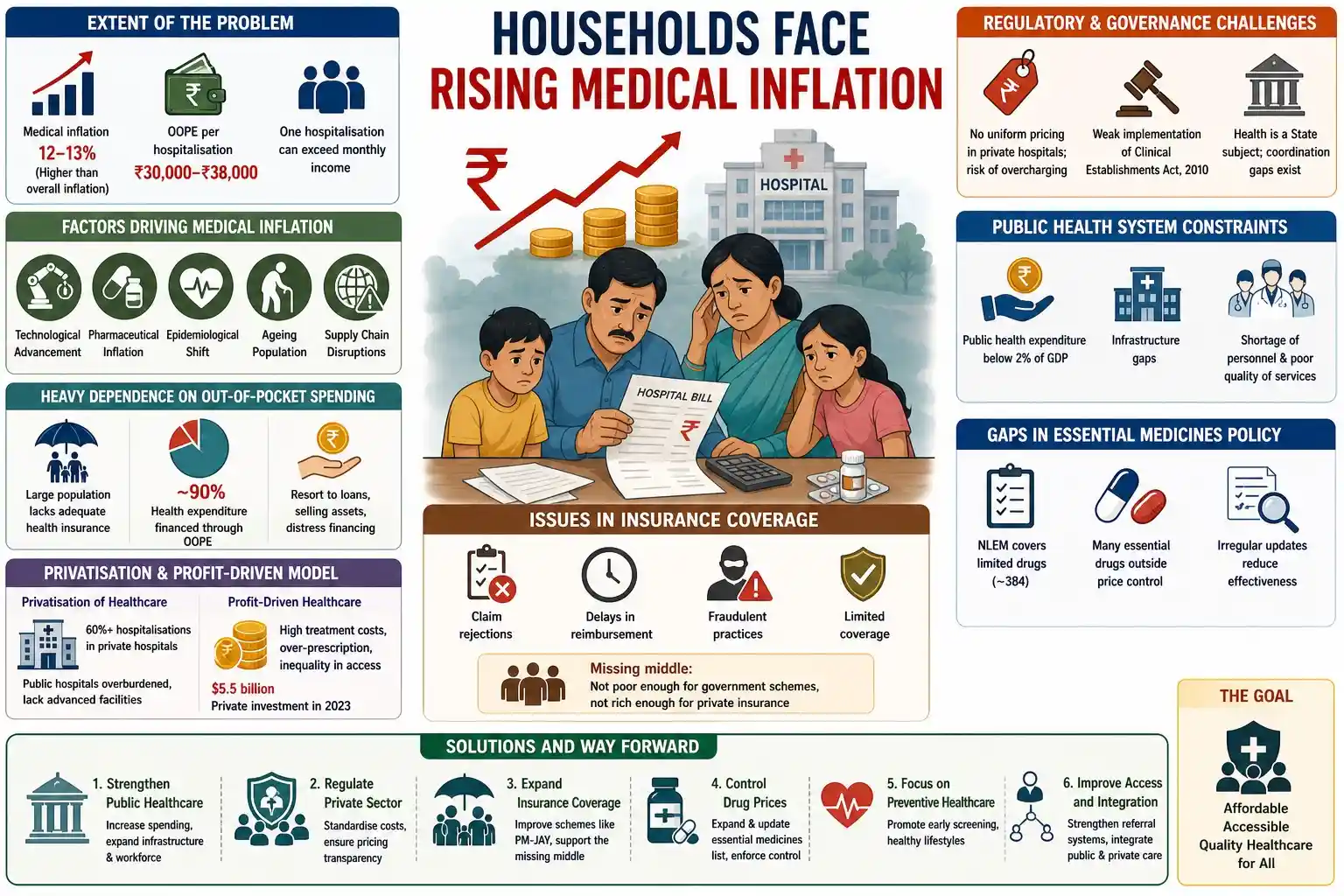
Extent of the Problem
- Medical inflation in India is estimated to be around 12–13%, significantly higher than overall inflation.
- Average out-of-pocket expenditure (OOPE) per hospitalisation has risen sharply, crossing ₹30,000–₹38,000, depending on rural or urban areas.
- For many households, a single hospitalisation expense can exceed monthly income, leading to debt or asset sales.
Heavy Dependence on Out-of-Pocket Spending
- A large proportion of Indians lack adequate health insurance coverage.
- Nearly 90% of total health expenditure is financed through OOPE in many cases.
- Families often resort to distress financing, including loans, selling jewellery, or property.
Factors Driving Medical Inflation
a) Technological Advancement
- New medical technologies improve treatment but increase input costs.
- Imported equipment and drugs further raise expenses.
b) Pharmaceutical Inflation
- Rising drug prices contribute significantly to overall healthcare costs.
c) Epidemiological Shift
- Increase in non-communicable diseases (like diabetes, heart disease) raises long-term treatment costs.
d) Ageing Population
- Growing elderly population leads to higher healthcare demand.
e) Supply Chain Disruptions
- Global disruptions increase costs of medicines and medical devices.
Privatisation of Healthcare
- Around 60%+ hospitalisations occur in private hospitals, where costs are higher.
- Public hospitals are often overburdened and lack advanced facilities, forcing patients to shift to private providers.
- Private sector dominance leads to variation in pricing and accessibility issues.
Profit-Driven Healthcare Model
- Increasing private investment (around $5.5 billion in 2023) has strengthened a profit-oriented approach.
- This often results in:
- Higher treatment costs
- Over-prescription of tests and procedures
- Inequality in access to quality healthcare
Issues in Insurance Coverage
- Even though schemes like Ayushman Bharat (PM-JAY) provide coverage up to ₹5 lakh, many problems persist:
- Claim rejections due to documentation issues
- Delays in reimbursement
- Fraudulent practices
- Limited coverage scope
- A “missing middle” exists—people who are not poor enough for government schemes and not rich enough for private insurance.
Regulatory and Governance Challenges
- Lack of uniform pricing regulation in private hospitals leads to overcharging.
- Implementation of laws like the Clinical Establishments Act (2010) remains weak.
- Health being a State subject, coordination gaps reduce effective regulation.
Public Health System Constraints
- India’s public health expenditure remains below 2% of GDP, which is low compared to global standards.
- Limited investment results in:
- Infrastructure gaps
- Shortage of medical personnel
- Poor quality of services
Gaps in Essential Medicines Policy
- The National List of Essential Medicines (NLEM) covers limited drugs (around 384), leaving many expensive drugs outside price control.
- WHO’s broader list highlights gaps in India’s coverage.
- Lack of frequent updates reduces effectiveness.
Solutions and Way Forward
a) Strengthen Public Healthcare
- Increase government spending on healthcare.
- Expand infrastructure and workforce capacity.
b) Regulate Private Sector
- Standardise treatment costs and enforce pricing transparency.
- Strengthen implementation of regulatory frameworks.
c) Expand Insurance Coverage
- Improve efficiency of schemes like PM-JAY.
- Address the needs of the “missing middle.”
d) Control Drug Prices
- Expand and regularly update the essential medicines list.
- Strengthen price control mechanisms.
e) Focus on Preventive Healthcare
- Promote early screening and healthy lifestyles.
- Reduce long-term disease burden.
f) Improve Access and Integration
- Strengthen referral systems from primary to tertiary care.
- Integrate public and private healthcare networks.
Medical inflation in India reflects deeper structural issues in healthcare financing, regulation, and accessibility. Without strengthening public health systems, improving insurance coverage, and regulating private healthcare costs, rising medical expenses will continue to push households into financial vulnerability. A balanced approach combining affordability, accessibility, and quality is essential to ensure healthcare security for all.
Did the PM’s Broadcast Violate the Model Code of Conduct (MCC)?
The controversy surrounding the Prime Minister’s broadcast raises important questions about the integrity of India’s electoral process, particularly regarding the use of public resources during elections. It reflects a broader tension between what is legally permissible under election law and what is ethically acceptable under the Model Code of Conduct, especially in an era where communication through mass media plays a central role in influencing voters.
Understanding the Model Code of Conduct
- The Model Code of Conduct is a set of guidelines issued by the Election Commission of India to regulate the behaviour of political parties and candidates during elections.
- The MCC is not a legally enforceable law, but it carries moral authority and is based on consensus among political parties.
- The primary objective of the MCC is to ensure free and fair elections by maintaining a level playing field for all political actors.
Key Provision: Part VII (Party in Power)
- Part VII of the MCC specifically governs the conduct of the ruling party during elections.
- It clearly states that the party in power must not use official machinery or public resources for election campaigning.
- It also prohibits the use of publicly funded media to gain a partisan advantage during the election period.
- The principle underlying these provisions is that State resources should not be used to influence electoral outcomes.
Nature of the Controversy
- The Prime Minister’s address was broadcast through public broadcasters such as Doordarshan, All India Radio, and Sansad TV.
- This has raised concerns about whether the broadcast constituted official communication or political messaging aimed at voters.
- Critics argue that the use of State-funded media during an election period creates an unfair advantage for the ruling party.
- Supporters may argue that the address was part of official duties and therefore permissible.
What Does Election Law Say?
- Section 123(3) of the Representation of the People Act, 1951 deals with appeals based on religion, caste, or community, and is not directly applicable in this case.
- Section 123(7) of the same Act defines corrupt practices as obtaining assistance from government officials for electoral purposes.
- The legal ambiguity lies in whether broadcasting through public media can be interpreted as “assistance” from the government.
- The law primarily focuses on who provides assistance rather than the platform used, which creates interpretational gaps.
Judicial Interpretation and Limitations
- The judiciary has generally interpreted election laws in a narrow and technical manner, focusing on explicit violations.
- In the Abhiram Singh (2017) case, the Supreme Court focused on specific types of appeals such as those based on religion or caste.
- However, the law has not adequately evolved to address modern campaign tools such as mass media broadcasts.
Why the MCC Becomes Crucial
- The MCC addresses ethical conduct rather than strictly legal violations.
- It examines whether public resources are being used in a manner that undermines electoral fairness.
- Therefore, even if a broadcast does not violate statutory law, it may still be inconsistent with the spirit of the MCC.
Reasons for Election Commission’s Inaction
- The Election Commission exercises discretion in enforcing the MCC, and each case is assessed individually.
- It may be difficult to clearly distinguish between official communication and political messaging in such situations.
- There is also a lack of clear precedent for similar cases involving mass media broadcasts.
- The Commission may be cautious about taking action in politically sensitive matters.
Core Legal and Ethical Dilemma
- The legal question is whether the broadcast qualifies as a corrupt practice under election law, which remains uncertain.
- The ethical question is whether the use of public broadcasters provides an unfair electoral advantage, which remains debatable.
- This highlights the gap between the narrow scope of statutory law and the broader principles of the MCC.
Broader Implications
- The issue raises concerns about the neutrality of public broadcasters during elections.
- It also brings attention to the need for clearer rules governing the use of State resources in political communication.
- Without clear guidelines, such situations may recur and undermine public trust in the electoral process.
The question of whether the Prime Minister’s broadcast violated the MCC cannot be answered solely through legal provisions, as it lies at the intersection of law, ethics, and institutional discretion. While existing laws may not clearly define such actions as corrupt practices, the spirit of the MCC demands greater caution in the use of public resources during elections. Strengthening clarity, updating legal frameworks, and ensuring consistent enforcement are essential to preserving the credibility and fairness of India’s democratic system.
Prelims Boosters
Fugitive Economic Offenders (FEOs)
Context:
- Enforcement Directorate (ED) declared 21 individuals as FEOs
What is a Fugitive Economic Offender (FEO)?
- A fugitive is a person who:
- Commits a crime and Escapes the country to avoid legal action
- Under Fugitive Economic Offenders Act, 2018 (FEOA):
- Person must have: Arrest warrant issued by Indian court and offence involving ₹100 crore or more
Key Concept: Extradition
- Extradition = Legal process to bring back accused from another country
Key Features of FEO Act, 2018
Confiscation of Property
- Authorities can: Seize properties in India & abroad
- Includes: Benami assets (in someone else’s name)
Bar on Civil Claims
- FEO cannot: File or defend civil cases in Indian courts
Special Courts
- Cases handled by: Special courts under PMLA, 2002
Enforcement Directorate (ED)About
Functions
|
Military Exercise CINBAX-II 2026
Context:
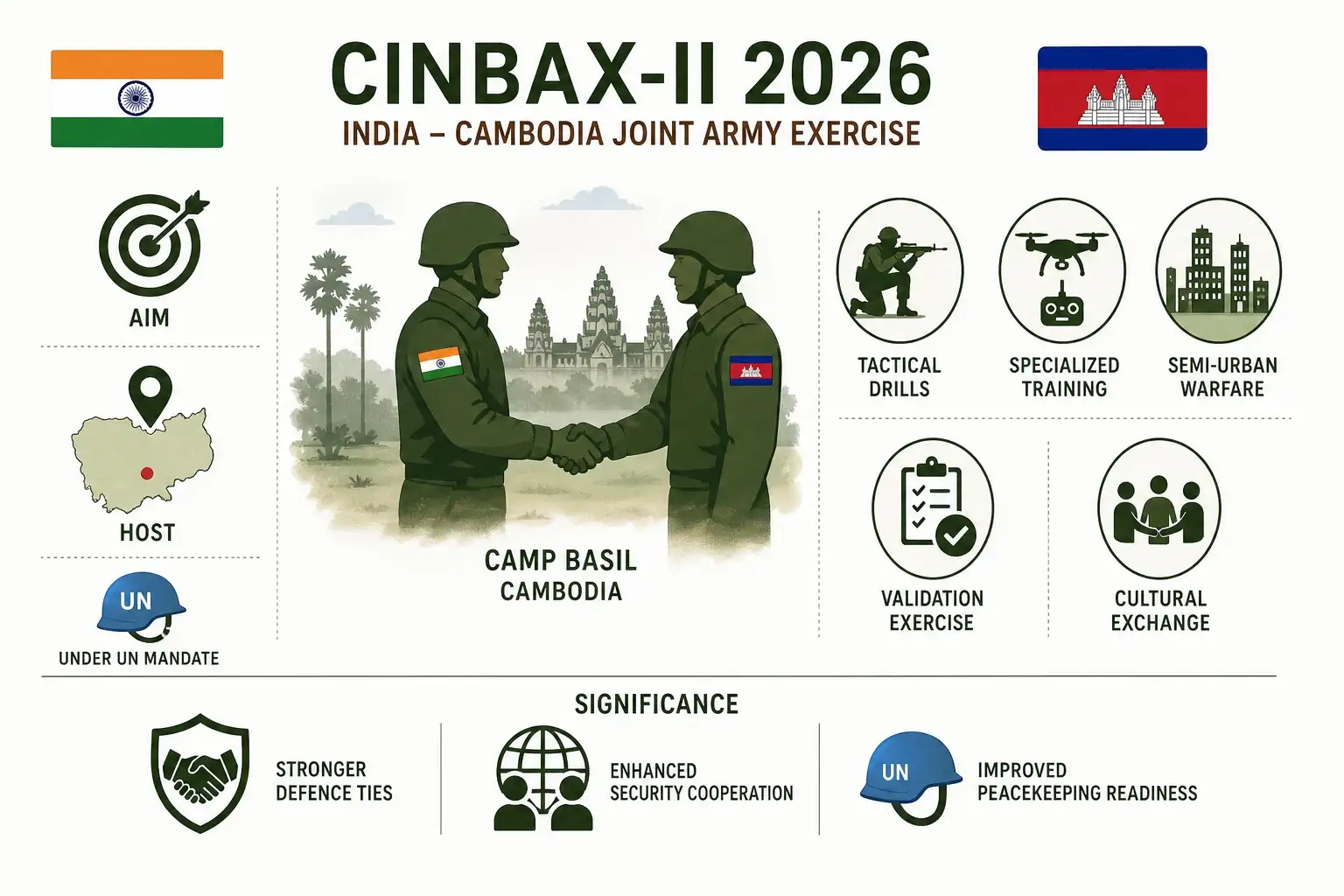
- India and Cambodia conducted 2nd edition of bilateral military exercise
About
- CINBAX-II = India–Cambodia bilateral army exercise
- Between: Indian Army and Royal Cambodian Army
- Conducted under: UN Mandate (Chapter VII) (peacekeeping & security operations)
Location & Host
- Host country: Cambodia
- Location: Camp Basil (Kampong Speu Province)
Aim
- Improve: Interoperability (working together), Coordination and Operational efficiency
- Focus: Counter-terrorism operations and UN peacekeeping scenarios
Key Features
1. Tactical Drills
2. Specialized Training
|
3. Semi-Urban Warfare Focus
4. Validation Exercise
5. Cultural Exchange
|
Significance
- Strengthens India–Cambodia defence ties
- Enhances regional security cooperation
- Improves UN peacekeeping readiness
Kailash Mansarovar Yatra (KMY)
Context:
- Nepal objected to the Lipulekh route, citing sovereignty concerns
About
- Kailash Mansarovar Yatra is a high-altitude pilgrimage
- Organized by: Ministry of External Affairs (MEA), India
- Destination: Mount Kailash (abode of Lord Shiva) and Lake Mansarovar
- Location: Tibet Autonomous Region (China)
Routes
1. Lipulekh Pass (Uttarakhand)
|
2. Nathu La Pass (Sikkim)
|
Key Features
- Duration: June – August/September
- Altitude: Above 15,000 feet
Eligibility
- Age: 18–70 years
- Only Indian citizens
- Must pass medical fitness tests
Support Agencies
- KMVN (Kumaon Mandal Vikas Nigam)
- ITBP / BSF
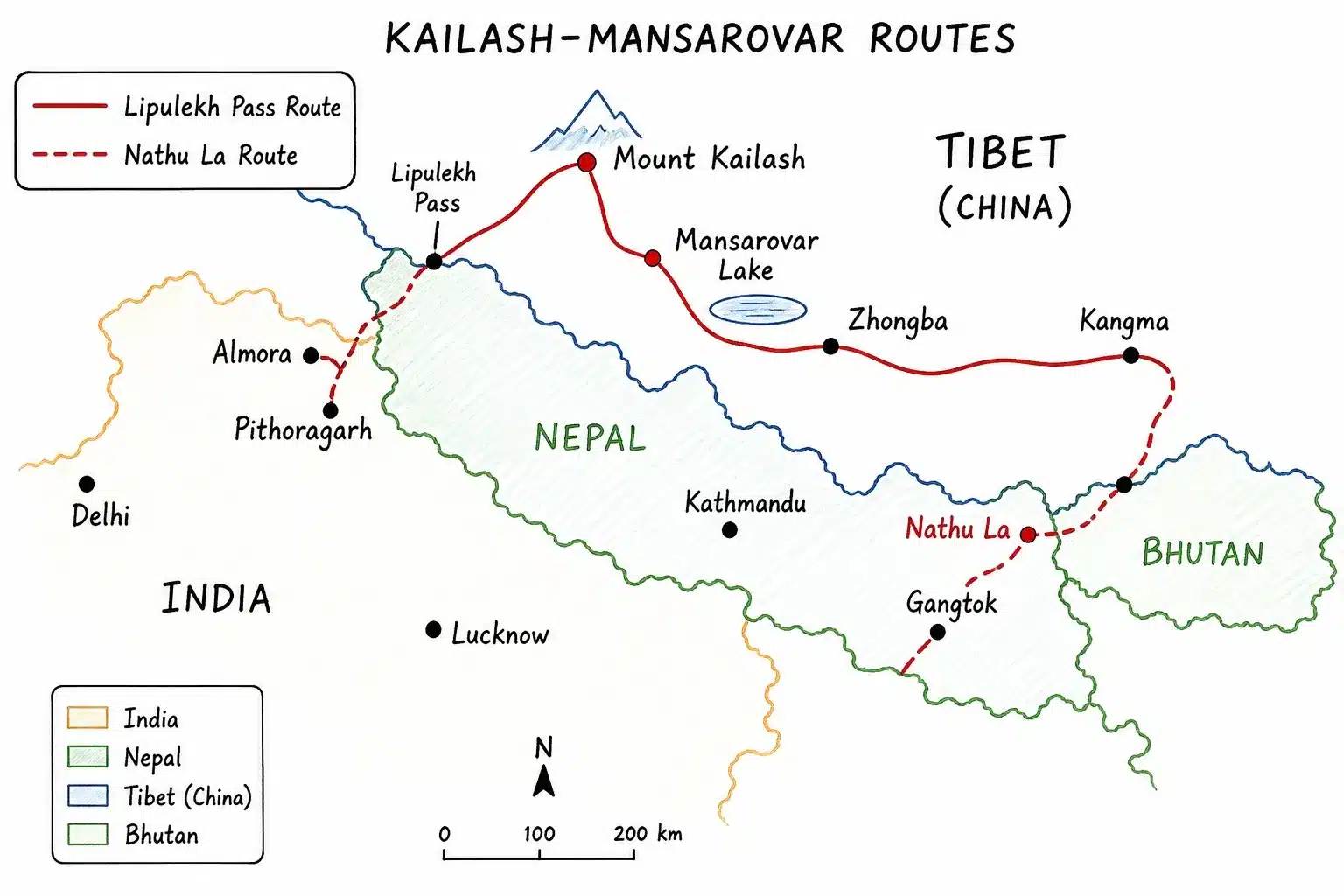
Religious Significance
- Hindus: Abode of Lord Shiva
- Buddhists: Associated with Demchok
- Jains: Linked to Rishabhadeva (1st Tirthankara)
- Bon religion: Sacred site
Geopolitical Importance
- Involves India–China–Nepal region
- Route disputes linked to boundary issues
Prosopis juliflora
Context:
- Used in Kandla (Deendayal) Port project to produce bio-methanol (clean fuel)
About
- Prosopis juliflora is an invasive plant species
- Type: Thorny shrub / small tree
- Family: Fabaceae (legume family)
Origin & Introduction
- Native to: Mexico, South America, Caribbean
- Introduced in India: 1877 (by British)
- Purpose: Control desertification and provide fuelwood
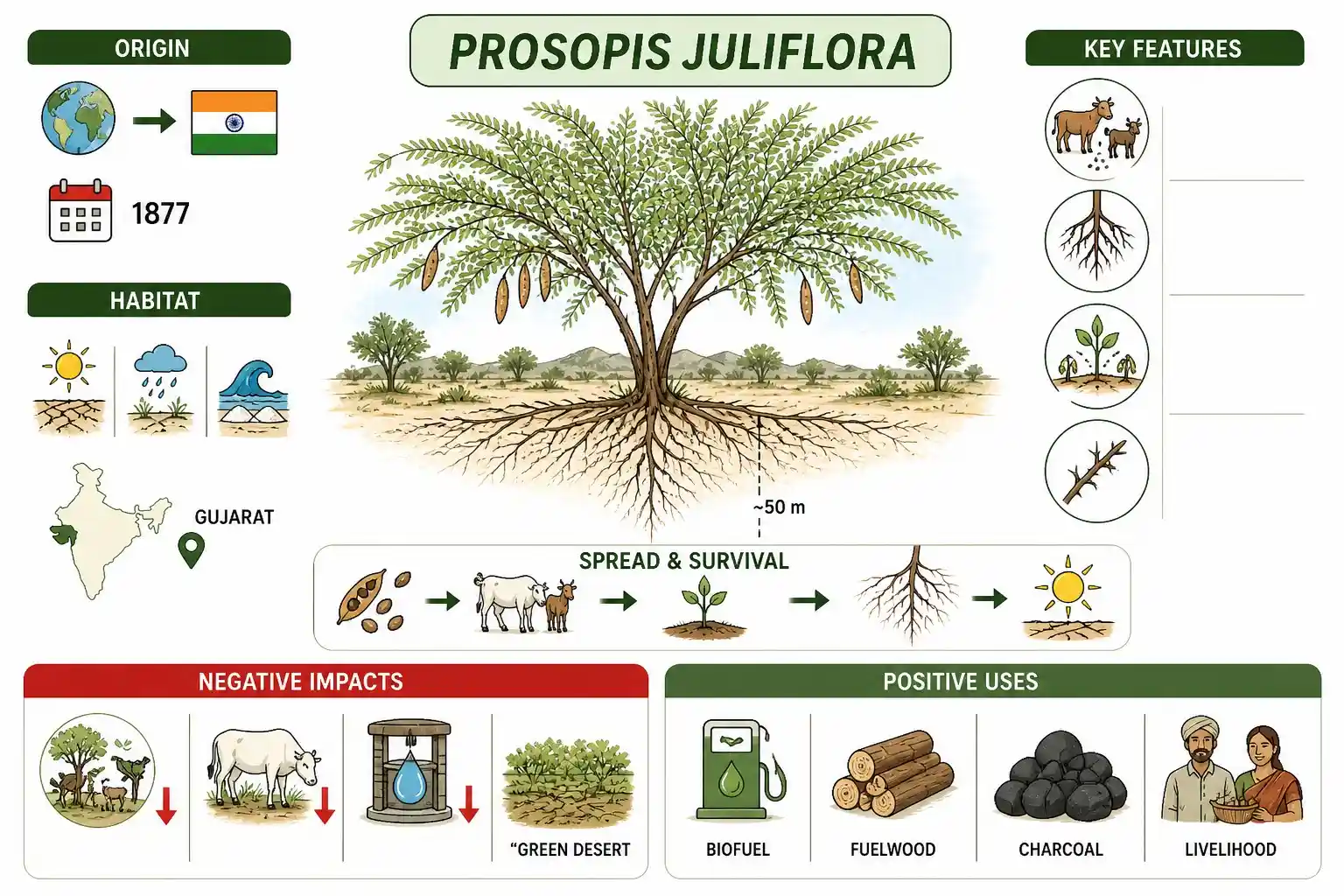
Habitat
- Grows in:
- Arid & semi-arid regions
- Low rainfall areas
- Salty soils (coastal, salt pans)
- Common in:
- Gujarat (Banni grasslands, Rann of Kutch)
Key Characteristics
1. Rapid SpreadSeeds spread via animals (cattle/goats) |
2. Deep RootsRoots up to ~50 meters and Can survive extreme drought |
3. AllelopathyReleases chemicals → kills nearby plants |
4. Thorny NatureSharp thorns → prevents grazing |
ImpactsNegative Effects
|
Positive Uses
|
Cell Broadcast System (CBS)
Context:
- India launched indigenous CBS to improve disaster management
About
- CBS is a mobile alert system
- Sends emergency messages to all phones in a specific area
- Developed by: Centre for Development of Telematics (C-DOT)
- Key idea: One-to-many communication (not like SMS)
Aim
- Shift from reactive → proactive disaster response
- Provide real-time alerts during: Floods, Earthquakes, Gas leaks and Emergencies
How It Works
- Message sent from central system → cell towers (BTS)
- Towers broadcast to all phones in that area
Key Features
1. No Network Congestion
2. Geo-Targeting
3. Multilingual Alerts
4. Priority Notification
|
5. Read-Aloud Feature
6. Network Independent
|