Operation Sindoor and India’s Strategic Options vis-à-vis Pakistan
Background of Operation Sindoor
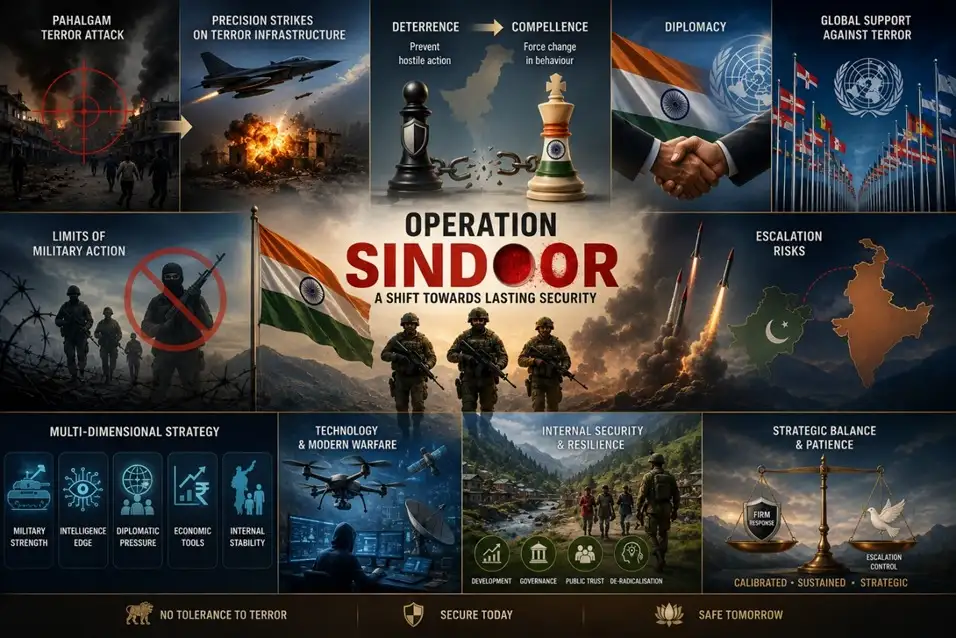
- The operation was launched after the Pahalgam terror attack in Jammu and Kashmir that caused large civilian casualties.
- India blamed Pakistan-backed terror groups and responded with precision strikes against identified targets.
- The operation reflected India’s willingness to impose visible costs on Pakistan for sponsoring cross-border terrorism.
- It signalled a departure from purely defensive or diplomatic responses.
Shift from Deterrence to Compellence
Deterrence
|
Compellence
|
Why the Pakistan Challenge Persists
- Pakistan’s security establishment continues to treat cross-border militancy as a strategic tool against India.
- Terror infrastructure remains deeply embedded within sections of the Pakistani establishment.
- Domestic political instability and military dominance in Pakistan complicate peace efforts.
- Anti-India narratives continue to be used internally for political mobilisation.
- Nuclear deterrence creates space for low-intensity proxy warfare below the threshold of full-scale war.
Limits of Military Action
- Precision strikes can impose costs but cannot permanently dismantle terror networks.
- Terror groups often regenerate with logistical and ideological support.
- Military operations alone cannot alter the structural incentives behind Pakistan’s use of proxy warfare.
- Escalation risks remain high due to the nuclear dimension of India-Pakistan relations.
The Escalation Challenge
- Any India-Pakistan military confrontation carries risks of rapid escalation.
- Limited conventional operations may unintentionally widen into broader conflict.
- Nuclear signalling by Pakistan complicates India’s response calculations.
- Therefore, India must balance firmness with escalation control.
Importance of Diplomacy
- Diplomatic engagement remains necessary even amid confrontation.
- Dialogue channels help manage crises and reduce risks of unintended escalation.
- International diplomacy also helps shape global opinion against cross-border terrorism.
- However, diplomacy without credible pressure has often failed to change Pakistan’s strategic behaviour.
Role of International Environment
- Global geopolitical shifts increasingly influence India-Pakistan dynamics.
- Major powers prioritise regional stability and nuclear risk management.
- International attention on terrorism fluctuates depending on broader geopolitical interests.
- India therefore needs sustained diplomatic efforts to keep the issue of cross-border terrorism internationally relevant.
Need for Multi-Dimensional Strategy
India’s long-term approach requires a combination of:
- Military Preparedness
- Maintain credible conventional and technological superiority.
- Intelligence-Based Operations
- Strengthen surveillance, cyber capabilities, and intelligence coordination.
- Diplomatic Pressure
- Continue exposing terror networks internationally.
- Economic Measures
- Use financial and trade-related tools selectively where feasible.
- Internal Stabilisation
- Strengthen governance, development, and security within Jammu and Kashmir.
Internal Security Dimension
- Counter-terror success depends not only on border management but also on internal resilience.
- Intelligence-led operations and local coordination remain critical.
- Development, political participation, and public trust are essential for long-term stability in Kashmir.
- Preventing radicalisation and recruitment is equally important.
Technology and Modern Warfare
- Future India-Pakistan confrontations are likely to involve drones, cyber warfare, precision strikes, and information warfare.
- Non-contact warfare and hybrid tactics are becoming increasingly important.
- India must modernise its defence architecture to address evolving threats.
Strategic Patience vs Immediate Retaliation
- India faces the challenge of balancing immediate response with long-term strategy.
- Excessive restraint may weaken deterrence credibility.
- Excessive escalation may create wider instability and international pressure.
- Therefore, calibrated and sustained pressure is becoming central to India’s evolving doctrine.
Can Pakistan’s Behaviour Change?
- Pakistan’s strategic establishment historically views proxy warfare as a low-cost instrument.
- Genuine change would require:
- Internal political transformation
- Reduction of military dominance
- Economic stabilisation
- International pressure against terror financing and support
- At present, such structural transformation remains uncertain.
Strategic Lessons for India
- India cannot rely solely on episodic military responses.
- Counter-terror strategy must combine military capability, diplomacy, intelligence, technology, and economic resilience.
- Crisis-management mechanisms must remain active to avoid uncontrolled escalation.
- India must prepare for prolonged strategic competition rather than expecting quick resolution.
Prelims Boosters
International Big Cat Alliance (IBCA)
Context:
The Union Minister for Environment, Forest and Climate Change launched the website and logo for the first International Big Cat Alliance Summit 2026 to be hosted in New Delhi.
About International Big Cat Alliance
- The International Big Cat Alliance is an inter-governmental international organisation launched in April 2023 during the 50th anniversary of Project Tiger.
- It focuses on the conservation of seven big cats: Lion, Tiger, Leopard, Snow Leopard, Cheetah, Jaguar, and Puma.
Objective
- The main objective of IBCA is to promote global cooperation for the conservation of big cats.
- It aims to facilitate collaboration, share conservation practices, and strengthen wildlife protection efforts worldwide.
Membership
- The alliance includes 95 range and non-range countries, conservation organisations, scientific institutions, and corporations.
- Membership is open to all United Nations member countries.
Founding Members
- Founding members include India, Bangladesh, Bhutan, Nepal, Kenya, Malaysia, Mongolia, Peru, Suriname, Uganda, and others.
Implementation Agency
- IBCA is implemented through the National Tiger Conservation Authority (NTCA).
- NTCA functions under the Ministry of Environment, Forest and Climate Change.
Financial Support
- India has committed ₹150 crore for the period 2023–2028.
- The funding will support infrastructure creation, corpus funds, and operational expenses.
Governance Structure
Assembly
|
Standing Committee
|
Secretariat
|
Significance
- IBCA strengthens international cooperation for wildlife conservation.
- It enhances India’s leadership role in global big cat conservation efforts.
Gulf of Aden
Context:
Recently, unidentified armed men hijacked an oil tanker near Yemen’s coast and diverted it towards the Gulf of Aden near Somali waters.
About Gulf of Aden
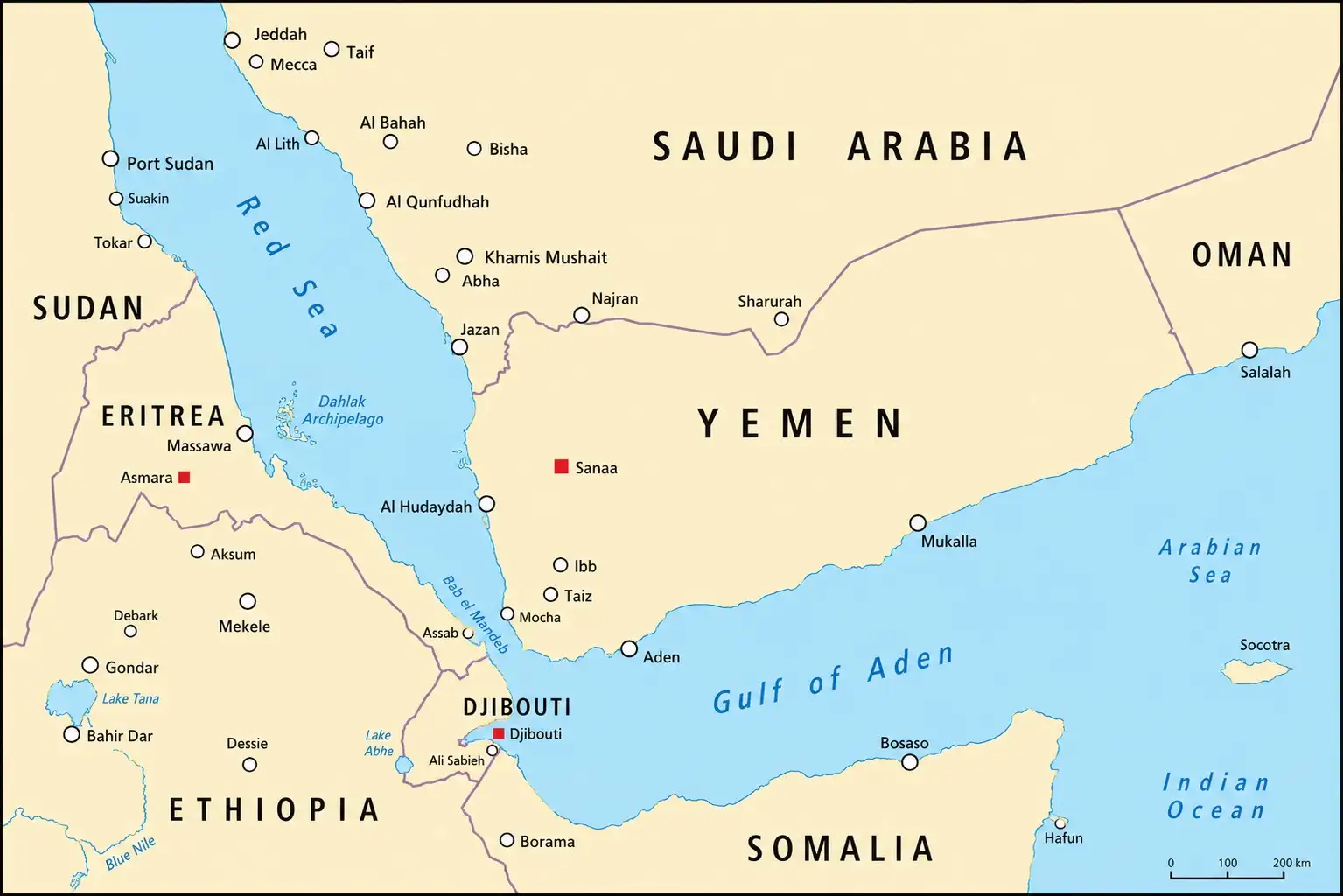
- The Gulf of Aden is an extension of the Indian Ocean located between the Arabian Peninsula in the north and the Horn of Africa in the south.
- It connects the Red Sea in the west with the Arabian Sea in the east through the Strait of Bab el Mandeb.
- The gulf is named after Aden, an important port city of Yemen.
Geographical Features
- The Gulf of Aden is approximately 900 kilometres long and around 500 kilometres wide.
- It is bordered by Yemen in the north and Somalia in the south.
- The Socotra Islands are located near the gulf and belong to Yemen.
- The Sheba Ridge, an extension of the Indian Ocean ridge system, is the major relief feature of the gulf.
Oceanographic Features
- The gulf experiences strong monsoon influence and nutrient-rich water upwelling.
- Compared to the Red Sea, the Gulf of Aden has lower salinity.
Important Cities and Ports
Major Cities: Aden, Mukalla, Berbera, Bosaso and Djibouti City
Major Ports: Aden in Yemen, Berbera and Bosaso in Somalia.
Strategic Importance
- The Gulf of Aden is a crucial part of the Suez Canal shipping route connecting Europe and Asia.
- Around 21,000 ships pass through the gulf every year.
- Nearly 11 percent of global seaborne petroleum trade passes through this route.
Swasth Bharat Portal
Context:
Recently, the Government of India launched the Swasth Bharat Portal.
About Swasth Bharat Portal
- Swasth Bharat Portal is a unified digital platform designed to integrate fragmented health programme systems across the country.
- It acts as a one-stop platform that connects various health programmes through APIs to improve interoperability and reduce administrative burden.
Objectives
- The portal aims to eliminate duplicate data entry across health systems.
- It seeks to streamline reporting and support faster decision-making in healthcare programmes.
- It also provides data visualisation tools for monitoring and evidence-based planning at the local level.
Key Features
- The portal is designed to evolve into a comprehensive digital health ecosystem.
- It will integrate with national registries such as the Healthcare Professionals Registry (HPR) and Health Facility Registry (HFR).
- It is compliant with the Ayushman Bharat Digital Mission (ABDM).
- It supports integration with ABHA (Ayushman Bharat Health Account) for secure exchange of patient health records.
Benefits
Reduction in Infrastructure Duplication
- Different health programmes currently maintain separate infrastructure systems.
- Swasth Bharat Portal reduces this duplication through a unified platform.
Reduction in Repetitive Data Entry
- Beneficiary data entered once can be used across multiple systems.
Unified Human Resource Deployment
- A common system reduces the need for separate development and maintenance teams.
Increased Interoperability
- The portal uses a federated API-based architecture to improve interoperability among health systems.
Significance
- The portal strengthens India’s digital healthcare ecosystem.
- It promotes efficient governance, better planning, and seamless health data management.
Governor’s Role in a Hung Assembly
Context:
The swearing-in of Vijay as Tamil Nadu Chief Minister was delayed after the Governor sought proof of majority support before inviting him to form the government.
What is a Hung Assembly?
- A hung Assembly occurs when no political party or pre-poll alliance secures an absolute majority in the Legislative Assembly.
- In such situations, the Governor exercises constitutional discretion to appoint a Chief Minister who is most likely to command majority support in the House.
Constitutional Provision
- Article 164(1) of the Constitution provides that the Chief Minister is appointed by the Governor.
- Normally, the Governor acts on the advice of the Council of Ministers, but in a hung Assembly, discretionary powers become important.
Aim of the Governor’s Role
- The Governor’s role is to ensure the formation of a stable government that enjoys the confidence of the Legislative Assembly.
- The Governor’s task is constitutional and administrative, not political.
Order of Preference Suggested by Commissions
Pre-Poll Alliance
- The Governor should first invite a pre-poll alliance that contested elections together and has the largest support.
Single Largest Party
- If no alliance has majority support, the Governor may invite the single largest party if it can prove majority backing.
Post-Poll Coalition
- A post-election coalition in which all parties agree to join the government may be invited.
Outside Support
- A coalition with outside support from other parties or Independents may also be considered.
Important Procedures
Floor Test
- Majority support must be tested on the floor of the Assembly and not decided privately by the Governor.
Vote of Confidence
- The Chief Minister is generally required to prove majority support within a reasonable time.
Significance
- It ensures continuity of governance when no party gets a clear majority.
- It helps maintain constitutional stability through the floor test mechanism.
Methane Alert and Response System (MARS)
Context:
The United Nations has expanded the Methane Alert and Response System (MARS) to include coal and waste sectors.
About MARS
- MARS is the world’s first satellite-based system for monitoring major methane emitters.
- It functions under the International Methane Emissions Observatory (IMEO) of the United Nations Environment Programme (UNEP).
- The system was announced during COP27 and officially launched in January 2023.
Objective
- The main aim of MARS is to identify methane emission events, alert governments and companies, and support rapid mitigation efforts to reduce global warming.
How it Works
- MARS analyses data from more than 35 satellites to identify methane plumes and trace them to specific facilities.
- Governments and companies are informed about major methane leaks detected in their regions.
- The system continues monitoring and publishes data on the “Eye on Methane” platform.
Key Features
- Initially focused on oil and gas, MARS now also covers coal mines and waste facilities.
- It uses artificial intelligence and machine learning for rapid satellite data analysis.
- Detection data is made public after 30 to 45 days to ensure transparency and accountability.
- It uses the Persistency-Weighted Flux method to identify long-term methane emitters.
Significance
- Methane is more than 80 times more powerful than carbon dioxide over a 20-year period in trapping heat.
- Rapid reduction of methane emissions is considered one of the fastest ways to slow global warming.