The Civil Services Examination (CSE) Prelims is often described as the most unpredictable stage of the UPSC journey. While General Studies (GS) Paper 1 commands the lion’s share of an aspirant’s study schedule, it is often General Studies Paper 2—the Civil Services Aptitude Test (CSAT)—that silently shatters dreams.
Over the past few years, the nature of the CSAT paper has evolved drastically. Gone are the days when a basic understanding of mathematics and reading comprehension could guarantee a smooth sail past the qualifying threshold. Today, CSAT has become a formidable gatekeeper, inducing severe exam anxiety even among the most brilliant minds.
At Educrat IAS, recognized widely as the best UPSC coaching centre in Kolkata, we have witnessed firsthand how CSAT anxiety grips aspirants. However, clearing the CSAT cutoff is not about mastering advanced engineering mathematics; it is about strategic selection, psychological resilience, and structured practice.
This comprehensive guide breaks down the ultimate CSAT strategy to help you conquer the 33.33% qualifying mark (66.67 marks out of 200) and eliminate Prelims anxiety once and for all.
1. Acknowledging the Shift: Why CSAT Causes Panic
To defeat the enemy, you must first understand its evolving tactics. In recent UPSC Prelims cycles, the difficulty level of CSAT has escalated significantly. The Quant section now frequently features permutations, combinations, number system problems, and probability questions reminiscent of advanced competitive exams. Concurrently, reading comprehension passages have become increasingly nuanced, demanding precise logical deduction.
This structural shift has led to two distinct types of anxiety among aspirants:
- The Non-Math Fear: Aspirants from humanities or arts backgrounds often convince themselves that they cannot pass due to the advanced mathematical leanings of the paper.
- The Complacency Trap: Aspirants with engineering or technical backgrounds frequently allocate zero time to CSAT, only to face a rude awakening when confronted with lengthy, time-consuming logical puzzles.
To counter this, a shift in mindset is required. You do not need to top the CSAT paper; you simply need to clear the cutoff. Your objective is accuracy and smart question selection, a philosophy deeply embedded in our Aarambh Foundation Batch at the premier IAS coaching institute in Kolkata.

2. Decoding the CSAT Syllabus: The Three Pillars
The CSAT paper comprises 80 questions to be solved within 120 minutes. Each question carries 2.5 marks, with a negative marking penalty of 1/3rd (0.83 marks) for every incorrect response. The paper fundamentally tests three core domains:
A. Quantitative Aptitude (Quant)
This section forms the core of recent CSAT papers. Focus your energy heavily on high-yield, conceptual topics rather than trying to memorize exhaustive shortcuts:
- Number System: Properties of numbers, divisibility rules, remainders, LCM & HCF, unit digits, and prime numbers. This topic alone frequently yields 10–15 questions.
- Arithmetic: Percentages, Profit & Loss, Simple & Compound Interest, Ratio & Proportion, Averages, and Time, Speed & Distance.
- Modern Math Basics: Fundamental principles of Permutations & Combinations (P&C) and basic Probability.
B. Logical Reasoning and Analytical Ability
This is traditionally the most scoring section of the paper, offering excellent returns on effort for those seeking reliable entry into the best IAS coaching in Kolkata classrooms for Mains preparation.
- Syllogisms and Venn Diagrams
- Coding-Decoding and Blood Relations
- Direction Sense and Seating Arrangements
- Data Sufficiency (which bridges Quant and Reasoning)
C. Reading Comprehension (RC)
Reading Comprehension requires you to identify the core message, crucial assumptions, inferences, and corollaries of short passages. It is an invaluable section for balancing a modest performance in math, provided you train your mind to avoid subjective bias and stick strictly to the author’s narrative.
3. Step-by-Step Strategy to Clear the CSAT Cutoff
Cracking the CSAT isn’t about working harder; it’s about working smarter. Since you only need to clear the baseline threshold of 33.33%, your training should focus entirely on tactical execution, accuracy, and ruthlessly eliminating errors.
Here is the exact step-by-step operational blueprint taught at Educrat IAS, the premier IAS coaching institute in Kolkata, to help you master the mechanics of Paper II.
Step 1: Establish Your Baseline Diagnostic
Before buying new books or diving into advanced formulas, you must map your current aptitude levels. Treat this as a diagnostic stress test to identify your starting point.
- The Drill: Download the official UPSC CSAT papers from the last three years. Find an isolated, quiet room, set a countdown timer for exactly two hours, and solve the paper with zero external assistance or reference material.
- The Analysis: Once done, calculate your score strictly applying the standard negative marking penalty for incorrect responses.
- The Safe Zone: If your score is comfortably high, your logical foundations are strong. You do not need daily CSAT classes. Focus on solving a couple of full-length papers monthly under exam conditions via a structured program like the Aanklan Prelims Test Series to maintain your speed.
- The Danger Zone: If you are hovering just around the passing line, you have the basic concepts but lack consistency. You are highly vulnerable to negative marking traps. You need targeted sectional practice, particularly focusing on data accuracy and reading speed.
- The Critical Zone: If you are falling below the passing mark, you need an absolute foundational overhaul. You must treat CSAT as a core subject, dedicating structured hours every single week to mastering primary formulas, basic calculation shortcuts, and core comprehension rules.
Step 2: Implement the “Rule of 50” (Quality Over Quantity)
The biggest mistake aspirants make in the exam hall is trying to attempt all 80 questions. Given the lengthy nature of recent papers, this approach triggers cognitive fatigue and drives up error rates. To comfortably clear the mark, your sweet spot lies in attempting around 45 to 50 highly accurate questions.
By limiting your target to a select group of questions, you unlock significantly more time per question instead of frantically rushing through the paper. This extra time drastically reduces silly calculation mistakes and helps you catch the subtle qualifiers—like “not”, “definitely”, “some”—hidden inside complex Reading Comprehension passages. You win the CSAT game through precision, not speed.
Step 3: Categorize by Strengths (The Cognitive Balance Sheet)
Every individual has a unique cognitive profile. To make your target attempts work, you must build a personalized plan based on your strengths across the three pillars:
- The Math-Leaning Aspirant: If you come from a technical or science background, your core focus should be maximizing scores in the Quantitative Aptitude and Logical Reasoning sections, while attempting only the short, direct reading comprehension passages as a safety buffer.
- The Verbal-Leaning Aspirant: If you come from a humanities or arts background, your strength lies in language. You should confidently target the Reading Comprehension and Logical Reasoning sections first, while selectively picking out only the basic arithmetic questions from the math section.
Our mentors at Educrat IAS—widely regarded as the top UPSC coaching centre in Kolkata—work individually with students to map this balance sheet, ensuring you play to your natural cognitive advantages rather than fighting the paper.
Step 4: Master the “Three-Pass” Execution Model
When the invigilator says “Start,” your paper management strategy determines your outcome. Never solve the paper linearly from question 1 to 80. Instead, divide your two hours into three distinct waves:
- Pass 1 (The First 45 Minutes): Scan the paper and harvest the low-hanging fruit. These include direct syllogisms, basic blood relation puzzles, straightforward averages, and short, crisp reading passages. Getting a solid chunk of indisputable answers marked early defuses exam panic entirely.
- Pass 2 (The Next 50 Minutes): Turn your attention to questions from your strength areas that you skipped initially because they looked lengthy or required deeper calculation. This includes modular arrangements, multi-statement data sufficiency, and longer conceptual reading passages. Focus on maintaining a clean, unhurried pace.
- Pass 3 (The Final 25 Minutes): Count your secure attempts. If you have crossed your safety target with high confidence, stop pushing further and avoid unnecessary guessing. Use this final window to carefully verify your calculations and double-check your OMR bubbling for alignment errors.
Step 5: Reverse-Engineer the Options (Substitution & Elimination)
CSAT is an objective test, which means the correct answer is already written right in front of you. You do not need to show your working steps to the examiner; you just need to identify the correct option. Master these two core techniques to save precious time:
- Option Substitution: If a number system problem involves complex algebraic variables, do not try to solve the entire equation from scratch. Substitute the given options directly into the question’s constraints. Usually, two options can be discarded instantly because they violate basic rules like odd/even properties or divisibility conditions.
- Extreme Word Elimination in Reading Comprehension: In the verbal section, UPSC frequently creates incorrect options by utilizing highly restrictive, absolute language. Be deeply suspicious of options containing words like “always”, “never”, “completely”, “all”, or “only”. Conversely, options featuring moderate, inclusive language like “may”, “some”, “can be”, or “generally” are statistically far more likely to represent the author’s balanced view.
4. Overcoming Prelims Anxiety: The Psychological Edge
Anxiety is rarely driven by a lack of knowledge; rather, it stems from a lack of predictability. When you step into the examination hall wondering what types of questions will appear, panic sets in. You can actively mitigate this anxiety through two primary strategies:
Demystify the Exam Through Mock Tests
Familiarity breeds confidence. Simulating the exact pressure cooker environment of the UPSC exam day helps normalize the experience. The Aanklan Prelims Test Series by Educrat IAS features 58 total tests, offering comprehensive coverage across both GS and CSAT under strict invigilation. Simulating these conditions repeatedly transforms the actual Prelims day into just another routine test.
Grounding Techniques During the Exam
If you encounter three difficult questions in a row, it is easy to spiral into panic. Remember: UPSC intentionally scatters speed-breakers throughout the paper to test your emotional intelligence. If a section feels impossibly hard, take a deep breath, drink a sip of water, and flip to a completely different section of the booklet. The exam is a test of administrative composure as much as academic aptitude.
5. Integrating CSAT with Your Overall UPSC Preparation
An efficient preparation model avoids isolating CSAT from your broader GS routine. A highly structured and comprehensive curriculum ensures that your daily learning naturally complements your aptitude training.
For instance, your Reading Comprehension skills improve rapidly when you consistently engage with editorial analysis. Developing a habit of reading premium current affairs material clarifies how logical arguments are constructed.
Leveraging Free Digital Ecosystems
A comprehensive digital prep routine can keep your analytical and general awareness faculties sharp without adding extra cognitive load. As the top destination for IAS coaching in Kolkata, we recommend leveraging daily micro-learning habits:
- Daily CA & Daily CA Quiz: Regularly testing your comprehension through well-structured quizzes keeps your mind agile and accustomed to extracting data under time constraints.
- Daily PIB Summary: Engaging with official policy documentation trains your brain to parse dense, administrative text, directly enhancing your speed in CSAT Reading Comprehension.
- Monthly UPSC CA Magazine & Monthly UPSC CA MCQs PDF: Reviewing consolidated monthly data helps you practice pattern recognition and structural analysis across complex information buckets.
- Monthly PIB Compilation: A perfect tool to ensure you catch core development data without getting overwhelmed by daily tracking.

6. Elevating Your Prep with Expert Mentorship in Kolkata
Self-study is an important element of preparation, but navigating the unpredictable waves of the UPSC CSE requires structured guidance, top-tier resources, and an environment that fosters accountability.
Educrat IAS brings Delhi’s trusted UPSC preparation model directly to West Bengal, eliminating the need for local aspirants to relocate. Led by seasoned faculties from Delhi and achieved Civil Servants, our institute provides a highly supportive and competitive learning environment, solidifying our reputation as the leading UPSC coaching in Kolkata.
Our pedagogical framework is built upon two landmark programs:
The Aarambh Foundation Batch
The Aarambh Foundation Batch is a meticulously structured 12-month program tailored for graduates and working professionals. It seamlessly integrates all stages of the examination—Prelims (GS and CSAT), Mains, and the Interview. Featuring small batch sizes for personalized attention, it ensures that students receive individual mentorship from UPSC toppers who understand exactly how to navigate changing exam trends.
The Aanklan Prelims Test Series
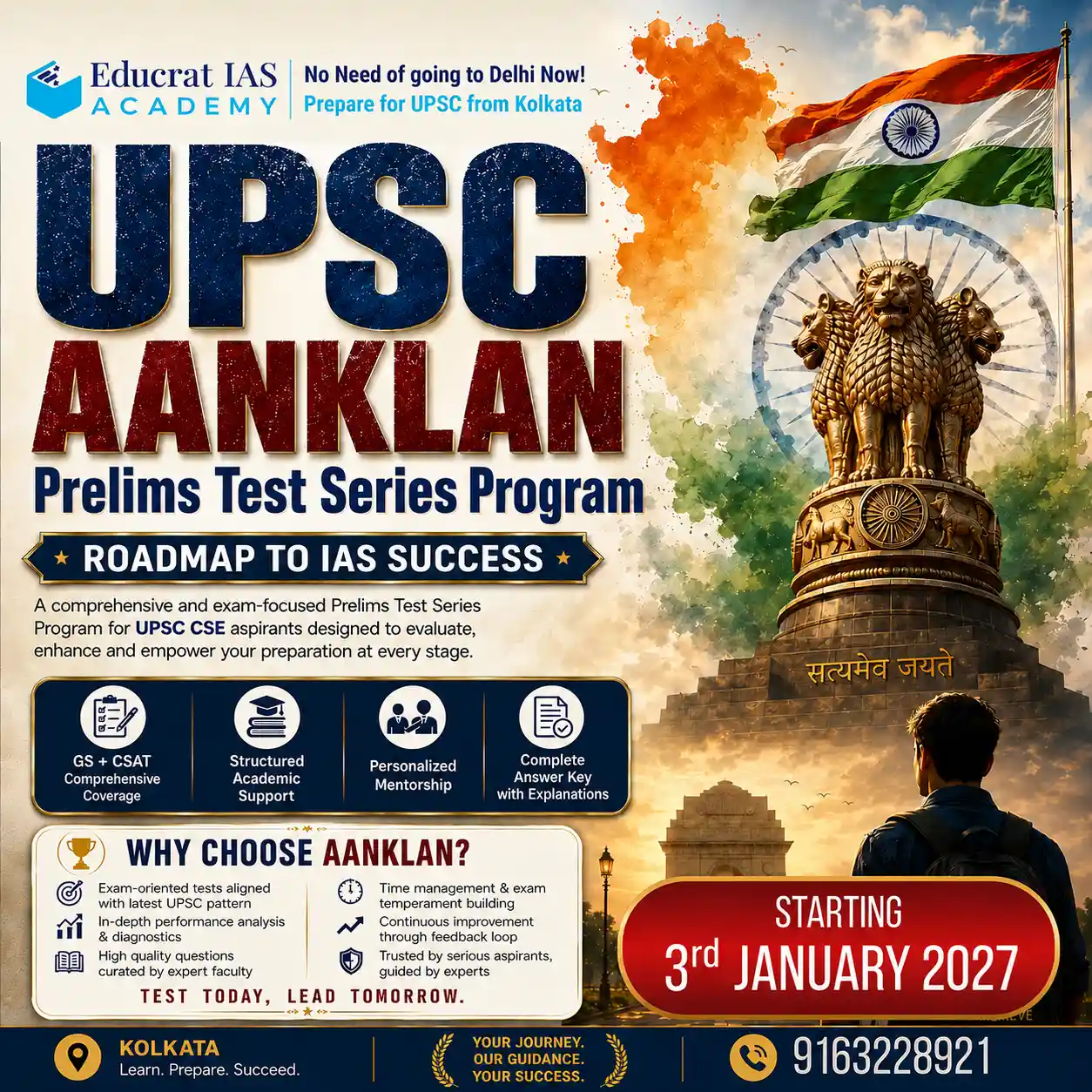
Our flagship Aanklan Prelims Test Series is designed around emerging UPSC trends and past question patterns. It includes 42 module-based exams and 16 full-length tests covering both GS and CSAT. With comprehensive answer keys, detailed explanations, and an All-India Ranking system, the series helps you systematically eliminate weak spots, fine-tune your question-selection strategy, and build the confidence necessary to keep exam-day anxiety at bay.
Our methodology is validated by a consistent track record of success across recent exam cycles, including standout performances by our offline classroom and interview batch students:
- Saima Khan (AIR 135, UPSC CSE 2025) – Offline Foundation Classroom Batch
- Debjyoti Halder (AIR 443, UPSC CSE 2025) – Offline Mains & Interview Batch
- Sahars Kumar (AIR 153, UPSC CSE 2024) – Offline Foundation Batch
- Paramita Malakar (AIR 477, UPSC CSE 2024) – Offline Foundation Batch
- Juhi Das (AIR 649, UPSC CSE 2025) – Offline Foundation Classroom Batch
Final Thoughts: The Threshold is Waiting to be Crossed
CSAT is a qualifying paper designed to test your baseline analytical capabilities under pressure, not an insurmountable barrier designed to halt your journey. By adopting a focused approach—prioritizing high-yield topics like the Number System, mastering strategic question selection, and building consistent evaluation habits—you can confidently clear the cutoff and keep Prelims anxiety entirely at bay.
If you are looking for structured guidance, personalized mentorship, and a community dedicated to excellence, connect with us at Educrat IAS, the premier UPSC coaching centre in Kolkata. Whether you are looking to build your core concepts through our Aarambh Foundation Batch or hone your exam strategy via the Aanklan Prelims Test Series, we provide the resources, expertise, and guidance needed to turn your aspirations into reality.
Ready to transform your UPSC preparation? Explore our comprehensive free resources, including our Monthly UPSC CA Magazine, Monthly PIB Compilation, and Daily CA Quizzes, or book a personalized counselling session with our expert mentors today!