The Essay Paper in UPSC Civil Services Mains carries 250 marks, making it one of the most decisive papers in determining the final rank. Unlike General Studies papers, the Essay paper evaluates a candidate’s ability to think critically, organize ideas logically, and present arguments in a coherent and persuasive manner. Many aspirants focus heavily on GS and Optional subjects while neglecting essay preparation, which often results in average scores.
At EDUCRAT IAS Academy, The Best IAS Institute in Kolkata, we have observed that candidates who start essay preparation early and practice consistently tend to score significantly higher than those who treat the paper as an afterthought. Through structured mentorship, regular evaluation, and proven writing frameworks, aspirants can transform essay writing from a weak area into a scoring opportunity. This article outlines a practical Essay Writing Strategy for UPSC Mains 2027 based on the methods followed by successful candidates and mentors.
Understanding the Essay Paper
Before preparing for the Essay paper, it is essential to understand what UPSC expects from candidates. The Essay paper is not a test of literary excellence or sophisticated vocabulary. Instead, it assesses clarity of thought, depth of understanding, balanced analysis, and effective communication. This is why, at EDUCRAT IAS Academy, essay preparation begins with helping students understand the examiner’s expectations rather than merely providing model essays.
Key Features of the Essay Paper
- Total Marks: 250
- Duration: 3 Hours
- Two Sections (A & B)
- Four topics in each section
- One essay to be written from each section
- Approximately 1000–1200 words per essay
Step 1: Select the Right Topic
Topic selection is often the most underrated aspect of essay writing. Many aspirants choose a topic simply because it appears familiar, without considering whether they can sustain a meaningful discussion on it for 1000–1200 words. A wise topic choice can make essay writing smoother and more effective.
Before Selecting a Topic
- Spend 5–10 minutes understanding the theme.
- Identify the central idea and keywords.
- Check whether multiple dimensions can be explored.
- Ensure availability of examples and case studies.
- Avoid topics that may lead to repetitive content.
- Choose a topic that allows balanced arguments.
During essay mentorship sessions at EDUCRAT IAS Academy, students are trained to decode keywords, identify hidden themes, and evaluate the scope of topics before beginning to write. This prevents the common mistake of choosing a topic that lacks sufficient dimensions.
Step 2: Invest Time in Brainstorming
Many candidates begin writing immediately after selecting a topic, which often leads to a disorganized essay. Brainstorming helps in generating diverse ideas and creating a logical flow before writing begins. A well-planned essay appears structured, coherent, and comprehensive. Spending a few minutes on brainstorming can save considerable time during the writing process and improve the overall quality of the essay.
During Brainstorming, Think About
- Historical perspective
- Political dimension
- Social dimension
- Economic implications
- Ethical considerations
- Environmental impact
- International perspective
- Challenges and opportunities
- Future outlook
Prepare a rough framework like a Mind map before writing the essay.
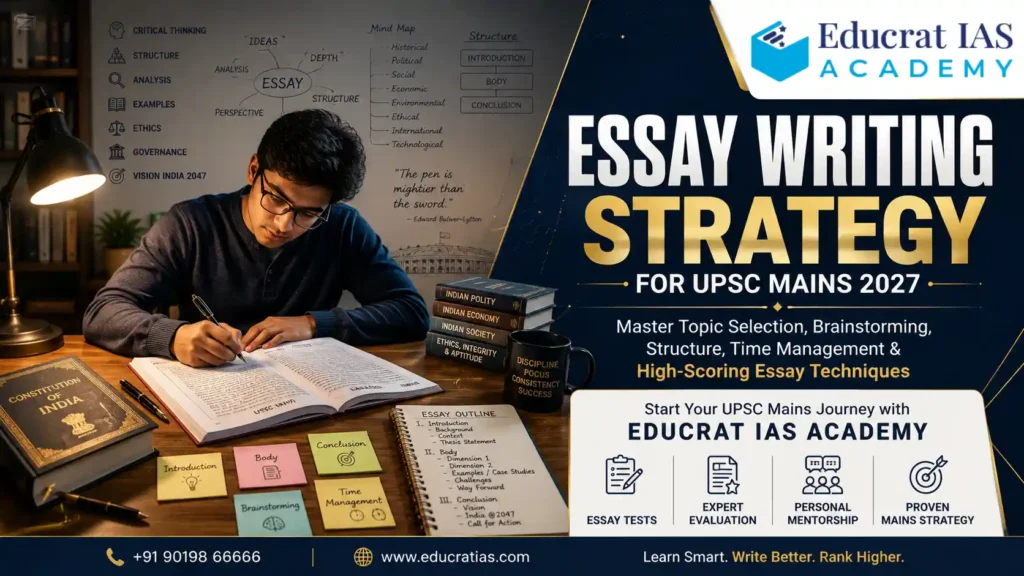
One of the most effective techniques taught in the EDUCRAT IAS Academy Essay Program is multidimensional brainstorming. Students learn how to approach a topic from historical, political, social, economic, ethical, environmental, and international perspectives before drafting the essay.
Step 3: Create a Strong Structure
A good essay resembles a well-constructed building where every part supports the overall theme. Without a proper structure, even good content may appear scattered and ineffective. A clear introduction, a logically organized body, and a meaningful conclusion help maintain continuity and improve readability.
At EDUCRAT IAS Academy, aspirants are provided with essay frameworks and structure-building exercises that help them organize ideas logically while maintaining a smooth flow throughout the essay.
Introduction
A strong introduction should neither be too lengthy nor too abrupt. It should naturally lead the examiner towards the central theme. Through regular practice and feedback sessions, students learn multiple introduction techniques that can be adapted to different essay themes. A good way to begin would be starting with an essay that links the topic with the approach that will be navigated in the rest of the essay.
Body
The body forms the heart of the essay and should contain the majority of the discussion. The best essays are those that combine facts with analysis and maintain coherence from beginning to end.
Tips for Essay Body
- Begin paragraphs with interlinking
- Keep each paragraph short of about 3-4 sentences
- Cater to different ideas in each paragraph.
- Keep the sentences short and less complicated to avoid grammatical errors.
- Incorporate relevant Quotes
- Not just historical but also contemporary and futuristic areas to be discussed.
To achieve this balance, EDUCRAT IAS Academy, the Best UPSC coaching, emphasizes the use of examples, case studies, constitutional values, and contemporary developments while maintaining a narrative flow rather than writing isolated points.
Conclusion
The conclusion should leave the examiner with a positive impression and a sense of direction. A forward-looking and optimistic conclusion often distinguishes a good essay from an average one.
During evaluation sessions at EDUCRAT IAS Academy, special attention is given to conclusion writing because many candidates unnecessarily lose marks by ending essays abruptly.
Step 4: Master Time Management
One of the biggest reasons for low essay scores is poor time management. Several aspirants write an excellent first essay but struggle to complete the second one due to lack of time. Effective time allocation ensures that both essays receive equal attention. Time management should become a habit through regular mock tests and writing practice.
A Practical Time Distribution
| Activity | Time |
| Topic Selection & Brainstorming | 20 Minutes |
| Essay 1 Writing | 70 Minutes |
| Essay 2 Writing | 70 Minutes |
| Revision & Review | 20 Minutes |
Important Tips
- Avoid spending excessive time on introductions.
- Maintain a steady writing speed.
- Leave sufficient time for revision.
- Practice writing under exam conditions.
To address this challenge, EDUCRAT IAS Academy conducts timed essay writing sessions that replicate actual UPSC examination conditions. This helps students develop the speed, discipline, and confidence required to complete both essays comfortably within the allotted time.
Step 5: Build a Repository of Examples
Examples transform an ordinary essay into a convincing and insightful one. They provide credibility to arguments and demonstrate a candidate’s awareness of contemporary issues.
Maintain Notes On
- Constitutional Articles
- Supreme Court Judgments
- Government Schemes
- NITI Aayog Reports
- International Reports
- Historical Events
- Success Stories
- Ethical Examples
- Quotations of Thinkers
- Stake-holders of society
- Civil Service Best Practices
Regular updating of this repository can significantly enrich essay content.
As part of its content enrichment initiative, EDUCRAT IAS Academy provides students with curated repositories of constitutional provisions, Supreme Court judgments, government initiatives, reports, ethical examples, and contemporary case studies that can be effectively incorporated into essays.
Step 6: Practice Every Week
Essay writing is not a theoretical subject that can be mastered through reading alone. It is a skill that improves through continuous writing and feedback. Regular practice helps candidates develop clarity of thought, improve articulation, and increase writing speed.
Recommended Practice Strategy
- Write one essay per week initially.
- Increase to two essays weekly after syllabus completion.
- Practice within the three-hour time limit.
- Seek evaluation from mentors.
- Analyze mistakes and feedback.
- Rewrite weak essays for improvement.
This is precisely why the EDUCRAT IAS Academy Essay Writing Programme focuses on regular writing, detailed evaluation, mentor feedback, and improvement tracking. Consistent practice remains the single most important factor behind high essay scores.
Common Mistakes to Avoid
Even knowledgeable candidates lose marks due to avoidable errors. These mistakes often affect the structure, coherence, and quality of the essay. Identifying and eliminating such errors can significantly improve scores. Aspirants should regularly review their essays to ensure that these common pitfalls are avoided.
Avoid the Following Mistakes
- Misinterpreting the topic.
- Writing a GS answer instead of an essay.
- Lack of coherence between paragraphs.
- Excessive use of quotations.
- One-dimensional analysis.
- Repetition of arguments.
- Poor handwriting and presentation.
- Abrupt conclusions.
- Poor time management.
The UPSC Essay paper offers one of the best opportunities to improve overall Mains marks. A well-written essay reflects not only knowledge but also the maturity, balance, and vision expected from a future civil servant.
At EDUCRAT IAS Academy, we believe that essay writing is a skill that can be systematically developed through the right guidance, regular practice, and constructive feedback. Aspirants targeting UPSC Mains 2027 should start early, write consistently, and seek continuous improvement.
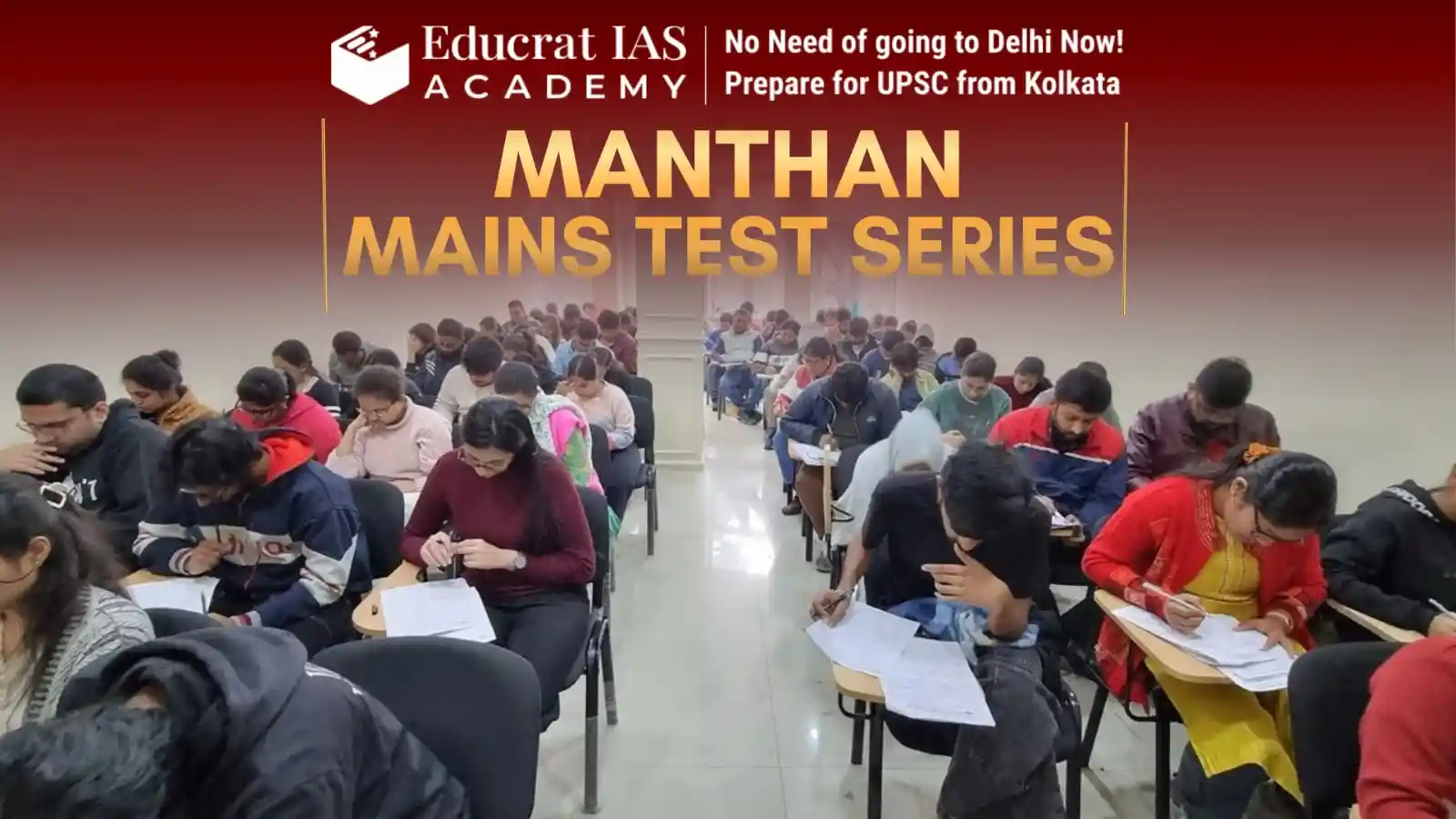
Join EDUCRAT IAS Academy’s Essay Writing Programme and gain access to:
- Mains Tests Series including Essay
- Expert Evaluation & Feedback
- Personalized Mentorship
- Topic-Wise Essay Frameworks
- Content Enrichment
- UPSC Mains Simulation Tests
EDUCRAT IAS Academy – Learn Smart. Write Better. Rank Higher.