A Decentralised Approach to India’s Waste Management Crisis
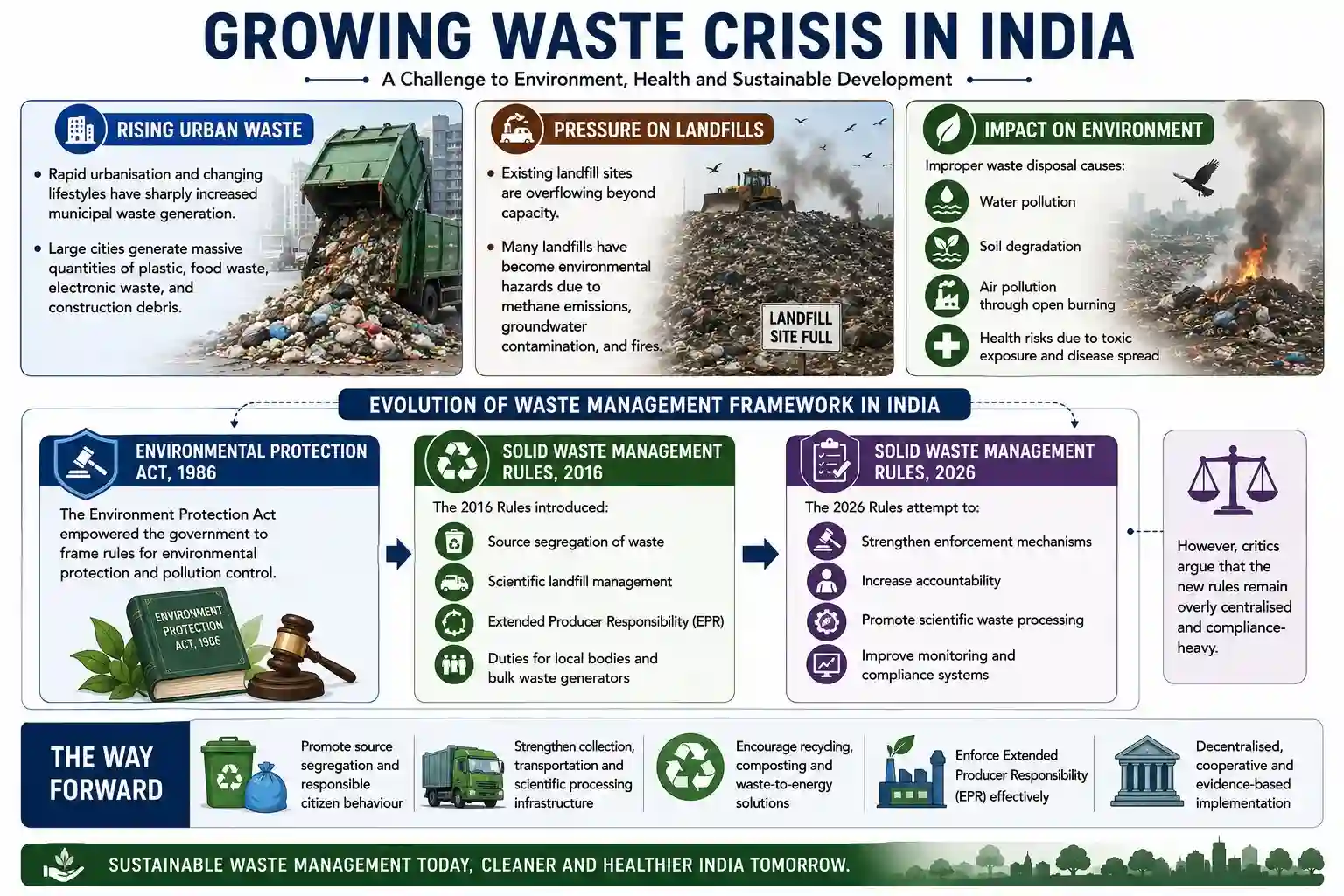
Problems with Centralised Waste Governance
a) Weak Local Capacity
b) Excessive Bureaucratic Compliance
|
c) One-Size-Fits-All Approach
d) Distance Between Policy and Implementation
|
Why Decentralisation Is Important
Meaning of Decentralised Waste Management
- Decentralisation means managing waste as close as possible to where it is generated.
- This includes: Ward-level segregation, Community composting, Local recycling systems and Small-scale waste processing units.
Benefits of Decentralisation
- Reduces transportation costs, Minimises landfill burden, Encourages community participation, Improves accountability & Enhances local innovation and adaptability.
Role of Urban Local Bodies
- Municipalities and Panchayats are central to effective waste management.
- Their responsibilities include: Door-to-door waste collection, Segregation of wet and dry waste, Waste transportation and processing, Public awareness campaigns and Sanitation planning.
- However, many local bodies remain financially and administratively weak.
Importance of Waste Segregation
Source Segregation
- Waste should be separated at the household level into: Wet waste, Dry waste, Hazardous waste and Sanitary waste.
Why It Matters
- Segregation: Improves recycling efficiency, Reduces landfill waste, Prevents contamination and Supports circular economy practices.
- Without segregation, scientific waste management becomes extremely difficult.
Informal Waste Workers and Recycling Economy
India’s informal waste workers play a major role in recycling and material recovery.Contribution of Informal Sector
- Waste pickers recover plastics, metals, paper, and reusable materials.
- They reduce the burden on municipalities and landfills.
Need for Inclusion
- Policies should: Provide social security and safety equipment, Recognise waste workers formally, Integrate them into municipal systems.
Technology and Scientific Waste Processing
CompostingWet waste can be converted into compost for agriculture and gardening.Biogas GenerationOrganic waste can produce biogas and renewable energy. |
RecyclingEfficient recycling reduces resource extraction and environmental damage.Waste-to-Energy PlantsAlthough promoted widely, these plants face concerns regarding:
|
Public Participation and Behavioural Change
Waste management cannot succeed through government action alone.
- Need for Citizen Participation
- Citizens must: Segregate waste at source, Reduce single-use plastics, Support recycling practices, Adopt sustainable consumption habits.
- Awareness and Education
- Schools, resident welfare associations, and local communities should promote environmental awareness and responsible waste behaviour.
Environmental and Public Health Concerns
- Poor waste management contributes to: Vector-borne diseases, Respiratory illnesses, Toxic contamination, Flooding due to clogged drains, Marine pollution through plastic waste.
Thus, waste management is both an environmental and public health issue.
Need for a Circular Economy
- A circular economy focuses on: Reuse, Recycling, Resource recovery, Waste reduction.
- Instead of treating waste as useless material, it should be viewed as a reusable economic resource.
Way Forward
Strengthen Local Governance
Promote Decentralised Infrastructure
|
Simplify Compliance
Integrate Informal Workers
Encourage Community Participation
|
Why Excessive Forex Conservation Can Slow India’s Economic Growth
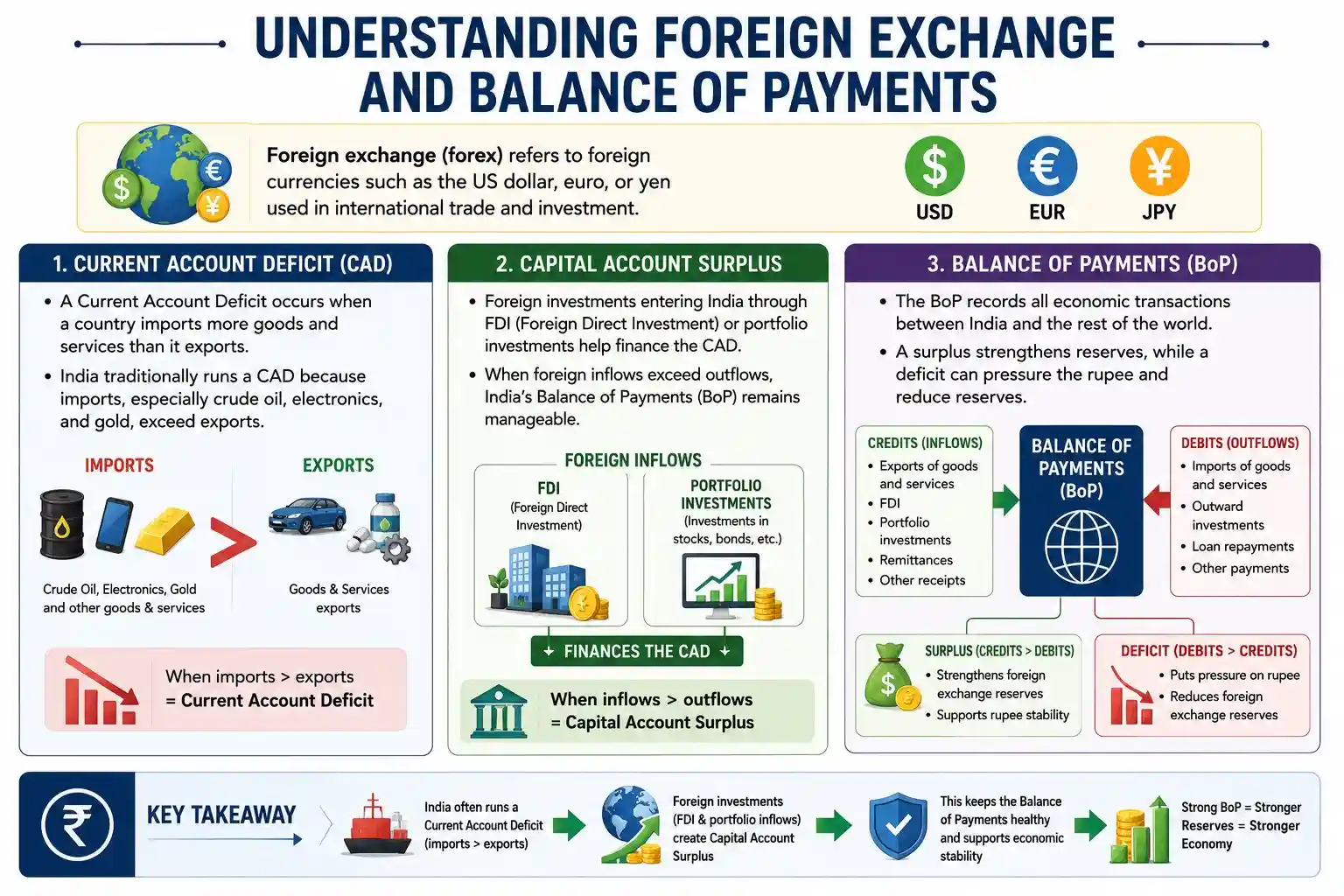
Why Governments Emphasise Forex Conservation
Governments often encourage forex saving during periods of:
- Rising crude oil prices, Global uncertainty or wars, Pressure on the rupee, Falling forex reserves, Widening current account deficits.
Measures may include:
- Reducing imports, Encouraging domestic substitutes, Discouraging luxury consumption, Promoting local products.
The Problem with Excessive Import Compression
While reducing unnecessary imports can help temporarily, aggressive import reduction can harm growth.
a) Reduced Consumption Slows Demand
- Consumer spending is a major driver of economic growth.
- If households drastically reduce spending, demand for goods and services falls.
- Businesses then reduce production, hiring, and investment.
b) Investment Activity Weakens
- Lower domestic demand discourages private investment.
- Investors avoid economies where consumption growth remains weak.
- This slows industrial expansion and job creation.
c) Imports Are Often Inputs for Production
India imports many essential intermediate goods such as:
- Crude oil, Fertiliser inputs, Semiconductor components, Industrial machinery, Electronic parts.
Reducing such imports may hurt manufacturing and agriculture rather than strengthen self-reliance.
India’s Structural Dependence on Imports
Energy Dependence
- India imports nearly 85% of its crude oil requirements.
- Transport, electricity, fertilisers, and industries depend heavily on imported energy.
Fertiliser Dependence
- Even domestic fertiliser production depends on imported natural gas and other feedstock materials.
- Therefore, complete self-reliance in agriculture is difficult without energy security.
Technology and Electronics
- India still relies significantly on imported high-end technology components and machinery.
- Sudden restrictions can slow industrial productivity.
Impact on the Rupee and Forex Reserves
Role of RBI
The Reserve Bank of India manages forex reserves to:
- Stabilise the rupee, Meet import obligations, Maintain investor confidence, Protect against external shocks.
Why Reserves Matter
Healthy reserves help India:
- Handle global crises, Manage capital outflows, Prevent excessive currency volatility.
However, reserves alone do not guarantee long-term economic strength unless production capacity also rises.
The Real Solution: Boosting Production and Productivity
The long-term solution is not merely reducing imports but increasing India’s economic competitiveness.
a) Expanding Manufacturing
- India must strengthen domestic manufacturing capacity.
- Policies like Make in India and Production Linked Incentive (PLI) schemes aim to reduce import dependence through industrial growth.
b) Increasing Exports
- Export growth brings sustainable foreign exchange earnings.
- High-value exports in electronics, pharmaceuticals, engineering goods, and services are essential.
c) Improving Productivity
- Better infrastructure, logistics, technology, and skilled labour increase productivity.
- Competitive industries reduce import dependence naturally over time.
d) Attracting Stable Investments
- Strong investment inflows support forex reserves without suppressing consumption.
- Investor confidence depends on growth potential, policy stability, and market size.
Limits of “Self-Reliance” Through RestrictionSelf-reliance does not mean isolation from global trade. Problems with Excessive Protectionism
|
Balancing Growth and External StabilityIndia requires a balanced strategy:
|
Broader Economic Significance
The debate reflects a larger economic question:
Should India focus primarily on conserving resources or on expanding economic capability?
Long-term prosperity requires:
- Industrial competitiveness.
- Technological advancement.
- Higher productivity.
- Global integration.
- Export-led growth alongside domestic demand.
Prelims Boosters
Indian Vulture
Context:
Recently, two Indian vultures released in Maharashtra’s Melghat Tiger Reserve were spotted near Bhopal after travelling more than 1,000 kilometres.
About Indian Vulture
- The Indian Vulture, also known as the Long-billed Vulture, is a bird of prey native to South Asia.
- Its scientific name is Gyps indicus.
- It belongs to the group known as Old World vultures.
- It is a member of the Accipitridae family, which also includes eagles and hawks.
Habitat and Distribution
- Indian vultures are mainly found in India, Pakistan, and Nepal.
- They inhabit open landscapes such as savannas, cultivated areas, villages, and semi-urban regions.
Physical Features
- It is a bulky medium-sized vulture with broad wings and a short tail.
- It has a mostly bald head, a long featherless neck, and a yellowish beak.
- Its body feathers are generally light brown in colour.
- Its large wingspan helps it glide over long distances with minimal energy use.
Population Decline
- The species suffered a massive population decline of around 97 to 99 percent.
- The major reason was poisoning caused by the veterinary drug diclofenac.
- Vultures consumed carcasses of cattle treated with diclofenac, which caused kidney failure in the birds.
Conservation Status
- The Indian Vulture is classified as “Critically Endangered” under the IUCN Red List.
About Melghat Tiger Reserve
Flora and Fauna of Melghat
|
United Nations Human Settlements Programme (UN-Habitat)
Context:
Recently, UN-Habitat launched the Catalogue of Solutions 2026–2029.
About UN-Habitat
- The United Nations Human Settlements Programme, commonly known as UN-Habitat, is the United Nations agency responsible for promoting sustainable urban development and adequate housing for all.
- It was established in 1977 after the Habitat I Conference held in 1976.
Objective
- The main objective of UN-Habitat is to promote socially, economically, and environmentally sustainable cities and human settlements.
- It focuses on improving urban planning, housing, infrastructure, and quality of life.
Headquarters
- The headquarters of UN-Habitat is located in Nairobi, Kenya.
Mandate
- Its mandate is based on resolutions of the United Nations General Assembly.
- It also derives authority from the Habitat Agenda adopted during the Habitat II Conference in 1996.
Governance Structure
UN-Habitat Assembly
|
Executive Board
|
Committee of Permanent Representatives (CPR)
|
PM MITRA Park
Context:
Recently, the Prime Minister inaugurated the PM MITRA Park at Warangal in Telangana.
About PM MITRA Park
- PM MITRA stands for Pradhan Mantri Mega Integrated Textile Region and Apparel Park.
- It is a mega textile hub that integrates the complete textile value chain in one location.
- Activities such as spinning, weaving, dyeing, printing, processing, and garment manufacturing are brought together in a single zone.
Objective
- The scheme aims to strengthen India’s textile sector through integrated infrastructure and large-scale manufacturing.
- It seeks to improve efficiency, reduce logistics costs, and boost exports and employment.
Types of Parks
- PM MITRA Parks can be developed as:
- Greenfield projects, which are built on new land.
- Brownfield projects, which upgrade existing industrial areas.
Locations of PM MITRA Parks
The seven approved PM MITRA Parks are located in: Telangana
- Tamil Nadu, Gujarat, Karnataka, Madhya Pradesh, Uttar Pradesh, Maharashtra
Nodal Ministry
- The Ministry of Textiles is the nodal ministry for the PM MITRA scheme.
Key Features
Integrated Value Chain
World-Class Infrastructure
|
Public-Private Partnership
Financial Assistance
|
MERCOSUR Group
Context:
Recently, India and Brazil agreed to significantly expand the existing trade agreement between India and the MERCOSUR bloc.
About MERCOSUR
- MERCOSUR stands for “Southern Common Market.”
- It is a South American regional economic organisation formed to promote economic integration among member countries.
- It was established in 1991 through the Treaty of Asunción.
- It became a customs union in 1995 after the Protocol of Ouro Preto.
Headquarters
- The headquarters of MERCOSUR is located in Montevideo, Uruguay.
Objectives
- MERCOSUR aims to ensure free movement of goods, services, capital, and people among member countries.
- It also seeks to promote regional economic cooperation and trade integration.
Member Countries
Founding Members
|
Other Members
|
Associate Members
|
Governance Structure
Common Market Council
|
Rotating Presidency
|
India and MERCOSUR
- India signed a Preferential Trade Agreement (PTA) with MERCOSUR in 2004.
- The agreement became operational in 2009.
- India and MERCOSUR are now working to expand the scope of the agreement to boost trade and investment.
Rainbow Clouds
Context:
Indonesia recently witnessed a rare and beautiful “rainbow cloud” phenomenon that attracted widespread attention online.
About Rainbow Clouds
- Rainbow clouds are formed due to a phenomenon known as cloud iridescence.
- Cloud iridescence occurs when sunlight is diffracted by very small water droplets or tiny ice crystals present in clouds.
- Diffraction happens when light bends and spreads around particles that are similar in size to the wavelength of visible light.
- This process separates sunlight into different colours, creating rainbow-like patterns and pastel shades in clouds.
Conditions Required
- The cloud particles must be extremely small and nearly uniform in size.
- The clouds should be thin enough for sunlight to pass through them.
- The position of the Sun and the viewing angle of the observer are also very important.
Clouds Associated with Iridescence
- Cloud iridescence is commonly seen in: Altocumulus clouds, Cirrocumulus clouds, Cirrus clouds and Lenticular clouds
- Lenticular clouds often produce the most vivid iridescent displays because of their smooth structure and stable airflow.
Why is the Phenomenon Rare?
- Rainbow clouds are uncommon because several atmospheric conditions must occur together.
- Even slight differences in droplet size can weaken or completely prevent the colour formation.
Difference Between Rainbow Clouds and Rainbows
- Rainbow clouds are not true rainbows.
- Ordinary rainbows form due to refraction, reflection, and dispersion of sunlight in raindrops.
- Rainbow clouds mainly form because of diffraction and interference of light in tiny cloud particles.
- Unlike rainbows, the colours appear closer to the Sun and do not form a large arc.
Significance
- Rainbow clouds are an important example of atmospheric optical phenomena.
- They help scientists study cloud composition, sunlight interaction, and atmospheric conditions.