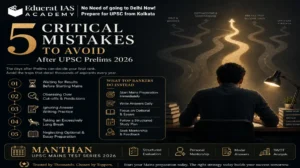
Cracking the Union Public Service Commission (UPSC) Civil Services Examination (CSE) is widely considered the most demanding academic milestone in India. With a vast, multi-layered syllabus spanning dozens of complex subjects and an annual final success rate hovering around 0.2%, the journey to the prestigious Lal Bahadur Shastri National Academy of Administration (LBSNAA) requires far more than raw intelligence—it demands a flawless, meticulously structured daily operating strategy.
A common myth propagated across social media platforms is that an active IAS candidate must study 16 to 18 hours a day, sacrificing sleep, physical health, and sanity. However, empirical data from top rankers—including our stellar classroom performers like Saima Khan (AIR 135) and Debjyoti Halder (AIR 443)—reveals a completely different truth. The secret to cracking the CSE does not lie in unsustainable short-term intensity, but in disciplined, predictable, and strategic consistency.
If you want to transition from a chaotic preparation loop to a highly structured, result-oriented pathway of success, this comprehensive, step-by-step guide outlines the ultimate daily routine of a successful UPSC aspirant.
The Macro Strategy: The "8-8-8 Rule" of Productive Routines
Before diving into the hourly breakdown, successful aspirants organize their 24-hour cycle using a strict productivity concept called the 8-8-8 Rule. This framework ensures that your physical cognitive capacity is balanced with the extreme mental demands of the syllabus:
- 8 Hours of Productive, Deep Study: Uninterrupted, high-concentration blocks focused entirely on core syllabus targets, conceptual retention, and answer writing.
- 8 Hours of Quality Sleep: A non-negotiable window to ensure long-term memory consolidation, cognitive retention, and neurological recovery.
- 8 Hours of “Life” Infrastructure: Commuting to classes, balanced meals, physical exercise, personal hygiene, and active mental de-stressing.
If you can maintain 8 hours of high-quality, distraction-free study daily for 12 months, you will automatically outpace the competition and rank within the top 1% of serious candidates nationwide.

The Master Timeline: A 24-Hour Blueprint of a UPSC Topper
| Time Window | Phase & Focus Area | Strategic Goal |
| 06:00 AM – 06:30 AM | Wake Up & Mental Reset | Hydration, light stretching, and setting daily micro-intentions. |
| 06:30 AM – 09:00 AM | PHASE 1: The Golden Static Block (2.5 Hours) | Focus on heavy General Studies core concepts and foundation NCERTs. |
| 09:00 AM – 09:30 AM | Breakfast & Transition | Nutritional refueling and preparation for active learning. |
| 09:30 AM – 01:00 PM | PHASE 2: Core Academic & Lecture Block (3.5 Hours) | Conceptual mastery through structured coaching modules. |
| 01:00 PM – 02:00 PM | Lunch & Power Nap | Complete mental decompression and a quick 20-minute rest. |
| 02:00 PM – 04:00 PM | PHASE 3: Current Affairs Matrix (2 Hours) | Editorial breakdown, Indian Express/The Hindu analysis, and PIB tracking. |
| 04:00 PM – 06:30 PM | PHASE 4: Optional Subject Specialization (2.5 Hours) | Targeting the critical 500-mark component with core answer mapping. |
| 06:30 PM – 07:00 PM | Evening Reset & Transition | A short break to disconnect before entering the active output mode. |
| 07:00 PM – 09:00 PM | PHASE 5: Output, Active Recall & Testing (2 Hours) | Daily UPSC-level MCQ solving and rigorous Mains answer writing practice. |
| 09:00 PM – 10:00 PM | Dinner & Digital Fasting | Family time and stepping away from all electronic screens. |
| 10:00 PM – 10:30 PM | PHASE 6: Daily Review & Next-Day Mapping (30 Mins) | Checking off daily milestones and setting up tomorrow’s desk. |
| 10:30 PM onwards | Sleep / Complete Digital Detox | 7.5 to 8 hours of deep sleep to ensure maximum long-term memory consolidation. |
Deep Dive: Execution Strategy for Each Phase
Phase 1: The Golden Static Block (6:30 AM – 9:00 AM)
Your mind is completely uncluttered in the early morning. This is the optimal window to execute “Eat the Frog”—tackling your most complex structural concept before any external distractions arise. Aspirants use this time to master the foundational frameworks of standard reference texts (like Laxmikanth for Polity, Ramesh Singh for Economics, or Nitin Singhania for Art & Culture) or curate condensed notes from core NCERTs.
During this block, you should focus entirely on active reading rather than passive skimming. Highlight keywords, link static concepts to historical precedents, and ensure your conceptual understanding is crystal clear. If you are a beginner or a university student looking to build this morning habit early, selecting a comprehensive UPSC Coaching Centre in Kolkata that provides structured reading roadmaps can streamline your self-study routines.
Phase 2: Core Academic & Interactive Learning (9:30 AM – 1:00 PM)
This mid-morning window is standard for high-level analytical absorption. Rather than aimlessly reading heavy textbooks alone and facing analytical bottlenecks, successful aspirants spend these hours under expert guidance to decipher complex dynamics like federal fiscal structures, international relation dynamics, or macroeconomic adjustments.
To maximize this phase, choosing an elite IAS Coaching Centre in Kolkata that eliminates the need to migrate to New Delhi for high-caliber instruction is a strategic game-changer. Our Aarambh Foundation Program provides a highly immersive, 12-month module built exactly around this critical midday block, bringing experienced Delhi faculty directly to you to deliver core thematic lectures.
Phase 3: The Current Affairs Engine (2:00 PM – 4:00 PM)
UPSC has completely shifted toward dynamic contextualization; static components are regularly tested through the lens of ongoing national and international affairs. To conquer this block:
- Read for Analysis, Not Gossip: Focus explicitly on The Hindu or The Indian Express editorials, looking for administrative problems, institutional frameworks, constitutional challenges, and policy interventions.
- Cross-Reference Government Sources: Dedicate the remaining 30 minutes to checking the Press Information Bureau (PIB) summaries and daily comprehensive news analyses.
- Note Optimization: Do not copy down entire articles. Bullet-point only critical data sets, constitutional articles invoked, supreme court judgments mentioned, or expert committee recommendations (such as the Sarkaria Commission, Punchhi Commission, or 2nd ARC).
Phase 4: The Optional Subject Pivot (4:00 PM – 6:30 PM)
Your Optional Subject accounts for 500 marks in the Mains merit calculation. It can single-handedly determine your final rank or service allocation. The late afternoon shift represents an ideal mental pivot, shifting away from General Studies to dive into specialized optional literature like Anthropology, Political Science, History, or Sociology.
Aspirants need a curriculum that focuses heavily on specific text interpretations, PYQ mappings, and high-scoring diagrams. Utilizing target-oriented modules, like the specialized Vishesh Optional Batches, can ensure this crucial afternoon slot remains highly organized, disciplined, and academically rigorous.
Phase 5: The Output Engine – Active Testing & Evaluation (7:00 PM – 9:00 PM)
Knowledge without expression is the single biggest pitfall in the Civil Services Examination. The evening hours must transform your mind from a passive consumer of information into an active output generator.| Rule Component | Core Execution Strategy | Expected Outcome |
| 7 Minutes | Strict Time Management | The maximum time allowed to read, structure, and completely write a 10-mark question during the actual exam. |
| 5 Dimensions | Multi-Dimensional Points | Provide a comprehensive answer by touching upon at least 5 different aspects (Social, Economic, Political, Environmental, and Technological). |
| 3 Visuals | Diagrams & Schematics | Enhance your presentation and save time by integrating 3 quick flowcharts, hub-and-spoke models, or Indian map layouts. |
To structure this phase flawlessly, aspirants turn to an answers-driven IAS Coaching Institute in Kolkata to access simulated test conditions.
- For Prelims (First Hour): Solve 25–30 high-yield MCQs under tight, strict invigilation parameters. This builds muscle memory for elimination tricks. Programs like the Aanklan Prelims Test Series (featuring 58 comprehensive tests) provide the ideal framework for this daily practice.
- For Mains (Second Hour): Write 2 to 3 standard mains answers using the 7-5-3 rule. Evaluating these responses using a robust, two-layered evaluation model—like the structure built into the Manthan Mains Test Series—helps you pinpoint structural flaws and master time management well before the actual exam.
Detailed Subject-Wise Time Allocation Strategy
To ensure that your daily 8-hour study routine addresses the massive depth of the UPSC syllabus, your weeks should be balanced systematically across the following pillars:
1. General Studies (Core Pillars)
- Time Allocation: 3.5 to 4 Hours Daily.
- Strategy: Rotate between two major GS subjects per week (e.g., History and Polity in Week 1, Geography and Economics in Week 2). This prevents academic fatigue while ensuring you complete the massive core syllabus within 8 to 9 months.
- Resource Mapping: Rely heavily on a single primary reference book supplemented by classroom dictates.
2. Optional Subject (The Rank Maker)
- Time Allocation: 2.5 Hours Daily.
- Strategy: The first 4 to 5 months of your preparation cycle must prioritize the Optional subject. Your daily goal during this phase should be to summarize complex theories into micro-charts that can be easily recalled during the grueling Mains week.
- Resource Mapping: Focus heavily on university-level standard texts and past 15 years’ Previous Year Questions (PYQs).
3. Current Affairs & Daily Updation
- Time Allocation: 2 Hours Daily.
- Strategy: Never spend more than 2 hours on the newspaper. Divide this block cleanly: 60 minutes for intensive newspaper reading, 30 minutes for analyzing monthly supplement compilations, and 30 minutes for mapping current issues directly to relevant GS papers (GS 1, 2, 3, or 4).
- Resource Mapping: Invest time in comprehensive institutional daily summaries to ensure you do not miss crucial policy declarations.
Tailoring the Routine to Your Current Profile
| Profile Type | Core Focus | Weekday Daily Target | Weekend Daily Target | Recommended Course |
| College Students / Beginners | Core NCERT foundations, basic syllabus decoding, and soft current affairs orientation. | 3 to 4 Hours | 8 to 10 Hours | Prarambh Early Riser Program (36-Month structural integration) |
| Graduates / Full-Time Aspirants | Rigorous multi-slot deep dives, daily output testing, and core optional focus. | 8 to 9 Hours | 8 to 9 Hours | Aarambh Foundation Program (12-Month comprehensive model) |
| Working Professionals | Condensed static blocks, commute-based news assimilation, and maximum weekend pushes. | 4 Hours | 10+ Hours | Combined Aanklan & Manthan Integrated Modules |
The Micro-Habits of UPSC Toppers: What Happens Between the Study Blocks?
While managing your study hours is crucial, what you do during your breaks and resting periods determines whether you can sustain this routine for a year or more. Top rankers implement specific operational habits to keep their minds sharp:
Active vs. Passive Decompression
When a study block ends, avoid picking up your smartphone to scroll through social media feeds. This introduces cognitive clutter and increases mental fatigue. Instead, opt for active decompression:
- Take a short 10-minute walk without any electronic devices.
- Listen to ambient instrumental music or practice deep breathing exercises.
- Keep your hydration levels high by drinking water at regular intervals throughout the day.
The Power of the 20-Minute Nap
Post-lunch sluggishness is a natural biological rhythm. Rather than fighting it with excess caffeine, successful candidates lie down for a strict 20-minute power nap. This quick reset recharges your prefrontal cortex, clearing out mental fatigue and preparing your brain for the intense analytical demands of afternoon current affairs and optional subject study blocks.
The Weekly Audit
Every Sunday evening, spend one hour assessing your performance over the past week. Count your actual productive study hours, evaluate your test scores, and identify any bottlenecks that disrupted your schedule. Adjust your targets for the upcoming week accordingly to keep your preparation moving forward efficiently.

Avoiding the "Three Pillars of Failure"
A routine is only as effective as your ability to stick to it over time. To ensure long-term consistency, protect your daily routine against these three subtle productivity traps:
- The Digital Notification Vortex: A single notification check can derail your focus for over 20 minutes due to context switching. Keep your mobile device completely powered off or out of the room during active study blocks.
- Resource Overload (The Collector Mentality): Accumulating 10 different book titles for a single subject leads to poor retention. Master one single primary text and revise it 5 times instead of reading 5 different sources once.
- Ignoring the CSAT Paper: Do not treat the Civil Services Aptitude Test as a simple afterthought. Devote at least 2 to 3 hours every week to quantitative aptitude, logical reasoning, and reading comprehension practice to avoid an unexpected exit at the Prelims stage.
The Journey Matrix: Tracking Progress Across a 12-Month Timeline
| Preparation Timeline | Core Strategic Focus | High-Yield Targets |
| Months 1 – 4 | Foundation & Base Building | Master basic NCERTs, understand core GS conceptual frameworks, and finalize your Optional Subject choice. |
| Months 5 – 8 | Advanced Integration | Deep dive into advanced GS reference books, complete 100% of the Optional syllabus, and start early answer writing. |
| Months 9 – 10 | Prelims Hyper-Focus | Solve intensive topic-wise MCQs, practice dedicated CSAT drills daily, and clear full-length simulated mock exams. |
| Months 11 – 12 | Mains Fine-Tuning | Practice high-speed answer writing structural edits, memorize GS-4 case study frameworks, and polish essay formats. |
Choosing the Right Guidance for Your Preparation
While maintaining a strong daily routine depends on your personal discipline, having access to the right mentorship network can save you months of trial and error. Navigating the massive UPSC syllabus completely alone often leads to confusion and wasted effort.
Aspiring candidates in West Bengal no longer need to deal with the high costs, logistical challenges, and stress of moving to New Delhi. You can access top-tier preparation resources right in your home city.
Choosing a highly regarded UPSC Coaching in Kolkata allows you to balance a structured home routine with competitive classroom milestones. A supportive preparation environment helps keep your daily schedule on track:
- Delhi Faculty Ecosystem: Learning from experienced mentors ensures you focus on highly relevant, exam-oriented concepts rather than getting lost in unnecessary details.
- Topper Mentorship: Interacting with successful former candidates helps you avoid common pitfalls and refine your daily execution strategy.
- Small Batch Accountability: Smaller classroom settings ensure you receive individual attention, helpful feedback on your answers, and clear guidance on your weak areas.
Elevate Your Routine from Average to Officer Status
Building a highly productive daily routine is much easier when you have an ecosystem that holds you accountable. If you are serious about clearing the Civil Services Examination, you no longer need to face the stress or massive expenses of relocating to New Delhi.
As the premier choice for UPSC Coaching Centre in Kolkata, Educrat IAS brings the complete Delhi preparation ecosystem directly to Eastern India. From small classroom environments and direct 1-on-1 mentoring by former toppers, to high-yield evaluation blueprints across our foundation programs and test series, we give you the tools to optimize every hour of your daily schedule.
Transform your daily routine from a simple checklist into an officer-producing engine.