Complete GS + CSAT Strategy (Subject-wise Priority, Topics & Smart Revision Plan)
Preparing for UPSC Prelims 2026 is not about covering unlimited books or chasing every source available online. The real challenge lies in identifying the most important topics, revising them repeatedly, and building conceptual clarity through disciplined preparation. Every year, UPSC changes the framing of questions, but the core areas remain largely the same. Aspirants who understand these patterns and prepare strategically always gain an advantage.
A large number of aspirants fail not because they lack intelligence or hard work, but because their preparation becomes scattered and unstructured. UPSC rewards clarity, consistency, revision, and smart prioritisation. The aspirants who clear Prelims are usually the ones who revise limited resources multiple times and develop the ability to eliminate wrong options under pressure.
At Educrat IAS Academy, widely recognised as the Best Civil service Coaching in Kolkata, we believe that UPSC preparation is not about studying endlessly; it is about studying strategically with the right roadmap, mentorship, revision cycles, and test practice. The preparation philosophy of “Minimum Resources + Multiple Revisions” has consistently helped aspirants improve retention, accuracy, and confidence.
This detailed guide combines GS Paper I and CSAT Paper II into one complete roadmap so that you can focus only on the highest-yield topics for UPSC Prelims 2026.
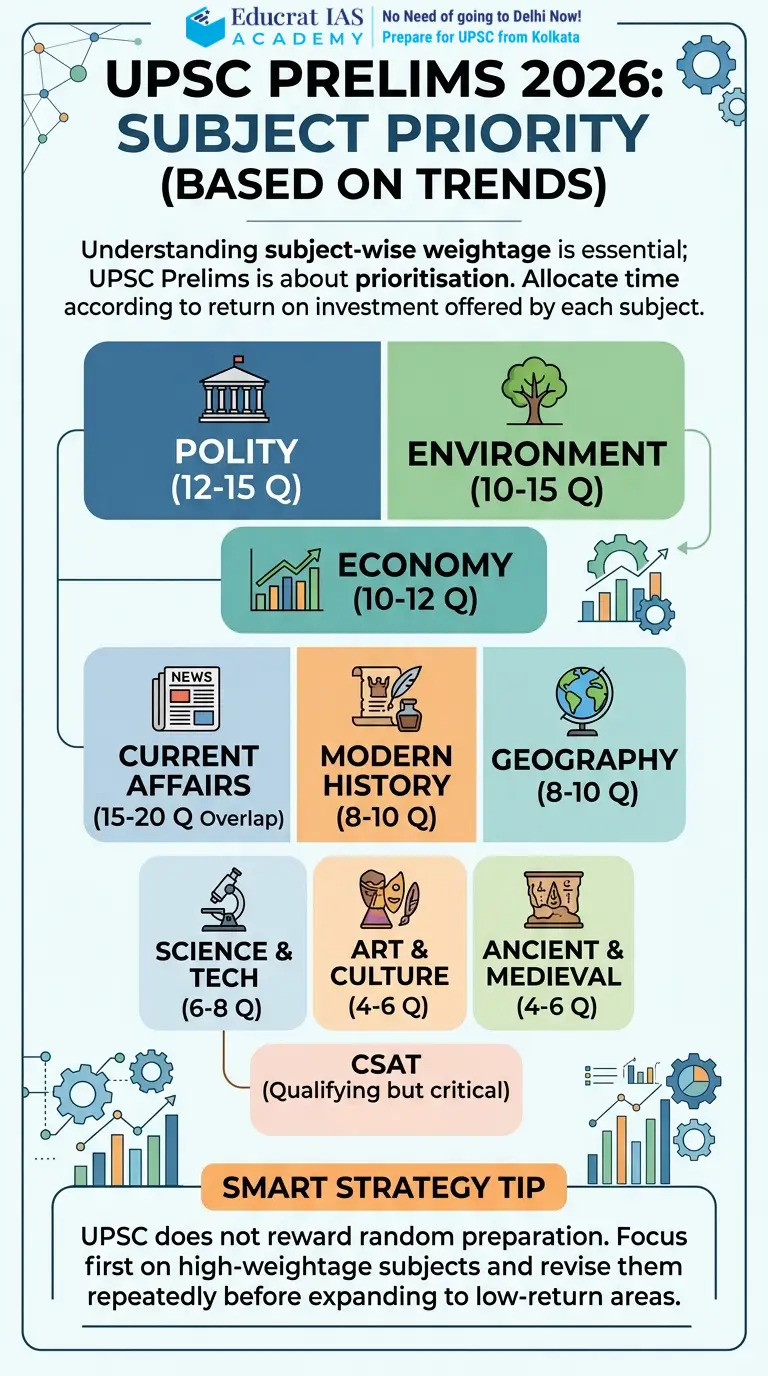
UPSC Prelims 2026 – Subject Priority (Based on Trends)
Understanding subject-wise weightage is essential because UPSC Prelims is a game of prioritisation. Some subjects consistently dominate the paper every year and therefore require multiple rounds of revision. A smart aspirant always allocates preparation time according to the return on investment offered by each subject.
The following trend analysis is based on recent UPSC papers and repeated themes observed over the years. Aspirants should focus heavily on high-weightage subjects while maintaining balanced coverage of the entire syllabus.
Subject Priority
Polity (12–15 Q)
Environment (10–15 Q)
Economy (10–12 Q)
Modern History (8–10 Q)
Geography (8–10 Q)
Current Affairs (15–20 Q overlap)
Science & Tech (6–8 Q)
Art & Culture (4–6 Q)
Ancient & Medieval (4–6 Q)
CSAT (Qualifying but critical)
Smart Strategy Tip:
UPSC does not reward random preparation. Focus first on subjects with consistently high weightage and revise them repeatedly before expanding to low-return areas.
Subject-wise Important Topics:
1. Polity for UPSC Prelims 2026
Polity remains one of the most scoring and predictable sections in UPSC Prelims. Unlike subjects heavily dependent on factual memory, Polity rewards conceptual clarity and repeated revision. Many questions are directly or indirectly inspired by previous year trends, making.
Another reason why Polity is important is because it overlaps significantly with UPSC Mains and Interview preparation. A strong Polity foundation improves governance understanding, current affairs analysis, answer writing quality, and administrative awareness. This makes it one of the most valuable subjects in the entire UPSC journey.
Students preparing through a structured UPSC coaching institute in Kolkata often perform better in Polity because of consistent PYQ analysis, mentorship, and revision planning. Educrat IAS Academy with the best UPSC Faculty in Kolkata present integrated preparation model emphasizes conceptual understanding, PYQ analysis, and revision-based learning for Polity preparation.
A. Historical Background of Constitution
- Regulating Act 1773
- Pitt’s India Act 1784
- Charter Acts (1813, 1833, 1853)
- Indian Councils Acts
- Government of India Acts (1909, 1919, 1935)
- Cripps Mission
- Cabinet Mission
- Indian Independence Act 1947
- Constituent Assembly
- Drafting Committee
- Sources of Indian Constitution
- Features borrowed from constitutions
B. Constitutional Framework
- Preamble
- Union & its Territory
- Citizenship
- Salient Features of Constitution
- Federal vs Unitary Features
- Parliamentary System
- Rule of Law
- Separation of Powers
- Basic Structure Doctrine
- Constitutionalism
C. Fundamental Rights, DPSP & Duties
- Articles 12–35
- Right to Equality
- Right to Freedom
- Article 19, 21, 32
- Cultural & Educational Rights
- Right against Exploitation
- Right to Religion
- Writs
- DPSP
- Fundamental Duties
- FR vs DPSP
D. Constitutional Amendments & Schedules
- Article 368
- Amendment procedure
- 42nd Amendment
- 44th Amendment
- 52nd Amendment
- 61st Amendment
- 73rd & 74th Amendments
- 86th Amendment
- 101st Amendment (GST)
- Important Schedules (especially 5th, 6th, 7th, 8th, 9th, 10th, 11th, 12th)
E. Union Executive
- President
- Vice President
- PM & Council of Ministers
- Cabinet Committees
- Attorney General
- Ordinance making power
- Veto powers
F. State Executive
- Governor
- CM & Council of Ministers
- Advocate General
G. Parliament
- Lok Sabha
- Rajya Sabha
- Sessions of Parliament
- Question Hour
- Zero Hour
- Parliamentary devices
- Types of Bills
- Money Bill
- Financial Bill
- Constitutional Amendment Bill
- Budget process
- Parliamentary Committees
- Joint Sitting
- Privileges
- Anti-Defection Law
H. Judiciary
- Supreme Court
- High Courts
- Subordinate Courts
- Judicial Review
- Judicial Activism
- PIL
- Collegium System
- Removal of Judges
- Landmark Judgments
I. Federalism & Centre-State Relations
- Legislative Relations
- Administrative Relations
- Financial Relations
- Inter-State Council
- Finance Commission
- GST Council
- Emergency Provisions
- President’s Rule
J. Local Government
- Panchayati Raj
- Gram Sabha
- Municipalities
- State Election Commission
- State Finance Commission
K. Constitutional & Statutory Bodies
Constitutional Bodies
- Election Commission
- UPSC
- CAG
- Finance Commission
- National Commissions
Statutory / Non-Constitutional Bodies
- NITI Aayog
- NHRC
- CVC
- Lokpal
- CIC
L. Governance & Current Affairs
- Delimitation
- Article 370
- Uniform Civil Code
- PMLA
- FEMA
- Digital Personal Data Protection
2. Environment & Ecology for UPSC Prelims 2026
Environment & Ecology has become one of the most dynamic and high-scoring subjects in recent UPSC Prelims papers. The subject now carries significant weightage because UPSC increasingly links environmental concepts with current affairs, climate change, biodiversity conservation, and international developments.
Many aspirants find Environment difficult because they approach it randomly. In reality, the subject becomes highly scoring once aspirants build conceptual clarity and revise important themes repeatedly. UPSC rarely asks isolated factual questions; instead, it tests the application of environmental concepts in contemporary contexts.
Aspirants should remember that Environment overlaps heavily with Geography, Science & Technology, Economy, and Current Affairs. Therefore, integrated preparation becomes extremely important.
Guidance from an experienced IAS coaching institute in Kolkata can help aspirants filter unnecessary sources and focus only on high-yield environmental topics relevant for Prelims.
A. Ecology Basics
- Ecosystem
- Food Chain & Food Web
- Ecological Pyramid
- Ecological Succession
- Ecotone
- Edge Effect
- Biomes
B. Biodiversity
- Biodiversity Levels
- Keystone Species
- Flagship Species
- Endemic Species
- Biodiversity Hotspots
- IUCN Red List
- Biosphere Reserves
- National Parks
- Wildlife Sanctuaries
- Ramsar Sites
- Wildlife Corridors
C. Environmental Pollution
- Air Pollution
- Water Pollution
- Noise Pollution
- Eutrophication
- Plastic Pollution
- Waste Management
D. Climate Change
- Greenhouse Gases
- Global Warming
- Carbon Sequestration
- Carbon Markets
- Carbon Credits
- UNFCCC
- Kyoto Protocol
- Paris Agreement
- COP Meetings
- REDD+
- Net Zero
E. Environmental Laws
- Environment Protection Act
- Wildlife Protection Act
- Forest Conservation Act
- Biological Diversity Act
- NGT
F. Conservation Projects
- Project Tiger
- Project Cheetah
- Dugong Project
- Snow Leopard Census
- Mission LiFE
G. Current Environment Topics
- GLOF
- Atlantification
- Blue Ocean Event
- Dark Sky Reserve
- Methane Emissions
- Biofuels
- E10 Fuel
- GRAP
3. Economy for UPSC Prelims 2026
Economy has evolved into a highly analytical subject in UPSC Prelims. Questions are no longer purely factual; UPSC increasingly focuses on application-based understanding linked with current affairs and governance issues.
Many aspirants fear Economy because they try to memorise terms without understanding concepts. However, once the basics are clear, Economy becomes logical, interconnected, and scoring. Aspirants should focus more on understanding than rote learning.
Strong conceptual teaching by the Top-Ranked UPSC Coaching Centre in Kolkata like Educrat IAS Academy can significantly simplify difficult Economy concepts and improve elimination techniques in Prelims MCQs.
A. Basic Economic Concepts
- GDP/GNP/NNP/NDP
- Nominal vs Real GDP
- GDP Deflator
- Inflation
- CPI/WPI/Core Inflation
- Stagflation
- Deflation
- Types of Unemployment
B. Fiscal Policy
- Fiscal Deficits- FD, RD, PD, ERD
- Union Budget
- FRBM Act
- Subsidies
- Public Debt
- Taxation
- Direct vs Indirect Taxes
- GST
C. Monetary Policy & Banking
- RBI
- MPC
- Repo Rate
- Reverse Repo
- CRR & SLR
- Bank Rate
- Open Market Operations
- Inflation Targeting
- Money Supply
- Banking Structure
- NPAs
- Basel Norms
- Digital Payments
- CBDC
D. External Sector
- Balance of Payments
- Forex Reserves
- Exchange Rate
- Currency Depreciation/Appreciation
- FDI/FPI
- WTO, IMF, World Bank
- SDR
E. Agriculture Economy
- MSP, PDS
- Food Security
- Crop Insurance
- Agricultural Credit
- Microfinance
- Green Revolution
- GM Crops
- Nano Urea
- Nano DAP
- Oilseeds, Millets
- Coffee, Tea, Rubber, Jute
F. Infrastructure & Development
- MSME
- Disinvestment
- Privatization
- Green Economy
- Climate Finance
G. Government Schemes
- PM Gati Shakti
- National Logistics Policy
- PM Vishwakarma
- PLI Scheme
- PM KISAN
- MGNREGA
- PM Surya Ghar
- IndiaAI Mission
- PM-JANMAN
- MISHTI
- SATAT
- PM PRANAAM
- SIGHT
- Vibrant Villages Programme
4. History for UPSC Prelims 2026
History remains one of the core pillars of UPSC Prelims preparation. While Modern History dominates the paper, UPSC has increasingly started asking analytical and culture-linked questions from Ancient and Medieval History as well. Aspirants should therefore prepare History strategically instead of focusing only on one segment.
The key to scoring in History lies in understanding chronology, movements, administrative systems, socio-religious reforms, and the broader impact of historical developments. Multiple revisions and PYQ analysis are extremely important because UPSC often repeats themes in indirect ways.
Many aspirants preparing at a Top-Ranked IAS coaching institute in Kolkata benefit from structured History timelines, integrated current affairs linkage, and repeated revision schedules.
A. Ancient History
- Indus Valley Civilization
- Vedic Age
- Mahajanapadas
- Jainism
- Buddhism
- Mauryan Empire
- Ashokan Edicts
- Gupta Empire
- Sangam Age
- Chera, Chola, Pandya
B. Medieval History
- Delhi Sultanate
- Vijayanagara Empire
- Bahmani Kingdom
- Mughal Empire
- Mansabdari
- Bhakti Movement
- Sufi Movement
- Temple Architecture
C. Modern History
- Advent of Europeans
- Carnatic Wars
- Battle of Plassey
- Battle of Buxar
- Revolt of 1857
- Socio-Religious Reforms
- INC Sessions
- Moderate Phase
- Extremist Phase
- Swadeshi Movement
- Surat Split
- Home Rule Movement
- Lucknow Pact
- Khilafat
- Non-Cooperation
- Civil Disobedience
- Quit India
- INA
- Cabinet Mission
- Mountbatten Plan
5. Geography for UPSC Prelims 2026
Geography is one of the most conceptual and application-oriented subjects in UPSC Prelims. Questions are rarely direct; UPSC often combines static geography with current affairs such as disasters, climate events, mapping, and environmental issues.
Aspirants who build strong conceptual understanding can solve Geography questions even when the exact topic is unfamiliar. This makes revision of concepts more important than memorising isolated facts.
A. Physical Geography
- Interior of Earth
- Seismic Waves
- Plate Tectonics
- Continental Drift
- Sea Floor Spreading
- Earthquakes
- Volcanoes
- Weathering
- Landforms
B. Climatology
- Atmosphere
- Heat Budget
- Pressure Belts
- Winds
- Jet Streams
- Monsoon
- El Niño
- La Niña
- Indian Ocean Dipole
- Cyclones
- Climate Change
C. Oceanography
- Ocean Relief
- Ocean Currents
- Tides
- Salinity
- Coriolis Effect
- Upwelling
D. Indian Geography
- Himalayas
- Northern Plains
- Peninsular Plateau
- Western & Eastern Ghats
- Coastal Plains
- Islands
- Mountain Passes
E. Rivers & Drainage
- Indus System
- Ganga System
- Brahmaputra System
- Peninsular Rivers
- River Linking
F. Indian Climate & Agriculture
- Southwest Monsoon
- Retreating Monsoon
- Western Disturbances
- Cyclone-Prone Areas
- Soils of India
- Cropping Seasons
- Irrigation
G. Resources & Industries
- Coal
- Petroleum
- Natural Gas
- Iron Ore
- Bauxite
- Renewable Energy
- Atomic Minerals
H. Mapping & Places in News
- Red Sea
- South China Sea
- Baltic Sea
- Persian Gulf
- Mediterranean Sea
- Indo-Pacific
- Ukraine
- Iran-Israel
- Nagorno Karabakh
- Morocco
- Turkey
- Ethiopia
- Yemen
- Strategic Straits & Corridors
6. Current Affairs for UPSC Prelims
At Educrat IAS Academy, we simplify Current Affairs preparation through:
- Daily Current Affairs
- Daily Current Affairs MCQ
- Monthly Current Affairs Magazine
- Monthly Current Affair MCQ
- Issue-based discussions
Highest Priority Areas
- Government Schemes
- Environment Current Affairs
- Economy Updates
- Reports & Indices
- International Organisations
Medium Priority
- Science & Technology
- Supreme Court Judgments
- Geography & Mapping
Lower Priority
- Sports
- Awards
- Personalities
7. Science & Technology for UPSC Prelims
Space Technology
- ISRO Missions
- Chandrayaan-3
- Aditya-L1
- Gaganyaan
- NISAR
- NavIC
- PSLV vs GSLV
- Cryogenic Engine
Biotechnology
- DNA & RNA
- CRISPR-Cas9
- mRNA Vaccines
- Stem Cells
- CAR-T Cell Therapy
- GM Crops
- Biofortification
Information Technology
- AI
- Machine Learning
- Blockchain
- Quantum Computing
- Cybersecurity
- 5G
- Space Internet
Defence Technology
- Ballistic Missiles
- Hypersonic Technology
- UAVs
- Nuclear Fusion
- Nuclear Reactors
Emerging Technology
- Nanotechnology
- Robotics
- Semiconductor Mission
- Hydrogen Fuel
- Li-ion Battery
- 3D & 4D Printing
8. Art & Culture for UPSC Prelims
Art & Culture may appear low in weightage, but it can become highly scoring with selective preparation. UPSC generally asks factual yet predictable questions from repeated areas.
Architecture
- Stupa Architecture
- Cave Architecture
- Temple Architecture
- Nagara
- Dravida
- Vesara
- Indo-Islamic Architecture
Paintings
- Ajanta Paintings
- Mughal Paintings
- Rajput Paintings
- Pahari Paintings
- Folk Paintings
Literature
- Vedic Literature
- Sangam Literature
- Buddhist Literature
- Jain Literature
- Sanskrit Literature
Dance & Music
- Classical Dances
- Folk Dances
- Hindustani Music
- Carnatic Music
UNESCO
- World Heritage Sites
- Recently Added Sites
9. INTERNATIONAL RELATIONS & GROUPINGS
International Organizations
- UN
- WTO
- IMF
- World Bank
Groupings
- G20
- BRICS
- QUAD
- SCO
- AUKUS
- I2U2
- NATO
- CSTO
- Arctic Council
- IORA
- G4
- MERCOSUR
Geopolitics
- Russia–Ukraine Conflict
- Iran–Israel Conflict
- India–China Border
- Indo-Pacific
- West Asia Crisis
- Global South
10. REPORTS, INDICES & RANKINGS
- HDI
- Global Hunger Index
- Global Innovation Index
- Global Peace Index
- Corruption Perception Index
- Climate Change Performance Index
- Logistics Performance Index
11. AWARDS & MISCELLANEOUS
- Bharat Ratna
- Padma Awards
- Nobel Prize
- Military Awards
- Borlaug Award
- Sports Awards
FINAL PRELIMS 2026 PRIORITY ZONES
Most Important Areas
Tier 1 (Highest Weightage)
|
Tier 2
|
Tier 3
|
12. CSAT (Paper II – Qualifying but Critical)
Many aspirants fail Prelims because they ignore CSAT. In recent years, CSAT has become more comprehension-heavy, analytical, and unpredictable. Aspirants should prepare for CSAT consistently from the beginning instead of treating it casually.
A structured UPSC CSE coaching in Kolkata environment often helps aspirants maintain regular CSAT practice through timed tests, comprehension drills, and reasoning sessions.
At Educrat IAS Academy, regular CSAT practice sessions are integrated into classroom programs and test series because qualifying comfortably is essential for clearing Prelims.
A. Reading Comprehension (Highest Weightage)
Important Areas
- Central Idea
- Inference
- Tone
- Assumptions
- Logical Conclusions
B. Quantitative Aptitude
Most Important Topics
- Number System
- Percentage
- Profit & Loss
- Ratio & Proportion
- Time & Work
- Time, Speed & Distance
- Probability
- Geometry
C. Reasoning & Analytical Ability
Most Important Topics
- Syllogism
- Seating Arrangement
- Coding-Decoding
- Blood Relation
- Direction Sense
- Series & Analogy
D. Data Interpretation
Most Important Topics
- Bar Graphs
- Pie Charts
- Tables
- Caselet DI
Final Strategy for UPSC Prelims 2026
UPSC Prelims is not a test of how many books you read. It is a test of revision quality, conceptual clarity, elimination ability, and exam temperament. Aspirants who stay consistent, revise repeatedly, and solve mocks regularly perform far better than those who keep collecting resources.
A strategic preparation model always outperforms random hard work.
Smart Revision Strategy
- Revise Polity, Economy & Environment 3–4 times
- Solve last 10 years PYQs
- Maintain limited resources
- Practice CSAT weekly
- Focus on elimination techniques
- Attempt mock tests in UPSC-like environments
- Prioritise revision over new material
At Educrat IAS Academy, our preparation ecosystem is designed around integrated preparation, revision cycles, answer writing, mentorship, and UPSC-like evaluation systems.
Conclusion
UPSC Prelims is not about studying everything under the sun. It is about mastering the right subjects, revising the most important topics repeatedly, and developing the discipline to stay consistent throughout the preparation journey.
If you follow this structured GS + CSAT roadmap, focus on high-yield areas, and revise strategically, you can significantly improve your chances of clearing UPSC Prelims 2026, whether you are a beginner or a repeat aspirant.
The journey may feel difficult initially, but every successful civil servant once started from the same stage of confusion and uncertainty. With the right roadmap, mentorship, and disciplined execution, your preparation can become focused, manageable, and result-oriented.
Start early. Revise consistently. Trust the process.