The UPSC Civil Services Examination is often described as one of the most challenging competitive examinations in India. Yet, every year, hundreds of aspirants successfully clear the examination despite having backgrounds that are vastly different from one another. Some come from premier institutions, while others prepare from small towns with limited resources. What ultimately differentiates successful candidates is not access to endless study material but the presence of a clear strategy and disciplined execution.
For aspirants targeting UPSC CSE 2027, the coming months offer a valuable opportunity to build a strong foundation before the pressure of the examination cycle intensifies. Unfortunately, many beginners spend their first year collecting resources, watching strategy videos, and constantly changing study plans. By the time they settle into a routine, precious months have already been lost.
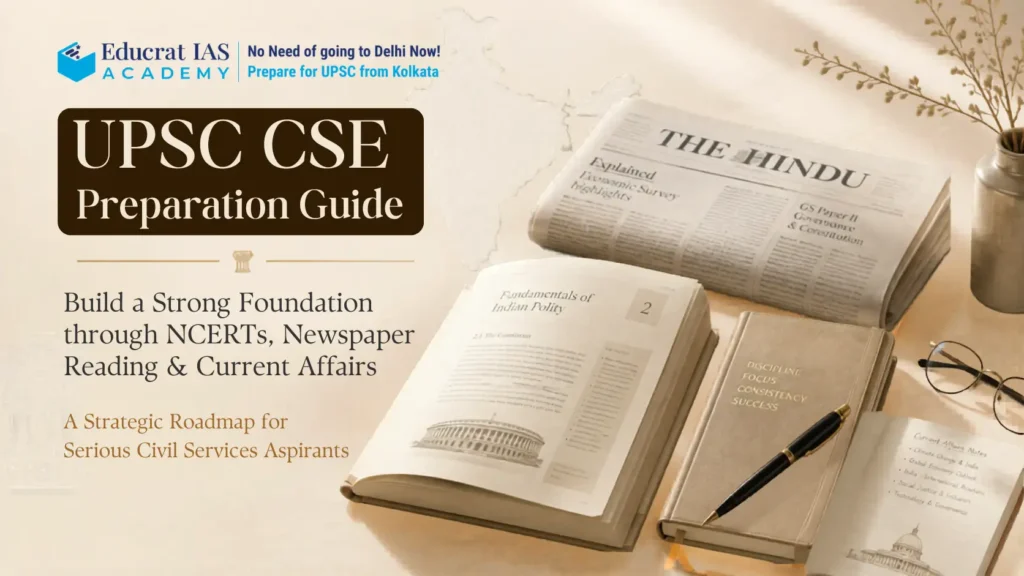
A careful study of successful UPSC preparation strategies reveals a common pattern. Almost every topper and reputed coaching institute emphasizes three foundational pillars: NCERT-based conceptual learning, intelligent newspaper reading, and systematic current affairs preparation. Together, these pillars create the knowledge base, analytical ability, and awareness required to excel in Prelims, Mains, Essay, and Interview.
This comprehensive blog by Educrat IAS Academy will show you how to master these three pillars and build a preparation strategy that remains effective throughout your UPSC journey.
Pillar One: NCERT Strategy – Building the Foundation Before Building the Structure
Every strong building begins with a solid foundation. In the same way, successful UPSC preparation begins with conceptual clarity. Before an aspirant can understand advanced discussions on constitutional morality, monetary policy, climate diplomacy, or agricultural reforms, they must first understand the fundamental concepts that underpin these topics.
This is precisely why NCERT textbooks continue to occupy a central position in UPSC preparation. Despite the availability of countless books, online courses, and study materials, NCERTs remain unmatched in their ability to explain concepts in a simple, structured, and logical manner. They help aspirants think systematically rather than memorize isolated facts.
Many beginners underestimate NCERTs because of their school-level appearance. However, experienced mentors and Best UPSC Institutes often point out that aspirants who skip NCERTs frequently struggle later while studying standard books because they lack conceptual grounding. NCERTs are not merely introductory resources; they are the foundation upon which all advanced preparation rests.
Why NCERTs Are Indispensable
Conceptual Clarity
The greatest strength of NCERTs lies in their ability to simplify complex topics. Whether it is understanding plate tectonics, constitutional principles, inflation, biodiversity, or social change, NCERTs explain concepts in a manner that is both accessible and comprehensive. This clarity becomes particularly valuable during the Mains examination, where UPSC increasingly asks analytical questions that require understanding rather than memorization.
Development of Interdisciplinary Thinking
UPSC no longer tests subjects in isolation. A question on climate change may require knowledge of geography, economics, international relations, and governance. NCERTs help aspirants understand these interconnections from an early stage of preparation. This interdisciplinary perspective eventually becomes one of the strongest advantages in both Prelims and Mains.
Improved Retention and Revision
Because concepts are presented logically, aspirants find them easier to remember. Instead of repeatedly memorizing information, candidates develop genuine understanding, which significantly improves long-term retention.
How to Read NCERTs Effectively
Many aspirants read NCERTs like school textbooks and then wonder why they are unable to recall information later. Effective NCERT preparation requires a structured approach.
First Reading: Understanding
Focus entirely on comprehension. Do not highlight excessively or make detailed notes.
Second Reading: Consolidation
Highlight key concepts, create short notes, and identify recurring themes.
Third Reading: UPSC Integration
Connect the topic with the syllabus, previous year questions, and current affairs.
For example, while studying the chapter on the Monsoon, think beyond rainfall patterns. Connect it with agriculture, disaster management, water security, and climate change.
At Educrat IAS Academy, we advise aspirants to complete their NCERT foundation within the first three to four months of preparation. The objective is not to spend a year reading school textbooks but to build sufficient conceptual clarity before transitioning to standard reference books.
Strong fundamentals today prevent confusion tomorrow.
Pillar Two: Newspaper Reading – Learning to Think Like a Civil Servant
If NCERTs provide the foundation, newspapers provide the lens through which aspirants learn to view the world. One of the most common mistakes made by beginners is treating newspaper reading as a routine activity rather than a skill. Many spend hours reading every article, believing that more reading automatically leads to better preparation. In reality, UPSC does not reward candidates for knowing every piece of news. It rewards candidates who can analyse issues, understand their implications, and present balanced viewpoints.
Newspaper reading is therefore not about information collection. It is about intellectual development. A good newspaper gradually transforms an aspirant from a passive consumer of information into an active observer of governance, policy, economics, society, and international affairs.
Why Newspaper Reading Matters
Developing Analytical Ability
Editorials and opinion articles expose aspirants to multiple perspectives on complex issues. Over time, this improves critical thinking and helps candidates develop balanced opinions.
This analytical mind-set is essential for writing high-quality Mains answers and essays.
Connecting Static and Dynamic Topics
A newspaper acts as a bridge between textbook knowledge and contemporary developments.
For example, a chapter on Parliament in Polity becomes more meaningful when connected with current legislative debates. Similarly, economic concepts become easier to understand when viewed through the lens of current inflation trends or fiscal policies.
Building Content for Mains Answers
Good answers require examples, reports, committee recommendations, judgments, and current developments. Newspapers provide these valuable additions that distinguish average answers from exceptional ones.
What Should You Read?
The objective is not to read everything.
Focus on:
Governance and Public Policy
Government schemes, policy reforms, and administrative developments.
Economy
Inflation, growth, taxation, employment, and RBI-related developments.
International Relations
India’s engagements with major countries and international organizations.
Environment
Climate change, biodiversity, renewable energy, and conservation efforts.
Science and Technology
Technological developments with governance or societal relevance.
What Should You Avoid?
Aspirants often waste valuable time on content that has little relevance to UPSC.
Avoid:
- Political accusations and counter-accusations
- Celebrity news
- Local crime reports
- Entertainment content
Remember, selective reading is a strength, not a weakness.
Educrat IAS Academy's Current Affairs Ecosystem
Recognizing the challenges aspirants face while reading newspapers, Educrat IAS Academy provides daily issue-based analysis, current affairs notes, MCQs, and monthly compilations designed specifically for UPSC.
This allows students to focus on understanding rather than information filtering.
Don’t just read the news. Learn to analyse it with Educrat IAS Academy’s Daily Current Affairs Programme.
Pillar Three: Current Affairs Strategy – Converting Information into Examination Marks
Among all aspects of UPSC preparation, current affairs often creates the greatest anxiety. Aspirants constantly worry about missing important news, choosing the wrong source, or failing to cover enough material.
Ironically, the problem today is not lack of information but excessive information.
Many candidates collect dozens of magazines, maintain hundreds of pages of notes, and subscribe to multiple current affairs platforms. The result is information overload and inadequate revision.
Successful aspirants follow a different approach. They focus on integration, consolidation, and revision.
Understanding the Role of Current Affairs
Current affairs are no longer a separate component of UPSC preparation. They have become integrated with nearly every subject in the syllabus.
A question on climate change may involve Geography, Environment, Economics, and International Relations simultaneously. Similarly, governance issues often overlap with Polity, Ethics, and Social Justice.
The goal is therefore not to study current affairs separately but to integrate them with static subjects.
The Four-Step Current Affairs Framework
Step One: Daily Newspaper Reading
Spend 45–60 minutes understanding important developments.
Focus on issues rather than events.
Step Two: Weekly Revision
Aspirants often underestimate the importance of revision. Weekly revision prevents information from accumulating and becoming unmanageable.
Step Three: Monthly Consolidation
Use a reliable monthly compilation to fill any gaps and organize information systematically.
Step Four: Topic-Wise Classification
Organize notes under broad categories such as:
- Polity and Governance
- Economy
- Environment
- International Relations
- Science and Technology
- Social Issues
This makes revision significantly easier before Prelims and Mains.
The Importance of Issue-Based Learning
Instead of memorizing isolated news items, study complete issues.
For example:
When reading about Artificial Intelligence, understand:
- Technology basics
- Ethical concerns
- Economic implications
- Government initiatives
- Regulatory challenges
This issue-based approach aligns perfectly with UPSC’s analytical orientation.
Educrat IAS Academy's Current Affairs Advantage
Our Current Affairs Programme is designed not merely to provide information but to help aspirants understand, revise, and apply knowledge effectively.
We provide Current Affairs and Current Affairs MCQ in forms of:
- Daily Current Affairs
- Daily Current Affairs MCQ
- Monthly Current Affairs Magazine
- Monthly Current Affair MCQ
Stay ahead of the competition with Educrat IAS Academy’s integrated Current Affairs Programme.
Bringing Everything Together: The Integrated UPSC 2027 Preparation Model
The biggest mistake beginners make is treating NCERTs, newspapers, and current affairs as separate entities. In reality, they should function as parts of a single preparation ecosystem.
Consider the topic of Agriculture.
- NCERTs help you understand cropping patterns and climatic conditions.
- Newspapers inform you about MSP reforms, farmer welfare schemes, and agricultural challenges.
- Current affairs magazines provide government initiatives, committee recommendations, and recent developments.
Together, these sources create a complete understanding of the topic that can be applied across Prelims, Mains, Essay, and Interview. This integrated approach is what separates serious aspirants from casual learners.
Conclusion
UPSC 2027 may seem distant today, but every successful candidate knows that the foundation of future success is laid through consistent daily effort. The most effective preparation strategy is not the one with the most resources or the most complicated timetable. It is the one that can be followed consistently for months and years. Begin with NCERTs to develop conceptual clarity. Use newspapers to cultivate analytical thinking. Integrate current affairs with static subjects and revise regularly. Focus on understanding rather than accumulation, quality rather than quantity, and consistency rather than intensity.
Most importantly, remember that preparation is a journey of gradual transformation. Every chapter read, every editorial analysed, and every concept understood brings you one step closer to your goal.
At Educrat IAS Academy, we believe that success in UPSC is not accidental—it is the result of strategic preparation, disciplined execution, and continuous guidance.
Ready to Begin Your UPSC 2027 Journey?
Join Educrat IAS Academy and gain access to:
✓ Expert Faculty Guidance
✓ Foundation Courses
✓ Daily Current Affairs
✓ Answer Writing Programmes
✓ Test Series
✓ Mentorship Support
✓ Comprehensive Study Material