Every year, lakhs of aspirants dream of becoming IAS, IPS, IFS, or other civil servants through the UPSC Civil Services Examination. While many successfully clear the Preliminary Examination, the real challenge begins with the UPSC Mains Examination, where descriptive answer writing becomes the deciding factor between an average score and an All India Rank.
One of the biggest misconceptions among UPSC aspirants is that reading more books automatically leads to higher marks. In reality, UPSC Mains is not a test of how much you know—it is a test of how effectively you present what you know. Two candidates may possess similar knowledge, yet the one who writes a well-structured, analytical, balanced, and time-bound answer invariably secures better marks.
This is precisely why answer writing is considered the backbone of UPSC Mains preparation.
The ability to interpret a question correctly, identify its core demand, organize ideas logically, present balanced arguments, and conclude with practical solutions is what distinguishes top-ranking candidates from the rest.
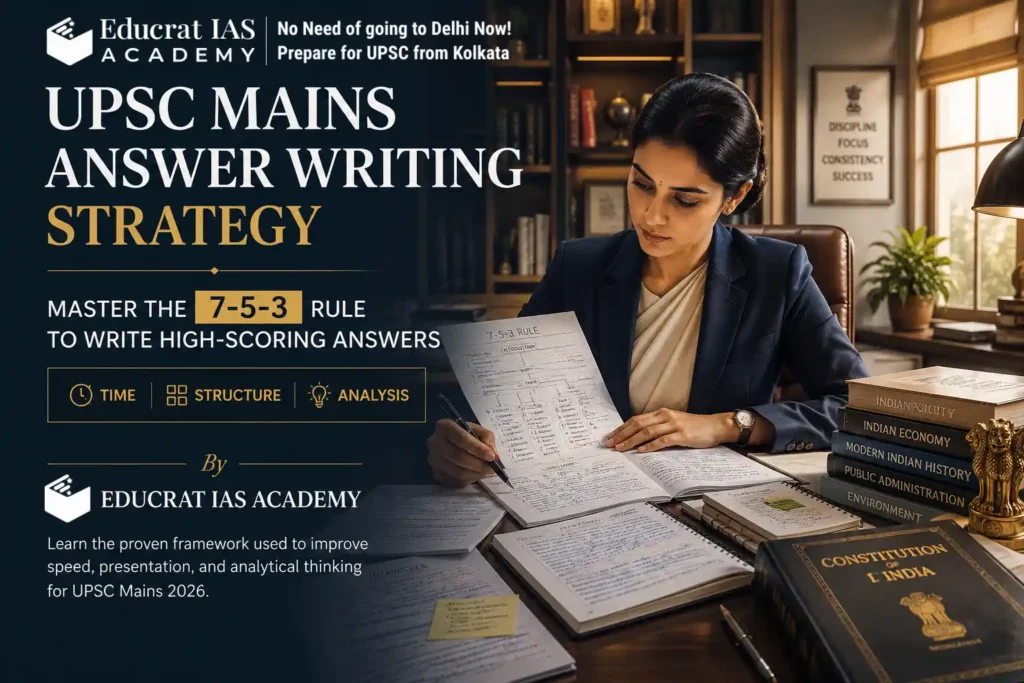
Among the numerous answer-writing frameworks available, one of the simplest yet most effective strategies is the 7-5-3 Rule. Designed to improve time management, content organization, and analytical depth, this rule provides aspirants with a practical roadmap for writing high-quality answers consistently throughout the examination.
At Educrat IAS Academy, this philosophy forms the foundation of our Manthan UPSC Mains Test Series Programme. Through regular answer-writing practice, expert evaluation, personalized mentorship, and UPSC-oriented feedback, aspirants gradually develop the habits required to excel in the Mains Examination.
In this comprehensive guide, we will explore the 7-5-3 Rule in detail, understand why it works, learn how to implement it effectively, and discover how disciplined answer-writing practice can significantly improve your UPSC Mains score.
Why Answer Writing Determines Success in UPSC Mains
The UPSC Civil Services Examination is often described as an examination of knowledge. While this is true to an extent, it is only half the story. The other half—and arguably the more important one—is your ability to communicate knowledge effectively within strict constraints of time and word limit.
Unlike school or university examinations, UPSC does not reward lengthy answers filled with every fact you know. Instead, the examiner looks for relevance, clarity, logical flow, analytical thinking, and balanced judgment. Every answer must directly address the question while remaining concise, well-structured, and supported with appropriate examples or evidence.
This means that merely possessing information is not enough. Aspirants must learn to transform information into well-crafted answers within a limited time frame.
Think of it this way: knowledge is the raw material, but answer writing is the finished product. No matter how rich the raw material is, poor presentation reduces its value.
Strong answer-writing skills enable aspirants to:
- Present complex ideas in a simple and structured manner.
- Demonstrate conceptual clarity rather than rote memorisation.
- Showcase analytical and multidimensional thinking.
- Cover all aspects of the question without unnecessary elaboration.
- Manage time effectively during the examination.
- Improve readability through headings, bullet points, diagrams, and flowcharts.
- Leave a positive impression on the examiner through balanced conclusions.
This is why experienced mentors often say that UPSC Mains is won not in the library, but on the answer sheet.
Understanding the UPSC Mains Examination
Before learning any answer-writing strategy, it is essential to understand the nature of the UPSC Mains Examination itself.
The Civil Services Examination consists of three stages:
- Preliminary Examination
- Mains Examination
- Personality Test (Interview)
Among these, the Mains Examination carries the maximum weightage in determining the final merit list. It consists of nine descriptive papers, out of which seven papers are counted for ranking.
Across these papers, candidates are expected to write nearly 4,000 to 4,500 words over five days of examination. Every answer is handwritten, evaluated individually, and judged on both content and presentation.
Unlike objective examinations, there is no scope for guessing. Every mark has to be earned through thoughtful writing.
Therefore, aspirants must simultaneously develop:
- Conceptual understanding
- Analytical thinking
- Writing speed
- Presentation skills
- Time management
- Decision-making under pressure
Ignoring answer writing until after the Preliminary Examination is one of the most common mistakes made by aspirants. Developing this skill requires months of consistent practice, making it essential to begin early.
What Does the UPSC Examiner Actually Look For?
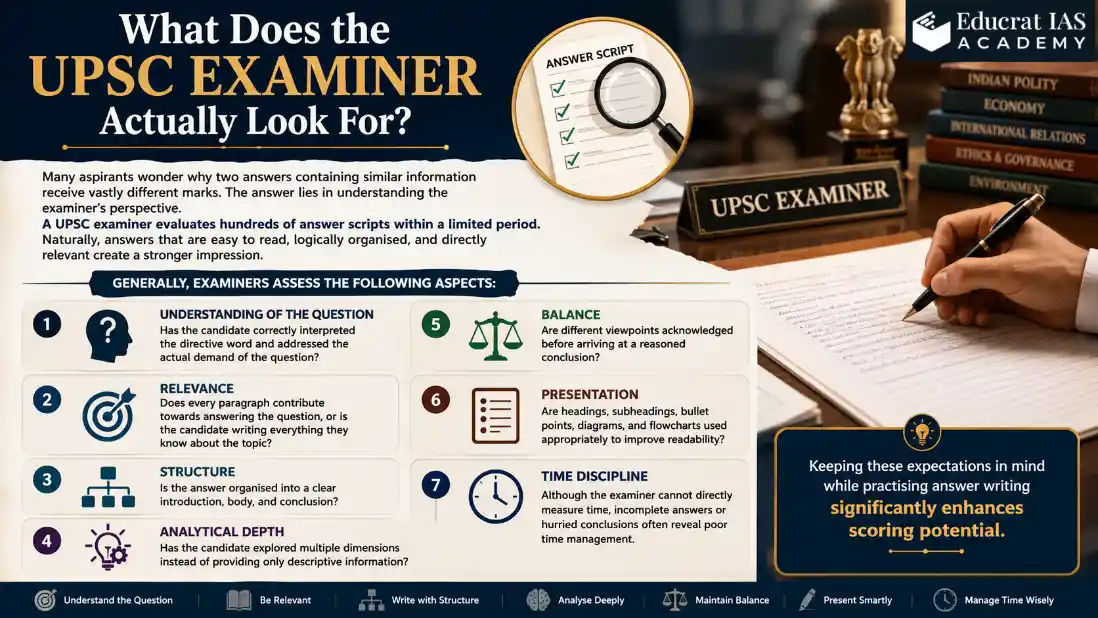
Many aspirants wonder why two answers containing similar information receive vastly different marks. The answer lies in understanding the examiner’s perspective.
A UPSC examiner evaluates hundreds of answer scripts within a limited period. Naturally, answers that are easy to read, logically organised, and directly relevant create a stronger impression.
Generally, examiners assess the following aspects:
Understanding of the Question
Has the candidate correctly interpreted the directive word and addressed the actual demand of the question?
Relevance
Does every paragraph contribute towards answering the question, or is the candidate writing everything they know about the topic?
Structure
Is the answer organised into a clear introduction, body, and conclusion?
Analytical Depth
Has the candidate explored multiple dimensions instead of providing only descriptive information?
Balance
Are different viewpoints acknowledged before arriving at a reasoned conclusion?
Presentation
Are headings, subheadings, bullet points, diagrams, and flowcharts used appropriately to improve readability?
Time Discipline
Although the examiner cannot directly measure time, incomplete answers or hurried conclusions often reveal poor time management.
Keeping these expectations in mind while practising answer writing significantly enhances scoring potential.
Understanding Directive Words: The Key to Answering Correctly
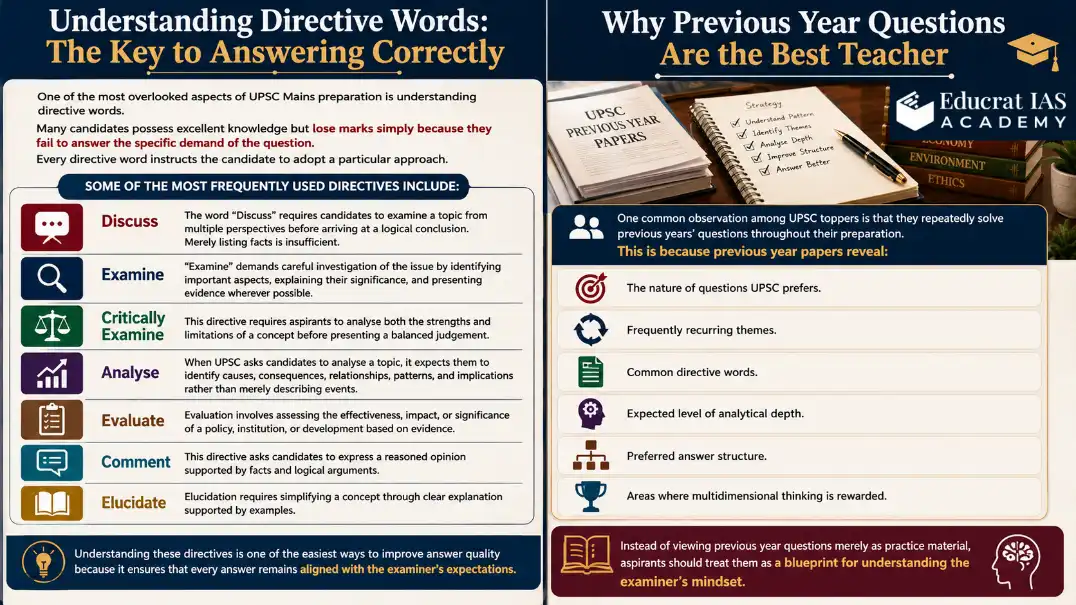
One of the most overlooked aspects of UPSC Mains preparation is understanding directive words.
Many candidates possess excellent knowledge but lose marks simply because they fail to answer the specific demand of the question.
Every directive word instructs the candidate to adopt a particular approach.
Some of the most frequently used directives include:
Discuss
The word “Discuss” requires candidates to examine a topic from multiple perspectives before arriving at a logical conclusion. Merely listing facts is insufficient.
Examine
“Examine” demands careful investigation of the issue by identifying important aspects, explaining their significance, and presenting evidence wherever possible.
Critically Examine
This directive requires aspirants to analyse both the strengths and limitations of a concept before presenting a balanced judgement.
Analyse
When UPSC asks candidates to analyse a topic, it expects them to identify causes, consequences, relationships, patterns, and implications rather than merely describing events.
Evaluate
Evaluation involves assessing the effectiveness, impact, or significance of a policy, institution, or development based on evidence.
Comment
This directive asks candidates to express a reasoned opinion supported by facts and logical arguments.
Elucidate
Elucidation requires simplifying a concept through clear explanation supported by examples.
Understanding these directives is one of the easiest ways to improve answer quality because it ensures that every answer remains aligned with the examiner’s expectations.
Why Previous Year Questions Are the Best Teacher
One common observation among UPSC toppers is that they repeatedly solve previous years’ questions throughout their preparation.
This is because previous year papers reveal:
- The nature of questions UPSC prefers.
- Frequently recurring themes.
- Common directive words.
- Expected level of analytical depth.
- Preferred answer structure.
- Areas where multidimensional thinking is rewarded.
Instead of viewing previous year questions merely as practice material, aspirants should treat them as a blueprint for understanding the examiner’s mindset.
At Educrat IAS Academy, previous year questions are integrated into classroom discussions and the Manthan UPSC Mains Test Series so that aspirants develop familiarity with actual UPSC standards rather than practising random questions.
Introducing the 7-5-3 Rule: A Practical Framework for UPSC Mains Answer Writing
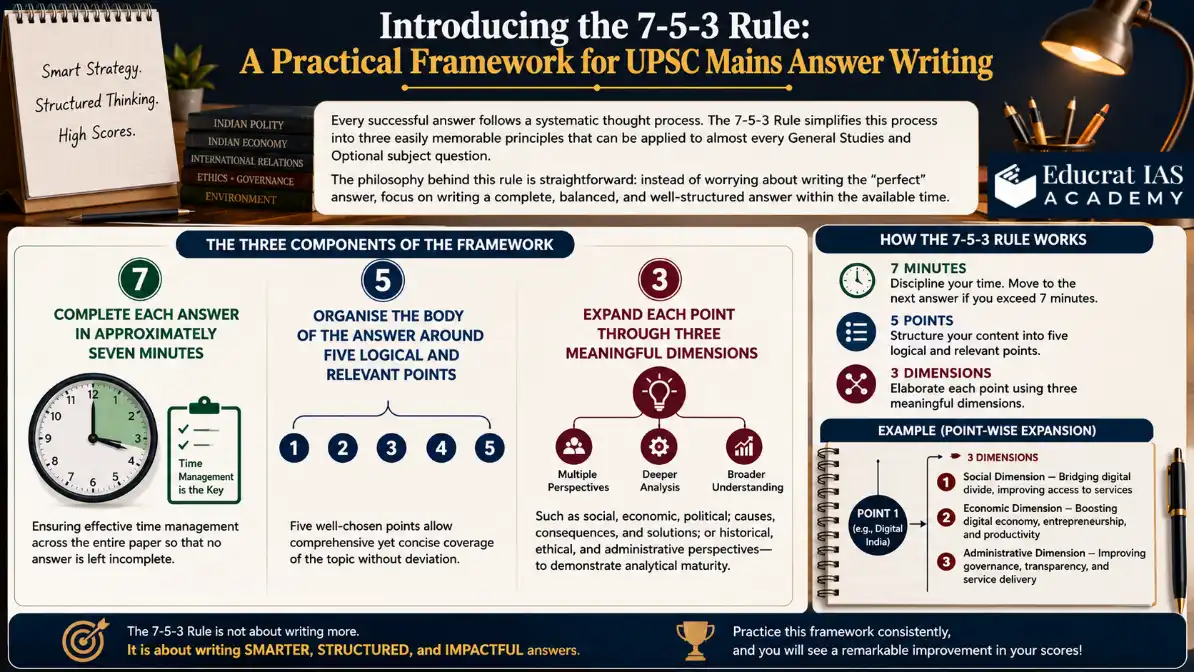
Every successful answer follows a systematic thought process. The 7-5-3 Rule simplifies this process into three easily memorable principles that can be applied to almost every General Studies and Optional subject question.
The philosophy behind this rule is straightforward: instead of worrying about writing the “perfect” answer, focus on writing a complete, balanced, and well-structured answer within the available time.
The three components of the framework are:
- 7 – Complete each answer within approximately seven minutes, ensuring effective time management across the entire paper.
- 5 – Organise the body of the answer around five logical and relevant points, allowing comprehensive yet concise coverage of the topic.
- 3 – Expand each point through three meaningful dimensions—such as social, economic, political; causes, consequences, and solutions; or historical, ethical, and administrative perspectives—to demonstrate analytical maturity.
Individually, each component strengthens one aspect of answer writing. Together, they create a powerful strategy that improves speed, structure, clarity, and depth simultaneously.
The beauty of the 7-5-3 Rule lies in its adaptability. Whether the question is from Polity, Economy, Geography, Ethics, History, Public Administration, Sociology, or Essay, the framework encourages aspirants to think systematically rather than write impulsively.
More importantly, this method gradually becomes second nature through continuous practice, allowing candidates to focus on content instead of worrying about structure during the actual examination.
The 7-5-3 Rule Explained: A Complete Framework for High-Scoring UPSC Mains Answers
In the previous section, we understood why answer writing is the single most important skill for success in the UPSC Mains Examination. We also introduced the 7-5-3 Rule—a practical framework that helps aspirants balance time management, structured presentation, and analytical thinking.
However, simply knowing the framework is not enough. The real transformation begins when aspirants learn how to apply each component consistently during answer-writing practice. The 7-5-3 Rule is not a rigid formula but a disciplined approach that trains your mind to think like a UPSC examiner expects.
Every answer in the Mains Examination is evaluated not only on the basis of content but also on how efficiently that content is presented within the prescribed word limit and time. The following sections explain each component of the 7-5-3 Rule in detail.
The First Pillar: The Seven-Minute Rule
A. Why Time Management is the Biggest Challenge in UPSC Mains
One of the most common reasons aspirants fail to complete the UPSC Mains paper is poor time management. Candidates often spend excessive time writing perfect answers to the first few questions, only to rush through the remaining ones or leave them unanswered. In UPSC, an incomplete paper can significantly reduce your overall score, regardless of how well the answered questions are written.
The UPSC Mains Examination is designed to test not only your knowledge but also your ability to think and write under pressure. Therefore, learning to complete every answer within a fixed time limit is essential.
As a general guideline:
- 10-marker (150 words): Aim to complete within 7 minutes.
- 15-marker (250 words): Aim to complete within 10–11 minutes.
These timings leave sufficient time for reading the paper, planning answers, and reviewing your work before submission.
B. Why the Seven-Minute Rule Works
The Seven-Minute Rule prevents perfectionism from becoming a disadvantage. Many aspirants believe that writing one outstanding answer is better than writing twenty good answers. Unfortunately, UPSC rewards consistency rather than perfection.
Completing every answer within the allotted time helps you:
- Finish the entire question paper.
- Maintain a consistent quality across all answers.
- Avoid panic during the final hour of the examination.
- Improve decision-making under pressure.
- Build confidence through disciplined practice.
Over time, your brain automatically learns to prioritize relevant information instead of recalling everything you have studied.
C. How Top Rankers Divide Seven Minutes
Successful candidates rarely begin writing immediately after reading the question. Instead, they mentally organize their thoughts before putting pen to paper.
A practical time distribution for a 10-marker is:
| Activity | Time |
| Read and understand the question | 30–40 seconds |
| Identify keywords and brainstorm | 45–60 seconds |
| Write introduction | 45 seconds |
| Develop the body | 4–5 minutes |
| Write conclusion | 30–40 seconds |
| Underline keywords and quick review | 20–30 seconds |
This disciplined approach ensures that every answer remains focused and complete.
D. Develop the Habit of Writing Under a Stopwatch
Answer writing without time constraints creates a false sense of confidence. Many aspirants write excellent answers at home in twenty minutes but struggle to produce similar quality in seven minutes during the examination.
To avoid this mismatch:
- Always practise with a stopwatch.
- Write in exam-like conditions.
- Avoid referring to notes while writing.
- Stop writing immediately when the allotted time is over.
- Evaluate whether the answer addressed the question effectively.
Initially, your answers may feel incomplete. However, with consistent practice, both speed and quality improve simultaneously.
D. Common Time Management Mistakes
Many aspirants unknowingly waste valuable minutes during the examination.
Some common mistakes include:
- Spending too much time thinking before writing.
- Writing unnecessarily lengthy introductions.
- Repeating the same ideas in different words.
- Trying to include every fact remembered.
- Drawing complicated diagrams that consume time.
- Revising answers excessively instead of moving to the next question.
Remember, UPSC rewards effective communication, not elaborate writing.
The Second Pillar: The Five-Point Rule
A. Why Structure Matters More Than Length
Imagine an examiner evaluating hundreds of answer sheets in a single day. Which answer is easier to assess—a dense two-page paragraph or a neatly organized response with clear headings and logical points?
Naturally, the latter creates a stronger impression.
The Five-Point Rule encourages aspirants to organize the body of every answer into approximately five major arguments or dimensions. This creates clarity, improves readability, and ensures comprehensive coverage of the topic.
Rather than writing randomly, each point should contribute directly to answering the question.
B. What Makes a Strong Point?
Every point should satisfy three conditions:
- It should directly address the demand of the question.
- It should introduce a unique idea instead of repeating earlier arguments.
- It should be supported with examples, facts, or constitutional provisions wherever appropriate.
For example, if the question asks about the impact of Artificial Intelligence on governance, five logical points could include:
- Improved public service delivery
- Better policy formulation through data analytics
- Increased transparency and accountability
- Challenges related to privacy and ethics
- Way forward through responsible regulation
Each point contributes something different to the answer, making it comprehensive and balanced.
C. How to Arrange Your Five Points
Logical sequencing enhances readability.
A commonly used structure is:
- Background or context
- Positive aspects
- Challenges or limitations
- Government initiatives or examples
- Way forward
Alternatively, depending on the question, you may organize points as:
- Causes
- Consequences
- Impacts
- Challenges
- Solutions
The structure should always reflect the demand of the question rather than following a fixed template.
D. Use Headings and Bullet Points Wisely
Breaking answers into headings and bullet points helps the examiner identify important arguments instantly.
For example:
Challenges of Urbanisation
- Pressure on urban infrastructure
- Growth of informal settlements
- Environmental degradation
- Traffic congestion
- Rising socio-economic inequalities
Such presentation improves readability without compromising analytical depth.
However, avoid converting the entire answer into disconnected bullet points. Each point should contain a brief explanation to demonstrate understanding.
E. When Should You Use Flowcharts, Tables, and Diagrams?
Visual presentation is one of the easiest ways to improve answer quality without increasing word count.
Use:
- Flowcharts to explain processes or cause-effect relationships.
- Tables for comparisons.
- Diagrams for geography, environment, governance, and science-related questions.
- Mind maps for multidimensional topics.
For example:
Instead of writing a paragraph comparing the Directive Principles and Fundamental Rights, a simple table communicates the same information more effectively.
Similarly, a flowchart explaining disaster management or policy implementation saves both time and words.
The key is simplicity. UPSC does not reward artistic diagrams; it rewards clarity.
The Third Pillar: The Three-Dimensional Rule
A. The Difference Between Description and Analysis
Many aspirants confuse descriptive writing with analytical writing.
Descriptive answers merely explain a concept.
Analytical answers examine it from multiple perspectives, evaluate its implications, and provide balanced reasoning.
UPSC consistently rewards analytical thinking because civil servants are expected to solve complex problems rather than merely describe them.
The Three-Dimensional Rule develops this analytical mindset.
B. What Does Three-Dimensional Thinking Mean?
Every major issue has multiple dimensions. Instead of viewing a topic from only one perspective, candidates should consciously examine it through three relevant lenses.
Depending on the question, these dimensions may vary.
For governance-related questions:
- Social
- Economic
- Political
For ethics questions:
- Ethical
- Administrative
- Constitutional
For environmental questions:
- Ecological
- Economic
- Social
For international relations:
- Strategic
- Diplomatic
- Economic
For public administration:
- Institutional
- Administrative
- Citizen-centric
The examiner immediately recognizes answers that demonstrate such multidimensional thinking.
C. The Universal Frameworks You Can Apply
The following combinations work for a majority of UPSC questions:
What – Why – How
Useful when explaining concepts.
Example:
- What is digital governance?
- Why is it important?
- How can it be implemented effectively?
Causes – Consequences – Solutions
Ideal for contemporary issues.
Example:
Question on climate change.
- Causes
- Impacts
- Mitigation measures
Advantages – Challenges – Way Forward
Perfect for evaluation-based questions.
Example:
Question on the National Education Policy.
- Benefits
- Implementation challenges
- Future reforms
Past – Present – Future
Useful for historical and governance questions.
Example:
Question on Panchayati Raj.
- Historical evolution
- Present status
- Future reforms
Constitutional – Administrative – Social
Excellent for Polity and Governance.
Example:
Question on police reforms.
- Constitutional basis
- Administrative challenges
- Public trust
D. Support Every Dimension with Evidence
A multidimensional answer becomes even stronger when supported with credible evidence.
Wherever appropriate, incorporate:
- Constitutional Articles
- Supreme Court judgments
- NITI Aayog recommendations
- Economic Survey findings
- Census data
- Government schemes
- SDGs
- Committee reports
- ARC recommendations
- International reports
- Relevant case studies
Even one well-placed statistic or committee recommendation can significantly improve the credibility of your answer.
Why the 7-5-3 Rule Produces High Scores
The strength of this framework lies in the way its three components complement each other.
The Seven-Minute Rule ensures disciplined time management.
The Five-Point Rule provides structure and readability.
The Three-Dimensional Rule develops analytical depth.
Together, they transform ordinary descriptive answers into balanced, examiner-friendly responses that cover all essential aspects of the question without exceeding the word limit.
At Educrat IAS Academy, aspirants are trained to internalize this framework through continuous practice in the Manthan UPSC Mains Test Series. Regular tests, detailed evaluation, personalized mentor feedback, and model answers help students gradually convert the 7-5-3 Rule from a theoretical concept into an instinctive writing habit. By repeatedly applying this strategy across General Studies and Optional subjects, aspirants develop the confidence to approach even unfamiliar questions with clarity, structure, and analytical precision.
Putting the 7-5-3 Rule into Practice
Applying the 7-5-3 Rule to a UPSC Question
Let’s understand how this strategy works with an actual UPSC-style question.
Question:
“Krishnadeva Raya was not only an accomplished scholar himself but was also a great patron of learning and literature. Discuss.”
Step 1: Decode the Question
Before writing, identify:
- Directive Word: Discuss
- Keywords: Krishnadeva Raya, Scholar, Patron of Learning and Literature
The question requires explaining both his personal scholarly achievements and his contribution to promoting literature.
Step 2: Plan Your Answer
Following the 7-5-3 Rule:
- 7: Complete the answer within the prescribed time.
- 5: Organize the body into five logical points.
- 3: Explain each point using relevant historical, cultural, and literary dimensions.
Step 3: Write the Answer
Introduction
Introduce Krishnadeva Raya as one of the greatest rulers of the Vijayanagara Empire, known for both military success and cultural patronage.
Body
Discuss:
- His own literary works.
- Patronage of Telugu and Sanskrit literature.
- The famous Ashtadiggajas in his court.
- Growth of art and learning during his reign.
- Lasting contribution to South Indian culture.
Conclusion
Conclude by highlighting that his reign represented a golden age of literature and intellectual development in medieval India.
This simple framework ensures that the answer remains structured, balanced, and relevant to the question.
Value Addition: The Difference Between a Good and a Great Answer
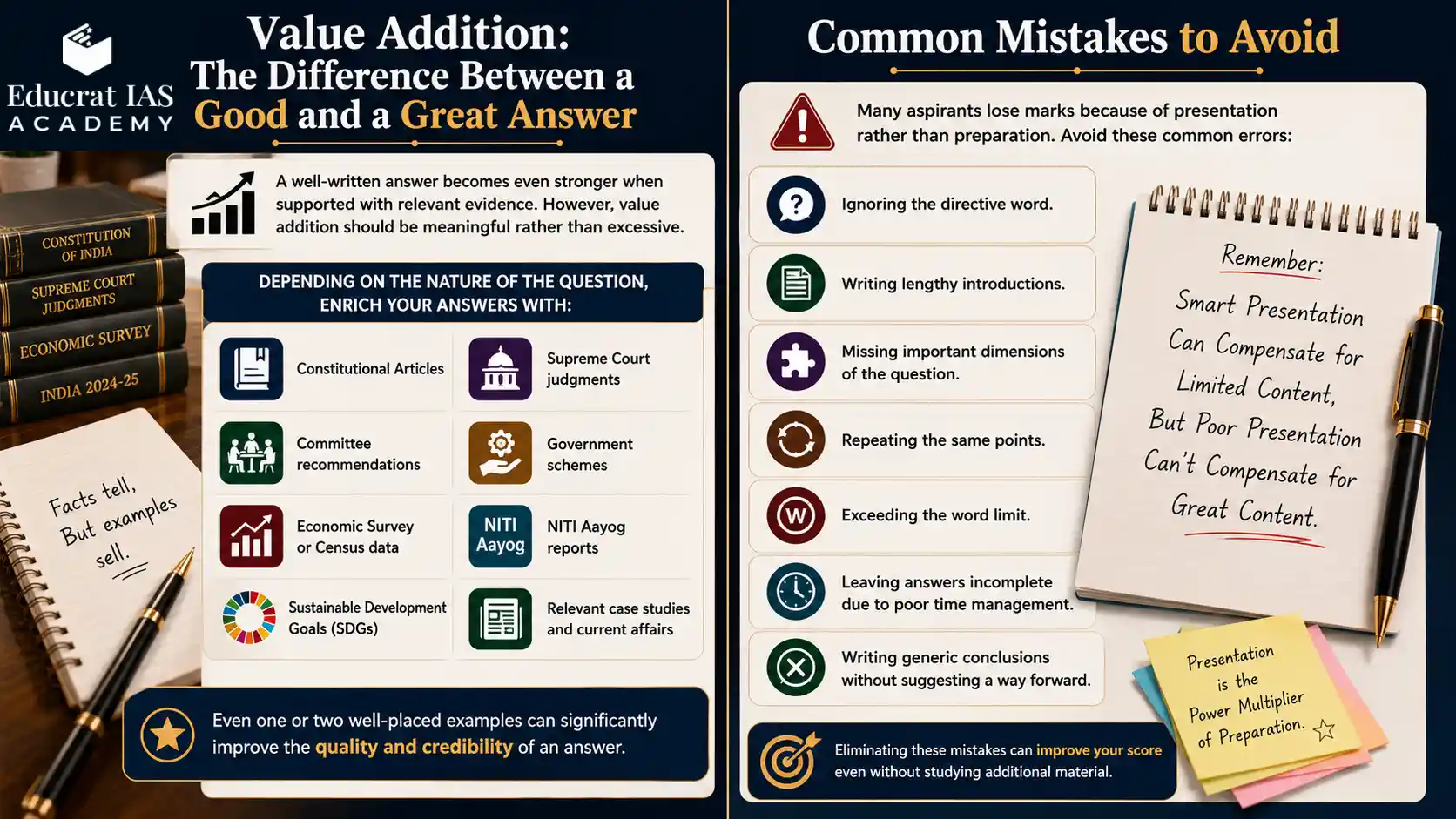
A well-written answer becomes even stronger when supported with relevant evidence. However, value addition should be meaningful rather than excessive.
Depending on the nature of the question, enrich your answers with:
- Constitutional Articles
- Supreme Court judgments
- Committee recommendations
- Government schemes
- Economic Survey or Census data
- NITI Aayog reports
- Sustainable Development Goals (SDGs)
- Relevant case studies and current affairs
Even one or two well-placed examples can significantly improve the quality and credibility of an answer.
Common Mistakes to Avoid
Many aspirants lose marks because of presentation rather than preparation. Avoid these common errors:
- Ignoring the directive word.
- Writing lengthy introductions.
- Missing important dimensions of the question.
- Repeating the same points.
- Exceeding the word limit.
- Leaving answers incomplete due to poor time management.
- Writing generic conclusions without suggesting a way forward.
Eliminating these mistakes can improve your score even without studying additional material.
Build a Daily Answer Writing Habit
Answer writing is a skill that improves only through consistent practice. Instead of waiting until after the Preliminary Examination, make it a part of your daily routine.
A simple practice plan is:
- Solve one Previous Year Question every day.
- Write one or two answers within the prescribed time limit.
- Compare your answers with model answers.
- Identify one improvement after every practice session.
- Revise your mistakes weekly.
Small but consistent improvements over several months lead to significant gains in the Mains Examination.
Improve Your Answer Writing with Educrat IAS Academy
While self-practice is essential, expert feedback plays an equally important role in identifying weaknesses and refining answer-writing skills.
The Manthan UPSC Mains Test Series by Educrat IAS Academy is designed to provide aspirants with a structured platform for continuous improvement through:
- UPSC-standard sectional and full-length tests.
- Detailed evaluation by experienced mentors.
- Personalized feedback on content, structure, and presentation.
- High-quality model answers for comparison.
- Regular mentorship sessions to improve analytical thinking and time management.
The programme focuses not only on increasing knowledge but also on helping aspirants present that knowledge effectively in the examination.
Conclusion
Scoring well in UPSC Mains is not about writing the longest answers—it is about writing the most relevant answers in the most effective manner. The 7-5-3 Rule offers a practical and easy-to-follow framework that helps aspirants manage time, organize ideas, and develop multidimensional analysis.
With regular practice, disciplined self-evaluation, and expert guidance, this strategy can become a powerful tool for improving your Mains performance. Remember, every answer you write is a step closer to becoming a better thinker, a better writer, and ultimately, a successful civil servant.
If you are serious about improving your answer-writing skills, begin practising today and reinforce your preparation through structured guidance such as the Manthan UPSC Mains Test Series by Educrat IAS Academy. Consistency, not perfection, is the key to success in UPSC Mains.