Preparing current affairs is an essential part of UPSC Civil Services Examination preparation. However, reading newspapers, following government schemes and making monthly notes are not enough to write effective answers in the Mains examination. Aspirants must learn how to connect current developments with static concepts and use them to support their arguments.
The UPSC Mains examination tests a candidate’s ability to understand issues, analyse different perspectives and present balanced, well-structured answers. Current affairs provide real-world examples, relevant evidence and contemporary context, while the static syllabus builds the conceptual foundation required to understand these developments.
The key to effective UPSC Mains answer writing is not to include more current affairs, but to use the right current affair to strengthen the answer to the question asked.
In this guide, we will explain how to use current affairs in UPSC Mains answer writing across GS Paper 1, GS Paper 2, GS Paper 3 and GS Paper 4, with practical examples and strategies for improving answer quality.
Why Are Current Affairs Important in UPSC Mains Answer Writing?
Current affairs help aspirants connect theoretical knowledge with real-world developments. For example, studying fundamental rights gives candidates the necessary constitutional understanding, while contemporary debates around data protection and digital governance demonstrate how these principles apply to modern administrative challenges.
Similarly, static knowledge of urbanisation becomes more meaningful when connected with urban flooding, housing shortages, migration or inadequate municipal infrastructure. Such connections help candidates move beyond textbook definitions and develop analytical answers.
Current affairs can strengthen an answer in three main ways. They provide relevant examples to support arguments, help explain the practical implications of policies and reforms, and demonstrate awareness of contemporary challenges. However, an answer should remain centred on the question rather than becoming a summary of recent news.
Remember: Static knowledge provides the foundation, current affairs provide the evidence, and analysis connects the two.
How to Integrate Current Affairs into UPSC Mains Answers
Before using any news item, identify the exact demand of the question. A question asking you to examine the causes of urban flooding requires a different response from one asking you to evaluate disaster management measures. Even if both questions relate to the same news event, the application of current affairs must change according to the directive.
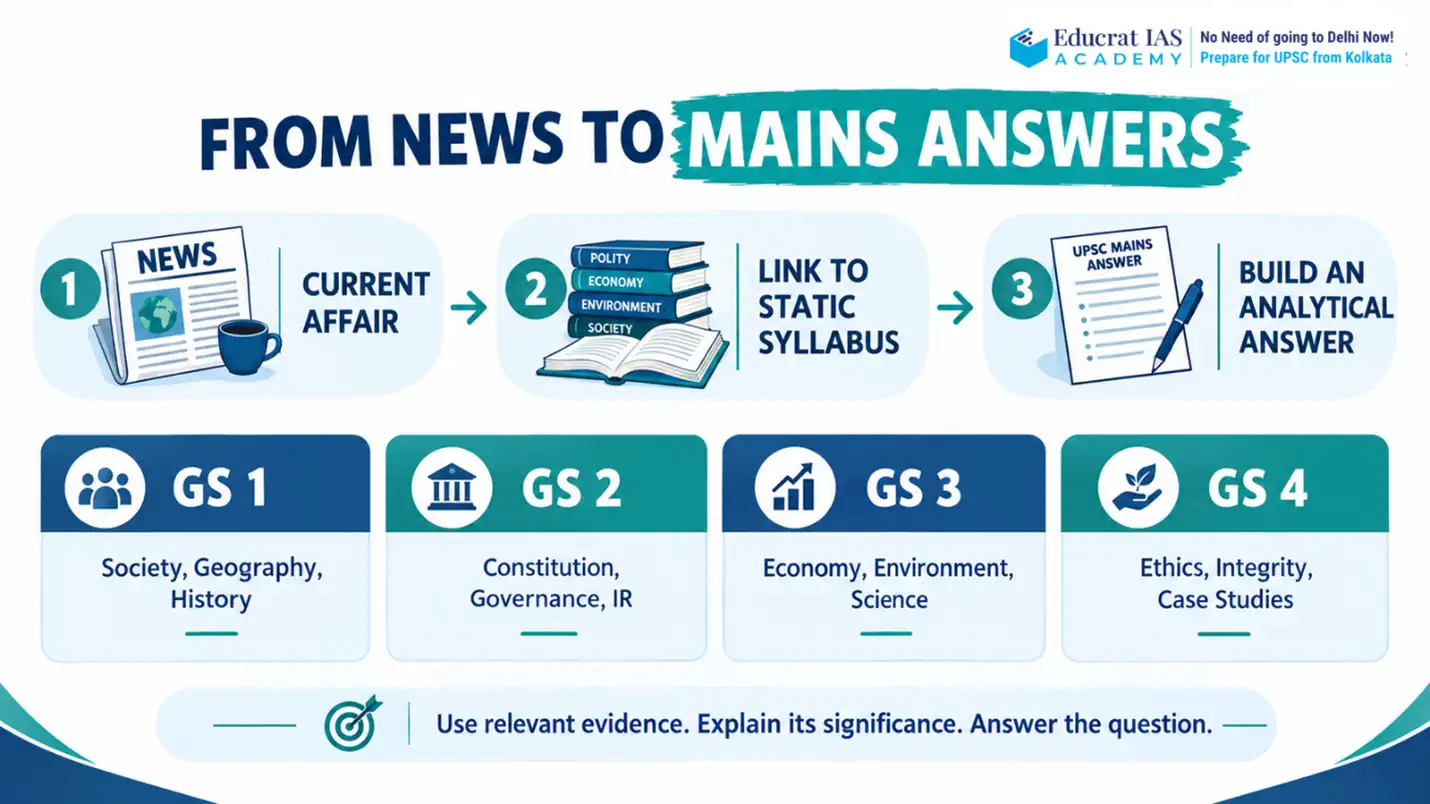
A practical approach involves five steps. First, identify the central issue and directive word. Second, recall the relevant static topic from the syllabus. Third, select one or two current examples that directly support the argument. Fourth, explain their significance rather than simply mentioning them. Finally, conclude with a balanced assessment or a practical way forward, wherever appropriate.
For example, while answering a question on digital governance, an aspirant can connect constitutional principles, administrative accountability and the Digital Personal Data Protection Act, 2023, with contemporary concerns around privacy, inclusion and the responsible use of technology.
This method makes current affairs a part of the answer’s reasoning instead of an additional paragraph inserted without purpose.
How to Use Current Affairs in GS Paper 1
GS Paper 1 covers Indian heritage and culture, history, geography and Indian society. Current affairs can help aspirants connect these static subjects with contemporary social changes, environmental developments and the continuing influence of historical events.
History and Culture
Current affairs related to archaeological discoveries, heritage conservation, traditional art forms and cultural recognition can be linked with Indian history and cultural heritage. For example, a news report about the conservation of a historic monument can support an answer on the importance of preserving India’s cultural heritage.
The answer should explain the historical significance of the site, the challenges involved in conservation and the role of tourism, public awareness and local communities. Simply naming a monument without explaining its relevance adds limited value.
Geography
Current developments involving cyclones, heatwaves, floods, coastal erosion and changing rainfall patterns can strengthen answers on physical geography and human-environment interactions. An aspirant writing about urban flooding, for instance, can connect heavy rainfall with drainage systems, impervious surfaces, wetland loss and unplanned urban expansion.
A strong geography answer explains the underlying process and uses current events to demonstrate how that process operates in the real world.
Indian Society
Current affairs are particularly useful for questions on urbanisation, migration, women’s empowerment, poverty, population, social justice and the effects of globalisation. For example, debates about women’s participation in the workforce can be linked with gender roles, unpaid care work, access to education, workplace safety and economic independence.
A good answer should examine both opportunities and persistent challenges. Relevant examples can make the discussion concrete, but the analysis should remain grounded in sociological concepts and the demand of the question.
How to Use Current Affairs in GS Paper 2
GS Paper 2 covers the Constitution, governance, polity, social justice and international relations. Current affairs are valuable in this paper because constitutional principles and government institutions frequently interact with contemporary policy decisions and public debates.
Constitution and Indian Polity
Important court judgments, constitutional debates, parliamentary developments and discussions on federalism can provide practical context for static constitutional concepts. For example, an answer on the Right to Privacy can connect the Supreme Court’s 2017 recognition of privacy as a fundamental right with contemporary concerns around digital governance and personal data protection.
Similarly, questions on federalism can be enriched by discussing Centre–State coordination, fiscal relations, inter-state cooperation and the functioning of constitutional institutions.
The objective is not to list every related development. It is to select evidence that directly supports the constitutional argument being made.
Governance and Social Justice
Government schemes, digital public services, education reforms, healthcare delivery and welfare programmes can support answers on transparency, accountability, inclusion and service delivery.
Suppose a question asks how technology can improve governance while ensuring inclusion. An aspirant can discuss the benefits of digital service delivery alongside challenges such as limited internet access, digital literacy, accessibility barriers and grievance redressal.
For international relations, major diplomatic developments, regional cooperation and multilateral initiatives can illustrate broader themes in India’s foreign policy. Candidates should explain the strategic or economic significance of a development rather than merely narrating what happened.
For GS Paper 2, connect current affairs with constitutional provisions, institutions, policy objectives and implementation challenges.
How to Use Current Affairs in GS Paper 3
GS Paper 3 includes the economy, agriculture, science and technology, environment, biodiversity, security and disaster management. It offers many opportunities to use current affairs as supporting evidence for analytical arguments.
Indian Economy and Agriculture
Developments related to inflation, employment, public investment, manufacturing, digital payments and agricultural markets can strengthen answers on economic growth and development. Government reports and official economic publications can provide useful data, provided the figures are accurate, relevant and correctly attributed.
For example, an answer on agricultural productivity can connect irrigation, soil health, storage, market access and climate resilience with contemporary agricultural initiatives. Instead of merely listing schemes, explain how they address specific constraints and where implementation gaps remain.
Environment and Disaster Management
Current developments involving heatwaves, floods, air pollution, renewable energy and biodiversity conservation can be connected with climate change, sustainable development and disaster preparedness.
For example, while discussing urban flooding, a candidate can link recent flood events with inadequate stormwater drainage, encroachment on natural water bodies, land-use planning and the need for climate-resilient urban infrastructure. Measures such as improved drainage, wetland protection, early-warning systems and coordinated city planning can then form the way forward.
Science and Technology
Developments in artificial intelligence, semiconductor manufacturing, space research and digital infrastructure can support answers on technological innovation, economic development and national security.
An answer on artificial intelligence in public administration, for instance, can examine improved service delivery alongside algorithmic bias, privacy risks, accountability and the need for human oversight.
In GS Paper 3, use current examples to explain causes, consequences, policy responses and practical solutions—not merely to show that you follow the news.
How to Use Current Affairs in GS Paper 4
GS Paper 4 focuses on ethics, integrity and aptitude, including ethical principles, emotional intelligence, public-service values and case studies. Here, current affairs can provide practical illustrations of abstract values and demonstrate how ethical principles apply to administrative decisions.
For example, a public debate over the use of artificial intelligence in welfare delivery can be linked with fairness, transparency, accountability, empathy and respect for individual rights. If an automated system wrongly excludes eligible beneficiaries, an administrator must consider both the efficiency of technology and its consequences for vulnerable citizens.
Similarly, examples of transparent decision-making can illustrate integrity and accountability, while situations involving disaster relief can demonstrate compassion, impartiality and duty towards citizens.
In ethics case studies, use current examples selectively. The most important elements are identifying stakeholders, explaining the ethical dilemmas, comparing available options and justifying a responsible course of action. An example should support ethical reasoning rather than replace it.
For preparation, aspirants can also refer to Educrat’s UPSC Ethics Examples guide for topic-wise illustrations of ethical values.
A Practical Example: Turning Current Affairs into a Mains Answer
Consider the following illustrative question:
“Urban flooding is as much a governance challenge as an environmental problem. Examine.”
A purely static answer might explain rainfall, poor drainage and the growth of urban settlements. Although relevant, it may remain descriptive if it does not connect these factors with contemporary urban challenges.
A stronger answer would begin by explaining that urban flooding occurs when rainfall and surface runoff exceed the capacity of natural and built drainage systems. The body could then connect geographical factors, such as intense rainfall, with governance issues such as unplanned construction, wetland encroachment, fragmented municipal responsibilities and inadequate drainage maintenance.
A relevant contemporary flood event could be used as an illustration, provided its details are verified. The answer could conclude with measures such as protecting natural drainage channels, improving stormwater infrastructure, strengthening urban planning and developing reliable early-warning systems.
Notice how the example works: static geography explains the causes, current affairs provide context, governance concepts explain institutional failures, and the conclusion offers practical solutions.
This is how current affairs should improve an answer: by making the analysis more specific, evidence-based and relevant to the question.
Common Mistakes to Avoid While Using Current Affairs
One common mistake is adding a recent news headline to every answer, even when it does not strengthen the argument. Current affairs should be selected according to relevance, not simply because an event is recent.
Another mistake is memorising statistics without understanding their source, reference year or significance. Incorrect figures or outdated information can weaken an otherwise good answer. Aspirants should verify important data through credible official sources before using it.
Candidates should also avoid writing lengthy descriptions of government schemes without explaining their objectives, outcomes or limitations. Similarly, repeatedly using the same example across different questions can make answers feel generic.
Finally, current affairs must not replace conceptual preparation. A candidate who knows the latest policy announcement but cannot explain the relevant constitutional, economic, geographical or ethical concept will struggle to build a well-reasoned answer.
How to Practise Current Affairs-Based Answer Writing Daily
A simple, consistent routine is more useful than making unlimited notes. Read exam-relevant news, identify its connection with the UPSC syllabus and record a concise note containing the issue, static concept, one verified example and possible Mains applications.
Then select a previous-year question or a syllabus-based practice question and write an answer under timed conditions. After writing, check whether the example directly supports your argument, whether all parts of the question are addressed and whether the conclusion follows logically from the discussion.
Aspirants can use the UPSC previous-year question papers to understand question patterns and the Educrat IAS Current Affairs Magazine to organise exam-relevant developments. Official UPSC question papers should also be used for direct reference to the examination’s actual questions.
The goal is to build a bank of usable arguments and examples, not a collection of disconnected news summaries.
Conclusion
Learning how to use current affairs in UPSC Mains answer writing requires a balance between static knowledge, contemporary awareness and analytical thinking. GS Paper 1 benefits from examples related to history, geography and society; GS Paper 2 connects current developments with constitutional principles and governance; GS Paper 3 uses them to explain economic, environmental and technological challenges; and GS Paper 4 applies them to ethical reasoning and public administration.
The best answer is not the one containing the most current affairs, but the one in which every example strengthens a relevant argument.
For aspirants seeking structured preparation, consistent practice and feedback are essential. Educrat IAS Academy’s MANTHAN Mains Test Series includes GS I–IV answer-writing practice, evaluation and current-affairs integration. Aspirants comparing the Best IAS Coaching in Kolkata or the Best UPSC Coaching in Kolkata should look for programmes that help them convert knowledge into clear, relevant and well-structured answers.
Ultimately, effective Mains preparation is about understanding the question, selecting the right evidence and presenting a balanced analysis within the word limit. With disciplined practice, current affairs can become a powerful tool for demonstrating depth, clarity and administrative understanding in the UPSC Mains examination.