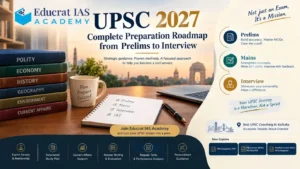
Master the Maze: UPSC Preparation Strategy 2027 (The Complete 1-Year+ Roadmap)
About UPSC CSE Examination:
Stage 1: Preliminary Examination (Screening)
The Prelims consists of two objective-type (MCQ) papers conducted on a single day. While essential for shortlisting, these marks are not counted toward the final merit list.
- Negative Marking: There is a penalty of 1/3rd of the marks assigned to a question for every incorrect answer. In both Paper I and Paper II.
- General Studies Paper I (Generally conducted between 9:30 AM to 11:30 AM): This paper evaluates the candidate’s knowledge in multiple subjects:
- Current events of national and international importance
- History
- Geography
- Indian Polity and Governance
- Economic and Social Development
- Environmental ecology, biodiversity, and climate change
- General Science
This paper plays the most important role in determining whether a candidate qualifies for the Mains stage.
- CSAT (General Studies Paper II) (Generally conducted between 2:30 PM to 04:30 PM): The Civil Services Aptitude Test (CSAT) evaluates the candidate’s logical and analytical skills.
Important topics include:
- English
- Mathematics
- Reasoning
Although the CSAT paper is qualifying, candidates should not ignore it, as failure to secure 33% marks will disqualify the candidate regardless of their GS score.
Stage 2: Main Examination (Written)
Candidates who clear the Prelims proceed to the Mains, a descriptive, essay-type examination consisting of nine papers. The Mains syllabus focuses on evaluating the analytical ability, conceptual clarity, and writing skills of the candidates.
- Qualifying Papers: Paper A (Indian Language) and Paper B (English) require a minimum score of 25%. Their marks are not counted for ranking.
- Merit-Ranking Papers: Seven papers contribute to the written total of 1750 marks:
- Essay
- GS Paper I – Indian Heritage and Culture, History and Geography of the World and Society
- GS Paper II – Governance, Constitution, Polity, Social Justice and International Relations
- GS Paper III – Technology, Economic Development, Bio-diversity, Environment, Security and Disaster Management
- GS Paper IV – Ethics, Integrity & Aptitude
- Optional Subject: Paper I and Paper II, Candidates choose one subject from a list of 48 options, including literature. This choice is critical as it accounts for 500 marks.
Stage 3: UPSC Interview (Personality Test)
The final stage is an interview conducted by a 5-member panel at UPSC headquarters in New Delhi. Candidates who qualify the Mains examination are called for the UPSC Personality Test, conducted at the UPSC headquarters in New Delhi.
The panel evaluates:
- Personality and confidence
- Communication skills
- Leadership qualities
- Awareness of national and international issues
- Suitability for a career in public service
Total Marks: 275.
Unlike a traditional academic test, the interview focuses on overall personality and decision-making ability.
At Educrat IAS Academy, the Best UPSC Coaching in Kolkata, we provide a comprehensive counselling session which helps aspirants understand the UPSC syllabus with clarity and depth.
Final Merit Calculation
The final ranking is determined solely by the combined score of the Mains Examination (1750 marks) and the Interview (275 marks), totaling 2025 marks.
UPSC CSE 2027 STRATEGY
Phase 1: The Foundation & “Why” (Months 1–3)
Focus: NCERTs and Conceptual Clarity
- Begin with taking a week to understand the syllabus, navigating through the basic books. Try to understand which routine format fits best for you and what are your strong suits.
- Before jumping into heavy reference books, you must build a sturdy base. Think of your preparation like constructing a building; without a deep foundation, the structure risks collapsing under pressure.
- The Content: Thoroughly cover the required NCERTs for History, Geography, Economics, and Polity.
- The Strategy: Do not focus on rote memorization yet. Understand the “why” behind historical events and geographical phenomena and the interconnectedness of subjects.
- Newspaper: Start with the gospels of UPSC: The Hindu newspaper and The Indian Express, try to form a bridge between the static and the current event.
- CSAT: Often ignored while shouldn’t be. CSAT is what pulls back many in UPSC. Begin CSAT preparations from the beginning by dedicating at least an hours daily.
- Mentorship: This is where a personalized mentorship program for UPSC becomes invaluable. Having a mentor to build a strong foundation and review your progress provides the course correction needed to bridge the gap between an aspirant and topper.
Joining the best UPSC coaching in Kolkata can help you streamline this phase. Experienced faculty at an IAS coaching institute Kolkata can point out which chapters are high-yield and which can be skipped while building a strong foundation.
Phase 2: Building Depth & Optional Mastery (Months 4–6)
Focus: Standard Books and Optional Subject
This is the most intensive phase. This is where you transition from basic concepts to the advanced requirements of the UPSC coaching centre Kolkata standards.
- Static Subjects: Dive into standard texts, M. Laxmikanth (Polity), Spectrum (Modern History), and other standard books.
- MCQ Solving: Revision is best done when practiced. Incorporate solving at least 10 mcq questions in your daily routine from both GS and CSAT. Consistent practice is the method of success.
- Answer Writing: Begin your answer writing practice. Start with 1 answer as day and get each evaluated by an experienced faculty or by a topper, this will help polish your answer writing skills.
- The Optional Choice: Your optional subject accounts for 500 marks. Master it now so you aren’t overwhelmed during the Prelims-to-Mains gap.
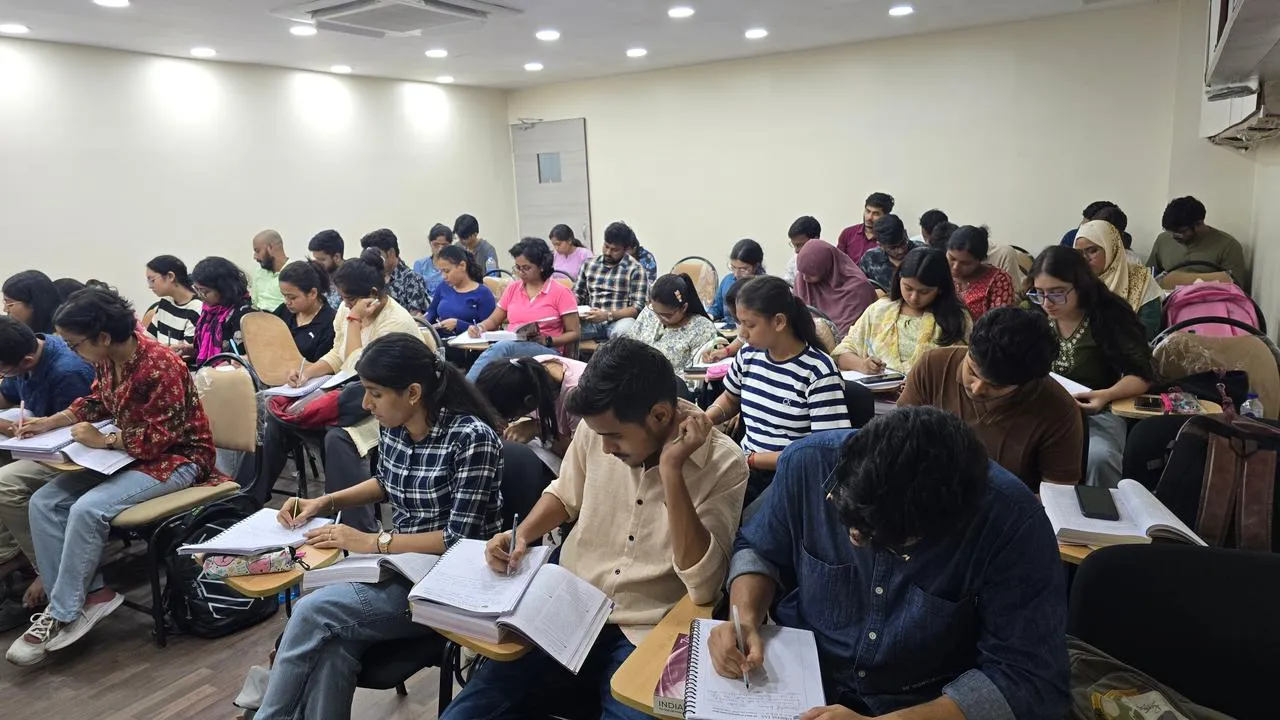
Attending regular UPSC classes Kolkata ensures you stay consistent. As the best IAS coaching in Kolkata, we emphasize completing the optional subject by the end of this phase.
Phase 3: The “Mains-First” Approach (Months 7-8)
Focus: Answer Writing and Current Affairs Consolidation
UPSC rewards planned consistency. Knowledge without expression is futile in the descriptive papers.
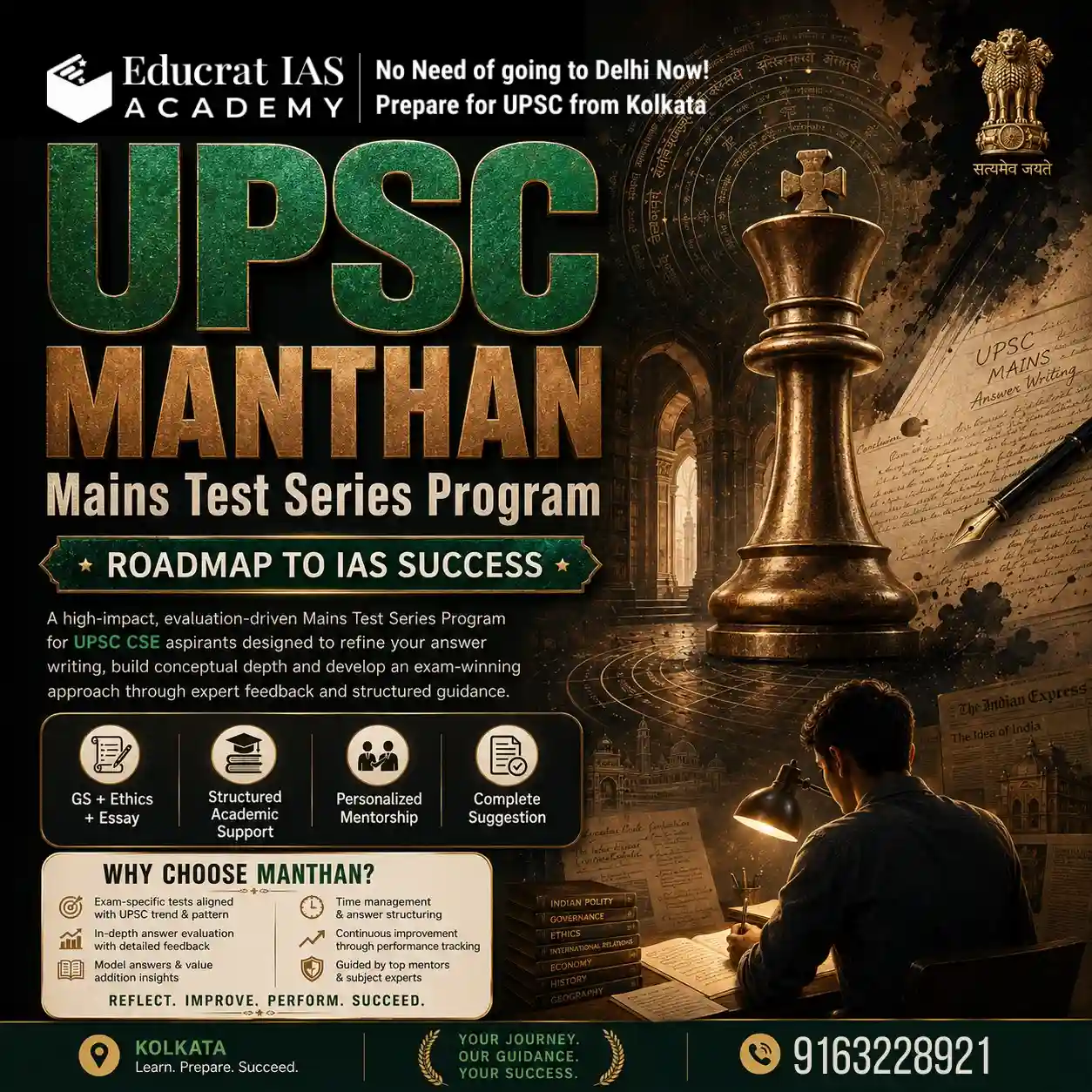
- The Writing Habit: Enroll in a dedicated test series for mains answer writing program like EDUCRAT IAS Academy’s UPSC Mains MANTHAN Test Series. Learning how to structure introductions, use flowcharts, and conclude effectively is a skill that takes months to hone.
- Current Affairs: Focus on analysis rather than just facts. Use your UPSC coaching institute Kolkata resources to relate dynamic events to static topics so as to make comprehensive notes. At Educrat IAS Academy, we provide Current Affairs and Current Affairs MCQ in forms of:
Phase 4: Prelims Intensive & Mock Drills (Months 9–12)
Focus: Speed, Accuracy, and CSAT
Three months before the Prelims, shift your gear entirely toward objective testing.
- Mock Tests: Most aspirants who fail in UPSC CSE attempt mock test either in online format or in informal environment. To succeed in UPSC it is important to negate the fear of examination. Sit in proper UPSC like stimulated environment with proper exam pattern to transition from UPSC aspirant to UPSC TOPPER.
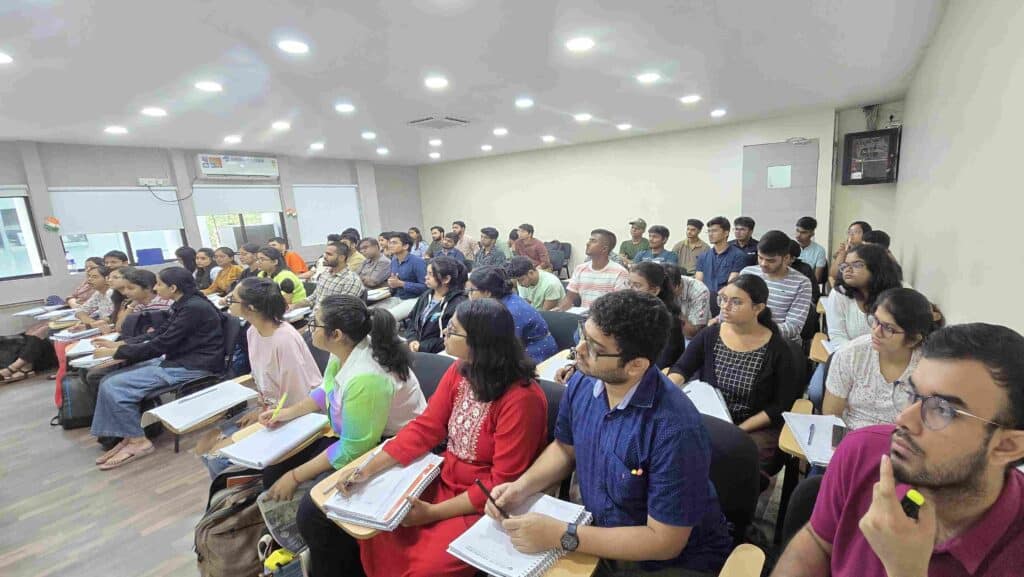
Join a rigorous UPSC Test Series Kolkata, such as our Aanklan series. Solving 40–50 full-length mocks helps you master the art of intelligent elimination.
EDUCRAT IAS UPSC Prelims Test Series:
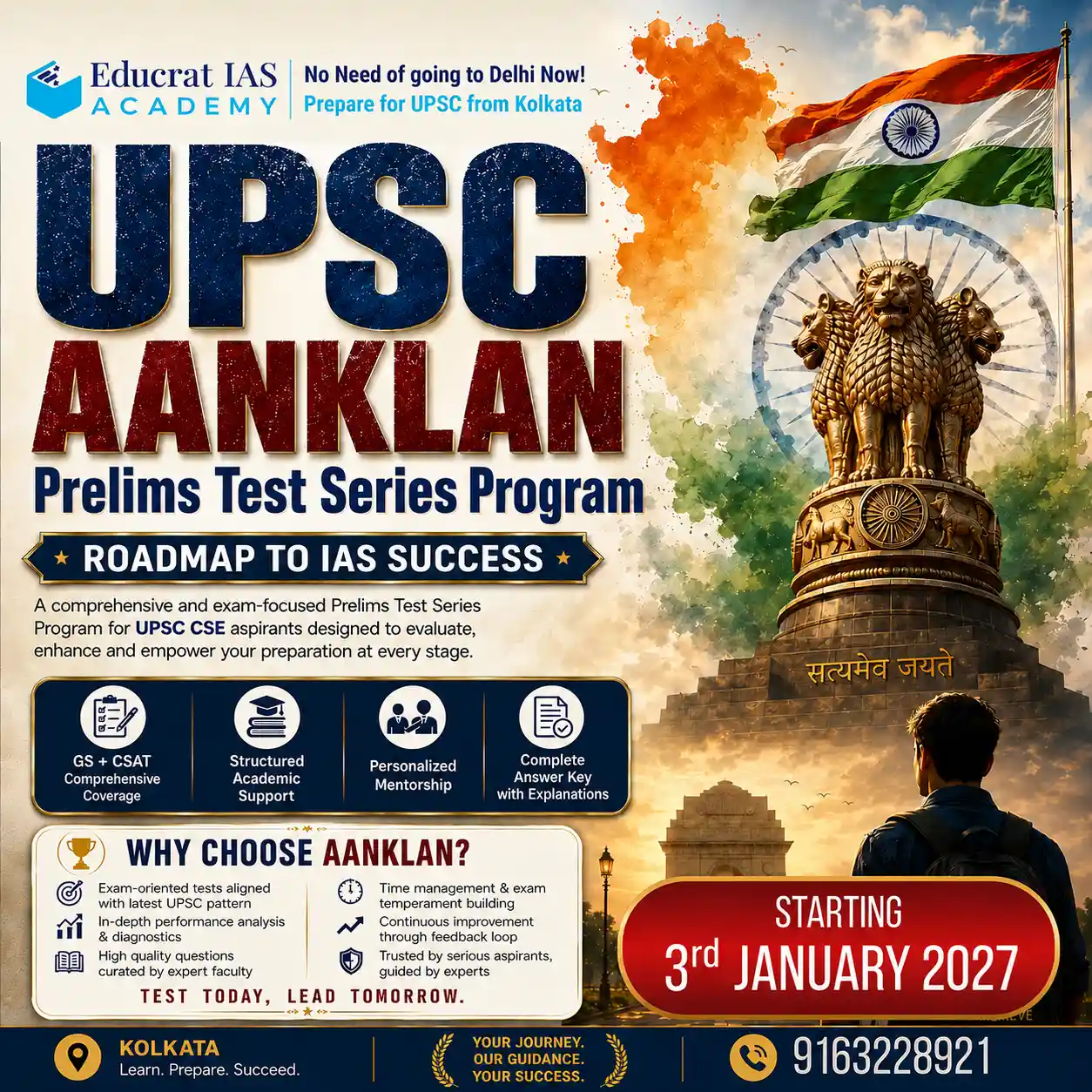
Aanklan (आकलन) Prelims Test Series
Our UPSC Prelims Test Series aims to cover the UPSC PYQs and emerging trends of UPSC Prelims MCQs, enabling the aspirants to prepare well in advance with the tricks and methods to solve UPSC level of MCQs.
The tests are conducted in UPSC like environment with strict invigilation. Detailed explanation, Answer Key, All India Ranking is provided to help students track their progress. These are all included in our UPSC Prelims Test Series Aanklan 2026.
- Compete with 200+ Aspirants from Eastern India in a UPSC-like simulated environment with a detailed answer key for each test.
- Comprehensive syllabus coverage for GS & CSAT: Covering all subjects and Current Affairs.
NOTE: CSAT: Do not ignore Paper II. Spend time at least 2 hours daily on Math, English and Logical Reasoning to ensure you comfortably clear the 33% qualifying mark.
The Realistic Winning Daily Routine
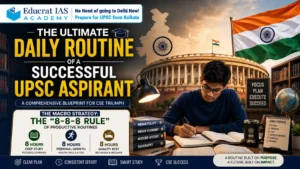
- 06:00 AM – 07:30 AM: Wake up and light exercise/meditation to build mental stamina.
- 07:30 AM – 09:30 AM: Slot 1: The Newspaper. Read The Hindu or Indian Express, focusing on issues of national and international importance. Read Currrent Affair analysis and solve MCQ based on those.
- 10:00 AM – 01:00 PM: Slot 2: Core Subject. Focus on heavy subjects like History, Geography, or Polity.
- 01:00 PM – 02:00 PM: Lunch and a short power nap.
- 02:00 PM – 04:00 PM: Slot 3: CSAT
- 05:00 PM – 07:00 PM: Slot 4: Optional Subject. Dedicate these hours to your chosen optional.
- 07:30 PM – 08:00 PM: Slot 5: Answer Writing/CSAT. Spend an hour on the mains answer writing program and 30 minutes on CSAT practice.
- 8:00 PM – 9:00 PM: Revision of the day.
- 09:00 PM – 10:00 PM: Dinner and some comfort hobby.
- 10:00 PM – 10:30 PM: Plan the next day’s targets to hit the ground running.
Keep each day realistic and sustainable: small targets but consistent targets.
Why a Structured Roadmap Matters for UPSC Success
A structured roadmap is the backbone of any successful attempt at the Civil Services Examination. Given the vastness of the syllabus and the intensity of the completion, moving forward without a clear plan is like sailing without a compass.
Here is why a structured strategy is a necessity for every aspirant:
1. Eliminates Randomness and “Resource Overload”
The UPSC syllabus is finite, but the study materials available in infinite. A roadmap acts as a filter, helping you distinguish between what is interesting and what is relevant. It ensures you focus on high-yield topics instead of getting lost in a sea of books, preventing the common trap of “reading everything but retaining nothing”.
UPSC doesn’t reward the person who reads 10 books once; it rewards the person who reads one book ten times. Minimum Resources, Multiple Revision is the key to becoming a UPSC Topper. At Educrat IAS Academy, the Best IAS institute in Kolkata, we provide all the required books and curated, high-yield study materials that eliminate the need for “material hopping.” Our mentors ensure you focus only on what is relevant for the 2026 exam cycle.
We provide Current Affairs and Current Affairs MCQ in forms of:
- Daily Current Affairs
- Daily Current Affairs MCQ
- Monthly Current Affairs Magazine
- Monthly Current Affair MCQ
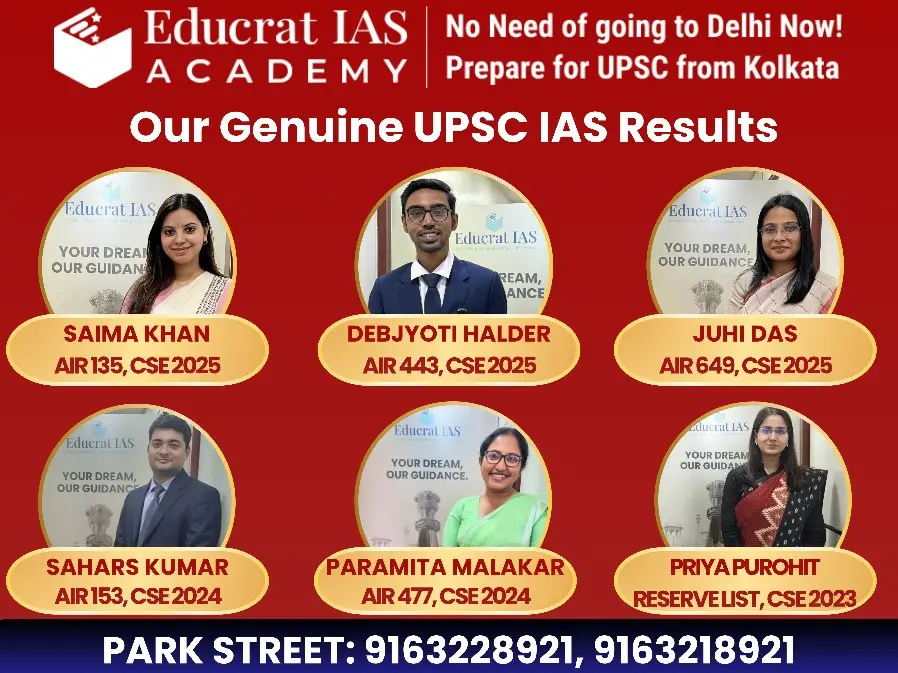
UPSC CSE 2025 Topper Talk: Winning Strategy of AIR 135, Saima Khan
AIR 135, Saima Khan credits her success to a “Smart Work > Hard Work” philosophy. Her core pillars is Resource Management, Mastering a few standard books through multiple revisions rather than chasing new materials.
2. Strategic “Integrated” Preparation
UPSC CSE 2027 is not just Prelims. One of the biggest mistakes aspirants do is treating Prelims and Mains as separate entities. A structured plan allows for an integrated approach where you build depth in answer writing for Mains while simultaneously securing for the Prelims. Since over 60% for the syllabus overlaps, a strategic roadmap helps you “study once and apply twice”, saving months of redundant effort.
Aspirants often wait until after Prelims to start practicing for Mains. This is a fatal mistake which is why aspirants fail in UPSC CSE. The Mains exam is a test of writing stamina and analytical speed, not just memory. At Educrat IAS Academy, the Top UPSC Coaching institute in Kolkata, our UPSC courses are specially curated to fit answer writing in every class throughout the course. Integrated preparation in UPSC CSE is what UPSC Toppers utilize to not fail in UPSC CSE.
UPSC CSE 2025 Topper Talk: Game-Changer for AIR 649, Juhi Das
AIR 649, Juhi Das believes in Answer Writing as a Game-Changer. She practiced structured, point-wise answers aligned with the UPSC demand for clarity and depth. Through disciplined study and answer writing practice, she successfully cleared as AIR 649 in UPSC CSE 2025 Topper.
3. Consistency Over Intensity
UPSC is not won by 18 hours for one week; it is won by studying 8 hours consistently for a year. A roadmap breaks down the massive 12 month goal into manageable daily and weekly targets. This build discipline and prevents the burnout that often comes from a lack of visible progress.
4. Choosing Optional Strategically
Your Optional accounts for 500 marks. If you don’t enjoy the subject, you won’t survive the deep-dive required to score 300+. There are several factors to consider while choosing Optional.
How to Choose Optional Subject in UPSC?
- Interest
- Overlap with General Studies
- Availability of Guidance & Resources
- Optional Subject Based on Graduation
- Answer Writing Nature
- Past Performance & Scoring Trend
5. Built in Buffer for Revision and Test Series Practice
Without a plan, revision is usually the first thing that gets sacrifices when time runs out. A structured roadmap treats revision as a non-negotiable phase rather than an afterthought. It ensures you have at least 2-3 months for multiple revision cycles, which is the only way to retain the enormous amount of information required for the GS and Optional papers.
To succeed in UPSC it is important to pair revision with negating the fear of examination. Sit in proper UPSC like stimulated environment with proper exam pattern to transition from UPSC aspirant to UPSC TOPPER.
UPSC CSE 2025 Topper Talk: AIR 153, SAHARS KUMAR, UPSC CSE 2024
Listen to what UPSC Topper has to say:
EDUCRAT IAS UPSC Test Series:
- Compete with 200+ Aspirants from Eastern India in a UPSC-like simulated environment with a detailed answer key for each test.
- Comprehensive syllabus coverage for GS & CSAT: Covering all subjects and Current Affairs.
- Comprehensive Coverage: Includes GS I, GS II, GS III, GS IV, and Essay papers, covering the entire syllabus.
- UPSC-like stimulated environment and Expert personalized evaluations with doubt-clearing sessions.
Comprehensive test series to evaluate your preparation
Prepare. Perform. Succeed.
6. Mental Clarity and Resilience
The psychological toll of UPSC is real. Anxiety often stems from a feeling of “not doing enough” or being “behind.” Having a clear schedule allows you to track your progress objectively. When you hit your weekly targets, it provides a sense of accomplishment that boosts your morale and keeps you mentally resilient for the long haul.
At Educrat IAS Academy, our mentorship program upsc is designed specifically to provide this structure. Whether you are in our upsc classes kolkata or following our upsc test series kolkata, the goal is to replace chaos with a clear, actionable path to success.
Why Strategy Beats Luck
Success in the Civil Services Examination isn’t just about hard work; it’s about working on the right things at the right time. Finding a reputable UPSC coaching institute Kolkata provides you with the ecosystem—competitive peers, updated resources, and expert guidance—that keeps you motivated.
At Educrat IAS Academy, recognized as providing the Best UPSC coaching in Kolkata, we don’t just provide lectures; we provide a vision. From our personalized mentorship program upsc to our exhaustive upsc test series kolkata, every resource is designed to make your 2027 attempt your final attempt.
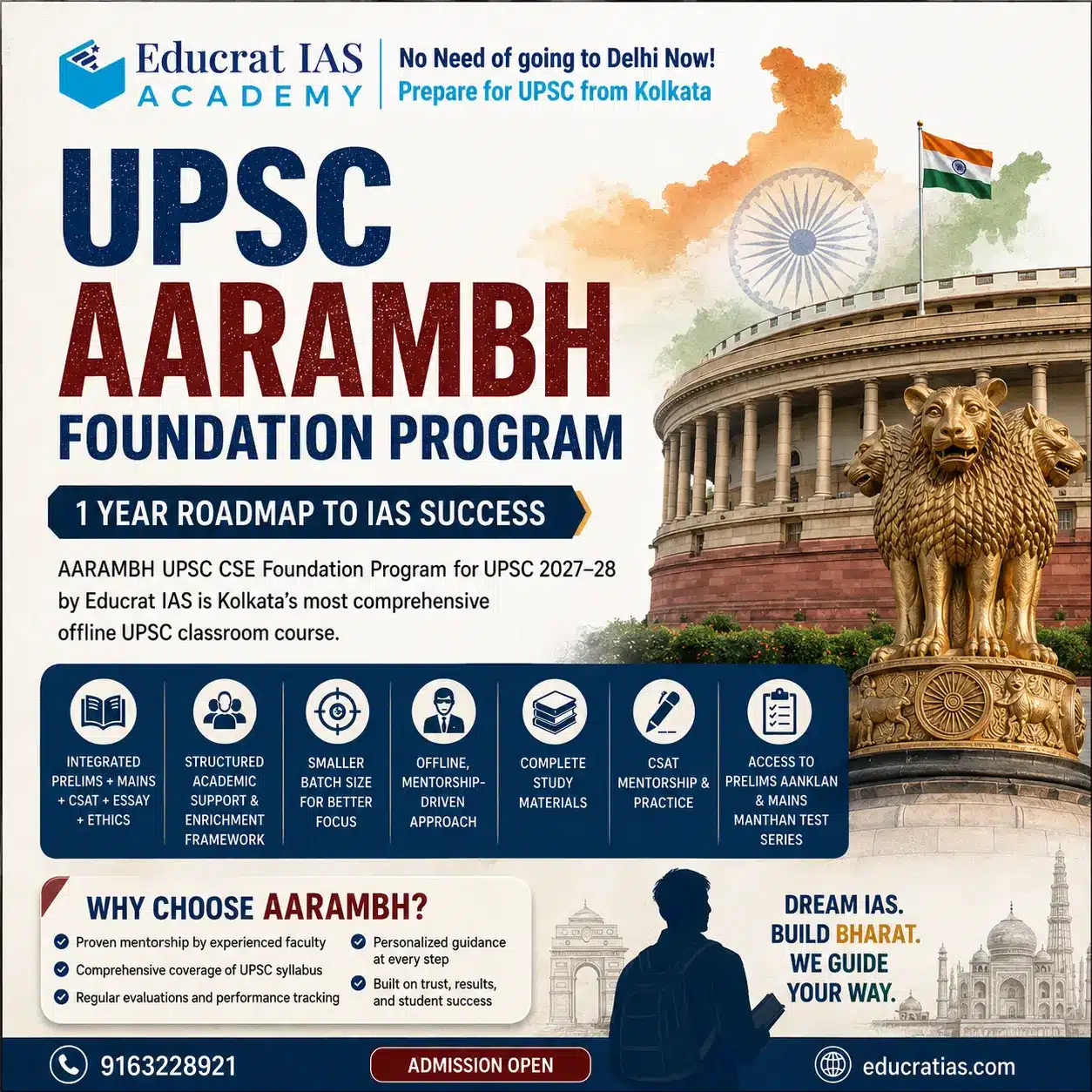
Whether you are looking for upsc preparation in kolkata through our Aarambh Foundation Batch or looking to sharpen your skills in our mains answer writing program, we are here to guide you.
Join the leading upsc coaching centre kolkata and the best ias coaching in kolkata today.