The moment you walk out of the examination hall after the UPSC Prelims, your perspective must shift entirely. Whether you are scoring borderline marks or safely clearing the expected cutoff, there is absolutely zero time to look back. The real battle for a rank in the Civil Services Examination begins now. With the upcoming Mains examination on the horizon, you have a critical 90-day window to transform your raw knowledge into high-scoring answers.
A serious aspirant knows that Prelims only gets you through the gate, but Mains gets you into the final merit list. As one of the top IAS coaching institutes in Kolkata, Educrat IAS has crafted The Ultimate 90-Day UPSC Mains Strategy—a step-by-step master plan designed to maximize your GS, Essay, and Optional scores.
The UPSC Mains 2026 exam date is scheduled to commence on August 21, 2026, and will span five consecutive days, comprising a total of nine papers. Aspirants are advised to consult the official UPSC Mains Timetable 2026, available on the official website at upsc.gov.in, for a detailed paper-wise schedule.
In this Blog:
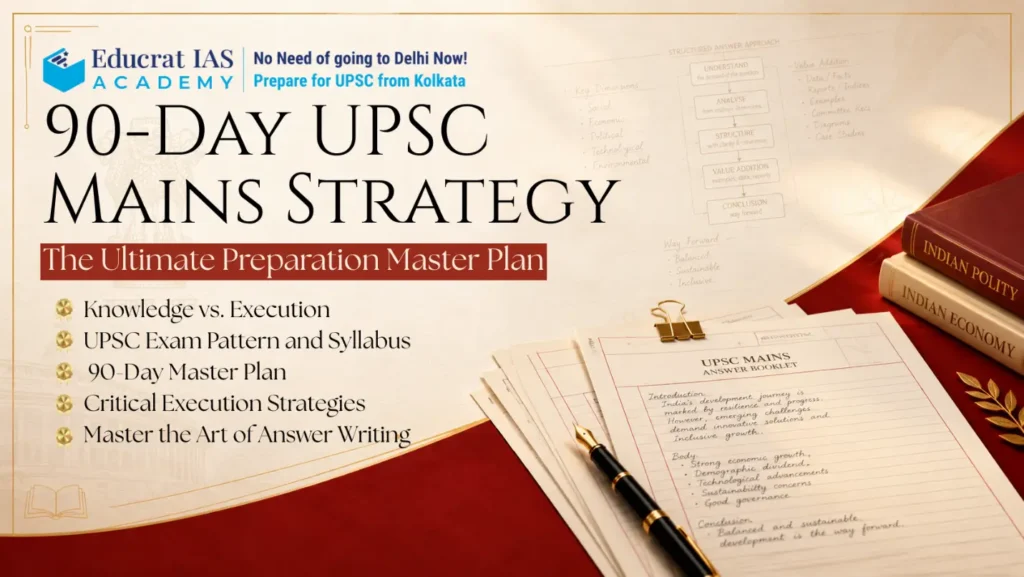
- The Core Philosophy of the 90-Day Mains Plan: Knowledge vs. Execution
- How to Prepare for UPSC Mains 2026?
- UPSC Exam Pattern for Mains
- UPSC Exam Syllabus for Mains
- Phase-Wise Breakdown of the 90-Day Master Plan
- Critical Execution Strategies Often Ignored by Aspirants
- Decode Success
- How Our Mentors Shape Your Writing Style to Match the Toppers
- How to Master the Art of UPSC Mains Answer Writing
- Accelerate Your Preparation
The Core Philosophy of the 90-Day Mains Plan: Knowledge vs. Execution
Many aspirants make the mistake of reading entirely new books during these 90 days. UPSC Mains is not a test of how much content you can read; it is a test of how effectively you can express what you already know under intense time pressure.
To score 400+ in General Studies and 130+ in Essays, your strategy must revolve around three pillars:
- Syllabus Micro-segmentation: Completing left-over high-yielding topics like World History, Disaster Management, Society, and Ethics.
- Value Addition: Integrating current affairs, administrative committees, diagrams, and case studies into your notes.
- Answer Writing Discipline: Writing consistently under simulated exam conditions to master time management.
How to Prepare for UPSC Mains 2026?
It is crucial for candidates to find out the best preparation strategy for themselves to successfully ace the UPSC Mains Exam 2026. Everyone has a different learning style, but the following areas are common, which can be included in the study plan of all candidates for a sound preparation strategy:
Thorough Understanding of Syllabus: Aspirants should meticulously go through the UPSC Mains syllabus to comprehend the scope of each subject and the specific topics to cover. Understanding the syllabus helps candidates tailor their preparation accordingly.
Intensive Study and Time Management: Consistent and focused study is essential for success in the Mains. Aspirants should allocate sufficient time for each subject, keeping in mind their strengths and weaknesses. A well-structured study timetable is critical for managing time effectively.
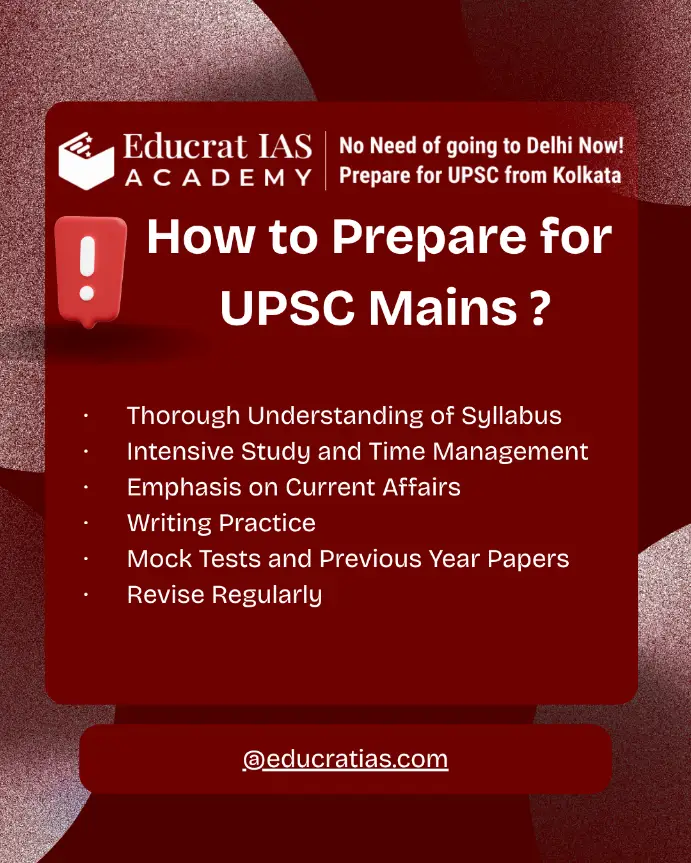
Emphasis on Current Affairs: UPSC often integrates current affairs into GS papers, making it crucial for candidates to stay updated with the latest developments in politics, economy, environment, and international relations.
Writing Practice: Since the UPSC Mains is a descriptive examination, writing practice is crucial. Aspirants must hone their writing skills, focus on clarity of expression, and develop a coherent and structured approach to answering questions.
Mock Tests and Previous Year Papers: Solving mock tests and previous year’s question papers can help candidates get familiar with the UPSC Exam Pattern, understand the type of questions asked, and work on time management.
Revise Regularly: Regular revisions are indispensable for the retention and reinforcement of knowledge. Candidates should revise all the subjects periodically to enhance their memory and grasp of key concepts.
UPSC Exam Pattern for Mains:
The UPSC Mains Exam is the core evaluation phase, comprising a mix of qualifying, compulsory and optional papers. It includes 2 language papers, essay writing, general studies papers and optional subject papers. This stage dives deep into a candidate’s true understanding of the subjects, their ability to analyze and articulate ideas under time pressure.
The written examination consists of 9 papers out of which 2 papers are qualifying in nature. The marks obtained in the remaining 7 papers and the interview test together are considered for making the final merit list.
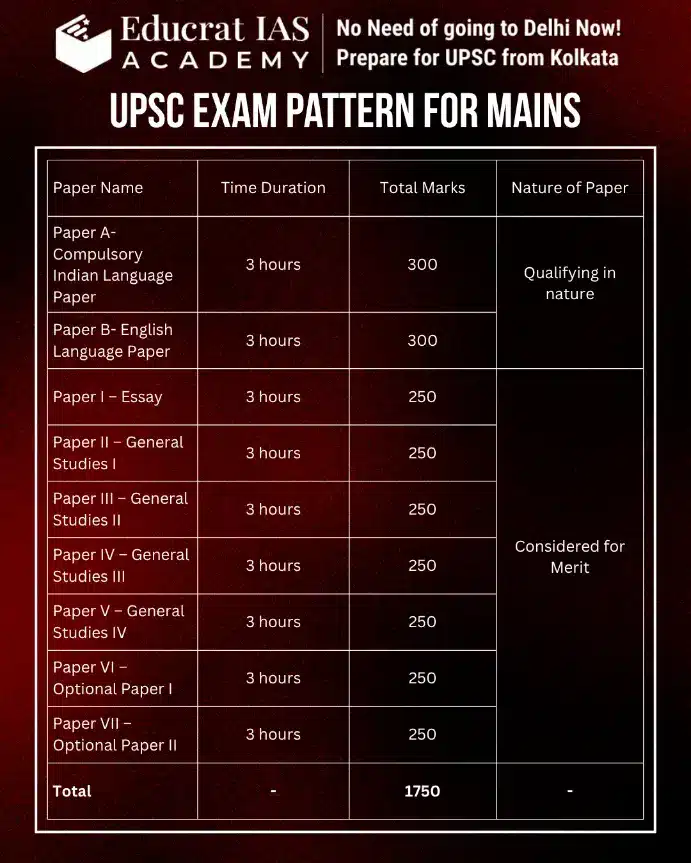
| UPSC Exam Pattern 2026 for Mains | |||
| Paper Name | Time Duration | Total Marks | Nature of Paper |
| Paper A- Compulsory Indian Language Paper | 3 hours | 300 | Qualifying in nature |
| Paper B- English Language Paper | 3 hours | 300 | |
| Paper I – Essay | 3 hours | 250 | Considered for Merit |
| Paper II – General Studies I | 3 hours | 250 | |
| Paper III – General Studies II | 3 hours | 250 | |
| Paper IV – General Studies III | 3 hours | 250 | |
| Paper V – General Studies IV | 3 hours | 250 | |
| Paper VI – Optional Paper I | 3 hours | 250 | |
| Paper VII – Optional Paper II | 3 hours | 250 | |
| Total | – | 1750 | – |
UPSC Exam Syllabus for Mains:
A clear understanding of the UPSC Mains syllabus is essential for effective preparation, answer writing, and strategic study planning. The Mains examination evaluates a candidate’s analytical ability, conceptual clarity, writing skills, and understanding of governance and society.
UPSC Mains Paper A: Indian Language (Qualifying)
The Indian Language paper tests a candidate’s ability to understand and express ideas effectively in any one of the languages listed in the Eighth Schedule of the Indian Constitution. The paper evaluates comprehension, precise writing, and language proficiency.
UPSC Mains Paper B: English (Qualifying)
The English paper assesses the candidate’s ability to read, comprehend, and communicate effectively in English. It includes comprehension passages, précis writing, grammar, and essay-type questions.
UPSC Essay Paper Syllabus
The Essay paper is one of the most scoring papers in the UPSC Mains Examination. Candidates are required to write two essays by selecting one topic from each section provided in the question paper. Topics generally revolve around:
- Current affairs
- Philosophical themes
- Governance
- Social issues
- Economic development
- Environmental concerns
A strong essay requires clarity, structure, balanced arguments, and effective presentation. Guidance from the best UPSC coaching in Kolkata like Educrat IAS Academy can significantly improve essay-writing skills through regular evaluation and mentorship.
UPSC Mains General Studies Paper 1 Syllabus
General Studies Paper 1 covers Indian Heritage and Culture, History, Geography, and Society. This paper emphasizes conceptual understanding and analytical interpretation of historical and social developments.
Important Topics in GS Paper 1
Indian Culture
- Art forms
- Literature
- Architecture from ancient to modern India
Modern Indian History
- Freedom struggle
- Significant personalities and movements
- Post-independence consolidation
World History
- Industrial Revolution
- World Wars
- Colonization and decolonization
- Political ideologies
Indian Society
- Diversity
- Women and social empowerment
- Urbanization
- Globalization
- Secularism and communalism
Geography
- Physical geography
- Natural resources
- Climatic phenomena
- Earthquakes, cyclones, tsunamis, and volcanoes
Many aspirants joining a Best Institute for UPSC Preparation in Kolkata focus extensively on answer writing and map practice for GS Paper 1.
UPSC Mains General Studies Paper 2 Syllabus
General Studies Paper 2 focuses on Governance, Constitution, Polity, Social Justice, and International Relations. It tests awareness of constitutional mechanisms and contemporary governance issues.
Important Topics in GS Paper 2
Indian Constitution
- Historical background
- Features and amendments
- Basic structure doctrine
- Comparison with other constitutions
Governance and Polity
- Parliament and State Legislatures
- Executive and Judiciary
- Constitutional and statutory bodies
- Representation of People’s Act
Social Justice
- Welfare schemes
- Health and education
- Poverty and hunger
- NGOs and SHGs
International Relations
- India and neighbouring countries
- Global organizations
- Bilateral and multilateral agreements
Quality mentorship and current affairs integration are important for scoring well in GS Paper 2. This is why many aspirants opt for comprehensive UPSC CSE coaching in Kolkata for conceptual clarity and answer enrichment.
UPSC Mains General Studies Paper 3 Syllabus
General Studies Paper 3 covers Economy, Agriculture, Science & Technology, Environment, Disaster Management, and Internal Security. This paper emphasizes application-based understanding and awareness of current developments.
Important Topics in GS Paper 3
Indian Economy
- Economic growth and development
- Budgeting
- Infrastructure
- Inclusive growth
- Liberalization
Agriculture
- Cropping patterns
- Irrigation systems
- MSP and subsidies
- Food processing
- Land reforms
Science and Technology
- IT and Space technology
- Robotics
- Biotechnology
- Nanotechnology
- Intellectual Property Rights
Environment and Ecology
- Conservation
- Pollution
- Environmental impact assessment
Security and Disaster Management
- Cyber security
- Terrorism
- Border management
- Disaster preparedness
UPSC Mains General Studies Paper 4 Syllabus
General Studies Paper 4 deals with Ethics, Integrity, and Aptitude. It evaluates a candidate’s moral reasoning, ethical decision-making, and administrative aptitude.
Important Topics in GS Paper 4
Ethics and Human Interface
- Determinants of ethics
- Human values
- Ethics in public life
Attitude
- Moral and political attitudes
- Persuasion and social influence
Aptitude and Integrity
- Impartiality
- Objectivity
- Compassion
- Public service values
Emotional Intelligence
- Application in governance and administration
Probity in Governance
- RTI
- Accountability
- Transparency
- Citizen charters
- Corruption challenges
UPSC Optional Subjects List
Candidates must choose one optional subject consisting of two papers carrying a total of 500 marks. Selecting the right optional subject is extremely important as it can significantly influence the final rank.
Popular Optional Subjects
- Anthropology
- Geography
- History
- Political Science and International Relations
- Public Administration
- Sociology
- Psychology
- Philosophy
- Literature Subjects
The UPSC Mains examination demands consistency, conceptual clarity, answer-writing practice, and strategic preparation. Understanding the syllabus thoroughly allows aspirants to streamline preparation and avoid unnecessary study material. With disciplined preparation and proper mentorship, aspirants can confidently approach the examination and improve their chances of success.
Phase-Wise Breakdown of the 90-Day Master Plan
Phase 1: Days 1 to 45 – Consolidation and Optional Mastery
- Focus Areas: Optional Subject, Ethics (GS IV), Essay, and Core GS Static portions.
- Daily Routine: Dedicate 4 hours daily to your Optional subject. Your Optional paper carries 500 marks and can single-handedly decide your selection. Spend the remaining 4–5 hours on GS answer writing and micro-notes creation by leveraging UPSC classes with expert guidance in Kolkata.
- Ethics & Essay: Do not treat GS IV and Essay as an afterthought. Spend at least two days a week practicing mock essays and writing case studies for Ethics.
- Important: Write at least 2 Mains answers every day to build your answer writing skills.
Phase 2: Days 46 to 75 – Answer Writing Rigor & Value Addition
- Focus Areas: Dive into intense answer writing, refining data blocks, and integrating Current Affairs.
- The Content Enrichment Step: Create 1-page micro-notes for specific keywords mentioned in the UPSC syllabus (e.g., Self Help Groups, Food Processing, e-Technology in the aid of farmers).
- Data Bank: Memorize key data points, NITI Aayog reports, Economic Survey highlights, and Supreme Court judgements to quote directly in your GS 2 and GS 3 answers.
- Begin with UPSC Mains Mock tests in UPSC like Environment.
Phase 3: Days 76 to 90 – Full-Length Simulations & Mental Conditioning
- Focus Areas: Majorly focus on writing full-length 3-hour tests back-to-back.
- The Real Simulation: UPSC Mains requires you to write two papers a day (6 hours of writing) for consecutive days. In the final phase, train your brain and hands to sustain this physical and mental pressure by taking full-length mock tests strictly matching official timings at an established UPSC coaching centre in Kolkata.
Many toppers advise writing three Mock tests a day. Pushing the extra 3 hours helps during the real examination. An aspirant with a practice of 3 mock tests in a day for 9 hours will find examination on the D-Days to be less pressurizing compared to others.
Critical Execution Strategies Often Ignored by Aspirants
1. Building the 6-Hour Writing Stamina
UPSC Mains is as much a test of physical endurance as it is of mental acuity. Writing for 6 hours a day across consecutive days can lead to severe physical fatigue and finger cramping, which degrades handwriting legibility. Your 90-day layout must explicitly include multi-test blocks where you sit for consecutive morning and afternoon mock exam sessions. This trains your neuromuscular memory to sustain consistent speed and clean penmanship from the first to the final minute of the examination cycle.
2. Syllabus Keywords Micro-Mapping
Do not merely review subjects broadly; instead, map your preparation directly onto the specific textual keywords outlined in the official UPSC syllabus document. Ensure you have a structured 200-word template already optimized for every niche keyword—such as Investment Models, Salient features of world’s physical geography, or Issues relating to development and management of Social Sector/Services. If a keyword appears on the syllabus, you cannot afford to formulate your structural flow on the spot in the exam hall.
Decode Success: Read Real Answer Copies of UPSC Toppers
One of the fastest ways to learn how to write a top-tier answer is to look at the work of those who have already conquered the exam. At Educrat IAS, we believe in complete transparency and practical learning.
We have compiled and uploaded the actual, evaluated answer booklets of our successful candidates directly on our portal. You can access them here: Educrat IAS UPSC Toppers Mains Answer Copies.
How Our Mentors Shape Your Writing Style to Match the Toppers:
When you analyze these copies, you will notice they aren’t written by accident; they are engineered. Our expert faculty works closely with each student to bridge the gap between an ordinary answer and a topper-level script:
- Deconstructing Complex Prompts: Our teachers train your brain to break down complex, multi-part UPSC questions so you never miss a sub-question.
- Transitioning from Paragraphs to Frameworks: Our mentors guide you on how to convert dense text into highly readable schematics, structural points, and maps that fetch extra half-marks per question.
- Injecting Bureaucratic Language: Through rigorous feedback, our team helps you replace casual vocabulary with precise administrative terms, constitutional articles, and policy frameworks.
How to Master the Art of UPSC Mains Answer Writing
An exceptional answer does not just answer the question; it addresses the exact demand of the question directive (e.g., Discuss, Critically Analyze, Evaluate, Elucidate).
1. The Perfect Structural Anatomy
Every answer you write should follow a standard, visually appealing layout:
- Introduction (10-15% of space): Define the core keyword or state a recent current affairs context/statistic.
- Body (70-80% of space): Break down your points into subheadings directly derived from the question. Use a mix of bullet points and small paragraphs.
- Conclusion (10-15% of space): End on a forward-looking, constructive, and optimistic note (aligning with government visions like SDG goals or Atmanirbhar Bharat).
2. Differentiate Your Answers
With thousands of copies to evaluate, examiners get bored reading generic paragraphs. Make your copy stand out by:
- Drawing quick maps (especially in Geography and International Relations).
- Using flowcharts to explain cause-and-effect relationships (in Economy and Disaster Management).
- Underlining key terms, constitutional articles, and committee names (e.g., Sarkaria Commission, Second ARC).
Accelerate Your Preparation with Educrat IAS MANTHAN Mains Test Series
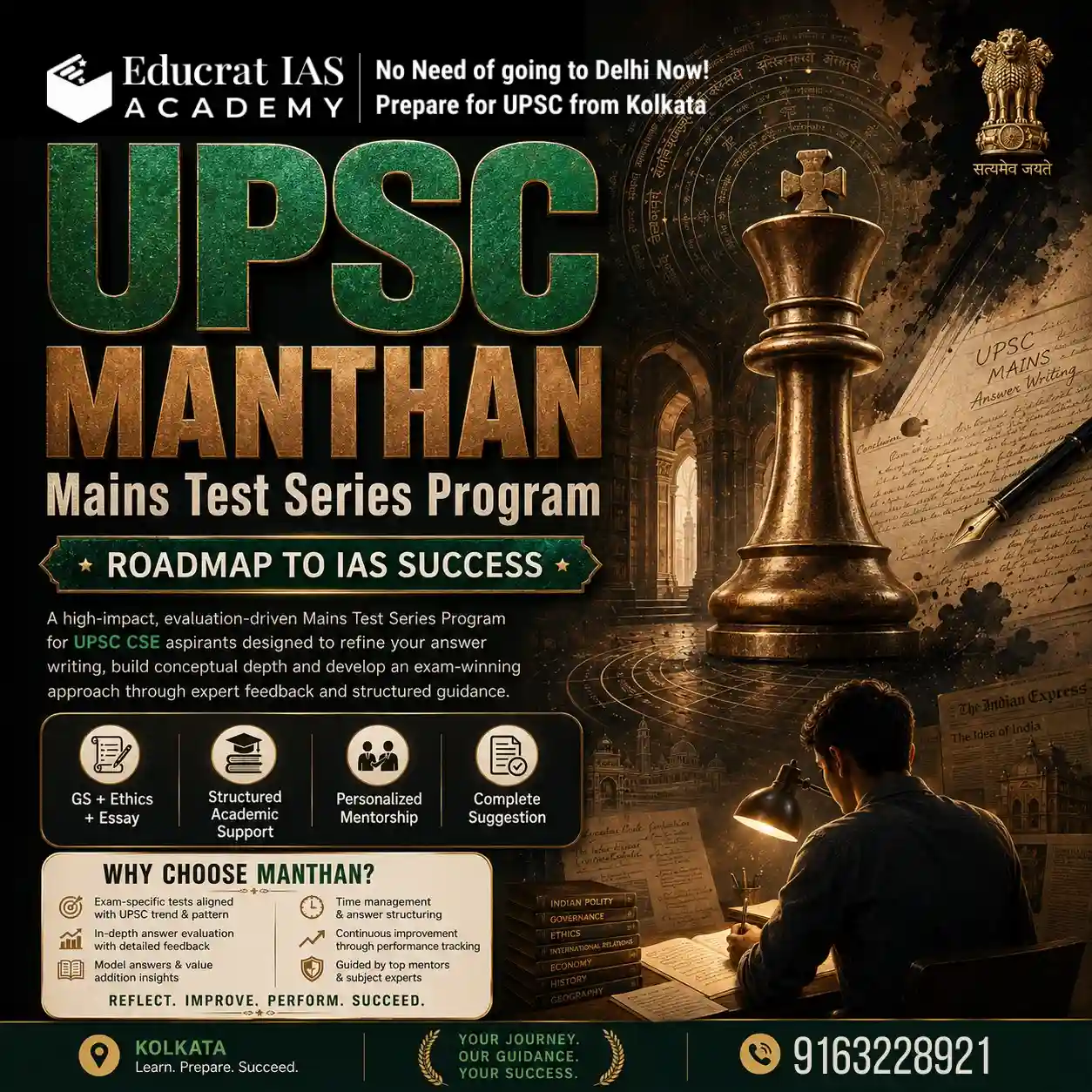
Self-study is highly valuable, but without objective external evaluation, you might keep repeating the same structural mistakes for 90 days. To bridge this gap, Educrat IAS presents the best UPSC Mains test series in Kolkata: UPSC Mains Test Series MANTHAN.
Designed specifically for serious aspirants who want to capitalize on the post-Prelims momentum, the MANTHAN Program launches right after the Prelims examination.
Why MANTHAN is the Ultimate Choice for Serious Aspirants:
- Delhi-Standard Faculty Metrics: Our curriculum development team and evaluators bring deep Delhi-ecosystem expertise directly to Kolkata. This ensures your answers are measured against national-level benchmarks, combining rigorous academic oversight with highly focused, small-batch monitoring.
- Proven Track Record of Direct Reflections: Our curriculum is highly aligned with real UPSC trends. In past exams, over 5 essay topics and 30+ GS questions from the Educrat IAS test series were directly reflected in the actual UPSC Mains papers.
- Two-Layered Detailed Evaluation & Feedback: We don’t just give superficial marks. Every copy undergoes a rigorous two-layered check providing a comprehensive SWOT (Strengths, Weaknesses, Opportunities, Threats) analysis within a strict 14-working-day turnaround time.
- One-on-One Mentorship: Bring your evaluated copies to our Park Street center (or online) for dedicated, personalized mentorship sessions to directly fix your weak areas with experienced faculty.
- Learn from Toppers: Gain access to evaluated copies of successful Educrat rankers like Saima Khan (AIR 135) and Debjyoti Halder (AIR 443) to understand what a top-scoring copy actually looks like.
- Comprehensive Academic Inclusions: The program comprises 11 Sectional Tests and 11 Full-Length Tests covering Essay, GS I, GS II, GS III, and GS IV, along with high-value model answers, post-test discussion sessions, and specialized Mains workbooks.
Details at a Glance:
- Duration: 3 Months (Perfectly matching the 90-day window)
- Mode: Offline (Park Street, Kolkata) & Online (For outstation students)
- Fee Structure: ₹10,000 + GST
Conclusion: Don’t Wait for the Results, Start Today!
The biggest differentiator between an aspirant who makes it to the interview list and one who doesn’t is the timing of their action. Waiting for the official UPSC Prelims results to come out before studying for Mains is a costly mistake that wastes 20–25 golden days.
Take the leap immediately after the Prelims. Trust your hard work, stick to this 90-day master plan, and back it up with a reliable evaluation partner.
Ready to transform your UPSC Mains preparation? Enroll in the Educrat IAS MANTHAN Mains Test Series today and give your Civil Services dream the structure it deserves!