The UPSC Civil Services Preliminary Examination is often described as the first major hurdle in one of India’s most challenging competitive examinations. Months, and sometimes years, of hard work culminate in a single day of testing. However, what many aspirants fail to realize is that their actions in the days immediately following the Prelims can significantly influence their chances of success in the subsequent stages.
Every year, a large number of candidates make avoidable mistakes after the examination, mistakes that cost them precious preparation time for the Mains. Whether you are confident about clearing the cut-off or uncertain about your performance, the period immediately after the Prelims requires strategic decision-making.
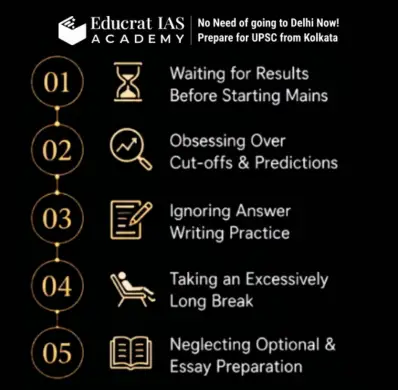
Mistakes to Avoid Immediately After the UPSC Prelims Exam
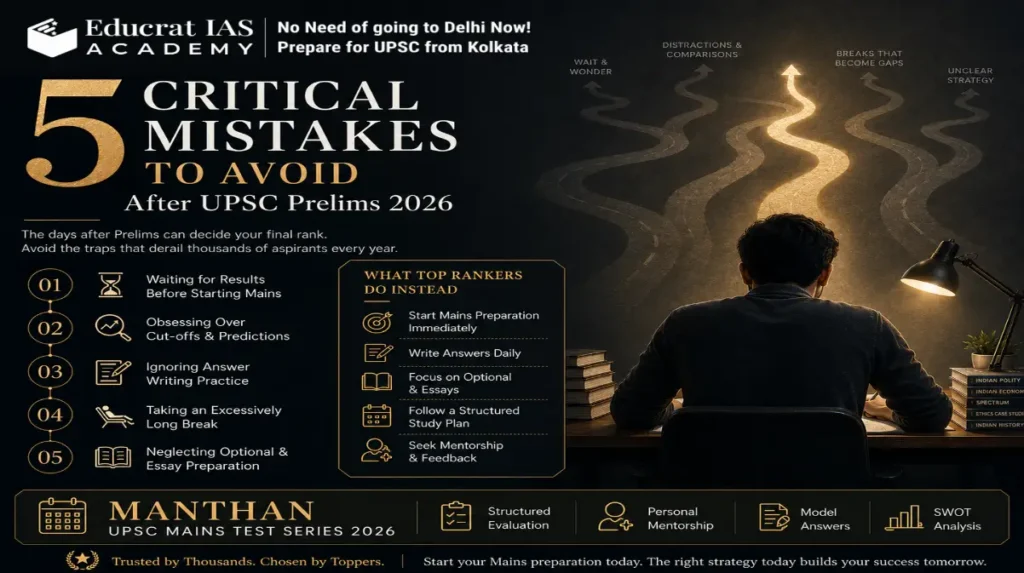
1. Waiting for the Official Result Before Starting Mains Preparation
This is perhaps the biggest mistake aspirants make.
The gap between the UPSC Prelims result and the Mains examination is relatively short. Candidates who wait for the official result before beginning Mains preparation often find themselves struggling to complete the vast syllabus, revise optional subjects, and develop answer-writing skills.
Instead of waiting, calculate your approximate score using reliable answer keys. If your score is reasonably close to or above the expected cut-off, begin Mains preparation immediately. Even if you are uncertain, the effort invested will never go to waste.
For UPSC Prelims 2026, UPSC has already released a provisional UPSC Prelims 2026 Answer Key. Calculate your approximate score using this official answer key. If your score is reasonably close to or above the expected cut-off, begin Mains preparation immediately. Keeping in view that the paper of UPSC Prelims 2026 was relatively tough compared to the prior years the expected cut-off for GS Paper I can be between 67 and 75. If your score is anywhere in between this or higher, this is the right time to begin your preparation. Even if you are uncertain, the effort invested will never go to waste.
Many successful candidates attribute their success to starting their mains answer writing program within a few days of appearing for the Prelims.
2. Becoming Obsessed with Answer Keys and Cutoff Predictions
After the examination, social media platforms become flooded with answer keys, expert analyses, cutoff predictions, and heated discussions.
While checking a few credible answer keys is important, repeatedly calculating scores from multiple sources can create unnecessary anxiety and confusion. Different coaching institutes often provide different answers for disputed questions, making the situation even more stressful. For UPSC Prelims 2026, UPSC has already released a provisional UPSC Prelims 2026 Answer Key, hence trust only that. Calculate your approximate score using this official answer key. If your score is reasonably close to or above the expected cut-off, begin Mains preparation immediately.
Remember that no coaching institute can predict the exact cut-off with certainty.
Aspirants should spend limited time evaluating their performance and then redirect their energy toward productive preparation. The real battle begins after Prelims, not on YouTube discussion panels.
3. Ignoring Answer Writing Practice
Many candidates spend months preparing for objective-type questions and suddenly realize after Prelims that they have not written a single structured answer for Mains. UPSC Mains demands analytical thinking, clarity of expression, balanced arguments, and effective presentation. These skills cannot be developed overnight.
The weeks immediately after Prelims are the ideal time to build a disciplined answer-writing routine. Joining a structured upsc test series kolkata can help aspirants receive regular evaluation, identify weaknesses, and improve consistency before the Mains examination.
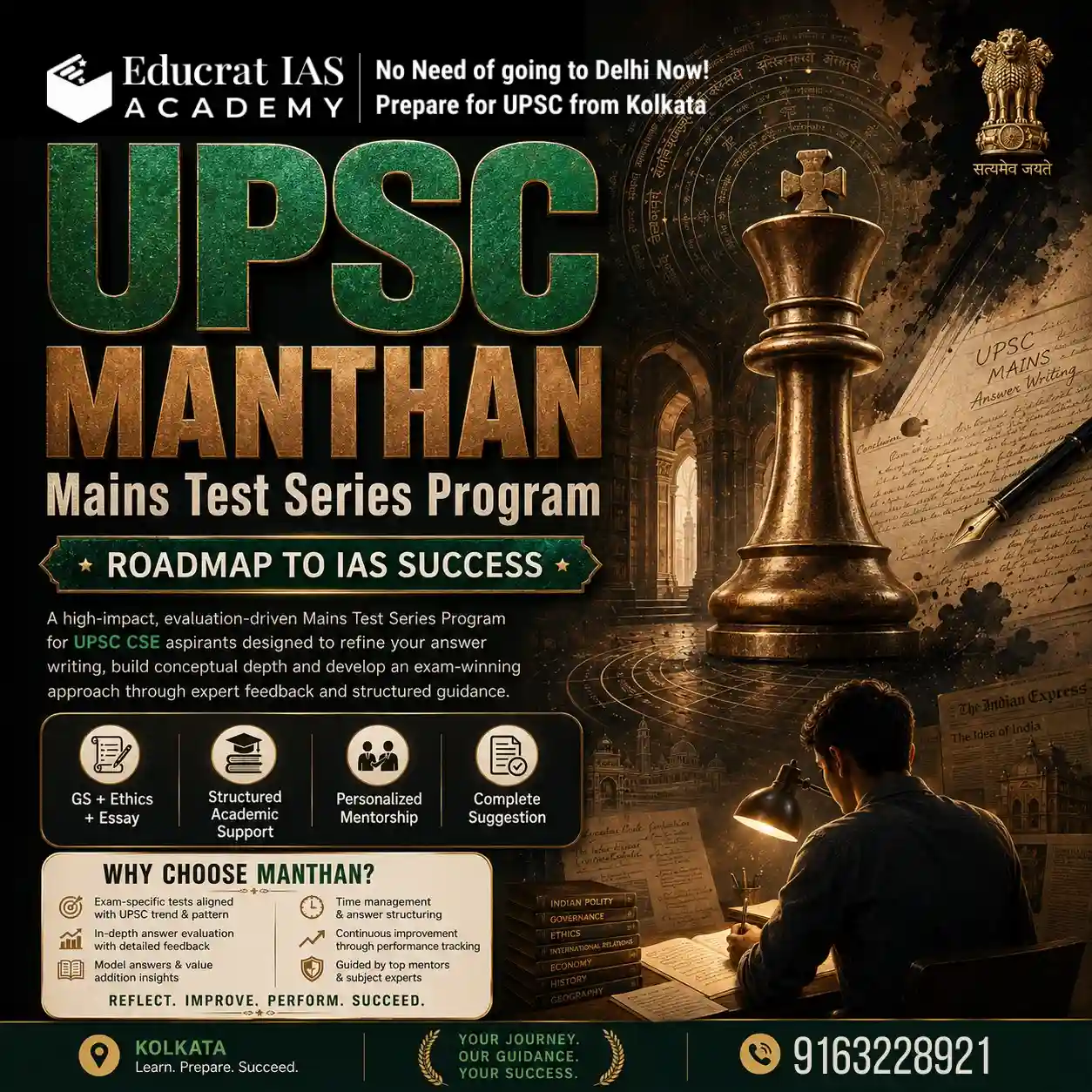
At Educrat IAS, we take pride in our track record, over 5 essay topics from our test series appeared in UPSC 2024, and 30+ topics from our tests were reflected in the actual UPSC Mains paper. Detailed Two Layered Evaluation & Feedback, Personalised SWOT Analysis, Mentorship on how to improve the weak areas, Model Answers will be a part of the UPSC Mains Test Series Manthan 2026 Program.
Educrat IAS MANTHAN UPSC Mains Test Series 2026 Program begins on 14th June 2026. The earlier you start writing, the more confident you become in tackling the demanding nature of the Mains papers.
4. Taking an Excessively Long Break
After months of intense preparation, many aspirants feel mentally exhausted. Taking a short break of two day or three is perfectly reasonable. However, extending that break into weeks can be extremely damaging. The momentum built during Prelims preparation is a valuable asset. Once lost, it becomes difficult to regain focus and discipline.
Instead of disconnecting completely, use a short recovery period to refresh yourself and then transition smoothly into Mains preparation. Candidates associated with a structured mentorship program upsc often find it easier to maintain consistency because they remain accountable to their mentors and study plans. Educrat IAS MANTHAN UPSC Mains Test Series 2026 Program begins on 14th June 2026. At Educrat IAS Academy we provide detailed answer keys, explanations, model answers for Mains, and personalised feedback to help aspirants continuously improve writing quality, and overall performance.
Remember: recovery is important, but complacency can be costly.
5. Neglecting Optional Subjects and Essay Preparation
Many aspirants devote almost their entire attention to General Studies after Prelims while postponing Optional and Essay preparation.
This approach can prove disastrous.
The Optional subject carries 500 marks: a substantial weightage in the final ranking, while Essay remains one of the most scoring papers for well-prepared candidates. Ignoring these areas until the last moment often results in incomplete preparation and unnecessary pressure.
Candidates should create a balanced schedule that allocates dedicated time to General Studies, Optional subjects, Essays, and answer-writing practice. Those seeking guidance from the best IAS coaching in Kolkata like Educrat IAS Academy, often receive integrated preparation plans that ensure no component of the Mains examination is neglected.
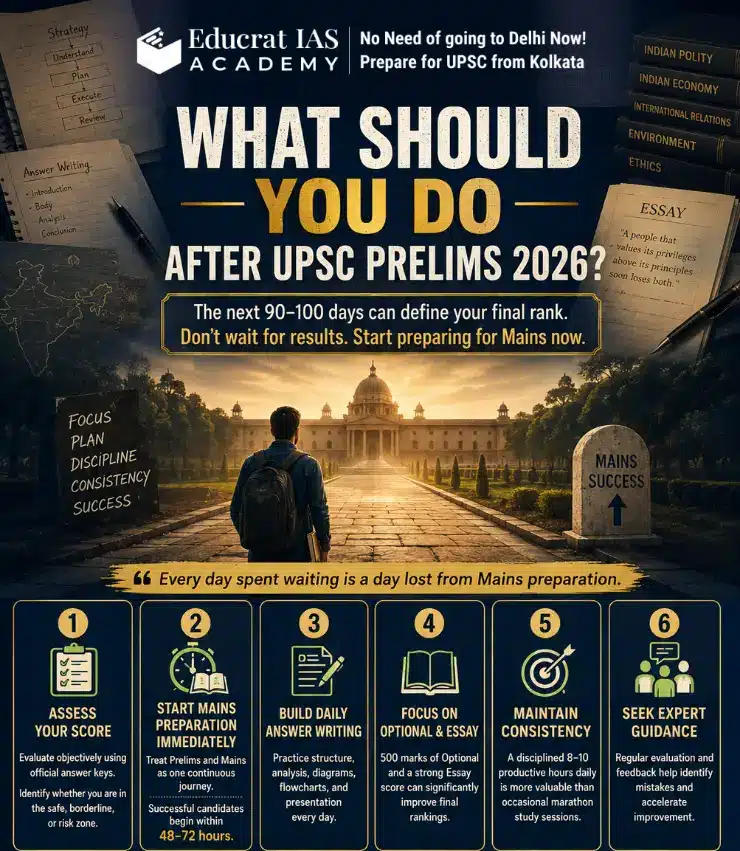
What Should You Do Instead?
The period immediately after the UPSC Prelims is not a time for uncertainty, it is a time for action. Candidates who eventually secure top ranks often begin preparing for Mains even before the Prelims result is declared. The 90–100 days available after the examination can completely transform your final score if utilized effectively.
Here is the ideal strategy every serious aspirant should follow.
1. Assess Your Score Using Official Answer Key
The first step after the examination is to evaluate your performance objectively. Use answer keys from the UPSC website where UPSC has already released a provisional UPSC Prelims 2026 Answer Key and calculate your approximate score. Do not spend days comparing dozens of answer keys or participating in endless cut-off debates on social media.
Your objective should not be to predict the exact cut-off but to determine whether you are in a reasonably safe zone, a borderline zone, or a risk zone.
If your score is close to or above the expected cut-off, assume that you have qualified and begin preparing for Mains immediately. Even candidates who eventually miss the cut-off often find that the Mains preparation undertaken during this period gives them a significant advantage in the next attempt.
Remember, every day spent waiting is a day lost from Mains preparation.
2. Begin Mains Preparation Immediately
One of the biggest mistakes aspirants make is treating Prelims and Mains as two separate examinations. In reality, they are different stages of the same process.
The UPSC Mains syllabus is vast and demands conceptual clarity, analytical thinking, multidimensional understanding, and strong writing skills. Completing the syllabus after the declaration of results becomes extremely difficult.
Start by revising the General Studies syllabus, collecting value-added notes, updating current affairs, and identifying weak areas. The first two weeks after Prelims should be dedicated to building a clear Mains strategy and creating a realistic study plan.
Successful candidates often begin Mains preparation within 48 to 72 hours after appearing for the Prelims examination.
3. Develop a Daily Answer-Writing Habit
Reading alone does not prepare a candidate for UPSC Mains. The examination rewards those who can express their thoughts clearly, concisely, and analytically within a limited time. Many aspirants know the answers but fail to communicate them effectively on paper.
Start with two or three questions daily and gradually increase the volume. Focus on:
- Structuring introductions and conclusions.
- Using relevant examples and case studies.
- Incorporating diagrams, flowcharts, and maps.
- Improving presentation and handwriting speed.
- Developing the ability to write balanced arguments.
Answer writing should become a daily non-negotiable habit. Consistency over three months can dramatically improve your performance in the actual examination.

4. Give Equal Importance to Optional Subjects and Essay
A common misconception among aspirants is that General Studies alone determines success in UPSC Mains. In reality, the Optional subject and Essay paper often become the deciding factors in final rankings.
The Optional subject carries 500 marks, making it one of the most influential components of the examination. Similarly, a strong Essay score can create a significant advantage over other candidates.
The post-Prelims period should be used to:
- Complete pending Optional syllabus.
- Revise notes multiple times.
- Solve previous-year questions.
- Begin with sectional tests.
- Write at least one essay every week.
Candidates who ignore these areas until the final month often find themselves underprepared and overwhelmed.
5. Maintain Consistency and Discipline
The journey from Prelims to Mains is a marathon, not a sprint. Some aspirants start enthusiastically after Prelims but lose momentum after a few weeks. Others create unrealistic study schedules that are impossible to sustain. Instead of aiming for perfection, aim for consistency.
A disciplined candidate studying productively for 8-10 hours every day over three months will almost always outperform someone who studies 15 hours one day and barely studies the next.
Create a routine, follow it diligently, and track your weekly progress. Small daily improvements accumulate into substantial gains over time.
6. Seek Proper Guidance and Regular Feedback
Preparing in isolation often leads to blind spots. Aspirants may continue making the same mistakes in answer writing, content preparation, or time management without realizing it.
Regular mentorship, peer discussions, and expert evaluation can help identify weaknesses early and provide corrective measures. Feedback allows candidates to refine their approach, improve answer quality, and focus on areas that actually matter from the examination perspective.
Educrat IAS MANTHAN UPSC Mains Test Series 2026 Program begins on 14th June 2026. At Educrat IAS Academy we provide detailed answer keys, explanations, model answers for Mains, and personalised feedback to help aspirants continuously improve writing quality, and overall performance.
Guidance is not about studying more; it is about studying smarter.
An Ideal 90-Day UPSC Mains Preparation Routine
The final three months before Mains should focus on answer writing, revision, current affairs integration, and test practice. A balanced routine may look like this:
Morning Session
6:00 AM – 7:00 AM
- Wake up and read newspapers.
- Note important issues, examples, judgments, reports, and data.
7:00 AM – 8:00 AM
- Breakfast and preparation for study.
8:00 AM – 11:00 AM
- General Studies Core Subject
- Focus on one GS paper daily (Polity, Governance, Society, Economy, Environment, Security, etc.).
Midday Session
11:00 AM – 1:00 PM
- Optional Subject Study
1:00 PM – 2:00 PM
- Lunch and short break.
Afternoon Session
2:00 PM – 5:00 PM
- Answer Writing Practice
- Write 5–10 GS questions or one sectional test.
5:00 PM – 6:00 PM
- Evaluate answers and identify mistakes.
Evening Session
6:00 PM – 7:00 PM
- Optional Subject Revision and PYQ Analysis.
7:00 PM – 8:00 PM
- Dinner and relaxation.
Night Session
8:00 PM – 9:30 PM
- Current Affairs Compilation and Revision.
9:30 PM – 10:30 PM
- Essay Preparation, Ethics Case Studies, or GS Revision.
10:30 PM
- Sleep.
Weekly Targets
- 2 Full-Length GS Tests
- 1 Optional Subject Test
- Atleast 1 Essay
- Daily Answer Writing
- One Complete Revision Cycle of Current Affairs
- Revision of Previously Prepared Notes
The Golden Rule
During the 90 days before Mains, revision should occupy at least 60–70% of your study time. New sources should be avoided unless absolutely necessary. The candidates who revise repeatedly, write consistently, and test themselves regularly are usually the ones who convert a Prelims qualification into a final UPSC rank.
Whether you are enrolled in upsc classes kolkata or preparing independently, the key is to avoid losing valuable time during this crucial transition period.
Aspirants pursuing serious upsc preparation in kolkata should remember that success in UPSC is often determined not by extraordinary effort on a single day but by consistent decisions made over several months.
Choosing the right guidance from a reputed upsc coaching centre kolkata can further help streamline your preparation and keep you focused on the ultimate goal.
Conclusion
The days immediately after the UPSC Prelims examination are among the most decisive phases of the entire Civil Services journey. While many candidates lose valuable momentum through uncertainty, anxiety, or overconfidence, successful aspirants use this period strategically to strengthen their Mains preparation.
Avoid these five critical mistakes, stay focused on your long-term goal, and remember that clearing Prelims is only the beginning. The candidates who act wisely today are often the ones whose names appear in the final merit list tomorrow.
Frequently Asked Questions (FAQs)
What should I do immediately after the UPSC Prelims exam?
Immediately after the UPSC Prelims exam, candidates should calculate their approximate score using the official answer key, assess their chances of qualification, and begin UPSC Mains preparation without waiting for the result. The period between Prelims and Mains is limited, making it crucial to focus on answer writing, Optional subjects, Essay preparation, and revision from the very beginning.