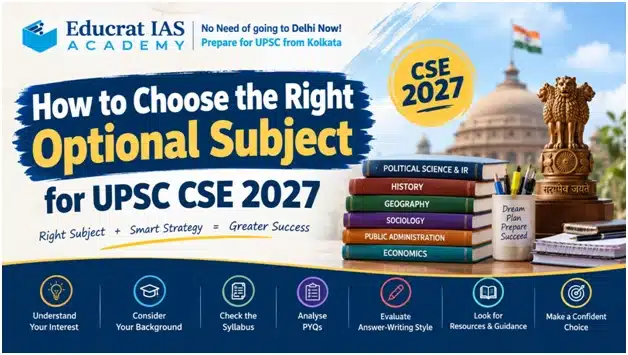
Choosing an optional subject is one of the most important decisions in the UPSC Civil Services Examination. Unlike Prelims, where candidates deal with broad objective papers, the optional in UPSC Mains requires deeper understanding, repeated revision and the ability to write analytical answers within a limited time. For CSE 2027 aspirants, making this decision early can help create a more focused and sustainable preparation strategy.
The UPSC Annual Calendar 2027 currently lists the Civil Services Preliminary Examination for 23 May 2027 and the Civil Services Main Examination from 20 August 2027. The examination notification for CSE 2027 is scheduled in the calendar for 13 January 2027, so candidates should re-check the official notification once it is released for any applicable changes.
Under the recent UPSC scheme, candidates choose one optional subject for two Mains papers, with each paper carrying 250 marks. Therefore, the optional contributes 500 marks to the written merit total of 1,750 marks. This makes optional preparation a substantial part of the Mains strategy, but it does not mean that aspirants should choose a subject simply because they hear that it is “scoring.”
What Is an Optional Subject in UPSC Mains?
The optional subject is a specialised discipline selected by the candidate for Paper VI and Paper VII of the UPSC Civil Services Main Examination. Each paper is of 250 marks and is generally three hours long. The current UPSC question-paper archive shows separate Paper I and Paper II question papers for disciplines such as Anthropology, Geography, History, Law, Mathematics, Political Science and International Relations, Psychology, Public Administration, Sociology and several other subjects, along with eligible literature subjects.
The important point is that the optional is not simply another General Studies paper. It requires subject-specific knowledge, conceptual depth and familiarity with the exact syllabus and previous years’ questions. An aspirant can choose a subject related to graduation, but there is no general rule that the optional must be the same as the candidate’s academic background.
How to Choose Optional Subject for UPSC CSE 2027
The best way to approach UPSC optional subject selection is to treat it as a personal decision based on evidence rather than trends. Do not begin with the question, “Which subject gives the highest marks?” Start with a more useful question: “Which subject can I study deeply, revise repeatedly and write confidently in the UPSC Mains examination?”
A strong selection process should consider your interest, educational background, syllabus size, availability of quality resources, guidance, previous years’ questions, answer-writing requirements and overlap with General Studies. Recent guidance in the UPSC preparation ecosystem also emphasises testing a subject through PYQs before making a final decision.
1. Start With Genuine Interest
Interest is often underestimated when candidates choose an optional subject. A syllabus may look attractive for a few days, but the real challenge begins when you have to study the same discipline repeatedly for several months.
A suitable optional should be a subject that you are comfortable reading, revising and discussing. Ask yourself whether you can sustain interest in the subject even when the syllabus becomes difficult. If you naturally enjoy understanding social behaviour, Sociology or Psychology may deserve consideration. If you are more comfortable with political institutions, ideologies and international relations, Political Science and International Relations may attract you. Students who enjoy physical geography, human geography and spatial analysis may consider Geography.
Interest does not automatically make a subject easy. It simply improves the possibility that you will remain consistent with it over the long preparation cycle.
2. Consider Your Graduation Background—But Do Not Follow It Blindly
Your academic background can provide a useful starting advantage, especially if you already understand the terminology and basic concepts of a subject. An engineering graduate may initially feel comfortable with a technical optional, while a student of Political Science, History, Sociology or Economics may already possess a foundation in a related discipline.
However, graduation background should be treated as one factor, not the only factor. A candidate may have studied a subject at university but may not enjoy its UPSC syllabus. Conversely, a graduate from one discipline can successfully select a completely different optional after properly understanding its syllabus and answer-writing demands.
Before finalising the subject, compare your academic familiarity with your current interest, available preparation time and comfort with the actual UPSC syllabus.
3. Check the Complete Syllabus Before Choosing
Many aspirants select an optional after watching a few videos or reading a short booklist. This can create problems later because the actual syllabus may be much broader than expected.
Download and read the official syllabus for each subject on your shortlist. Do not only read the headings. Look at the detailed subtopics under both Paper I and Paper II and identify areas that are unfamiliar to you.
Then ask a practical question: Can I realistically complete this syllabus and revise it at least two or three times before Mains?
A subject with a manageable syllabus is useful only when you can understand it deeply. “Short syllabus” and “easy subject” are not the same thing.
4. Analyse UPSC Previous Year Questions Before Finalising
Previous Year Questions, or PYQs, are among the most valuable tools for choosing an optional subject. UPSC’s official archive provides recent optional question papers for a wide range of subjects.
Take the PYQs of your shortlisted subjects and examine them carefully. Look for recurring themes, conceptual depth, question wording and the type of analysis expected.
You can make this exercise more practical by selecting five to ten questions from each shortlisted subject. Read the syllabus topic connected with each question, study the basic material and then try writing a short answer. This is a form of “trial preparation” that can tell you much more than simply reading online rankings of optional subjects.
If you find that a subject’s questions consistently make sense to you and you can organise answers logically after reasonable study, that is valuable evidence for your decision.
5. Compare the Answer-Writing Style
Different optionals demand different types of answers. Some subjects require extensive conceptual explanation. Others involve theories, thinkers, diagrams, case studies, equations, maps, examples or technical presentation.
The question is not whether one answer style is universally better. The real question is: which style suits your strengths?
For example, some aspirants are comfortable with analytical and argumentative writing, while others prefer structured factual explanation or scientific presentation. A technically strong student may enjoy numerical or scientific problem-solving, whereas another candidate may prefer theory-based humanities answers.
Before choosing an optional, look at actual UPSC question papers and a few high-quality model answers. This will help you understand what writing in that subject actually looks like.
6. Evaluate GS Overlap—But Do Not Make It the Sole Criterion
General Studies overlap is one of the most discussed factors in UPSC optional subject selection. Subjects such as Political Science and International Relations, Geography, History, Sociology and Public Administration can have areas that connect with portions of the General Studies syllabus.
Such overlap can improve preparation efficiency because concepts studied for the optional may also help with certain GS themes. Educrat IAS’s UPSC preparation resources similarly highlight GS overlap as one factor candidates can consider while selecting an optional.
However, overlap should never become the only reason to select a subject. A subject may overlap with GS and still require considerable specialised preparation. Optional papers test deeper subject understanding than a broad GS treatment.
Think of overlap as an efficiency benefit, not a substitute for subject mastery.
7. Check the Availability of Books, Notes, Guidance and Evaluation
Preparation becomes easier when you have reliable resources. Before finalising your optional, identify the standard books, syllabus-specific notes, PYQ compilations and answer-writing resources available for that subject.
You should also check whether quality guidance and copy evaluation are accessible in your preferred mode. This matters because many aspirants can read books independently but struggle when they start writing optional answers without feedback.
Educrat IAS currently has a dedicated Vishesh UPSC Optional Program, with structured optional preparation focused on concept clarity, answer writing, evaluation and mentorship. Its current optional offerings include Sociology, Political Science and International Relations, and Public Administration, along with optional test-series support.
The objective is not to choose a subject simply because coaching is available for it. Rather, coaching availability should be one part of your overall decision.
8. Do Not Choose an Optional Only Because a Topper Chose It
This is one of the most common mistakes in UPSC preparation.
A topper’s optional subject can be informative, but it should not become a template for every aspirant. A successful candidate may have an academic background, reading habit, mentor support or subject familiarity that another student does not have.
EducratIAS’s published successful-candidate profiles themselves show different optional choices among candidates, including Sociology, Medical Science, Anthropology, Political Science and International Relations, Bengali Literature and Law. This illustrates an important point: successful UPSC candidates come from different academic and optional-subject backgrounds.
Use topper strategies as case studies. Do not treat them as instructions.
9. Do Not Chase “Scoring Optional” Trends
Searches for the “best optional subject for UPSC” often lead aspirants toward claims about scoring trends. Historical marks can be interesting, but they can also be misleading when taken without context.
A subject may have a small candidate pool, different levels of preparation, or a different distribution of experience among candidates. A single topper’s marks cannot establish that an optional is universally scoring.
The more useful question is whether you can consistently perform well in that subject. Recent discussions of optional selection increasingly advise candidates to focus on fit, sustainability and PYQ performance rather than simply chasing a perceived scoring trend.
10. Think About Your Available Preparation Time
Time is a major factor in choosing an optional subject for UPSC CSE 2027.
A full-time aspirant may be able to devote several hours each day to optional preparation. A working professional may have much less time during weekdays. A college student may need to balance university studies with UPSC preparation.
Therefore, the same subject can have very different practical demands for different candidates. Your decision should consider how much time you can realistically spend on first reading, note-making, answer writing and revision.
Do not select a subject assuming that you will suddenly start studying 12 to 14 hours every day. Build your decision around the schedule you can actually maintain.
A Simple 7-Step Method to Finalise Your Optional
A practical method for UPSC CSE 2027 aspirants is to shortlist three subjects first. Then download their official syllabi and recent PYQs. Read the first few major topics of each subject and study basic introductory material. After that, write a few answers from each subject under timed conditions.
Finally, compare them on seven factors: interest, academic familiarity, syllabus manageability, PYQ comfort, answer-writing style, resource availability and GS overlap.
Instead of asking which subject looks most attractive from the outside, identify the subject that remains comfortable after actual trial preparation. This approach turns optional selection from a social-media trend into an evidence-based preparation decision.
When Should You Finalise Your UPSC Optional Subject for 2027?
For a candidate preparing seriously for CSE 2027, the optional should ideally be finalised early enough to allow substantial syllabus completion before the Prelims-focused phase. Waiting until the last moment can create pressure because the optional requires depth and repeated revision.
The Educrat IAS 2027 preparation roadmap also places emphasis on finalising the optional during the early foundation stage and building substantial optional preparation well before the Prelims-to-Mains transition.
The exact timeline will depend on your starting point. A beginner may need a short period of exploration before committing, while an experienced aspirant with a proven optional strategy may already know which direction to take.
Choosing an Optional With the Right Guidance
Self-study is possible for many optional subjects, but feedback can become particularly valuable once you begin answer writing. A good mentor or faculty member can help you identify whether your answers are meeting the demand of the question, whether your structure is appropriate and whether you are spending too much time on low-value content.
For aspirants comparing the Best UPSC Coaching in Kolkata, optional-subject guidance should be evaluated separately from general GS teaching. Look for subject-specific faculty, syllabus coverage, PYQ-based teaching, regular answer writing, copy evaluation and access to mentorship.
Similarly, students searching for the Best IAS Coaching in Kolkata should look beyond classroom infrastructure and consider whether the institute provides a complete preparation ecosystem that includes optional strategy, Mains answer writing, test practice and personalised feedback.
Educrat IAS currently combines its foundation programs with dedicated optional preparation and test-series support, while its broader preparation ecosystem includes current-affairs resources, answer-writing practice, mentorship and Mains testing.
Final Thoughts
There is no single optional subject that can be called the right choice for every UPSC aspirant. The right optional is the one that fits your academic background, genuine interest, preparation time, learning style and ability to write answers according to UPSC’s requirements.
For CSE 2027, do not rush into optional selection because of a topper interview, coaching advertisement or social-media trend. Shortlist subjects, read the syllabus, analyse PYQs, test your answer-writing ability and review the resources available to you. Once you identify a subject that you can understand deeply and revise consistently, commit to it and prepare it systematically.
The optional subject can become a strong part of your UPSC Mains preparation when selected carefully and backed by disciplined study, repeated revision, PYQ practice and continuous answer-writing improvement. The goal is not to find the subject that looks easiest on paper. The goal is to find the subject in which you can build depth, consistency and confidence over the entire UPSC CSE 2027 preparation cycle.